
Proof-Based Hiring in Web3: Hiring Signals, Recruiter Screening, JD Proof Lines, and Shortlist Quality

This hub is for founders, hiring managers, recruiters, Web3 talent teams, and technical screeners who want to evaluate blockchain candidates through visible proof instead of polished claims, keyword-heavy resumes, or vague interview confidence.
A candidate can also read this page to understand what hiring teams verify before shortlist. But the main purpose of this hub is hiring-side evaluation: how to read proof, define JD proof lines, screen candidates, calibrate interviews, and improve shortlist quality.
TL;DR
Proof-based hiring in Web3 means evaluating candidates through visible, role-aligned evidence instead of polished claims alone.
Strong blockchain hiring signals usually come from GitHub trail, project explanation, testing depth, ownership, debugging maturity, and risk awareness.
Weak JDs create weak shortlists because they ask for stacks and years, but not proof of work.
Strong recruiter screening is not keyword matching. It is proof matching.
Candidates get shortlisted faster when their resume, portfolio, GitHub, and LinkedIn all point to the same believable work trail.
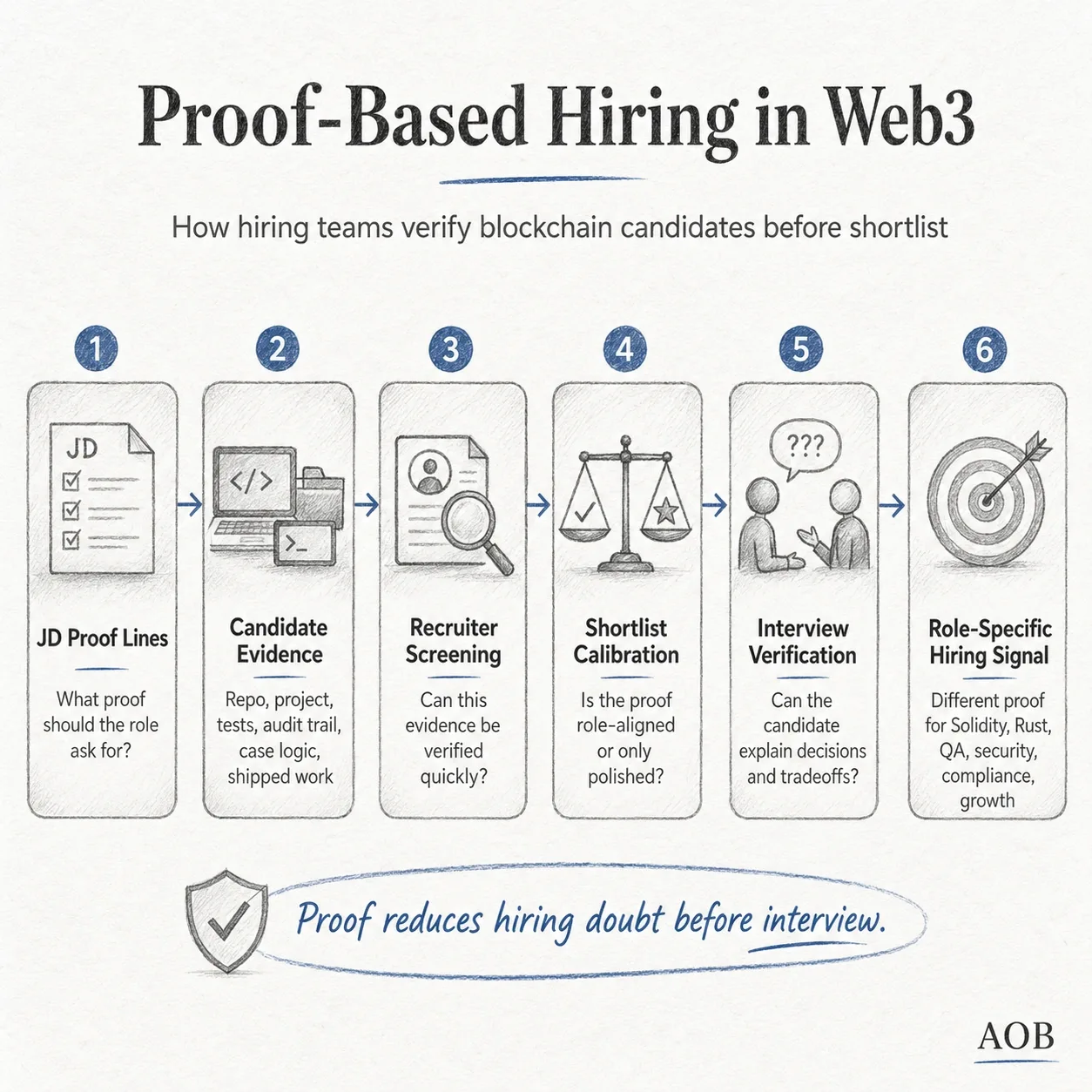
Quick map of this hub
Use this hub as a hiring-side router for proof-based hiring in Web3. The goal is not to explain every hiring problem in one page. The goal is to help founders, recruiters, hiring managers, and technical screeners choose the right AOB resource based on the proof problem they are facing.
1. Proof-based hiring framework
Use this lane if your team is trying to understand what visible evidence should matter before a blockchain candidate reaches the interview.
2. JD proof lines
Use this lane if your blockchain job description is attracting weak-fit applicants because it lists stacks, years, and responsibilities but does not explain what proof the candidate should show.
Start here:
Why Blockchain Job Descriptions Are So Vague — And What Hiring Teams Actually Mean | ArtofBlockchain
Related:
Web3 JD Review for Teams Attracting Weak-Fit Blockchain Applicants | ArtofBlockchain
3. Recruiter screening
Use this lane if recruiter screening is stuck at keyword matching, title matching, or checking whether someone has “Web3 experience” without knowing how to verify the proof behind it.
Related:
Recruiters: how do you verify real blockchain experience before the interview? | ArtofBlockchain
4. Shortlist calibration
Use this lane if your team is seeing too many confident profiles but not enough role-aligned evidence. This is where proof-based hiring helps reduce noise before interviews.
Related:
Web3 Hiring Risks & Compensation Hub for Hiring Teams | ArtofBlockchain
5. Role-specific hiring signals
Use this lane if you are hiring for different blockchain roles and need to understand why smart contract engineers, protocol engineers, security candidates, QA testers, and compliance candidates should not be evaluated through the same proof checklist.
Start here:
Role-Specific Hiring Playbooks | ArtofBlockchain
6. Candidate evidence from hiring-team lens
Use this lane only when your hiring team wants to understand how to read GitHub, portfolios, project explanations, resumes, and proof artifacts without turning screening into a full technical audit.
Start here:
GitHub for Blockchain Developers: How to Make Your Projects Recruiter-Readable | ArtofBlockchain
Related:
The Smart Contract Portfolio That Shows How You Think | ArtofBlockchain
If the shortlist quality is weak, fix the proof lines before screening
Many Web3 hiring problems begin before the first interview.
The JD asks for Solidity, Rust, protocol engineering, smart contract security, QA, compliance, or Web3 experience, but it does not explain what proof the hiring team will actually trust. That creates noisy applications, weak-fit shortlists, and interviews where both sides are guessing what “good” means.
If you are hiring for blockchain roles and want your JD to attract better-aligned candidates, start with AOB’s JD Review:
Web3 JD Review for Teams Attracting Weak-Fit Blockchain Applicants | ArtofBlockchain
If you want to publish a Web3 role on AOB’s curated job board, start here:
Post a Web3 Job | Blockchain Job Board for Founders, Recruiters & Hiring Teams | ArtofBlockchain
The goal is not to make the JD longer. The goal is to make the expected proof clearer before candidates apply.
Who this hub is for
Use this page if you are:
Trying to understand what founders and recruiters actually look for in blockchain candidates
Hiring for Web3 roles and struggling to separate polished profiles from believable proof
Rewriting blockchain job descriptions and want clearer proof expectations
Preparing for interviews and trying to show better GitHub, portfolio, or project signal
Building a stronger shortlist process for smart contract, protocol, QA, security, compliance, or hybrid Web3 roles
What this hub is not
This is not a candidate CV improvement guide.
It is not a GitHub portfolio tutorial.
It is not a smart contract interview question bank.
It is not a general Web3 career guide.
It is not a replacement for technical interviews, reference checks, work trials, or engineering judgment.
This hub exists to organize AOB’s hiring-side proof-based hiring cluster: JD proof lines, recruiter screening, shortlist calibration, interview evidence, role-specific hiring signals, and candidate evidence that can be verified before interview.
For candidates reading this hub
If you are a candidate, use this page to understand how hiring teams think. But do not treat this as the main page for fixing your CV, GitHub, LinkedIn, or portfolio.
If your problem is that your blockchain work is not converting into interviews, start here:
Blockchain CV Review: What Recruiters Reject in 10 Seconds (Proof-Stack Checklist) | ArtofBlockchain
If you want AOB to review your CV proof stack, start here:
Web3 CV Review for Candidates Whose Proof Is Not Converting Into Interviews | ArtofBlockchain
If your GitHub exists but does not clearly show ownership, testing depth, tradeoffs, or role-aligned evidence, start here:
GitHub for Blockchain Developers: How to Make Your Projects Recruiter-Readable | ArtofBlockchain
Start here: strongest AOB resources for this topic
If you want the fastest path into this hub, start with these:
Proof-Based Hiring in Web3: How Founders Evaluate GitHub, Tests, Smart Contracts, and Audit Work Without Technical Knowledge
Why Blockchain Job Descriptions Are So Vague — And What Hiring Teams Actually Mean
Why Blockchain Job Descriptions Are So Vague — And What Hiring Teams Actually Mean | ArtofBlockchain
Web3 Interview Signals & Calibration Hub: How Hiring Teams and Candidates Interpret Interviews Correctly
Blockchain Developer Resume Guide (2025): How Web3 Recruiters Shortlist Candidates
Blockchain Developer Resume Guide (2025): How Web3 Recruiters Shortlist Candidates | ArtofBlockchain
The Smart Contract Portfolio That Shows How You Think
The Smart Contract Portfolio That Shows How You Think | ArtofBlockchain
What proof-based hiring in Web3 actually means
Proof-based hiring in Web3 is wider than resume review and wider than technical interviews.
It means asking a more useful question: what can this person show, explain, and defend that maps to the role we are actually hiring for? In blockchain hiring, polished language alone is not enough. A candidate may know the vocabulary, but hiring confidence grows when there is visible work, clear ownership, reasoning under constraints, and evidence that survives deeper scrutiny.
That is why the strongest hiring loops do not stop at stack familiarity. They look at artifact quality, explanation quality, iteration trail, and role alignment. A person does not become more believable because they mention DeFi, MEV, L2s, or audits. They become more believable when the work trail makes those claims easier to trust.
Start with these:
Proof-Based Hiring in Web3: How Founders Evaluate GitHub, Tests, Smart Contracts, and Audit Work Without Technical Knowledge
How Recruiters Can Hire Smarter in Web3: From Proof-Based Screening to Global Pay Clarity
Recruiters — how do you actually check if someone’s blockchain experience is real?
Recruiters: how do you verify real blockchain experience before the interview? | ArtofBlockchain
What strong proof is usually included before interviews move forward
role-aligned project evidence
visible GitHub or work trail
tests, writeups, specs, or debug notes where relevant
explanation of trade-offs and constraints
proof that the person can describe what they owned
signals of judgment, not just stack familiarity
Why most blockchain resumes and profiles fail
The problem is not always lack of skill.
A lot of blockchain resumes fail because they describe tools, not proof. They say “worked on DeFi,” “used Solidity,” or “built an NFT marketplace,” but they do not make it easy to verify what was actually built, what part the person owned, what changed because of their work, or where the recruiter should click next.
Another common failure is mismatch across surfaces. The resume says one thing, GitHub shows something weaker, LinkedIn feels generic, and the portfolio does not support the strongest claims. That kind of mismatch increases doubt fast. In Web3 hiring, doubt is expensive. It is easier to reject than to investigate.
This is why shortlist decisions often happen before the “best” candidate is even fully read. Trust drops when claims are broad, artifacts are weak, and the visible trail is fragmented.
Start here:
Blockchain Developer Resume Guide (2025): How Web3 Recruiters Shortlist Candidates
Blockchain Developer Resume Guide (2025): How Web3 Recruiters Shortlist Candidates | ArtofBlockchain
Blockchain CV Review: What Recruiters Reject in 10 Seconds (Proof-Stack Checklist)
Blockchain CV Review: What Recruiters Reject in 10 Seconds (Proof-Stack Checklist) | ArtofBlockchain
Almost every blockchain job form asks for my LinkedIn link — what makes a recruiter trust it fast?
GitHub, portfolio, and project proof: what actually builds trust
Many candidates think “I have projects” is enough.
It is not enough unless the work is inspectable, role-aligned, and explainable.
A strong GitHub does not need to look perfect. It needs to show readable structure, useful READMEs, meaningful commits, sensible testing, and some sign that the person actually iterated rather than uploaded a polished snapshot at the end.
A strong portfolio does not need ten projects. It needs a few projects that clearly answer the recruiter’s real questions: what problem was solved, what decisions were made, what constraints mattered, and what this project proves about the candidate.
This is also where interview quality starts long before the interview begins. If a candidate cannot walk through a project without sounding vague or rehearsed, the artifact loses value. Good proof is not just visible. It is explainable.
Read these together:
GitHub for Blockchain Developers: Why It’s Essential for Showcasing Your Skills
GitHub for Blockchain Developers: Proof of Work for Web3 Hiring | ArtofBlockchain
The Smart Contract Portfolio That Shows How You Think
The Smart Contract Portfolio That Shows How You Think | ArtofBlockchain
Building a Blockchain/Web3 Portfolio: Site Sections, Case Studies, and Metrics
Projects That Can Help Me Land a Junior Blockchain Developer Job
A believable proof stack is usually simple
one clean resume
one inspectable GitHub trail
two or three well-explained projects
one visible writing layer such as a README, postmortem, architecture note, or testing note
one consistent story across resume, LinkedIn, portfolio, and interviews
JD proof lines and why weak JDs create weak shortlists
Weak blockchain JDs ask for stacks, years, and buzzwords.
Strong JDs explain what early work looks like and what proof will be evaluated.
This is one of the biggest reasons Web3 hiring becomes noisy. Teams say they want Solidity, Rust, DeFi, protocol, infra, growth, or security experience, but they do not define what would actually make a candidate believable in the first screening loop. As a result, candidates optimize for labels and hiring teams receive volume instead of fit.
A tighter JD gives stronger candidates a better target. It also makes shortlist evaluation more consistent because the hiring team is no longer arguing in vague language about “seniority” or “quality.” They are judging against visible proof lines.
Before posting a role, a team should be able to say what strong proof looks like in the first ten working days, what artifacts would build trust quickly, and what kind of polished profile would still fail the trust test.
Start here:
Why Blockchain Job Descriptions Are So Vague — And What Hiring Teams Actually Mean
Why Blockchain Job Descriptions Are So Vague — And What Hiring Teams Actually Mean | ArtofBlockchain
Role-Specific Hiring Playbooks
Role-Specific Hiring Playbooks | ArtofBlockchain
Blockchain Job Description Review Service for Web3 Hiring Teams
Blockchain Job Description Review Service for Web3 Hiring Teams | ArtofBlockchain
Before posting a Web3 job, be able to answer:
What should this person be able to show in the first 10 working days?
Which artifacts would increase trust fastest?
What matters more here: shipping speed, protocol depth, audit thinking, QA rigor, or communication?
What proof would make us move someone to shortlist quickly?
What would look polished but still fail our trust test?
Recruiter screening and shortlist quality in Web3
Recruiter screening in blockchain breaks when it relies on title match or keyword match alone.
That is how teams end up with shortlists full of candidates who sound close to the role but are hard to verify. Broad screening often rewards surface familiarity: right buzzwords, familiar company names, or generic “worked on Web3 products” language. Stronger screening rewards evidence that can be checked quickly.
This is where blockchain hiring signals matter. Good screening asks better first questions. What has this person actually shipped? Can they explain what they owned? Are their proof links real and relevant? Does the work trail fit the role, or just the industry?
Shortlist quality improves when proof matching comes before stack matching. That is a much better filter for Web3 than generic recruiter heuristics imported from other software markets.
Relevant AOB resources:
How Recruiters Can Hire Smarter in Web3: From Proof-Based Screening to Global Pay Clarity
Recruiters — how do you actually check if someone’s blockchain experience is real?
Recruiters: how do you verify real blockchain experience before the interview? | ArtofBlockchain
Senior blockchain dev here — how do mature Web3 teams calibrate interviews differently than early-stage startups (and what should I read from it)?
Hiring Managers & Recruiters Hub — Hiring Signals • Interview Expectations • Communication • Team Fit • Review Culture
Interviews should test judgment, not memory
One of the biggest mistakes in Web3 hiring is confusing vocabulary recall with operating ability.
A candidate can memorize reentrancy, CEI, bridges, sequencers, account abstraction, zk terms, MEV, tokenomics, or protocol architecture labels. That does not automatically mean they can reason through a messy code path, explain a failed deployment, defend a design trade-off, or describe what they would change after production feedback.
Stronger interviews test how someone thinks when the problem gets less neat. That is where project explanation, debugging depth, risk awareness, ownership, and communication matter more than trivia performance.
Good interview loops do not become easier by becoming more theoretical. They become stronger by becoming more evidence-aware.
Useful resources:
Web3 Interview Signals & Calibration Hub: How Hiring Teams and Candidates Interpret Interviews Correctly
How to Interview Smart Contract Engineers Without Confusing Memorization for Judgment
Interview Smart Contract Engineers: Evaluate Real Solidity Skill | ArtofBlockchain
How to Explain Blockchain Projects in Interviews (So Recruiters Actually Understand Them)
Smart Contract Interview Prep Hub
Strong interview evidence often sounds like this:
Here is what I built
Here is what broke
Here is what I changed
Here is why I made that trade-off
Here is what I would do differently now
Role-specific proof: what believable evidence looks like by role
Not all proof looks the same across blockchain roles.
That is why generic advice weakens hiring quality. Good proof depends on the job.
Smart contract engineering
Believable proof often includes deployed contracts, readable repos, test quality, debugging notes, gas or design trade-off explanation, and the ability to explain why certain patterns were used.
Useful AOB routes:
Protocol/Rust/infrastructure
Believable proof often includes systems reasoning, performance awareness, state handling, reliability thinking, architectural explanation, and PR narratives that show technical judgment rather than only syntax skill.
Useful AOB routes:
Security/auditing
Believable proof often includes threat models, findings writeups, exploit reasoning, invariant thinking, test depth, and clear explanations of how a failure would happen in production.
Useful AOB routes:
How to Answer Common Smart Contract Security Mistakes in Blockchain Auditor Interviews
How to Interview Smart Contract Engineers Without Confusing Memorization for Judgment
QA / reliability
Believable proof often includes transaction lifecycle understanding, wallet and RPC edge-case thinking, test matrices, incident handling, reproducible bug reports, and the ability to explain why something passes locally but fails under live conditions.
Useful AOB routes:
Compliance/operations/Hybrid roles
Believable proof often includes workflow ownership, documentation quality, investigation logic, process thinking, regulatory interpretation, and visible evidence of decision quality rather than vague “operations support” claims.
Useful AOB routes:
Blockchain Compliance Careers: Skills, Education, and Market Outlook for 2025
Crypto Compliance Analyst: where to start with KYC/AML/Travel Rule
A simple proof-based hiring checklist for hiring teams
Before you shortlist, be able to answer:
What evidence supports this candidate’s strongest claim?
Can we verify ownership, reasoning, or execution quality from public artifacts?
Does the resume point to believable proof, or just broad labels?
Can the candidate explain why the work mattered and what they learned?
Do the artifacts map to the role we are actually hiring for?
Are we rewarding polish, or are we identifying trust?
If we interviewed this person tomorrow, what would we want them to walk us through?
If you cannot answer these clearly, your shortlist process is weaker than it looks.
If you are a candidate, where to start
Do not try to fix everything at once.
Start by making your proof easier to inspect.
Fix your resume before adding more projects
Make your GitHub easier to verify
Choose two or three projects you can explain deeply
Add one short written artifact: README, postmortem, architecture note, or testing note
Make LinkedIn, resume, and portfolio point to the same proof story
Best AOB starting points:
Blockchain CV Review: What Recruiters Reject in 10 Seconds (Proof-Stack Checklist)
Blockchain CV Review: What Recruiters Reject in 10 Seconds (Proof-Stack Checklist) | ArtofBlockchain
Web3 CV Review Services Are Now Open on Home | ArtofBlockchain
Web3 CV Review Services Are Now Open on ArtOfBlockchain.club | ArtofBlockchain
Blockchain Developer Resume Guide (2025): How Web3 Recruiters Shortlist Candidates
Blockchain Developer Resume Guide (2025): How Web3 Recruiters Shortlist Candidates | ArtofBlockchain
GitHub for Blockchain Developers: Why It’s Essential for Showcasing Your Skills
GitHub for Blockchain Developers: Proof of Work for Web3 Hiring | ArtofBlockchain
The Smart Contract Portfolio That Shows How You Think
The Smart Contract Portfolio That Shows How You Think | ArtofBlockchain
Related AOB hubs and supporting resources
If you want to go deeper into adjacent parts of this cluster, continue with these:
Web3 Interview Signals & Calibration Hub
Role-Specific Hiring Playbooks
Role-Specific Hiring Playbooks | ArtofBlockchain
Web3 Hiring Signals
Web3 Hiring Signals | ArtofBlockchain
Hiring Managers & Recruiters Hub — Hiring Signals • Interview Expectations • Communication • Team Fit • Review Culture
Smart Contract Security Audits Hub
Smart Contract QA Testing Hub
Blockchain QA & Smart Contract Testing Hub (Coverage, Flaky Tests, Gas + Proof) | ArtofBlockchain
Smart Contract Interview Prep Hub
Smart Contract Developer Career Hub
Smart Contract Developer Career Hub: Skills, Proof, Interview Prep and Jobs | ArtofBlockchain
FAQs About Proof-Based Hiring in Web3
What is proof-based hiring in Web3?
Proof-based hiring in Web3 means evaluating candidates through visible, role-aligned evidence instead of relying only on polished resumes, broad claims, or keyword-heavy profiles. That evidence may include GitHub trail, project writeups, testing depth, portfolio clarity, debugging decisions, and the ability to explain what the candidate actually owned.
What do blockchain recruiters and hiring managers actually look for first?
Most hiring teams do not get trust from buzzwords alone. They usually look for fast signals such as role-fit, believable project evidence, inspectable links, ownership clarity, and whether the candidate can explain how their work maps to the role being hired for.
Is GitHub necessary for blockchain jobs?
Not for every single role, but for many technical blockchain roles, GitHub is one of the fastest trust layers. It helps recruiters and hiring managers inspect code trail, testing habits, README quality, iteration, and whether the candidate can point to real engineering work instead of broad summaries.
Why do weak blockchain job descriptions create weak shortlists?
Weak JDs usually ask for years, stacks, and industry labels, but they do not explain what proof of work actually matters for the role. That makes candidates optimize for surface matching, and it makes hiring teams sort through volume instead of strong-fit evidence.
What makes a blockchain portfolio believable?
A believable portfolio does not need many projects. It needs a few strong projects that are easy to inspect and easy to understand. Hiring teams usually trust portfolios more when the candidate explains the problem, the decisions made, the constraints, and what the project proves about their fit for the role.
How is proof-based hiring different across smart contract, security, QA, and compliance roles?
The proof changes by role. Smart contract roles often need readable repos and testing depth. Security roles need exploit reasoning and findings quality. QA roles need reliability thinking and reproducible testing logic. Compliance roles need workflow clarity, investigation logic, and strong documentation.
How can candidates improve their proof for Web3 jobs quickly?
The fastest improvement usually comes from tightening the resume, making GitHub easier to inspect, reducing project noise, and making LinkedIn, portfolio, and project explanations tell the same proof story.
Final thought
Proof-based hiring in Web3 works when hiring teams stop asking only what a candidate knows and start asking what they can show, explain, and defend.
The strongest hiring loops are not the most complicated. They are the clearest. When proof expectations are visible, shortlists get tighter, interviews get better, and trust builds faster on both sides.
What proof artifact has made you trust a candidate faster — or what kind of proof do you wish more blockchain JDs asked for?
