Blockchain Developer Resume Guide: How Web3 Recruiters Shortlist Candidates

Most Web3 resumes do not fail because the candidate lacks skill. They fail because the role story breaks across four surfaces: CV, GitHub, LinkedIn, and portfolio.
A recruiter reads “Solidity developer” on page one, opens GitHub, finds tutorial repos, checks LinkedIn, sees a generic software headline, and stops trusting the file. That is the real filter. In Web3, interviews create confidence, but proof creates trust.
This guide is not generic resume-writing advice. It is a recruiter-aware framework for building a Web3 resume that gets interviews because it feels believable, role-aligned, and easy to verify. Some reviewers will never open every link. Some will click only one artifact. So your resume has to do two jobs at once: stand on its own and direct the reviewer toward the right proof.
The goal here is simple: make your target role clear, make your ownership defensible, and make every linked artifact tell the same role story.
Need a recruiter-aware Web3 CV review?
Your CV may not have a skill problem. It may have a proof-signal problem.
At AOB, we review Web3 CVs for shortlist blockers like:
weak proof of work
GitHub / LinkedIn / CV mismatch
vague project bullets
role-story confusion
impact that sounds claimed but not defensible
If you want a paid review built around proof-based hiring in Web3, start here:
Web3 CV Signal Audit / Web3 CV Reposition + Rewrite
Related reading on the hiring philosophy behind this guide:
Proof-based hiring in Web3
Proof-Based Hiring in Web3: How Founders Evaluate GitHub, Tests, Smart Contracts, and Audit Work Without Technical Knowledge | ArtofBlockchain
GitHub Docs – About READMEs
About Readmes
How Web3 Recruiters Read Blockchain Developer Resumes in 2026
Most Web3 recruiters spend 10–15 seconds on a resume during the first pass. In that window, they’re not reading every line — they’re checking whether the candidate looks real or risky.
What they typically scan first:
Role fit (is this resume aligned to the job they posted?)
Proof links (GitHub / portfolio / testnet / hackathon)
Project clarity (what did you build, and what part did you own?)
Signals of maturity (testing, security awareness, trade-offs)
GitHub matters more than certificates
Certificates can help at the beginner stage, but for most Web3 roles, GitHub and public work are what move the resume forward. Recruiters don’t expect perfect repos — they expect evidence of thinking: readable READMEs, meaningful commits, and signs you iterated instead of copy-pasting.
Proof beats buzzwords
Words like DeFi, NFT, L2, ZK don’t impress on their own anymore. Recruiters trust candidates who explain what they built, why they made a design choice, and what they learned when things broke.
Public work beats private claims
If your resume says “worked on blockchain project” but there’s no visible artifact, it becomes hard to evaluate. Public proof reduces risk: repo links, demos, testnets, hackathon pages, technical write-ups.
Keep this lens in mind while writing every section below.
A strong resume isn’t flashy. It’s trustable.
For deeper context on how recruiters judge engineering ability:
How Web3 recruiters evaluate real engineering ability
Interview Smart Contract Engineers: Evaluate Real Solidity Skill | ArtofBlockchain
Basic Structure of a Blockchain Developer Resume
A clean structure helps with both ATS parsing and human scanning. Your original structure is solid — the improvement is to write each section so it supports the recruiter’s decision flow.
1) Contact Information
Include the basics and make proof links visible.
Include:
Name
Location (City, Country)
Email + phone
LinkedIn
GitHub / portfolio links
Why recruiters care:
This is where they decide whether they’ll click to verify your work. Put your GitHub/portfolio links where they’re hard to miss.
2) Professional Summary (2–3 lines)
This is not a biography. It’s a quick role fit + proof + scope snapshot.
What to include:
Your target role (smart contract / dApp / protocol / QA)
Your strongest stack (Solidity / Rust + tools)
One measurable result or proof signal
Why recruiters care:
In Web3, summaries that show impact + proof outperform summaries that just list technologies.
3) Technical Skills (keep it role-aligned)
Instead of dumping a long skills list, group skills by category and keep them relevant to the job.
Example grouping:
Languages: Solidity, Rust, Go
Frameworks: Foundry, Hardhat
Security / QA: Slither, fuzzing, invariant tests
Infra / Tooling: Docker, CI, RPC tooling
Why recruiters care:
A role-aligned skill section makes filtering faster. A generic list increases doubt (“does this person actually use these?”).
4) Project Portfolio (2–4 projects, written for trust)
Your original advice here is excellent: use a Problem → Action → Result (PAR) structure and include proof links.
Use this template:
Problem: what was broken or missing?
Action: what did you build and what did you own?
Result: what improved (metrics, performance, cost, reliability)?
Link: GitHub / demo / testnet
Why recruiters care:
PAR tells them you can think like an engineer, not just follow tutorials.
Related deep-dive on portfolios that build trust:
Smart contract portfolio that shows how you think
The Smart Contract Portfolio That Shows How You Think | ArtofBlockchainLinkedIn Talent Solutions Blog
Talent blog
5) Professional Experience (metrics + ownership)
List roles in reverse order. Use action verbs, but don’t make it sound like a marketing brochure.
Strong bullets show:
What you built
What you improved
What you reduced (gas, bugs, time)
What you owned (component, module, release)
Why recruiters care:
Web3 hiring is risk-driven. Ownership and measurable outcomes reduce risk.
6) Education & Certifications
Keep it simple. Include relevant coursework or thesis only if it supports the role.
Reality check:
Certificates won’t replace proof, but they can complement it (especially for freshers).
7) Optional Sections (only if they strengthen proof)
Hackathons (especially if you shipped)
Open-source contributions
Writing / research notes
Speaking / community contributions
Why recruiters care:
These act as public evidence multipliers.
Resume Structure for Every Experience Level
For Freshers / Entry-Level
If you’re early career, your resume should look like: projects first, proof first, learning velocity visible.
What to emphasize:
2–3 solid projects (even if small)
GitHub links
Hackathons / internships
Clear role goal (“Junior Solidity Developer”, etc.)
Tip:
Don’t try to look senior. Look honest and reliable.
For Experienced Professionals
For experienced candidates, the resume should show impact, leadership, and scale.
What to emphasize:
High-impact projects and scope
Ownership of architecture decisions
Security, performance, production constraints
Mentoring, reviews, standards contributions (if real)
Role-Specific Resume Tips (with clearer framing)
Your original role-specific section is valuable — kept intact, with clearer “why” context.
Blockchain Developer (Smart Contract / dApp / Web3)
Recruiters want to see:
Which chains you built on
What you shipped (contracts, integrations, deployments)
Proof links + usage/results
Related interview preparation hub:
Smart contract interview expectations
Smart Contract Interview Prep: Solidity, Security, Debugging, Take-Home Tests & Hiring Signals | ArtofBlockchain
Blockchain Analyst
Recruiters want:
Evidence of analysis output (dashboards, reports, insights)
Tools like Python / SQL / Dune used on real datasets
Clear linkage: “what decision did your analysis support?”
Blockchain Security Expert / Auditor
Recruiters want:
Audits, bug bounties, tooling familiarity
Specific vulnerability classes you’ve found/fixed
Security mindset: testing, threat modeling, incident learnings
OpenZeppelin Docs / Blog
OpenZeppelin Docs
How to Write Blockchain Resume Projects That Recruiters Trust
For blockchain roles, projects are the most important part of the resume.
They are often the reason a recruiter decides to open your GitHub — or not.
A common mistake candidates make is treating projects like assignments:
“Built an NFT marketplace using Solidity and React.”
This tells the recruiter what you touched, but not how you think or what you owned.
Recruiters instead look for projects written as engineering stories.
The Project Framing Recruiters Understand
Strong blockchain resumes explain projects in three parts:
What problem you were solving
Shows context and intent: learning experiment, hackathon build, or real user problem.What you actually did
Ownership matters. Contract design? Testing? Integration?What happened as a result
Gas improvements, bug reduction, security learnings, and architectural insights.
This framing helps recruiters quickly assess:
Depth
Decision-making
Readiness for real systems
Even small projects become credible when written this way.
Example: Turning a Weak Project Entry into a Strong One
Weak version:
Built a DeFi staking contract using Solidity and Hardhat.
Stronger version:
Designed and implemented a staking smart contract on the Ethereum testnet using Solidity. Focused on safe reward calculation, access control, and edge-case handling. Wrote unit tests with Hardhat and fixed reentrancy issues discovered during testing.
(GitHub link)
The second version reduces uncertainty.
The recruiter can now see what you cared about and how you worked.
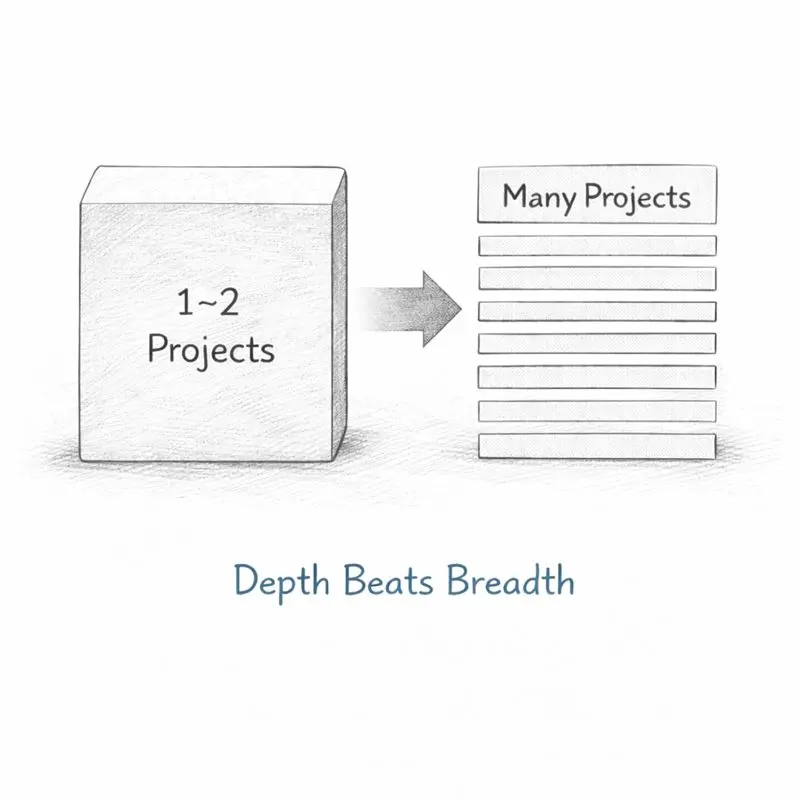
How Many Projects Should You Include?
More projects do not equal a better resume.
Recruiters generally prefer:
2–4 well-explained projects
over6–8 shallow ones with no explanation
Depth signals learning and reliability.
Breadth without explanation signals experimentation without ownership.
How Recruiters Interpret Resume Examples
Recruiters are not comparing formatting.
They are comparing risk.
Each resume silently answers:
“How risky would it be to trust this person with production systems?”
What Makes Resume Examples Strong
Clear context (learning vs production)
Individual ownership
Trade-offs or mistakes explained
Proof links
What Weak Examples Have in Common
Tool lists without usage
Buzzwords like scalable or secure without explanation
Team language hiding ownership
Avoidance of failures
These patterns don’t mean the candidate is bad — the resume just doesn’t help the recruiter decide.
Common Blockchain Resume Mistakes (With Explanation)
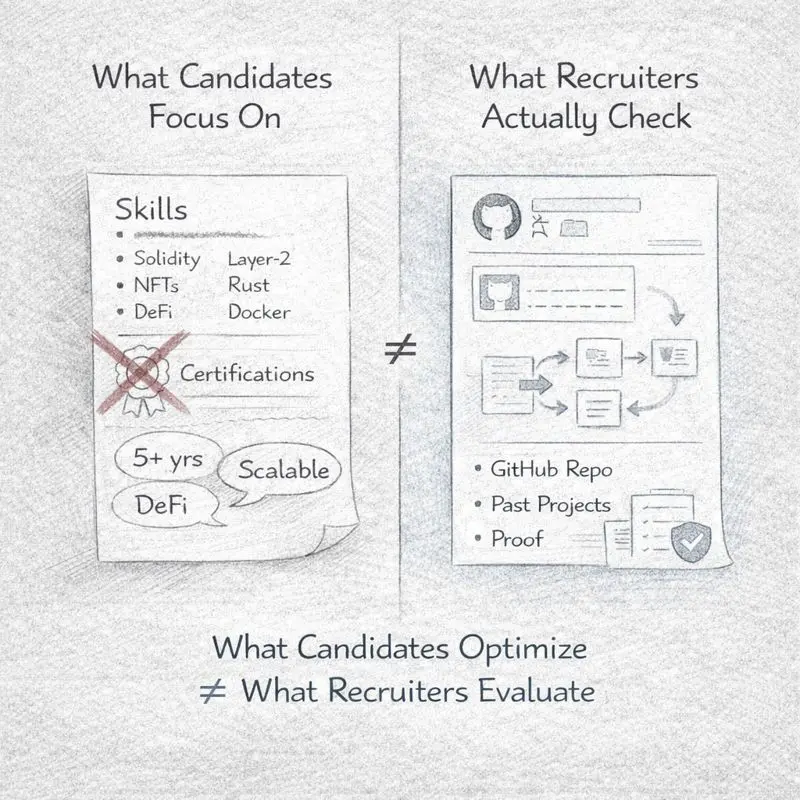
Most blockchain resumes don’t fail due to lack of skill.
They fail due to unanswered questions.
1. Listing Skills Without Showing Usage
If Solidity or Rust appears, recruiters expect:
Where you used it
What you built
What challenges you faced
Without this, the skill is discounted.
2. Overusing Buzzwords Instead of Decisions
Words like secure only matter if you explain:
What made it secure
What risks you considered
What trade-offs you accepted
Recruiters trust reasoning, not adjectives.
3. Hiding Ownership Behind Team Language
“Worked with a team” is safe — but vague.
Recruiters want:
What you owned
What broke
How you fixed it
Ownership builds confidence faster than collaboration language.
4. Treating GitHub as a Checkbox
A GitHub link without explanation often hurts more than it helps.
Recruiters notice:
Missing READMEs
One-commit repos
Copied tutorials
GitHub is judged on thinking and iteration — not activity.
5. Copying Web2 Resume Formats into Web3
Web2 emphasizes:
Titles
Tenure
Company names
Web3 emphasizes:
Proof of work
Learning speed
Technical judgment
Using Web2 formats misrepresents strong Web3 candidates.
Related explanation on missed interviews despite strong skills:
Why strong blockchain candidates still don’t get interview calls
Why Am I Not Getting Shortlisted for Blockchain Jobs? What Qualified Web3 Candidates Miss | ArtofBlockchain
Blockchain Developer Resume Checklist (With Context)
Use this checklist as a sanity filter, not a perfection test.
Structure & Clarity
Your resume should make sense in 10–15 seconds.
Skills & Role Fit
Every skill should be defensible with:
A project
A decision
Or a result
Proof of Work
At least one project should be:
Public
Explainable
Discussion-ready in an interview
This often decides shortlisting.
Final Reality Check
Ask yourself:
“If I were hiring, would I trust this person after reading this resume?”
That question matters more than formatting tricks.
Related discussion on landing roles despite market noise:
Why strong blockchain candidates still don’t get interview calls
Guidance on how to land a good job in web3 | ArtofBlockchain
Frequently Asked Questions About Blockchain Developer Resumes (2025)
FAQ 1. Do Web3 recruiters care more about GitHub or resume keywords?
GitHub and public work usually matter more. Keywords help with filtering, but proof builds confidence. Keywords are necessary — not sufficient.
FAQ 2. How long should a blockchain developer resume be in 2025?
1 page for most candidates.
2 pages only if you have:
Multiple production systems
Protocol-level experience
Deep audit/security work
Clarity matters more than length.
FAQ 3. Should I include testnets, hackathons, or unpaid projects?
Yes — especially early career or during transitions.
What matters is not payment, but:
Ownership
Technical thinking
Learning through execution
FAQ 4. Is ATS screening common in Web3 hiring?
Some companies use ATS, but human review happens early.
Your resume should be:
ATS-readable
Written for recruiters and engineers
Over-optimizing for bots usually backfires.
FAQ 5. What makes a blockchain resume different from a Web2 resume?
Web2 relies on:
Titles
Tenure
Companies
Web3 relies on:
Proof
Public artifacts
Reasoning
Learning velocity
Final Thoughts: What Actually Gets You Shortlisted in Web3
By 2025, blockchain hiring has matured — but not become rigid.
Recruiters still look for people who can:
Think clearly
Build responsibly
Explain decisions
Learn fast when things break
Your resume doesn’t need to look impressive.
It needs to look reliable.
Clarity over claims.
Proof over buzzwords.
Ownership over decoration.
That mindset will outperform any resume template.
About the author
I’m Shubhada Pande, founder of Home | ArtofBlockchain — a discussion-first platform where real Web3 hiring signals surface publicly through engineers, auditors, product leaders, and operators actively working in the ecosystem.
Over the last few years, I’ve studied 1,100+ real blockchain career and hiring discussions to understand what actually predicts success in Web3 roles — beyond résumés, buzzwords, or generic interview loops.
If you’re a founder, recruiter, or talent partner trying to:
Reduce mis-hires in smart contract or protocol roles
Evaluate candidates beyond GitHub stars and CVs
Understand how experienced Web3 candidates really think
…this work is built for you.
Connect with me on LinkedIn:
👉 Shubhada Pande Art Of Blockchain
Or reach out directly:
📩 founder@artofblockchain.club
Home | ArtofBlockchain — A Discussion-First Platform for Blockchain Jobs & Web3 Careers