
Smart Contract Developer Hiring: Practical Signals Teams Should Check Before Extending an Offer

Most Web3 founders know the pain of mis-hiring a smart contract developer. The symptoms repeat every time:
Feature velocity slows.
QA and security stretch thin.
Seniors take on invisible clean-up work.
Teams shift from proactive to reactive.
Incidents show recurring patterns, not one-offs.
Here’s the uncomfortable truth:
Most mis-hires happen before the offer stage — not after onboarding.
Founders rely on signals they think predict performance:
GitHub activity
Past job titles
Audit firm names
Years of experience
Framework checklists
These signals look impressive.
They rarely predict real engineering maturity.
To hire well, founders need behavioral, cognitive, and technical signals that map to real-world work — not résumé optics.
For hiring teams, this is also where JD clarity matters. If the job description only says “Solidity developer with DeFi experience,” the hiring process will attract keyword-matched candidates, not necessarily engineers who can reason through failure modes, test assumptions, explain trade-offs, and handle ambiguous smart contract requirements.
If your shortlist looks busy but still feels risky, review the role before adding more applicants.
Blockchain JD Review for Web3 Hiring Teams
Web3 JD Review for Teams Attracting Weak-Fit Blockchain Applicants | ArtofBlockchain
This blog breaks down practical hiring signals that smart contract teams should evaluate before extending an offer.
For founders, recruiters, and hiring teams, this is not a generic interview checklist. It is a pre-offer signal check for smart contract developer hiring: how to verify whether a Solidity candidate can reason through failures, testing depth, production risk, async ownership, and system-level trade-offs before the team commits to an offer.
Evaluate non-technical judgment and protocol governance awareness through the framework detailed in ethical considerations and developer responsibilities in Web3
For candidates preparing for these rounds, refer them to our Smart Contract Interview Preparation Hub
If your smart contract developer JD is attracting applicants who list Solidity, Hardhat, Foundry, audits, or DeFi keywords but do not show clear proof of engineering maturity, review the role expectations before scaling the hiring process:
1. The Candidate’s Model of How Failures Happen in Smart Contracts
Strong smart contract engineers share one trait:
They have an internal model of how things break.
Ask them:
“Walk me through the last bug you caused or fixed.”
Low-signal candidates discuss:
Tools used
Surface-level definitions
What “the team” did
High-signal candidates explain:
Why they believed something would work
Which assumption failed
What logs vs on-chain state revealed
How the incident changed their mental model
This difference shows immediately.
For smart contract developer hiring, this is one of the clearest proof-based hiring signals because it shows whether the candidate has actually lived through debugging pressure, production uncertainty, failed assumptions, and post-incident learning.
A polished GitHub profile may show activity, but the way a developer explains a bug shows how they think when something breaks.
For deeper examples, see:
Gas Pitfalls Juniors Mention & What Interviewers Actually Assess
Solidity Gas Optimization in Interviews: Why Juniors Fail the Question and What Seniors Actually Look For | ArtofBlockchain
A candidate's ability to articulate failure modes separates senior engineers from juniors who memorize definitions.
Review how candidates navigate edge cases in our breakdown of common Solidity interview pitfalls and debugging failures
Why this signal matters
Engineers spend more of their career debugging, not coding.
A developer who cannot explain debugging logic increases downstream risk for QA, auditors, integration teams, and incident response.
2. Their Ability to Describe System Behavior, Not Just Code Behavior
Many candidates know syntax.
Few can explain system behavior — the actual source of most vulnerabilities.
Ask:
“If this contract lived on mainnet, what assumptions does it depend on?”
Weak candidates answer at the function level.
Strong candidates think at the system boundary level:
“This price feed assumes…”
“This liquidity pool can be griefed if…”
“This upgradeable pattern breaks when…”
“This invariant must hold…”
This tests mental simulation:
Can they imagine the contract in motion, not just in isolation?
More examples in:
How Should I Answer DeFi Interview Questions on Securing Price Oracles?
I Have a DeFi Interview This Week — How Do I Explain Price Oracle Security Without Sounding Superficial? | ArtofBlockchain
System-thinking is the earliest sign of a true security mindset — the rarest trait in Web3 hiring.
3. Their Relationship With Testing: Ritual or Reasoning?
Testing reveals how a developer thinks.
Ask:
“When you write tests for a new module, what do you test first?”
High-signal answers:
“I start with invariants.”
“I simulate state transitions.”
“I write negative tests before gas tests.”
“I test assumptions, not just outcomes.”
Low-signal answers:
“I start with happy paths.”
“I only follow the Hardhat template.”
“I write tests after finishing the feature.”
Testing maturity predicts production stability more than any portfolio or certification. This is why hiring teams should not evaluate Solidity developers only by asking whether they have used Hardhat, Foundry, Slither, or OpenZeppelin.
The stronger signal is whether they can explain what their tests are protecting, which assumptions they are trying to break, and how their testing approach reduces the chance of smart contract failures after deployment.
See:
Smart Contract Fundamentals Hub
Smart Contract Fundamentals Hub: EVM Execution, Solidity First Principles, and Mainnet-Ready Mental Models | ArtofBlockchain
A useful way to separate strong candidates from keyword-matched candidates is to ask: “Can this person make risk visible before code goes live?” For smart contract developer hiring, the strongest signals usually appear in how they explain tests, assumptions, failure modes, and trade-offs — not in how many tools they name.
For broader hiring-side structure, use the Smart Contract Developer Career Hub as the router:
Smart Contract Developer Career Hub: Skills, Proof, Interview Prep and Jobs | ArtofBlockchain
4. The Way They Handle Ambiguity in a Problem Statement
A classic mis-hire pattern:
Great performance on fully defined tasks
Total freeze when requirements are ambiguous
But early-stage Web3 teams always work under ambiguity.
Give a prompt:
“Design a minimal rewards contract assuming cross-chain data may arrive late.”
Watch for:
clarifying questions
trade-offs
risk reasoning
boundaries and invariants before coding
Ambiguity exposes engineering maturity. This is especially important for early-stage Web3 teams because smart contract work rarely arrives as a perfectly written ticket. A candidate who can convert unclear product requirements into assumptions, constraints, invariants, test cases, and risk boundaries is usually safer to hire than someone who only performs well on clean coding tasks.
See:
Handling Production Incidents as a Junior Solidity Engineer
When a Junior Triggers a Production Incident: What’s the Right Way to Respond Without Making Things Worse? | ArtofBlockchain
5. Their Decision-Making Logic in Conflicting Trade-Offs
Smart contract development is 90% trade-offs:
gas vs readability
modularity vs bytecode size
trust assumptions vs speed
security vs deadlines
Ask:
“Tell me about a trade-off you made that not everyone agreed with.”
Weak candidates give excuses.
Strong candidates show:
risk ranking
alternatives considered
invariants prioritized
cost-benefit logic
See:
Hardhat or Foundry First — What Actually Helps in Your First Smart Contract Role?
Moving from Web2 Backend to Solidity in Singapore: Should I Learn Foundry or Hardhat First to Clear Smart Contract Interviews? | ArtofBlockchain
Trade-off clarity predicts fewer future incidents than syntax mastery. For founders and hiring managers, this is where practical smart contract developer hiring becomes different from ordinary software hiring. You are not only checking whether the developer can write Solidity code.
You are checking whether they can make responsible engineering decisions when gas cost, upgradeability, deadline pressure, security assumptions, user funds, and protocol trust are all pulling in different directions.
6. Their Ability to Explain Something Complex in Plain Language
This is not about communication.
It’s about clarity of thought.
Ask:
“Explain upgradeable contracts to someone who knows Solidity but not proxies.”
This matters for collaboration with QA, PMs, business teams, and auditors
Related:
How to Explain Blockchain Career Gap in Interviews
I’m a blockchain developer returning after a 1.5-year break — how do I explain the gap for US-based Web3 roles (EST/PST overlap etc)? | ArtofBlockchain
7. Their Past Learning Trajectory (Not Their Current Skill Level)
Experience in Web3 is nonlinear.
Candidate A:
1 year in blockchain
150 PRs
multiple failed experiments
documented learnings
Candidate B:
4 years in blockchain
repeated same work
low growth
Hire for trajectory, not résumé length. This is where proof-based hiring in Web3 becomes more useful than seniority labels. A candidate with fewer years but clear pull requests, documented debugging notes, architecture explanations, test improvements, and visible learning loops may create more trust than someone with a longer title history but very little evidence of growth.
Ask:
“What did you change after your last failure?”
Great answers show new habits, risk reduction, or new testing strategies.
See:
Guidance on Next Steps for Web3 Development Career
Guidance on Next Steps for Web3 Development Career | ArtofBlockchain
8. Their Default Approach to Collaboration and Async Work
Web3 teams operate globally. For remote smart contract developer roles, async ownership is not a soft skill. It is a hiring signal. A developer who can leave reproducible context, document blocked states, propose fallback paths, and keep work moving across time zones reduces coordination drag for the entire engineering team.
Async is the default.
Ask:
“What do you do when blocked by someone in another timezone?”
High-signal candidates:
leave reproducible states
write high-context comments
propose fallback paths
unblock themselves through mocks
take responsibility
Low-signal candidates:
wait
nudge
delay
escalate ownership
See:
How to Manage Time Zone Differences in Remote Blockchain Jobs
How Do You Manage Time Zone Differences In Remote Blockchain Jobs
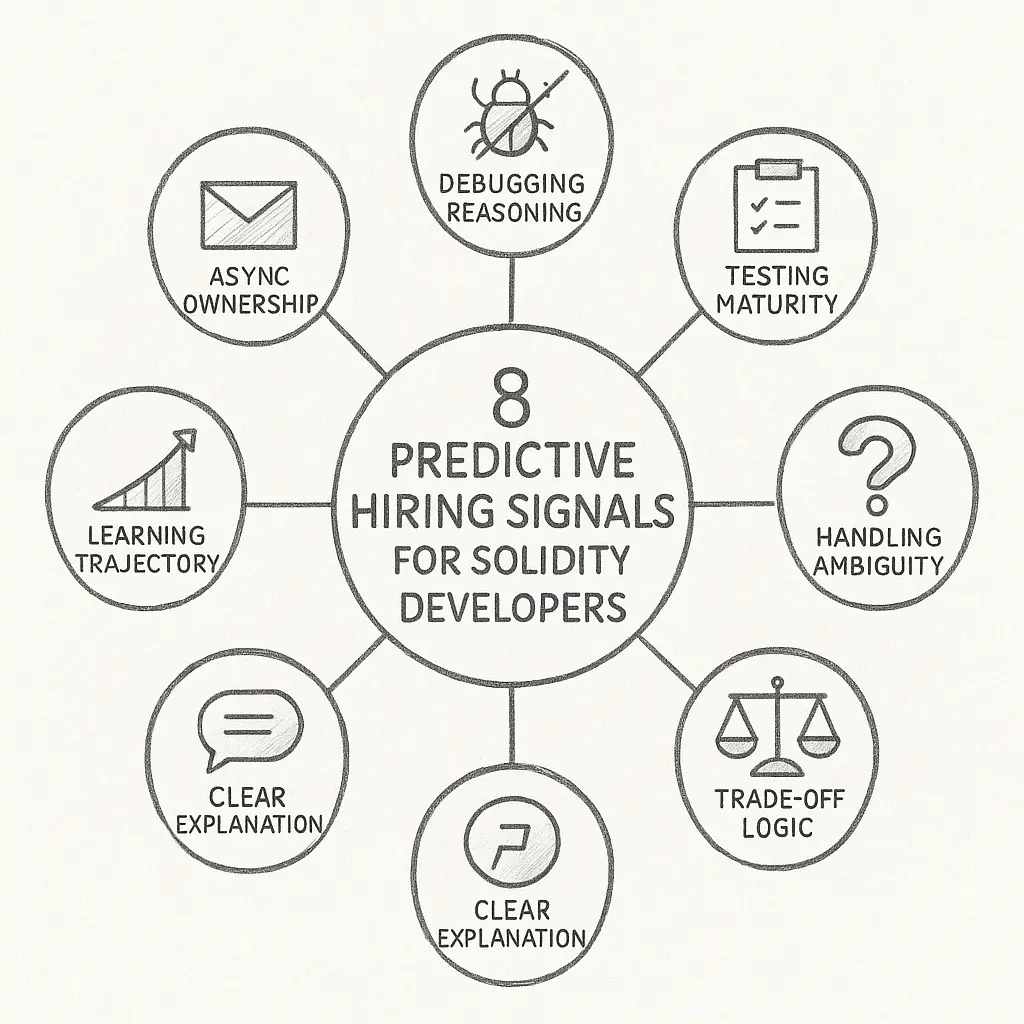
So When Should a Founder Extend an Offer to a Smart Contract Developer?
Extend an offer when a candidate consistently shows:
Strong debugging reasoning
System-level thinking
Test design maturity
Ease with ambiguity
Clear trade-off logic
Plain-language clarity
Upward learning trajectory
Responsible async habits
When these eight signals align, the risk of mis-hiring drops sharply — regardless of job titles or company names. A founder does not need to turn every smart contract developer hiring process into a long technical maze.
The goal is to verify the few signals that actually predict performance after joining: debugging reasoning, system-level thinking, testing maturity, ambiguity handling, trade-off logic, plain-language clarity, learning trajectory, and async ownership.
For a broader hiring signal map across Web3 roles, use this hub:
Web3 Hiring Signals
Blockchain Hiring Signals for Founders: Why Good Web3 Roles Still Attract Weak-Fit Applicants | ArtofBlockchain
For smart contract developer career and hiring-side routing, use this hub:
Smart Contract Developer Career Hub
Smart Contract Developer Career Hub: Skills, Proof, Interview Prep and Jobs | ArtofBlockchain
FAQs on smart contract developer hiring signals before extending an offer
1. What practical hiring signals should Web3 teams check before extending an offer to a smart contract developer?
Web3 teams should look beyond years of Solidity experience and check how the candidate reasons about contract failure, test coverage, upgrade risk, gas trade-offs, edge cases, audit feedback, and production incidents. A strong smart contract developer should be able to explain why a design decision is safer, how they tested the risky path, and what could break when the contract interacts with users, protocols, tokens, or off-chain systems.
2. How can founders evaluate smart contract developer proof before making a final hiring decision?
Founders should ask for proof that is readable, role-aligned, and connected to real engineering judgment. This can include GitHub repositories, Foundry or Hardhat tests, audit notes, bug fixes, architecture explanations, deployment decisions, or written breakdowns of past contract failures. The goal is not to collect more links. The goal is to understand whether the candidate can explain the risk behind the code and make decisions that reduce uncertainty for the team.
3. What should a smart contract developer interview test if the role involves production contracts and real user funds?
The interview should test how the candidate thinks under risk. Good areas include access control mistakes, oracle dependency, reentrancy assumptions, upgrade paths, token edge cases, emergency pause logic, invariant testing, and incident response. For production-facing roles, hiring teams should not only ask “can this person write Solidity?” They should ask whether this person can protect contract behavior when incentives, integrations, and user activity become unpredictable.
4. How do hiring teams identify whether a Solidity developer has real debugging and security reasoning skills?
A strong Solidity developer usually explains the failure path before jumping to the fix. They can describe what they checked, why the bug happened, how they reproduced it, what test failed, and how they prevented the same class of issue from returning. Weak candidates often explain only the final patch. Strong candidates show debugging trails, security assumptions, test evidence, and the reasoning behind the fix.
5. What proof should blockchain developers show if they want to be shortlisted for smart contract engineering roles?
Blockchain developers should show proof that helps hiring teams verify their judgment quickly. A clean GitHub repo, meaningful tests, a short architecture note, a security-focused README, audit participation, bug bounty notes, deployment experience, or a clear explanation of trade-offs can all help. The strongest proof is not the most complex project. It is the project that makes the candidate’s thinking readable to founders, recruiters, and engineering leads.
6. Why is a normal CV not enough when hiring smart contract developers for Web3 teams?
A normal CV can show keywords, tools, and past job titles, but it often hides the actual quality of engineering judgment. Smart contract roles involve irreversible transactions, protocol risk, user funds, and security-sensitive decisions. That is why hiring teams need proof beyond the CV: tests, code review habits, failure reasoning, architecture clarity, and examples of how the candidate handles ambiguity before something reaches production.
7. How should Web3 hiring teams create a smart contract developer interview scorecard before extending an offer?
A useful scorecard should separate proof signals into clear buckets: Solidity fundamentals, security reasoning, testing maturity, debugging process, system design judgment, communication clarity, and production readiness. This helps hiring teams avoid choosing only the candidate who speaks confidently in interviews. It also makes the final hiring decision more consistent, especially when founders, recruiters, and technical reviewers are evaluating the same candidate from different angles.
8. What are red flags when evaluating a smart contract developer before offer stage?
Common red flags include vague GitHub proof, copied tutorial projects, weak testing habits, inability to explain past design decisions, overconfidence around security, poor understanding of edge cases, and no clear reasoning around trade-offs. Another red flag is when a candidate can name tools like Foundry, Hardhat, Slither, or OpenZeppelin but cannot explain how those tools helped them catch or prevent a real issue.
9. How can candidates prepare for smart contract developer hiring processes where teams check proof, not just interview answers?
Candidates should prepare by making their proof easier to evaluate. That means cleaning their GitHub, adding short explanations to important projects, showing test coverage where relevant, documenting design decisions, and preparing to explain one or two difficult bugs or trade-offs in detail. Hiring teams remember candidates who can connect code, risk, and business impact in plain language.
If you're a founder evaluating Solidity talent or a candidate preparing for real interviews, explore AOB’s curated blockchain job listings:
If you are a founder, recruiter, or Web3 hiring team evaluating Solidity talent, do not start only by increasing the number of applicants. Start by making the role easier to evaluate. A clear smart contract developer JD should define the protocol context, testing expectations, security assumptions, collaboration style, proof signals, and pre-offer screening criteria.
Blockchain JD Review for Web3 Hiring Teams
Web3 JD Review for Teams Attracting Weak-Fit Blockchain Applicants | ArtofBlockchain
If you are a candidate preparing for smart contract developer roles, your CV should make these signals easy to verify before the interview: shipped work, debugging proof, test reasoning, architecture decisions, and role-aligned evidence.
Web3 CV Review Services
Web3 CV Review for Candidates Whose Proof Is Not Converting Into Interviews | ArtofBlockchain
AOB Curated Blockchain Job Board
Post a Web3 Job | Blockchain Job Board for Founders, Recruiters & Hiring Teams | ArtofBlockchain