Smart Contract Developer Career Framework: EVM Skills, Proof Portfolios, and Technical Hiring

Landing a production smart contract engineering role requires verifiable proof of adversarial testing, deterministic state handling, and EVM debugging capabilities. This central framework structures the technical competencies, repository standards, and interview evaluation criteria required for Web3 protocol and smart contract engineering.
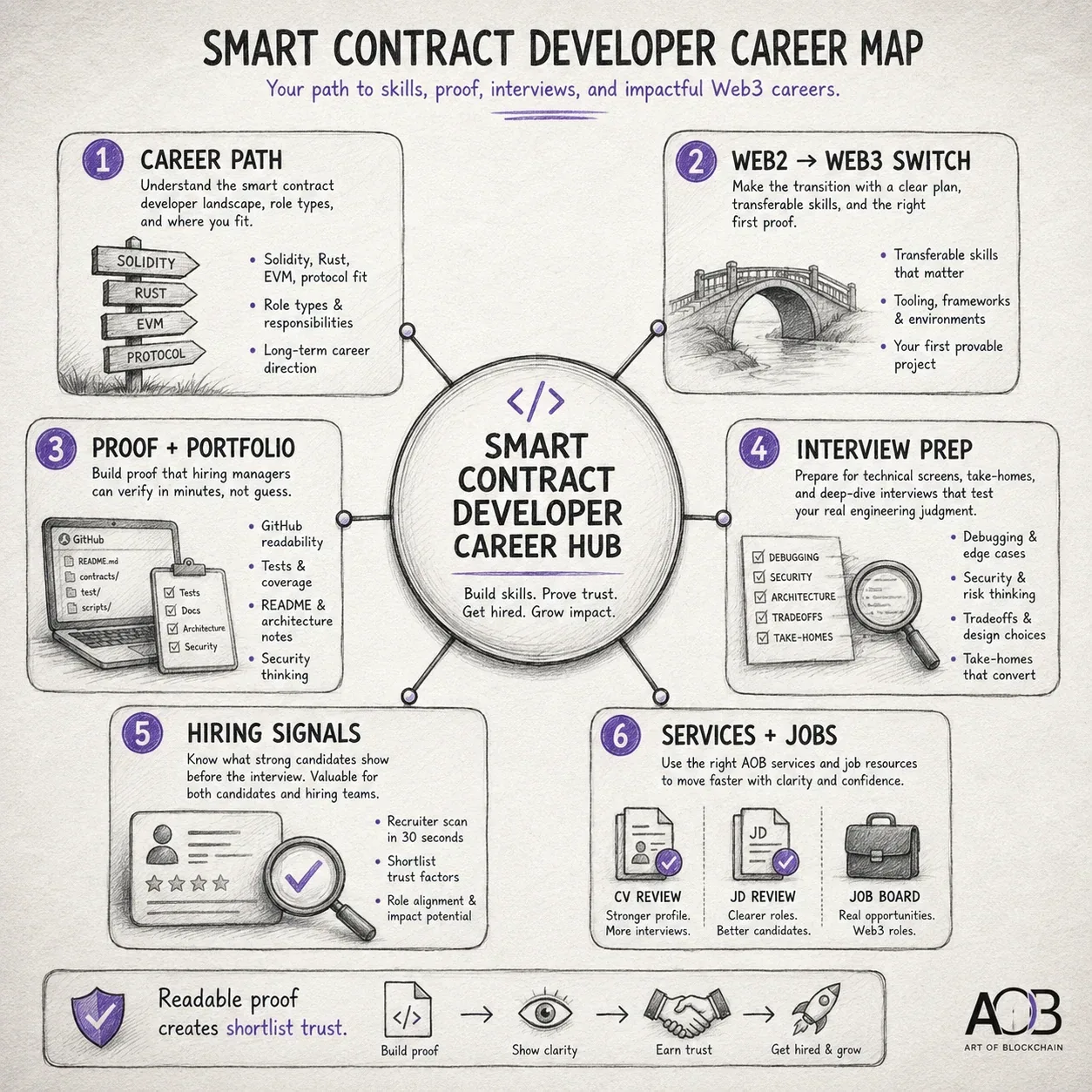
🧭 Smart Contract Engineering Knowledge Hierarchy: Building proof-of-work that hiring managers and protocol leads trust requires systematic progression across core syntax, EVM architecture, testing, and interview evaluation:
1. Foundations & Standards: Master contract patterns, access controls, and ERC standards in Core Smart Contract Engineering Skills
2. Execution Mechanics & Gas: Explore opcodes, storage slots, and Yul in Advanced EVM Concepts & Internals
3. Production QA & Tooling: Master Foundry, Hardhat fork testing, and invariant suites in Debugging, Tooling & Production Engineering
4. Technical Interview Preparation: Practice live take-home tests, security rounds, and whiteboard challenges in our Smart Contract Interview Prep Hub
EVM Architecture & Protocol Competencies Protocol teams evaluate developers on EVM execution mechanics rather than syntax familiarity. Core technical benchmarks include:
EVM Storage & Gas Optimization: Packed storage slots, memory vs. calldata allocation, transient storage, and inline assembly/Yul for gas-critical operations.
Deterministic State & Safety: Reentrancy vectors (read-only and cross-function), access control paradigms, and cross-contract state validation.
Tooling Standard: Production workflows centered on Foundry (Forge, Cast, Anvil) for fast property testing and deterministic script execution.
Foundational Pathway:
How to Become a Blockchain Engineer: Choose Your Track, Build Proof, and Prepare for Hiring Screens
EVM vs. Non-EVM Track Selection: Should I Start with Solidity or Rust?
2. Web2 Backend to Web3 Transition Engineering: Transitioning from traditional backend systems (Node, Go, Java, Python) requires adapting to immutability and adversarial execution:
Mental Model Shift: Transitioning from server-managed rollbacks to unalterable state transitions and upfront transaction gas costs.
Testing Rigor: Moving from standard mock unit testing to adversarial mainnet fork simulations.
Transition Blueprint:
Moving from Web2 Backend to Solidity: Tooling and Interview Strategy
Multi-Chain Experience Design: Showing
3. High-Signal Portfolio Architecture & Verifiable Proof: Standard tutorial tokens produce zero hiring signal. A production-grade smart contract repository must demonstrate:
Contract Core (src/): Implements explicit access control, reentrancy mitigation, and gas optimizations.
Test Architecture (test/): Unit test suites with 100% branch coverage, property-based fuzz tests, and actor-based invariant suites.
Deployment Automation (script/): Deterministic Foundry deployment scripts with multi-sig simulation staging.
Technical Documentation (README.md): System threat model, static analysis outputs, and architectural trade-off justifications.
Portfolio Proof Standards: Smart Contract Portfolio for Jobs: What Hiring Managers Actually Trust
GitHub Verification Metrics: How Recruiters Read GitHub for Blockchain Jobs
4. Technical Assessment & System Design Evaluation: Engineering interview rounds evaluate failure-mode analysis and architectural judgment:
Trade-Off Articulation: Explaining design decisions (e.g., Diamond Multi-Facet Proxy vs. immutable standalone contracts).
Take-Home Protocol Execution: Submitting production-grade test suites, static analysis reports (Slither/Aderyn), and documented assumptions.
Live System Teardowns: Explaining transaction trace reverts and proposing secure fixes.
Interview Prep Guide: Smart Contract Interview Prep: Solidity, Security, Debugging & Take-Homes
Technical Screen Signals: How to Pass Smart Contract Developer Interviews
5. Protocol Team Hiring Signals & Candidate Scoring Teams evaluate engineering candidates using clear signal distinctions:
Testing Signals: Weak signals rely on basic hardcoded mock tests; strong signals demonstrate invariant testing and fork tests.
Security Signals: Weak signals claim "bug-free code"; strong signals show public audit contest participation and documented threat models.
Architecture Signals: Weak signals use copy-pasted OpenZeppelin templates; strong signals provide custom implementations with gas/security tradeoff notes.
Candidate Evaluation Heuristics: Smart Contract Developer Hiring: Practical Signals for Teams
Technical Skill Verification: Interview Smart Contract Engineers: Evaluate Real Solidity Skill
6. Verification Services & Career Infrastructure When candidate proof or hiring descriptions need direct optimization:
Candidate Proof Review: Web3 CV Review for Smart Contract Engineers
Hiring Role Calibration: Web3 JD Review for Protocols & Founders
Role Discovery: ArtofBlockchain Job Board
Frequently Asked Questions: Smart Contract Careers & Hiring
1. What portfolio proof matters most for smart contract developer roles?
Hiring teams verify repositories based on test coverage (fuzzing and invariant suites), explicit threat modeling in the documentation, clear gas optimization choices, and reproduction scripts for edge-case vulnerabilities. Basic deployed tokens without tests produce minimal hiring signal.
2. How should junior or transitioning developers structure their first Web3 projects?
Rather than building large, untestable clones of complex protocols, build smaller, well-specified contracts featuring:
Full Foundry unit and fuzz test suites.
Static analysis logs from Slither or Aderyn.
Clear architectural trade-off documentation in the project README.
3. Should engineers learn Solidity or Rust first?
Solidity is the primary language for EVM-compatible networks (Ethereum, Arbitrum, Optimism, Base, Polygon). Rust is essential for SVM (Solana), Cosmos SDK, and protocol/node client infrastructure. Select the language aligned with your targeted chain ecosystem.
4. Is audit experience required for smart contract developer jobs?
No, but security awareness is mandatory. Candidates who demonstrate understanding of common attack vectors (reentrancy, oracle manipulation, arithmetic rounding) and show defensive coding habits consistently outperform applicants who only know basic Solidity syntax.
5. How can protocol teams prevent weak-fit applicant volume in job postings?
Define explicit technical milestones and proof expectations in the job description, such as experience with invariant testing, gas benchmarking, or specific framework proficiencies (e.g., Foundry), rather than listing generic keyword bullet points.