Hiring Managers & Recruiters Hub - Hiring Signals • Interview Expectations • Communication • Team Fit • Review Culture

This hub focuses on how hiring managers, recruiters, founders, and senior engineers evaluate Web3 hiring signals before they trust a candidate, shortlist a profile, or move someone into a deeper interview process.
For hiring teams, the main problem is not only finding people who use the right blockchain resume keywords. The harder part is separating resume claims vs verifiable proof: GitHub repositories, smart contract tests, audit artifacts, QA examples, protocol research, DAO contributions, and communication patterns that reduce hiring uncertainty before interviews.
For candidates, this hub also explains why polished language alone may not be enough. In proof-based hiring in Web3, the strongest profiles usually show role-aligned proof that recruiters can understand quickly and senior engineers can verify during interviews.
TL;DR: What this hub helps you understand
This hub explains what hiring teams verify before shortlisting Web3 candidates.
The focus is on Web3 hiring signals beyond resumes: GitHub proof, testing proof, audit proof, QA examples, protocol research, communication clarity, and role-aligned proof.
For recruiters and founders, it helps reduce hiring uncertainty before interviews.
For candidates, it shows why polished blockchain resume language is not enough if the proof trail is unclear.
Use this hub as a hiring-side map for understanding how recruiters evaluate blockchain candidates, how hiring managers evaluate Web3 candidates, and how proof-based hiring in Web3 works before the interview stage.
How Hiring Teams Read Proof Before the Interview
Before a Web3 candidate reaches a serious interview, hiring teams usually look for signs that the person’s experience can survive basic verification. A resume may say “smart contract developer,” “security researcher,” “QA engineer,” “protocol contributor,” or “growth lead,” but the hiring decision often depends on whether there is a candidate proof trail behind that claim.
This is where recruiter-readable proof matters. Hiring managers do not need every detail at the first scan, but they do need enough shortlist-ready proof to understand whether the person’s work matches the role, the risk level, and the team’s current hiring need.
Web3 Hiring Signals That Matter Before Shortlisting
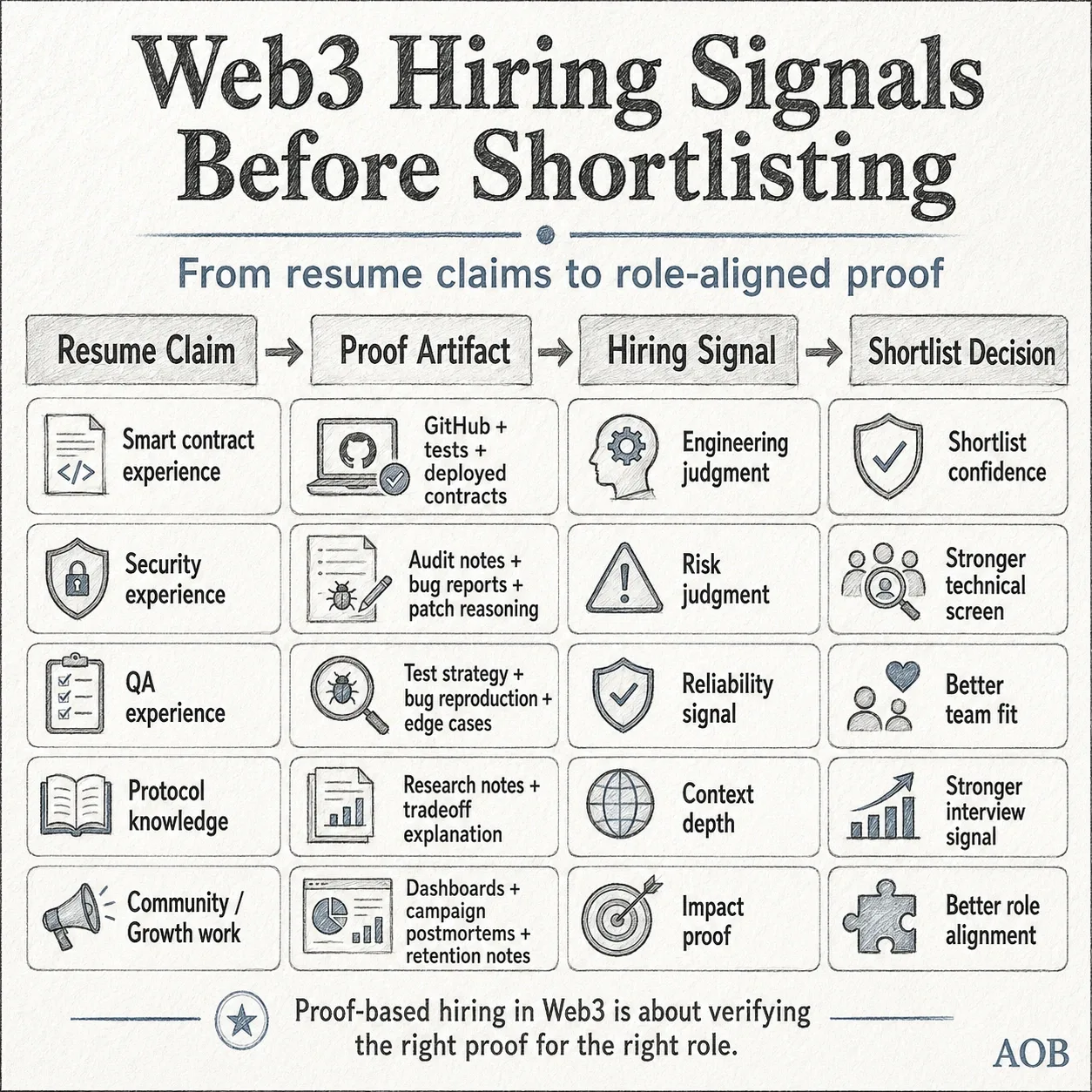
For hiring teams, this is also where job description clarity matters. If the JD asks for “Web3 experience” but does not define the proof needed for smart contract, QA, security, protocol, or growth roles, the shortlist becomes noisy.
If you are hiring and want the role to attract stronger, more relevant candidates, review the JD clarity route here:
Web3 JD Review for Teams Attracting Weak-Fit Blockchain Applicants | ArtofBlockchain
If you already have a clear role and want visibility inside a blockchain careers community, post the role here:
Post a Web3 Job | Blockchain Job Board for Founders, Recruiters & Hiring Teams | ArtofBlockchain
Want to understand what hiring managers expect — AND apply to teams hiring right now?
SECTION 1 — What Hiring Managers Expect
What do hiring managers expect when you talk about testing strategy?
Company expectations in smart contract roles — showing ownership
SECTION 2 — Communication Skills & Professionalism
Live PR review nerves — do seniors judge beginners too harshly?
Live PR review nerves — do seniors secretly judge beginners too harshly? | ArtofBlockchain
How to communicate when a smart contract demo fails mid-client call
SECTION 3 — Team Dynamics, Culture & Feedback
Do seniors judge too harshly in blockchain code reviews?
Do Seniors Judge Too Harshly in Blockchain Code Reviews? | ArtofBlockchain
Imposter syndrome & team-pressure anxiety
Recruiters usually do not have time to deeply inspect every GitHub repository, audit note, QA example, or protocol contribution in the first pass. That is why recruiter-readable proof matters. The strongest profiles make the hiring signal visible quickly: what was built, what was tested, what broke, what was improved, and why the work is relevant to the role.
SECTION 4 — Signals Recruiters Look For
How do juniors stand out when everyone submits similar solutions?
Clean code, but still rejected — what do juniors miss in take-home assignments? | ArtofBlockchain
Resume roast — what experienced recruiters look for
Looking for a quick resume roast for blockchain dev roles | ArtofBlockchain
SECTION 5 — Founder / Product / Ops Hiring Lens
This section focuses on what startup founders and product teams evaluate when hiring:
Security PM interview expectations
Testing strategy signals (QA → team alignment)
SECTION 6 — Hiring-Related Career Anxiety
These threads capture job seekers who are overwhelmed by hiring expectations:
Failed a technical interview for a security role — need guidance
Feeling lost in blockchain firm — seeking clarity before reapplying
https://artofblockchain.club/discussion/feeling-lost-in-blockchain-firm-as-rust-developer
SECTION 7 — Bonus: Hiring Transparency & Pay Signals
Negotiating salaries with founders
Token compensation clarity from an employer perspective
Use this hub as a hiring-side map. If you are a candidate, study the signals before applying. If you are a founder, recruiter, or team lead, use the sections below to check whether your hiring process is asking for the right proof before the interview stage.
Related AOB routes:
Web3 hiring signals:
Web3 Hiring hub | ArtofBlockchain
Curated blockchain jobs:
JD review for Web3 hiring teams:
Web3 JD Review for Teams Attracting Weak-Fit Blockchain Applicants | ArtofBlockchain
Post a Web3 job:
Post a Web3 Job | Blockchain Job Board for Founders, Recruiters & Hiring Teams | ArtofBlockchain