Proof-Based Hiring in Web3: A Founder’s Guide to Evaluating GitHub, Tests, Smart Contracts, and Audit Claims

Updated for 2026 Web3 hiring signals: this guide focuses on how founders, recruiters, and hiring managers can evaluate blockchain candidates through visible proof before relying on interviews alone.
While hiring, most founders review code thoroughly, as the wrong hire can cost massively.
In the Web3 industry, due to its decentralized and irreversible nature, a blockchain candidate can sound sharp in interviews, explain architecture perfectly, and still create confusion once real work begins. Hiring after the verified proof of work matters more in Web3 than in any other industry.
This guide aims for a founder-side evaluation framework for checking whether a candidate’s GitHub, tests, pull requests, smart contract work, and audit claims reduce hiring risk.
The central idea for blockchain industry hiring is simple:
Do not judge only whether someone can talk about code.
Judge whether their work leaves behind traceable proof.
That proof usually appears in GitHub history, test coverage, pull request behavior, debugging traces, audit-linked changes, and the way smart contract decisions are documented over time.
You do not need to read every line of Solidity or Rust to use this lens well. You need to know where reliable engineers leave evidence of judgment, ownership, and risk awareness.
Who Is This Guide For?
Use this guide when you need a practical first-pass evaluation lens before a deeper technical review, trial task, or final hiring decision.
For Founders and Hiring Teams
If you are hiring for a blockchain, smart contract, protocol, security, compliance, or agentic Web3 role, and if the hiring cycles are long, the issue could be candidate quality as well as proof definition.
AOB helps hiring teams review Web3 job descriptions, clarify proof signals, and publish curated blockchain roles for candidates who understand the difference between claims and evidence.
Useful links:
Web3 job posting:
Post a Web3 Job | Blockchain Job Board for Founders, Recruiters & Hiring Teams | ArtofBlockchain
JD review support:
Blockchain Job Description Review Service for Web3 Hiring Teams | ArtofBlockchain
It is especially useful for:
Non-technical founders
You are hiring smart contract, protocol, infrastructure, or security talent, but you do not want to pretend you can judge every line of code.
Technical founders with limited bandwidth
You can review engineering work at a high level, but you do not have time to inspect every repo, PR, and test suite in depth.
Hiring managers and recruiters in Web3
You need a cleaner lens than interview fluency, keyword familiarity, or portfolio polish.
Teams are trying to build a proof-based hiring process
You want a more reliable way to evaluate blockchain candidates before they touch production-critical work.
This page stays at the thesis and evaluator level.
If you want deeper tactical guidance on GitHub screening, portfolio trust signals, recruiter-side calibration, and hiring-process design, use the linked AOB pages throughout this guide.
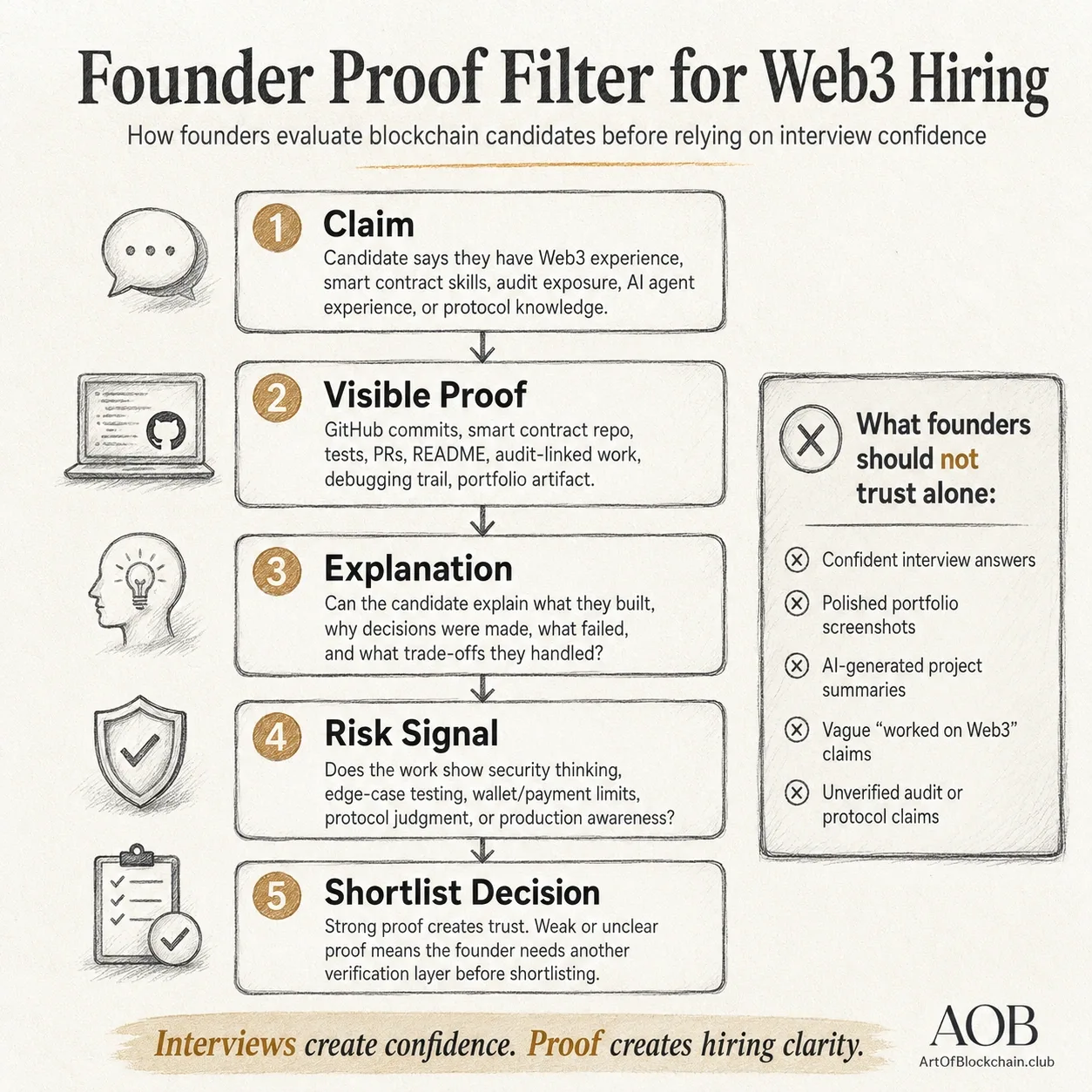
TL;DR
Proof-based hiring works because interview performance and engineering reliability are not the same thing.
In Web3, founders are usually trying to answer one practical question: does this candidate provide sufficient visible evidence to reduce the risk of trusting them with production-critical work?
The most useful proof signals usually come from:
GitHub history that shows lived-in work, not staged activity
tests that reveal risk awareness, not just happy-path passing
pull requests that show reasoning, communication, and ownership
debugging traces that show calm problem-solving under uncertainty
audit-linked work that leaves behind visible engineering fingerprints
The goal is not to become a code reviewer.
The goal is to use proof signals before interview confidence becomes the main reason for a shortlist.
Founder Evaluation Scorecard: 15-Minute Proof Review
Use this as a first-pass screen before deeper technical review. The goal is not to judge every line of code. The goal is to check whether the candidate leaves enough visible proof to reduce hiring risk.
(1) Proof area: GitHub history
What to check: Does the work show iteration over time?
Strong signal: Commits, issues, fixes, and revisions spread across real project history.
Weak signal: Many repos created in a burst with vague commit messages.
(2) Proof area: Tests
What to check: Does the candidate test for failure, not only success?
Strong signal: Revert cases, edge cases, role checks, invalid inputs, and broken assumptions.
Weak signal: Only happy-path tests or shallow, generated-looking files.
(3) Proof area: Pull requests
What to check: Can the candidate explain why a change was made?
Strong signal: Clear PR description, linked issue, trade-off explanation, and calm review replies.
Weak signal: No description, no context, defensive replies, or missing tests.
(4) Proof area: Smart contract work
What to check: Can the project be understood without a sales pitch?
Strong signal: README explains assumptions, contract behavior, limitations, and testing notes.
Weak signal: Screenshots or demos with no repo, deployment, or reasoning trail.
(5) Proof area: Audit claims
What to check: Is the claim connected to visible work?
Strong signal: Mitigation PRs, issue IDs, test updates, or timeline-matching commits.
Weak signal: PDF/report claim only, with no code-linked participation.
This scorecard does not replace technical review. It helps founders avoid giving interview confidence more weight than traceable proof.
How to Read Each Proof Signal Without Becoming a Code Reviewer
Web3 systems break in ways traditional software often does not. A small oversight in a contract can lock funds, break critical flows, create governance risk, or expose vulnerabilities on a public chain.
That changes what good hiring looks like.
A strong interview is useful, but it is still only a conversation. Real work exposes habits, assumptions, and workflows. That is why blockchain hiring signals matter more than polished explanations.
After reviewing 450+ CVs, a few patterns show up again and again.
1. The candidate might sound senior, but the visible work is not enough proof.
The tests pass locally, but the thinking does not survive reality
Strong engineers do not panic when assumptions fail. They reproduce the issue, reduce variables, verify conditions, and debug with structure. Weak engineers treat failure like a mystery.
How someone handles a pull request tells you a lot more about future team drama than how well they interview.
Empty descriptions. Unlinked tickets. Zero context on trade-offs. Getting defensive in the comments. Skipping tests. These aren't just minor style quirks—they actively kill your team's momentum.
That's the whole point behind proof-based hiring in blockchain right now.
You aren't just trying to figure out if someone knows how to code. You need to know what happens when the work gets chaotic. Do they keep their cool and communicate clearly, or do they leave everyone guessing?
What Proof Actually Looks Like
Proof is visible engineering behavior that can be checked, questioned, and traced.
Once the founder has used the scorecard, the next step is not to inspect everything deeply. The next step is to understand what each signal usually reveals about the candidate’s working style.
GitHub history
GitHub history matters because it shows whether the work has developed over time or was created only to impress during hiring. Founders do not need to understand every commit. They need to check whether the work looks lived-in, revised, questioned, and improved.
Tests
Tests matter because they reveal how the candidate thinks when the system does not behave as expected.
Early-career candidates often test whether something works. Stronger candidates usually test what happens when assumptions break: invalid inputs, access-control mistakes, timing issues, edge cases, failed transactions, and role-based behavior.
Pull requests
Pull requests show how a candidate communicates when real work changes. For founders, this matters because a technically strong person who cannot explain trade-offs, respond to review, or document decisions may still create delivery risk inside a small Web3 team.
Debugging footprints
Smart contract work should show discipline, clarity, and risk awareness. A founder is not checking whether every line is perfect. They are checking whether another engineer could understand the contract assumptions, test behavior, limitations, and deployment context without depending only on the candidate’s verbal explanation.
Audit-linked traces
A vague README does not automatically mean weak engineering, but it does create more uncertainty for a founder who cannot inspect every line of code.
How Non-Technical Founders Can Read GitHub Without Pretending to Read Code
GitHub is not only a code host.
For hiring, it can act like a behavioral diary.
You are not opening a repo to become an auditor. You are opening it to check whether the person behind the work shows structure, ownership, and judgment over time.
Consistency matters more than repository count
Thirty clean repos created in a burst are less useful than one project with a real history of iteration.
Look for:
commits spread across time
messages that explain what changed
issues that were opened, discussed, and resolved
evidence of revisions, not just uploads
Debugging footprints are hard to fake
If nothing ever breaks on someone’s GitHub, it usually tells you very little.
Strong candidates often leave signs of real work:
Issue threads around broken assumptions
Fix commits
Retries and refinements
Notes around environment or state differences
The test folder reveals thinking style
Healthy repositories usually show some mix of:
edge-case checks
revert cases
event validation
more than one or two shallow happy-path files
naming that suggests real intent
PR behavior is one of the best non-technical filters
Strong pull requests usually show intention.
Weak pull requests usually show chaos.
Look for:
a clear description
context around why the change was made
linked issue or bug context
calm replies to review
evidence that tests changed when behavior changed
Quick GitHub Checklist for Non-Technical Founders
Before moving a candidate forward, check whether at least some of these signals are visible:
=> one repo with real history instead of only fresh uploads
=> commits that explain changes in plain language
=> issues, bugs, or fixes that show real work happened
=> tests that include failure paths or edge cases
=> pull requests with context, not just code changes
=> README notes that explain assumptions, limits, and setup
=> evidence that the candidate can explain one meaningful artifact clearly
If none of these signals are visible, the candidate may still be capable, but the hiring process needs another proof layer before trust is given.
If you want the deeper recruiter-side version of GitHub screening, read How Recruiters
Read Your GitHub (2025): Building Proof Stacks for Blockchain Trust.
How to Evaluate Audit Claims Without Overtrusting Them
Audit claims need careful handling because they can sound impressive even when the candidate’s actual role is unclear.
A useful rule:
Write-ups can show learning.
Code-linked traces show responsibility.
Use this claim-vs-proof lens:
Candidate claim: “I worked on audits”
Better proof to look for: Issue IDs, review comments, mitigation PRs, or linked findings.
Candidate claim: “I fixed vulnerabilities”
Better proof to look for: Test updates, patch commits, and before-and-after explanation.
Candidate claim: “I understand smart contract security”
Better proof to look for: Reproduction notes, risk explanation, edge-case testing, and threat-model thinking.
Candidate claim: “I contributed to protocol security”
Better proof to look for: Timeline-matching commits, reviewer discussion, and documented trade-offs.
Candidate claim: “I wrote audit reports”
Better proof to look for: Public report plus repo-linked evidence of actual fix involvement.
This does not mean every valid audit contribution must be public. But when no trace exists at all, the claim needs stronger questioning during the hiring process.
A Clear README Helps Founders Evaluate Blockchain Developer Proof Without Reading Every Line of Code
A strong README often includes:
What the contract does in plain language
Assumptions
Design choices
Testing notes
Known trade-offs or limitations
A vague README often hides clear thinking.
Strong Smart Contract Portfolios Show Reasoning, Trade-Offs, and Traceable Engineering Proof
Good smart contract portfolios usually include more than polished UI, screenshots, or case-study summaries.
They often give founders a way to trace the work through:
They often include:
repo links
contract addresses or deployments where relevant
issue threads
pull request traces
before-and-after explanations
notes on trade-offs or failed assumptions
Real engineering work usually leaves a trail
The best portfolio signal is not “this looks impressive.”
It is “I can trace how this evolved.”
That matters more than design polish because it helps founders evaluate blockchain candidates on proof, not performance.
For the portfolio-specific layer of this idea,
Read The Smart Contract Portfolio That Shows How You Think.
How Founders Should Evaluate AI Skills in Agentic Web3 Hiring
Agentic Web3 changes the hiring question. For a normal blockchain role, founders may ask:
Can this person build, test, debug, and explain smart contract or protocol work clearly?
For an agentic Web3 role, the question becomes sharper:
Can this person design systems where AI agents interact with wallets, tools, APIs, payments, permissions, or smart contracts creating controlled risk?
That difference matters.
A candidate may know AI terms. They may talk about agents, MCP, x402, AP2, autonomous payments, agentic wallets, or AI-assisted workflows. But vocabulary is not proof. Founders need to check whether the candidate understands what can go wrong when automation starts touching money, permissions, contracts, or production systems.
In agentic Web3 products, the risk is not only bad code.
The risk can also come from:
=> an agent taking action with too much permission
=> a wallet flow that does not clearly separate user approval from automated execution
=> tool access that is too broad or poorly logged
=> prompt injection changing what an agent does
=> payment flows without clear spending limits or recovery paths
=> unclear responsibility when an automated action fails
=> no audit trail for what the agent saw, decided, and executed
=> tests that only show the happy path, not failure or misuse cases
With a rapid increase in adoption of AI tools, the hiring proof becomes more complicated.
The scope expands from building AI agents to judgement candidate understands underlying risk due to the use of AI agents
For agentic Web3 roles, founders should look for proof such as:
=> permission design notes
=> wallet or payment approval boundaries
=> test cases for failed, malicious, or unexpected agent behavior
=> logs or observability around agent actions
=> clear documentation of tool access
=> fallback paths when automation fails
=> examples of human-in-the-loop checkpoints
=> reasoning around security, compliance, and user trust
This is especially important for products involving agent payments, autonomous wallets, protocol operations, DeFi workflows, or AI-assisted smart contract activity.
That is the difference between someone who has experimented with agentic Web3 and someone who may be ready to work on real products.
Questions Founders Can Ask When Proof Looks Unclear
When proof looks unclear, do not reject immediately. Ask sharper questions:
=> Which part of this repo changed the most after feedback?
=> Can you walk me through one pull request where the first approach did not work?
=> Which test did you add because something broke or almost broke?
=> What assumption did you change while building this contract?
=> If another engineer joined this project tomorrow, what would they need to understand first?
=> For audit-related work, which finding, mitigation, or test update were you personally responsible for?
=> If you worked with AI agents or autonomous workflows, where did you define the limits of what the agent could do?
=> What happens if the agent, wallet, payment flow, or tool call behaves unexpectedly?
These questions help founders test ownership without pretending to conduct a full technical audit.
How to Verify Audit Experience Without Being a Security Expert
“Audit experience” is one of the easiest phrases to overstate in Web3.
That does not mean every claim is inflated.
It means evaluators need a simple way to separate observational familiarity from real participation.
A useful rule:
write-ups show learning.
Code-linked traces show responsibility.
Look for signals like:
pull requests tied to mitigation work
issue IDs with reproduction context
test updates reflecting the fix
timeline-matching commits
comments that show reasoning around impact or trade-offs
Be more cautious when the proof is mostly:
PDFs with no repo trace
Medium summaries with no linked fixes
abstract security vocabulary with no visible work trail
A real audit usually leaves fingerprints across repos, tests, issues, or reviews.
If you want to pressure-test this thinking against a real recruiter-style discussion,
Read
Recruiters — How Do You Actually Check if Someone’s Blockchain Experience Is Real?.
Testing Strategy Is Often the Clearest Signal of Engineering Judgment
One of the fastest ways to understand how founders evaluate blockchain candidates is to look at how the candidate thinks about failure.
Juniors often test functionality.
Stronger engineers usually test failure, assumptions, role interactions, timing, edge cases, and conditions that break happy-path confidence.
That is why tests are not just proof of correctness.
They are proof of judgment.
Useful questions for evaluators are often simple:
Does this project only test success?
Is there any evidence that the candidate thought about reversions, invalid inputs, or broken assumptions?
Do the tests suggest real-world conditions, or only ideal local behavior?
Is the testing style narrow and performative, or broad and risk-aware?
You do not need to grade the code line by line.
You need to notice whether the testing style suggests maturity.
If you want the broader market frame around how teams and candidates read each other before hiring decisions happen, use Web3 Hiring Signals: What Strong Candidates Quietly Look For Before Applying as the companion page.
What Inflated Proof Usually Looks Like
The goal is calibration. A few patterns appear often enough that founders and hiring managers should recognize them quickly.
GitHub that looks staged
Common warning signs:
many repos created in a short burst
identical structures across projects
commit floods on one day
vague messages like “final update”
no issues, no debugging trail, no iteration
Portfolio pages that look polished but thin
Common warning signs:
screenshots with no repo links
case studies with no reasoning trail
audit summaries with no code evidence
design polish carrying more weight than engineering proof
Audit claims that stop at vocabulary
Common warning signs:
Only PDF reports
No mitigation pull requests
No test updates
No issue discussion
No traceable code-linked participation
The point is not to reject candidates for imperfection.
The point is to stop mistaking polish for evidence.
A Simple Proof-Based Hiring Process for Founders
Once the proof signals are visible, founders still need a simple process. The goal is not to turn hiring into a heavy technical audit. The goal is to avoid shortlisting candidates only because they interview well.
A simple process can look like this:
Step 1: Check whether the candidate has one meaningful artifact.
This could be a GitHub repo, smart contract project, audit-linked contribution, protocol debugging trail, technical write-up, AI workflow, agentic wallet prototype, or production-facing contribution that helps founders evaluate blockchain candidates before relying on interview confidence.
Step 2: Ask the candidate to explain one decision inside that artifact.
Do not ask for a broad summary. Ask why one design choice was made, what alternatives existed, and what risk remained.
Step 3: Check one failure-related signal.
Look for tests, bug fixes, edge cases, review comments, fallback paths, logs, or documentation that shows how the candidate thinks when something breaks.
Step 4: Compare the proof with the interview.
If the interview sounds stronger than the proof, ask follow-up questions. If the proof is stronger than the interview, the candidate may still deserve a deeper technical review.
This keeps the hiring process practical without making founders pretend to be auditors.
Verify one high-risk claim
If the candidate mentions audit work, major refactors, mainnet debugging, or production ownership, check whether there is at least one visible trace connected to that claim.
Judge behavior under uncertainty, not confidence alone
The final question is rarely “Did they sound smart?”
It is usually “Did their proof reduce uncertainty?”
That is a better evaluator lens for hiring teams who want a clearer way to hire blockchain developers.
A Founder’s Reflection on Proof-Based Hiring
One of the biggest hiring mistakes in Web3 is not only missing talent.
It is mistaking confidence for predictability.
A polished conversation can create comfort. A clean portfolio can create excitement. But neither tells you enough unless the work also leaves behind proof: reasoning inside pull requests, visible test discipline, debugging footprints, trade-off awareness, and a pattern of behaving clearly when assumptions break.
That is why proof-based hiring matters.
Founders are not trying to become smart contract auditors during recruitment. They are trying to reduce uncertainty before uncertainty becomes expensive.
The practical shift is simple:
Stop asking only, “How well did this person explain themselves?”
Start asking, “What reliable proof does this person leave behind when real engineering work happens?”
That shift makes hiring calmer.
It makes evaluation more consistent.
And it gives non-technical and semi-technical decision-makers a better way to judge blockchain candidates without pretending to read every line of code.
Where to Go Next Based on What You Are Evaluating
Use this page as the founder-side starting point for proof-based hiring in Web3.
If you are evaluating a specific part of a candidate’s profile, the next step depends on the signal you want to inspect more deeply.
For recruiter-side verification, read Recruiters — How Do You Actually Check if Someone’s Blockchain Experience Is Real?
Hiring for a Web3 Role?
Before you shortlist candidates, make sure the role defines what proof actually matters.
For Web3 hiring, that proof may include GitHub history, test discipline, smart contract documentation, pull request reasoning, audit-linked work, protocol judgment, compliance understanding, or agentic AI risk awareness.
AOB supports founders and hiring teams with Web3 JD review and curated job posting so the role attracts candidates with clearer, more relevant proof.
Post a Web3 job on AOB:
Post a Web3 Job | Blockchain Job Board for Founders, Recruiters & Hiring Teams | ArtofBlockchain
FAQs
What exactly is proof-based hiring in Web3?
Proof-based hiring in Web3 means evaluating blockchain candidates based on visible, verifiable work rather than relying solely on interview fluency. This process usually means checking GitHub history, test behavior, pull request reasoning, debugging traces, smart contract documentation, portfolio evidence, and audit-linked contributions before giving interview confidence too much weight.
Can non-technical founders use proof-based hiring to evaluate blockchain developers?
Yes. A non-technical founder does not need to review every line of Solidity, Rust, or protocol code. They can still use proof-based hiring signals such as commit history, issue discussions, README clarity, test coverage patterns, pull request explanations, and whether the candidate can explain one meaningful technical artifact without hiding behind jargon.
What is the clearest difference between polished proof and trustworthy proof in Web3 hiring?
Polished proof is usually presentation-heavy: clean screenshots, strong claims, attractive portfolio pages, and confident interview answers. Trustworthy proof is traceable: founders can follow the work across commits, tests, pull requests, issues, debugging notes, trade-offs, audit-linked changes, and the candidate’s explanation of what changed over time.
Does proof-based hiring replace blockchain developer interviews?
No. Proof-based hiring improves interviews. The stronger approach is to review visible evidence first, then use the interview to test ownership, reasoning, communication, and judgment around the candidate’s actual GitHub work, smart contract project, test strategy, audit claim, or agentic Web3 prototype.
How can a founder evaluate a blockchain developer’s GitHub without becoming a code reviewer?
A founder can evaluate GitHub by looking for patterns rather than grading code line by line. Useful signals include whether commits are spread across time, whether pull requests explain why changes were made, whether tests include failure cases, whether issues show real debugging, and whether the README explains assumptions, limitations, and setup clearly.
What proof matters most for smart contract developer hiring?
For smart contract developer hiring, the strongest proof usually combines GitHub history, risk-aware tests, smart contract documentation, pull request reasoning, debugging traces, and audit-linked evidence where relevant. A polished portfolio can help, but traceable engineering behavior is more useful when founders are trying to reduce hiring risk before shortlisting.
How should founders evaluate AI skills in agentic Web3 roles?
Founders should not evaluate AI skills only through vocabulary, tool familiarity, or demo quality. In agentic Web3 roles, stronger proof usually shows how the candidate thinks about wallet permissions, payment limits, tool access, logs, fallback paths, prompt-injection risk, human approval points, and what happens when an agent behaves unexpectedly.
Why is proof-based hiring important for agentic Web3 products?
Agentic Web3 products can involve wallets, payments, smart contracts, APIs, automated decisions, and user approval flows. That raises the cost of weak evaluation. Founders need candidates who can show evidence of risk-aware design, not only experimentation with AI agents, autonomous wallets, or new protocol vocabulary.
Written by Shubhada Pande · Founder, ArtOfBlockchain · 14,500+ blockchain followers on LinkedIn