Smart Contract Interview Prep: Solidity, Security, Debugging, Take-Home Tests & Hiring Signals

Start here if you are unsure what smart contract interviewers test beyond syntax in Solidity and EVM rounds. This is where you connect interview answers with reasoning, proof, and shortlist confidence
This hub organizes AOB resources for Solidity interviews, EVM reasoning, smart contract security questions, debugging rounds, take-home assignments, project explanation, portfolio proof, and hiring signals. Use it to decide what to work on next if you are trying to understand how to prepare for smart contract developer interviews beyond Solidity interview questions, especially when your gap is not only knowledge but weak proof, unclear project explanation, or poor shortlist conversion.
This guide is written by Shubhada Pande, founder of ArtOfBlockchain.club, based on practical questions seen inside the AOB community from Web3 candidates, contractors, recruiters, and hiring teams.
Connect with Shubhada Pande on LinkedIn:
https://www.linkedin.com/in/shubhada-pande-art-of-blockchain/
TL;DR
Smart contract interviews usually test reasoning, tradeoff clarity, debugging maturity, security awareness, and proof of real work.
Strong candidates do not just answer questions. They explain why they made a decision, what could fail, and how they would reduce risk.
Take-home assignments should show structure, not overbuilding.
Security questions are usually about judgment, not memorized vulnerability lists.
One repo, one short write-up, one debugging or production-style artifact, and one clean project explanation often improve interview trust faster than more theory revision.
Before you go deeper: is this a knowledge problem or a signal problem?
If your issue is basic Solidity, EVM, or security understanding, use this hub to choose the right preparation lane.
If your issue is that you know the work but your CV, GitHub, portfolio, or project explanation is not creating interview trust, that is a signal clarity problem. In that case, start with AOB’s paid CV review service before sending more applications:
Web3 CV Review for Candidates Whose Proof Is Not Converting Into Interviews | ArtofBlockchain
You can also read the proof-stack checklist here:
Blockchain CV Review: What Recruiters Reject in 10 Seconds (Proof-Stack Checklist) | ArtofBlockchain
For hiring teams, if your smart contract developer interviews are noisy because the role itself is vague, use AOB’s JD Review service:
Web3 JD Review for Teams Attracting Weak-Fit Blockchain Applicants | ArtofBlockchain
Who this hub is for
Use this page if you are:
Preparing for smart contract developer interviews or Solidity interviews
Trying to understand what interviewers actually test beyond syntax
Failing take-homes, debugging rounds, or “explain your project” rounds
Trying to build better proof for Web3 interviews
Moving from QA, backend, or general development into smart contract roles
Trying to understand what hiring teams quietly trust in stronger candidates
Quick map of this hub
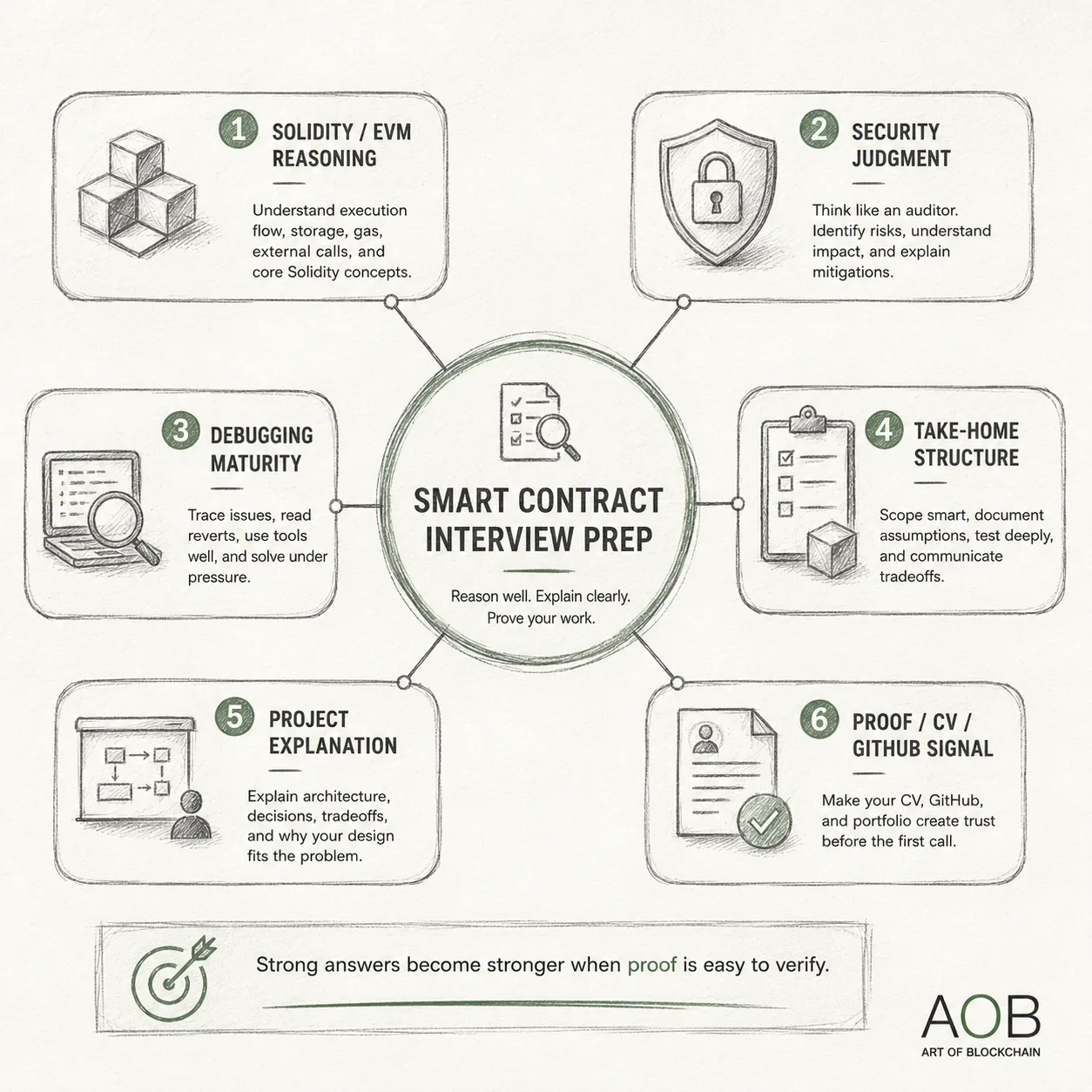
1. If you need interview calibration first
Start here if you are unsure what smart contract interviewers test beyond syntax in Solidity and EVM rounds. This is where you connect interview answers with reasoning, proof, and shortlist confidence.
2. If your Solidity or EVM base feels weak
Use this lane if you keep getting stuck on execution flow, storage, gas, external calls, or Solidity first principles. Do not jump into advanced interview answers before your fundamentals are readable.
3. If security questions expose shallow preparation
Use this lane if your answers sound like memorized vulnerability names instead of real exploit reasoning. Strong smart contract candidates explain what fails, why it fails, how they would detect it, and how they would reduce damage.
4. If debugging rounds hurt your confidence
Use this lane if you panic during reverts, failed tests, trace inspection, fork tests, or unclear Solidity errors. Debugging maturity is one of the fastest trust signals in smart contract interviews.
5. If take-homes or project explanations are your weak point
Use this lane if you can build, but cannot explain your architecture, tradeoffs, testing depth, or risk assumptions clearly. Many smart contract candidates lose trust because their project explanation sounds vague even when the work is real.
Related:
The Smart Contract Portfolio That Shows How You Think | ArtofBlockchain
6. If your proof is not converting into interviews
Use this lane if your CV, GitHub, portfolio, and LinkedIn are not telling one clear story. Interview prep works better when your proof is already recruiter-readable before the first call.
Start here:
Web3 CV Review for Candidates Whose Proof Is Not Converting Into Interviews | ArtofBlockchain
Related:
GitHub for Blockchain Developers: How to Make Your Projects Recruiter-Readable | ArtofBlockchain
What smart contract interviews actually test
Most smart contract interviews are wider than “can this person write Solidity.”
Good interviewers are usually checking whether you can explain a system clearly, reason through risk, recognize where assumptions break, and make your choices reviewable. That is why broad preparation often feels inefficient. You do not need endless question banks. You need better visibility into what strong teams are actually evaluating.
What interviewers usually care about before moving you forward
Can you explain one real problem clearly?
Can you name the tradeoff you made, not just the tool you used?
Can you reason about failure, not just happy-path execution?
Can you show one piece of proof that is easy to verify?
Can you explain risk without sounding vague or memorized?
Can you talk about testing, debugging, or monitoring in a grounded way?
Can you stay clear under time pressure?
If you want the evaluator-side lens, pair this hub with:
Hiring Managers & Recruiters Hub: Hiring Signals & Interview Expectations
Smart Contract Developer Hiring: Practical Signals Teams Should Check Before Extending an Offer
How to Interview Smart Contract Engineers Without Guessing Their Real Ability
The typical smart contract interview loop
Recruiter or founder screen
This round is often filtering for clarity, role match, and whether your background sounds real. The strongest candidates explain one project, one hard decision, and one thing they learned instead of listing tools.
Technical deep-dive round
This is where Solidity, the EVM, storage, gas, execution flow, testing habits, and protocol thinking get stress-tested. Weak candidates drift into textbook answers. Strong candidates define the problem, explain the boundary, and name the tradeoff.
Use these if your technical prep still feels scattered:
How to Prepare for Live Coding Interviews as a Junior Blockchain Engineer
How to Nail DeFi Protocol Questions in Blockchain Job Interviews: Real Talk
How Should I Answer DeFi Interview Questions on Securing Price Oracles?
Live debugging round
This round usually reveals how you behave when the clean path disappears. Interviewers want to see how you isolate failure, test assumptions, and explain what you are checking without panicking.
Take-home assignment
This round often exposes whether you know how to make reasoning visible. Timeboxed scope, assumptions, tests, risks, and tradeoffs matter more than showing off every possible feature.
Security or audit-style round
This is not just about naming vulnerabilities. It is about whether you can think through exploit paths, external dependencies, privilege boundaries, and blast radius.
Team-fit or collaboration round
This is where review maturity, uncertainty handling, ownership, and communication become visible.
Smart contract take-home assignments: what strong candidates do differently
Take-homes create confusion because many candidates treat them like mini-products.
A better approach is to treat a smart contract take-home assignment structure with tests, threat model, assumptions, and tradeoffs as part of the submission, not as extra decoration after the code is done
Good proof does not need to be huge. It needs to be legible.”
The real question is how to make smart contract GitHub proof recruiter-readable before the first interview, so the reviewer can see ownership, testing depth, risk awareness, and one clear project story without guessing.
Green flags
A strong take-home is timeboxed, clearly scoped, and followed by a review conversation.
Red flags
Weak processes often show up as oversized scope, vague IP language, unclear evaluation criteria, or pressure to deliver something that looks suspiciously close to production work.
What usually helps most
Ask what the reviewer will check first. Tests? Docs? Threat model? Gas tradeoffs? Design clarity? That one question often changes how strong your final submission looks.
A practical take-home structure that shows maturity
Problem restated in your own words
Constraints and assumptions
Short risk list or threat model
Tests: must-have vs nice-to-have
Key tradeoffs you made
What you would monitor in production
Helpful support pages:
Security-first questions that show real maturity
A lot of security interview answers stay shallow because candidates answer them like quiz questions.
Good interviewers are usually not asking, “Can you name the bug?” They are asking, “Can you explain what fails, why it fails, how you would detect it, and how you would reduce the damage?”
Start here:
Debugging maturity: one of the fastest trust signals in interviews
Many candidates underestimate how much debugging clarity affects interviewer confidence.
Useful AOB resources:
Proof that improves shortlists
A lot of smart contract interview prep stays abstract because candidates prepare answers without preparing evidence.
Good proof does not need to be huge. It needs to be legible.
Strong interview proof often includes
One repo that solves a real problem
One short write-up that explains tradeoffs and risks
One debugging, incident, or monitoring artifact
One clear explanation of testing depth
One project story that sounds owned, not borrowed
Support resources:
Proof-Heavy Smart Contract Portfolios: What Hiring Managers Actually Trust
Building a Blockchain/Web3 Portfolio Site: Sections, Case Studies, and Metrics
GitHub Account for Blockchain Developers: Why It’s Essential for Showcasing Your Skills
Need direct help before your next interview?
If your interview problem is no longer “I need more theory” but “my proof is not creating trust fast enough,” use AOB’s candidate-side paid services.
This is useful when your CV is not converting, your GitHub link feels weak, your portfolio does not explain ownership, or your smart contract project explanation still sounds vague in interviews.
Start here:
Web3 CV Review for Candidates Whose Proof Is Not Converting Into Interviews | ArtofBlockchain
Read the proof-stack checklist first if you want to understand what may be breaking in the recruiter scan:
Blockchain CV Review: What Recruiters Reject in 10 Seconds (Proof-Stack Checklist) | ArtofBlockchain
How to explain your project work without sounding vague
This is why learning how to explain smart contract architecture decisions in interviews matters as much as the code itself. The interviewer is often checking whether you can connect design choices, constraints, risks, and testing depth without sounding theoretical.
Better project explanations usually include:
What the system was trying to do
What constraint shaped the design
What tradeoff do you accept?
What could fail
What you tested
What would you improve if the system moved closer to production
Best support pages:
How to Explain Your Smart Contract Architecture Decisions Without Sounding Vague
Building a Blockchain/Web3 Portfolio Site: Sections, Case Studies, and Metrics
Production readiness: the rare signal that stands out fast
Even junior candidates can sound stronger by framing answers around:
What I checked first
What I ruled out
What I would log or monitor
What I would treat as the biggest hidden risk
How I would reduce blast radius before a bigger fix
Useful resources:
A simple interview prep checklist for candidates
Before your next interview, be able to answer:
What is one real smart contract or protocol problem I can explain clearly?
What tradeoff did I make, and why?
What is one risk I noticed before it became a bug?
What did I test beyond the happy path?
What would I monitor in production?
What proof link can I share without apologizing for it?
What part of my explanation still sounds vague?
Quick note for hiring teams
This page is candidate-first, but it also works as a fast calibration tool for hiring managers and recruiters.
A simple prompt often reveals more than a polished resume summary:
Ask for one tradeoff story
Ask for one proof link
Ask what would break in production and how they would detect it
For the evaluator lens, pair this hub with:
Hiring smart contract talent and not getting strong-fit applicants?
A lot of smart contract hiring problems begin before the interview.
If the JD does not clearly explain ownership, must-have skills, security expectations, proof signals, and screening logic, the interview loop becomes noisy. Teams then waste time with candidates who sound fluent but are not role-aligned.
For hiring teams, AOB can help with:
JD Review for clearer role framing:
Web3 JD Review for Teams Attracting Weak-Fit Blockchain Applicants | ArtofBlockchain
Posting a Web3 role to a focused blockchain career audience:
Post a Web3 Job | Blockchain Job Board for Founders, Recruiters & Hiring Teams | ArtofBlockchain
Curated blockchain job visibility:
Job Board | ArtofBlockchain
Related AOB hubs and pages
If you need stronger foundations, start with the
Smart Contract Fundamentals Hub.
If testing depth is your weak layer, go to the
Smart Contract QA Testing Hub.
If security reasoning is where you keep losing trust, use the
Smart Contract Security Audits Hub.
If debugging rounds keep hurting your confidence, use the
Solidity Debugging & Tooling Hub.
If you want broader role-direction and career mapping, use the
Smart Contract Developer Career Hub.
If your biggest issue is interview calibration, use
Web3 Interview Signals Calibration.
How AOB can help you?
If you are a candidate, AOB can help you tighten your CV, proof links, and project explanation before interviews:
If you are a hiring team, AOB can help with JD Review, Job Posting, and shortlist support:
Author and AOB context
This hub is written by Shubhada Pande, founder of ArtOfBlockchain.club, based on practical questions seen inside the AOB community from Web3 candidates, contractors, recruiters, and hiring teams preparing for smart contract interviews, project explanation rounds, take-home assignments, and proof-based hiring screens.
Connect with Shubhada Pande on LinkedIn:
https://www.linkedin.com/in/shubhada-pande-art-of-blockchain/
Closing Thoughts
Strong interview performance is not about perfect answers.
It is about reasoning clearly, explaining tradeoffs honestly, and showing enough proof that the other side can trust how you think.
Use this hub to identify which round keeps breaking your conversion — screens, take-homes, security depth, debugging, or project explanation — and then strengthen that layer with clearer proof.