Role-Specific Hiring Playbooks

Shubhada Pande

Shubhada Pande

@ShubhadaJP
Published: Dec 20, 2025
Updated: May 5, 2026
Views: 511

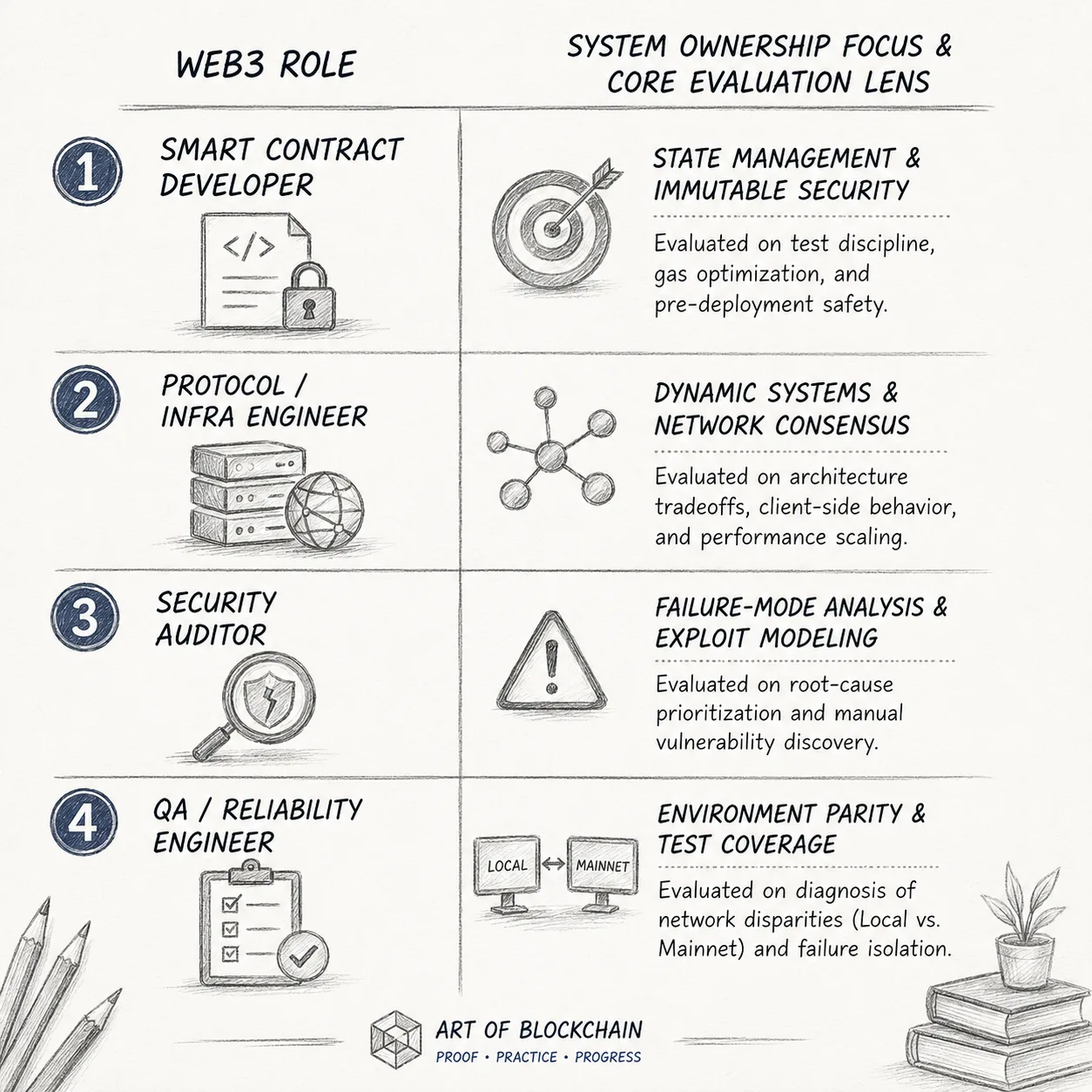
Different Web3 roles need different hiring signals.

A smart contract engineer, protocol engineer, blockchain security reviewer, QA specialist, and Web3 growth operator should not be screened with the same checklist. The risk is simple: teams either over-test the wrong thing, trust polished resumes too quickly, or reject strong candidates because their proof is not being read in the right role context.

This hub organizes role-specific hiring playbooks for founders, recruiters, hiring managers, and Web3 talent teams who want a more proof-based way to evaluate blockchain candidates.

Use it as a router. Start with the role closest to your hiring problem, then go deeper into the linked AOB page.

Different Web3 roles need different proof signals. One generic hiring checklist creates noisy shortlists.

Quick map of this hub

Smart contract and protocol roles

Use this lane when the role involves Solidity, Rust, EVM reasoning, protocol design, contract architecture, or production engineering. The hiring signal is not only “can this person code?” It is whether their work shows reasoning, test discipline, security awareness, and role-aligned proof.

Start here:
Smart Contract Developer Career Hub: Skills, Proof, Interview Prep and Jobs | ArtofBlockchain

Related:
Smart Contract Interview Prep: Solidity, Security, Debugging, Take-Home Tests & Hiring Signals | ArtofBlockchain

Security and audit roles

Security hiring needs a different lens. A good auditor or security-minded engineer should show failure-mode thinking, risk prioritization, exploit reasoning, and the ability to explain why something is unsafe before it becomes expensive.

Start here:
Smart Contract Security Audits Hub: Audit Checklist, Common Solidity Risks, and Auditor Roadmap | ArtofBlockchain

Related:
How Do I Explain ‘Common Smart Contract Security Mistakes’ in Auditor Interviews Without Sounding Generic? | ArtofBlockchain

QA, SDET and reliability roles

Blockchain QA is not only manual testing or writing basic test cases. In Web3, QA signals often include mainnet awareness, flaky test diagnosis, gas validation, coverage discipline, environment mismatch thinking, and the ability to catch failure before production pressure exposes it.

Start here:
Smart Contract QA Testing Hub: Flaky Tests, Coverage Drift, Gas Validation, and Interview Signals | ArtofBlockchain

Related:
Why Do Tests Pass on Hardhat/Anvil Forks but Break on Mainnet? What Hidden Differences Are We Missing? | ArtofBlockchain

Interview calibration by role

A short technical screen should not test every possible skill. It should quickly reveal whether the candidate can reason, explain tradeoffs, recognize risk, and connect their claimed experience to visible proof.

Start here:
Web3 Interview Signals and Calibration Hub: How Hiring Teams Read Interviews, Misread Signals, and Verify Real Readiness | ArtofBlockchain

Related:
Nethermind Interview (15-Minute Screen): What They Usually Test + How to Answer Clearly Without Sounding Rehearsed | ArtofBlockchain

Hiring risk, compensation and role clarity

Some Web3 hiring problems start before screening. If compensation, token upside, remote expectations, ownership, or interview structure are vague, strong candidates may drop off before the team gets a fair chance to evaluate them.

Start here:
Web3 Hiring Risks & Compensation Hub for Hiring Teams | ArtofBlockchain

Related:
Is It Safe to Accept Tokens Before Tokenomics Is Published? Developers Share What Really Happens | ArtofBlockchain

JD review and hiring support

If your role is live but attracting weak-fit applicants, the issue may not be sourcing alone. The JD may be unclear on scope, must-have skills, proof expectations, interview process, or compensation framing.

Start here:
Blockchain Job Description Review Service for Web3 Hiring Teams | ArtofBlockchain

For hiring visibility:
Post a Web3 Job | Blockchain Job Board for Founders, Recruiters & Hiring Teams | ArtofBlockchain

Who this hub is for

This hub is for Web3 founders, recruiters, hiring managers, technical leads, and talent teams who are trying to evaluate blockchain candidates with more precision.

It is especially useful if your team is hiring for roles where generic technical screening is not enough, such as:

  • smart contract engineers

  • protocol engineers

  • blockchain infrastructure engineers

  • smart contract auditors

  • blockchain security researchers

  • QA, SDET, and reliability engineers

  • technical leads helping recruiters define screening signals

  • early-stage founders writing their first serious Web3 technical JD

The main problem this hub solves is not “how to get more applicants.” It helps hiring teams understand what kind of proof should matter for each role before they shortlist, interview, or reject candidates.

What this hub covers

This hub organizes role-specific hiring signals across Web3 technical roles.

It helps hiring teams separate:

  • resume claims from visible proof

  • broad blockchain interest from role-aligned evidence

  • confident interview answers from actual reasoning

  • generic GitHub activity from recruiter-readable artifacts

  • smart contract knowledge from production judgment

  • security vocabulary from real failure-mode thinking

  • QA experience from blockchain reliability awareness

  • vague JD requirements from actual role ownership

The goal is to make evaluation cleaner. A smart contract developer, protocol engineer, auditor, and blockchain QA specialist may all work inside Web3, but they should not be judged through the same proof lens.

What this hub is not

This is not a generic “how to hire blockchain developers” article.

It is not a full recruitment playbook, interview question bank, or technical assessment library.

It is not trying to explain every Web3 role from scratch.

It is also not a replacement for technical interviews, reference checks, trial tasks, or internal engineering judgment.

This page exists to route hiring teams toward the right evaluation lane. The deeper explanation should happen inside the linked role-specific pages, not here.

For the broader hiring framework, use the parent Web3 Hiring Signals hub. For role-specific screening, use this page as the map.

Start here based on your hiring situation

Use this section if you already know where the hiring problem is showing up. This is the fast route. The deeper role-specific playbooks come after this.

If your JD is attracting the wrong candidates

Start with JD clarity before adding more sourcing channels.

A weak Web3 JD often mixes core ownership, adjacent responsibilities, token expectations, remote setup, seniority level, and proof requirements into one broad role. That makes it harder for strong candidates to self-select and harder for recruiters to screen consistently.

Start here:
Blockchain Job Description Review Service for Web3 Hiring Teams | ArtofBlockchain

If you are hiring a smart contract developer

Start with role-aligned proof, not only Solidity keywords.

For smart contract roles, useful signals include test discipline, debugging history, contract architecture, security awareness, deployment judgment, and the ability to explain tradeoffs clearly.

Start here:
Smart Contract Developer Career Hub: Skills, Proof, Interview Prep and Jobs | ArtofBlockchain

If you are hiring for protocol or infrastructure work

Look for evidence of systems thinking.

Protocol and infra candidates may show proof through Rust work, client-side reasoning, EVM internals, performance tradeoffs, networking assumptions, architecture notes, or readable PRs. The signal is not only language familiarity. It is whether the person can reason under complexity.

Start here:
I Want to Become a Blockchain Engineer, Not Just a Smart Contract Developer — Should I Start with Solidity or Rust? | ArtofBlockchain

Related:
Advanced EVM Concepts & Internals | ArtofBlockchain

If you are hiring for security or audit work

Do not screen only for audit-tool familiarity.

Security candidates should show failure-mode thinking, exploit reasoning, risk prioritization, and the ability to explain what could go wrong before it becomes expensive. A polished security vocabulary is not enough if the proof trail is shallow.

Start here:
Smart Contract Security Audits Hub: Audit Checklist, Common Solidity Risks, and Auditor Roadmap | ArtofBlockchain

If you are hiring blockchain QA, SDET, or reliability talent

Look for blockchain-specific reliability judgment.

The candidate should understand why tests can pass locally and still fail under mainnet-like pressure, integration complexity, gas-sensitive paths, contract upgrades, indexing delays, RPC behavior, and monitoring gaps.

Start here:
Smart Contract QA Testing Hub: Flaky Tests, Coverage Drift, Gas Validation, and Interview Signals | ArtofBlockchain

If your interviews feel noisy or inconsistent

Fix calibration before adding more rounds.

A good technical screen should reveal reasoning, tradeoff awareness, proof alignment, and communication under constraint. It should not become a generic quiz that rewards confidence but misses whether the person can actually own the role.

Start here:
Web3 Interview Signals and Calibration Hub: How Hiring Teams Read Interviews, Misread Signals, and Verify Real Readiness | ArtofBlockchain

If the role is ready and you need focused visibility

Use AOB’s job posting route once the role is clear.

This works better when the JD already explains ownership, role expectations, remote setup, compensation structure where possible, and what kind of proof the team values.

Start here:
Post a Web3 Job | Blockchain Job Board for Founders, Recruiters & Hiring Teams | ArtofBlockchain

Role-specific hiring playbooks

Each Web3 role creates trust differently.

A smart contract developer may need to show test discipline and contract reasoning. A protocol engineer may need to show systems thinking. A security reviewer may need to show exploit reasoning. A QA or reliability engineer may need to show failure diagnosis across local, testnet, and mainnet-like conditions.

Use the sections below to choose the right proof lens before screening candidates.

Smart contract developer hiring signals

Smart contract developers should not be evaluated only by Solidity keywords, token standards, or the number of contracts they have written. The stronger signal is whether their work shows judgment around contract behavior, edge cases, testing, debugging, upgrades, gas-sensitive decisions, and security assumptions.

A recruiter-readable proof trail may include a GitHub repo, audit-aware fixes, test cases, deployment notes, contract walkthroughs, or a clear explanation of why certain design choices were made.

Proof signals to check

  • Can the candidate explain contract behavior without hiding behind jargon?

  • Do their projects show tests, edge cases, or debugging notes?

  • Have they worked with real contract constraints such as gas, access control, upgrades, or external calls?

  • Can they explain what could go wrong in the contract?

  • Is their proof readable enough for a hiring team to verify?

Useful AOB routes

Smart contract career hub:
Smart Contract Developer Career Hub: Skills, Proof, Interview Prep and Jobs | ArtofBlockchain

Smart contract interview prep hub:
Smart Contract Interview Prep: Solidity, Security, Debugging, Take-Home Tests & Hiring Signals | ArtofBlockchain

Core smart contract engineering skills:
Core Smart Contract Engineering Skills | ArtofBlockchain

Protocol and infrastructure hiring signals

Protocol and infrastructure roles need a deeper evaluation lens than “knows Rust” or “has blockchain experience.” These roles often require systems thinking, performance awareness, networking assumptions, consensus tradeoffs, EVM internals, client behavior, and production engineering judgment.

The proof trail should show how the candidate thinks when the system is complex, not just whether they can complete a coding task.

Proof signals to check

  • Can the candidate explain tradeoffs in protocol or infrastructure decisions?

  • Do they understand where performance, reliability, and security interact?

  • Can they reason through EVM internals, Rust systems work, or chain-specific constraints?

  • Do their projects or PRs show design thinking, not only implementation?

  • Can they explain what they would monitor, test, or simplify in production?

Useful AOB routes

Rust vs Solidity job opportunities:
I Want to Become a Blockchain Engineer, Not Just a Smart Contract Developer — Should I Start with Solidity or Rust? | ArtofBlockchain

Advanced EVM concepts and internals:
Advanced EVM Concepts & Internals | ArtofBlockchain

Smart contract and protocol direction:
Smart Contract Developer Career Hub: Skills, Proof, Interview Prep and Jobs | ArtofBlockchain

Security and audit hiring signals

Security and audit roles need evidence of risk thinking. Tool familiarity is useful, but it is not enough. A strong security candidate can explain attack paths, prioritize severity, question assumptions, and describe why a design may fail before money is at risk.

The hiring signal is not “has seen many vulnerabilities.” The stronger signal is whether the candidate can reason through failure modes and communicate risk clearly.

Proof signals to check

  • Can the candidate explain the root cause of a vulnerability?

  • Can they separate low-risk noise from high-risk issues?

  • Do they show exploit reasoning, not only checklist knowledge?

  • Can they explain the business or protocol impact of a bug?

  • Do their notes, reports, or repos show careful thinking under uncertainty?

Useful AOB routes

Smart contract security audits hub:
Smart Contract Security Audits Hub: Audit Checklist, Common Solidity Risks, and Auditor Roadmap | ArtofBlockchain

Common smart contract security mistakes in auditor interviews:
How Do I Explain ‘Common Smart Contract Security Mistakes’ in Auditor Interviews Without Sounding Generic? | ArtofBlockchain

Smart contract audit tools and methods:
How do real smart contract audits work in practice? What do auditors check before Slither, Mythril, Foundry fuzzing, or Echidna? | ArtofBlockchain

QA, SDET and reliability hiring signals

Blockchain QA is not only about writing test cases. A strong QA, SDET, or reliability candidate should understand how smart contracts, wallets, RPCs, indexing, testnets, gas behavior, contract upgrades, and integrations can create failures that do not appear in ordinary local testing.

This role needs proof of diagnosis. The best candidates can explain what broke, why it broke, how they isolated the problem, and what they would change in the release process.

Proof signals to check

  • Can the candidate explain why tests pass locally but fail in production-like environments?

  • Do they understand blockchain-specific reliability risks?

  • Can they reason through flaky tests, RPC issues, indexing delays, and integration gaps?

  • Do they show test coverage thinking, not only test execution?

  • Can they communicate risk clearly before release?

Useful AOB routes

Smart contract QA testing hub:
Smart Contract QA Testing Hub: Flaky Tests, Coverage Drift, Gas Validation, and Interview Signals | ArtofBlockchain

Local tests passing but mainnet-like failures:
Why Do Tests Pass on Hardhat/Anvil Forks but Break on Mainnet? What Hidden Differences Are We Missing? | ArtofBlockchain

Moving from software testing to blockchain QA:
Blockchain QA for Software Testers: Do You Need Solidity, Better Test Logic, or Proof Artifacts? | ArtofBlockchain

Interview signal and calibration

Role-specific hiring breaks down when the interview loop is generic. A 15-minute screen, take-home task, technical interview, or founder call should test the signal that matters for the role — not every possible blockchain topic.

For example, a smart contract candidate may need to explain contract risk. A protocol candidate may need to reason through system tradeoffs. A QA candidate may need to diagnose failure paths. A security candidate may need to prioritize exploit risk.

The interview should connect claims to proof.

Proof signals to check

  • Does the candidate connect their answers to actual work they have done?

  • Can they explain tradeoffs without overclaiming?

  • Do they know where their proof is weak or incomplete?

  • Can they communicate risk, ownership, and decision logic clearly?

  • Does the interview reveal role fit, or only confidence?

Useful AOB routes

Web3 interview signals and calibration:
Web3 Interview Signals and Calibration Hub: How Hiring Teams Read Interviews, Misread Signals, and Verify Real Readiness | ArtofBlockchain

Nethermind 15-minute technical screen:
Nethermind Interview (15-Minute Screen): What They Usually Test + How to Answer Clearly Without Sounding Rehearsed | ArtofBlockchain

Senior blockchain interview calibration:
Senior blockchain dev here — how do mature Web3 teams calibrate interviews differently than early-stage startups (and what should I read from it)? | ArtofBlockc

How to use these playbooks before screening candidates

Use these playbooks before the first serious screen, not after the hiring process has already become noisy.

The goal is to make the role easier to evaluate before resumes, GitHub links, portfolios, and interview answers start blending together. A hiring team should know what kind of proof matters for the role before deciding who looks strong.

Define the role ownership first

Before screening candidates, separate the core role from adjacent responsibilities.

A smart contract developer role may include contract architecture, testing, deployment, debugging, and security-aware development. But if the team also expects protocol design, DevOps, frontend integration, auditor-level review, and tokenomics thinking, the role may already be too broad.

Ask:

  • What will this person own in the first 90 days?

  • Which skills are truly required on day one?

  • Which skills can be learned after joining?

  • What proof would make us comfortable shortlisting this person?

  • What proof is nice to have but not essential?

If the team cannot answer this clearly, the issue may be JD clarity, not candidate quality.

Decide what proof matters for the role

Proof should match the role.

For smart contract roles, useful proof may include tests, debugging notes, deployment decisions, security-aware fixes, and clear contract explanations.

For protocol or infrastructure roles, useful proof may include systems tradeoffs, Rust or EVM reasoning, architecture notes, PR explanations, and production judgment.

For security and audit roles, useful proof may include exploit reasoning, risk ranking, vulnerability writeups, audit-style notes, and failure-mode analysis.

For QA, SDET, and reliability roles, useful proof may include test strategy, failure diagnosis, flaky test investigation, monitoring awareness, and mainnet-like environment reasoning.

The mistake is treating all blockchain proof as equal. A GitHub repo, certification, article, test case, audit note, or interview answer only matters if it helps the team verify role fit.

Separate visible proof from interview confidence

Some candidates explain well but have thin proof.

Some candidates have useful proof but do not package it clearly.

Some candidates have many projects, but the projects do not match the role being hired for.

This is why the screening process should not rely only on profile polish, follower count, certifications, or confident answers. The better question is:

Can this person show evidence that reduces uncertainty for this specific role?

That evidence may be technical, operational, security-focused, reliability-focused, or communication-focused depending on the role.

Use interviews to verify, not discover everything

The interview should verify the most important signals, not search blindly for them.

For example:

  • Ask a smart contract candidate to explain a design tradeoff in one project.

  • Ask a protocol candidate to walk through a systems decision or performance assumption.

  • Ask a security candidate to explain why one vulnerability matters more than another.

  • Ask a QA candidate to describe how they would investigate a failure that appears only in a testnet or mainnet-like setup.

  • Ask a senior candidate to explain what they would simplify, monitor, or refuse to ship.

This keeps the interview tied to role evidence instead of becoming a generic blockchain quiz.

Watch for weak proof patterns

Weak proof does not always mean the candidate is weak. Sometimes it means the proof is not readable.

But hiring teams should be careful when they see patterns like:

  • projects with no explanation of ownership

  • GitHub activity without role-relevant artifacts

  • security claims without risk reasoning

  • QA claims without failure diagnosis

  • protocol claims without tradeoff explanation

  • interview answers that sound polished but avoid specifics

  • resumes that list Web3 keywords but do not show evidence

The point is not to reject faster. The point is to shortlist with more confidence.

Use the parent hiring signal framework when the role is unclear

If you are unsure which signal matters most, start from the broader AOB hiring framework first.

Parent hub:
Web3 Hiring Signals | ArtofBlockchain

Proof-based hiring framework:
Proof-Based Hiring in Web3: Hiring Signals, Recruiter Screening, JD Proof Lines, and Shortlist Quality | ArtofBlockchain

Recruiter-side screening discussion:
Recruiters: how do you verify real blockchain experience before the interview? | ArtofBlockchain

Hiring support from AOB

Role-specific hiring signals are useful only when the hiring process is clear enough to apply them.

If the JD is vague, the interview loop is generic, or the role is trying to cover too many responsibilities, even a strong candidate pipeline can become noisy. Hiring teams may attract applicants, but still struggle to separate real proof from polished claims.

AOB supports Web3 hiring teams in three practical ways: JD clarity, focused job visibility, and role-pattern discovery.

JD Review for Web3 hiring teams

Use this if your role is live or almost ready, but the job description feels too broad, unclear, or difficult to screen from.

AOB JD Review helps check whether the role explains:

  • actual ownership

  • must-have vs nice-to-have skills

  • seniority expectations

  • technical proof expectations

  • remote or hybrid work clarity

  • token, stablecoin, or compensation-related ambiguity where relevant

  • interview process signals

  • candidate trust gaps

This is useful when a team is getting applicants, but the shortlist still feels weak or inconsistent.

Start here:
Blockchain Job Description Review Service for Web3 Hiring Teams | ArtofBlockchain

Post a Web3 job on AOB

Use this when the role is already clear and you want focused visibility inside a blockchain careers audience.

AOB job posting is a better fit when the hiring team can already explain the role, responsibilities, location setup, remote expectations, compensation structure where possible, and the proof signals that matter for screening.

Post a Web3 job here:
Post a Web3 Job | Blockchain Job Board for Founders, Recruiters & Hiring Teams | ArtofBlockchain

Browse role patterns on the AOB job board

Use the job board if you want to compare how active blockchain roles are being described across engineering, security, QA, compliance, growth, and other Web3 functions.

This can help hiring teams understand role language, market expectations, and how candidates may compare your opening with other Web3 opportunities.

Browse blockchain jobs:
Job Board | ArtofBlockchain

When to use which route

If your role is unclear, start with JD Review.

If your role is clear and ready to publish, use job posting.

If you are still studying the market, browse current Web3 job patterns first.

The stronger the role definition, the easier it becomes to evaluate proof. The clearer the proof expectation, the easier it becomes to build a shortlist that hiring teams can actually trust.

Founder note

Most Web3 hiring mistakes are not caused by a lack of applicants. They happen because the team has not defined what proof should look like for the role.

A smart contract engineer, protocol engineer, security reviewer, QA specialist, and reliability engineer each create trust differently. If the same screening checklist is used for every role, the team may reward polished answers and miss the deeper signal.

This hub is meant to help hiring teams read candidates through the right role-specific lens before the shortlist becomes noisy.

For the broader AOB framework, start here:
Web3 Hiring Signals | ArtofBlockchain

For the proof-based hiring thesis, read:
Proof-Based Hiring in Web3: Hiring Signals, Recruiter Screening, JD Proof Lines, and Shortlist Quality | ArtofBlockchain


Poll: Which Web3 role is hardest for your team to evaluate from proof alone?

Smart contract developers
Protocol / infrastructure engineers
Security / audit candidates
QA, SDET, or reliability engineers

Choose one option.

Join to vote
Votes hidden 3w left

Welcome, guest

Join ArtofBlockchain to reply, ask questions, and participate in conversations.

ArtofBlockchain powered by Jatra Community Platform