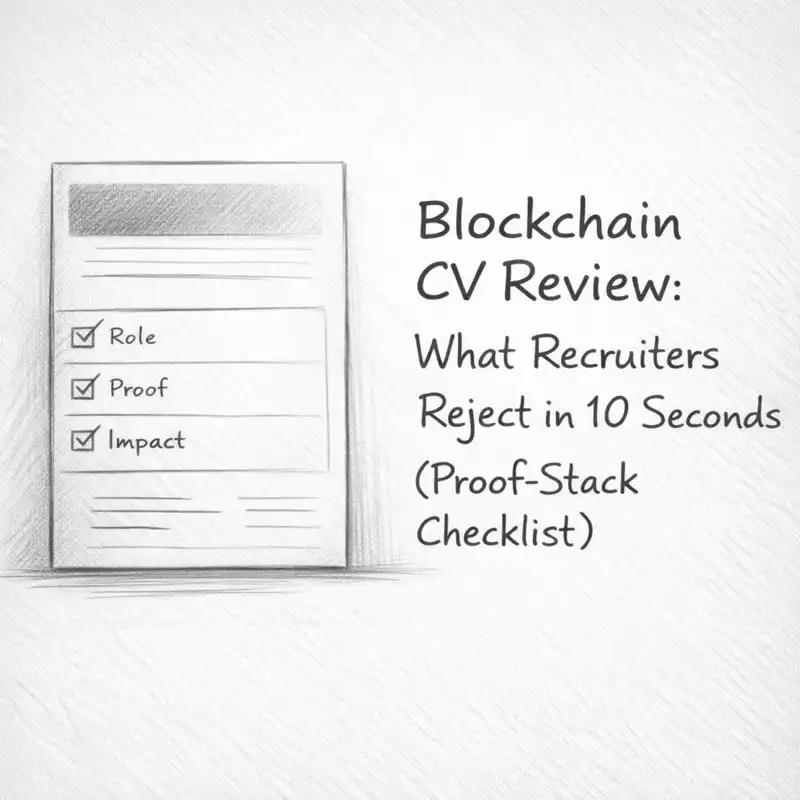
Blockchain CV Review: What Recruiters Reject in 10 Seconds (Proof-Stack Checklist)

If you’re applying for Web3 roles and getting silence, it’s easy to assume your technical stack or resume formatting is the problem.
Often, it’s not. It’s your CV’s first 10 seconds.
Web3 recruiters, engineering leads, and protocol founders do not read resumes top-to-bottom. They run a quick, ruthless risk scan.
They aren’t just looking for skills; they are filtering out uncertainty, AI-generated resume spam, and unverified claims. In an industry built on trustlessness, an unverified CV is an instant red risk signal.
At ArtOfBlockchain.club, our community discussions focus on Proof-Based Hiring—the principle that verifiable artifacts, reproducible tests, and concrete on-chain signals beat traditional pedigree and buzzword checklists every single time.
Inside the 10-Second Recruiter Risk Scan
When a hiring manager opens your CV, their cognitive filter executes three distinct checks before deciding whether to read further or close the tab:
Seconds 1–3: The Target Role & Scope Lock
What they look for: Does your headline immediately tell them what specific problem you solve?
The instant fail: Vague multi-hyphenate titles like "Web3 Enthusiast | Smart Contracts | Growth | AI | Full-Stack" force the reader to guess your specialty, creating cognitive load and immediate risk.
Seconds 4–7: The Proof-Stack vs. The Tool Shopping Cart
What they look for: Do your bullets tie your tools to a concrete artifact, test suite, or verifiable metric?
The instant fail: A long list of tools (Solidity, Hardhat, DeFi, TypeScript, Discord, Tokenomics) paired with generic responsibilities ("Developed smart contracts and managed community engagement"). This signals a tutorial clone or synthetic profile.
Seconds 8–10: The One-Click Verification Test
What they look for: Can they click a link (a curated GitHub repo, a Foundry test suite, a Dune dashboard, an audit writeup, or an operational case study) and verify your claim in a single click?
The instant fail: Dead links, uncurated GitHub profiles full of forked tutorial repos, or claims of "leading/owning" initiatives with zero evidence of what actually changed.
Real-World Teardown #1 (Technical Roles): The "Full-Stack Blockchain Developer" Trap
In our community proof-check breakdown—analyzed deeply in our forum discussion on the Full-Stack Blockchain Developer Profile—we uncovered a recurring trap for technical candidates.
Many developers try to stand out by listing every framework they have ever touched. On paper, it looks comprehensive. But to a protocol engineering lead reviewing the CV, a sprawling list of unverified tech stacks signals surface-level familiarity rather than production depth.
When engineering teams evaluate technical CVs, they look for evidence of how you handle failure modes:
Did you write invariant or fuzz tests using Foundry or Echidna to check edge cases?
Did you optimize gas consumption in a way that can be verified via a public commit or deployment contract address?
Can a reviewer inspect your pull requests to see how you handled rounding errors, access control permissions, or oracle dependencies?
If your technical CV lists tools without showing the testing, debugging, and verification path behind them, it fails the 10-second proof check.
Real-World Teardown #2 (Non-Technical & Web2 Transition Roles): Lessons from Our September Live Session
During our live community event—documented in our Beyond the CV Announcement Hub and reflected in our follow-up breakdown shared on LinkedIn—we tackled the unique challenges facing non-technical professionals (Product Managers, Growth Leads, BD, Community Managers, and Compliance/Operations specialists) transitioning into Web3.
In the AI era, any non-technical candidate can use language models to generate polished resume bullets. Because of this, recruiters instantly reject duty-based descriptions like "Grew community to 50k members" or "Managed marketing campaigns."
Proof-based hiring for non-technical roles demands operational and on-chain visibility:
For Growth & BD: Showing how you drove sustainable wallet retention cohorts, contributed to governance participation on Snapshot/Tally, or secured integrations that impacted protocol TVL tracked on DeFiLlama.
For Compliance & Risk: Demonstrating how you handled transaction monitoring logic, reduced false-positive wallet screening alerts using tools like Chainalysis KYT, or structured cross-border payment flows adhering to regulatory frameworks.
For Web2-to-Web3 Transitioners: Translating your past fintech, backend, infrastructure, or product background into verifiable transferrable evidence—such as high-concurrency API performance, idempotent settlement workflows, or rigorous incident post-mortems—without faking a blockchain job title. (For a deeper dive into translating your background, explore our community guide on What is Web3 Experience).
The Role-by-Role Proof-Stack Diagnostic Guide
Track 1: Smart Contract & Protocol Engineering
The Instant-Reject Line (The "Fluff" Signal): "Built an NFT marketplace & DEX using Solidity and Web3.js" (No links).
The Hidden Risk Signal: Tutorial fork or AI-generated boilerplate; zero evidence of production safety.
What Proof-Based Hiring Demands Instead: "Optimized vault deposit routing in Foundry, cutting execution gas by 18% across 14k+ txns." (Linked to verified GitHub PR & Foundry gas snapshot).
Track 2: Security & Smart Contract Audits
The Instant-Reject Line (The "Fluff" Signal): "Passionate about smart contract security, fuzzing, and EVM internals."
The Hidden Risk Signal: Self-proclaimed title with no track record of finding actual vulnerabilities.
What Proof-Based Hiring Demands Instead: "Identified 2 High and 3 Medium reentrancy/oracle bugs in competitive audit contexts." (Linked to Code4rena/Sherlock leaderboard or public write-up).
Track 3: Web3 Growth & Community
The Instant-Reject Line (The "Fluff" Signal): "Grew Discord to 40,000 members and hosted weekly hype sessions."
The Hidden Risk Signal: Signals bot inflation, vanity metrics, and 2021-era speculative community building.
What Proof-Based Hiring Demands Instead: "Drove 28% 30-day wallet retention post-TGE; converted 1,200 active governance delegates via structured onboarding." (Linked to Dune/Snapshot).
Track 4: Business Development & L1/L2 Partnerships
The Instant-Reject Line (The "Fluff" Signal): "Closed strategic partnerships with 15+ Web3 ecosystems."
The Hidden Risk Signal: Unverifiable claim with no context on integration success or liquidity impact.
What Proof-Based Hiring Demands Instead: "Originated 4 cross-chain liquidity integrations adding $6.4M in sticky TVL within 60 days." (Linked to public protocol data and co-marketing announcements).
Track 5: Crypto Compliance & Operations
The Instant-Reject Line (The "Fluff" Signal): "Experienced in AML/KYC operations, risk reporting, and crypto transactions."
The Hidden Risk Signal: Generic corporate boilerplate; unclear grasp of on-chain forensics or compliance tooling.
What Proof-Based Hiring Demands Instead: "Reduced false-positive wallet screening alerts by 35% using Chainalysis KYT while enforcing FATF Travel Rule workflows." (Linked to workflow architecture).
Why DIY Editing Fails: The 5 Blind Spots on Your CV
When candidates attempt to fix their own resumes using generic templates, they consistently run into five structural blind spots:
Mistaking Tutorial Output for Production Proof: Listing a standard bootcamp project without highlighting the unique edge cases, state constraints, or architectural decisions you solved.
The "Interview Defense" Trap: Using aggressive buzzwords or claiming ownership of complex protocol components that you cannot defend when a senior engineer or founder drills down in minute five of an interview (supported by our insights in the Smart Contract Interview Prep Hub).
Broken Proof-Link Friction: Forcing a recruiter to hunt through a disorganized GitHub profile or a massive PDF portfolio to find your actual work.
Role-Fit Dilution: Trying to appeal to every possible job description rather than locking in a hyper-specific target role and engineering your top half around it.
Leaving Value on the Table (Web2 Transitioners): Burying valuable backend, security, product, or compliance metrics under weak framing instead of converting them into rigorous Web3 operational proof.
Pre-Application Sanity Check: The 6-Point Proof-Stack Audit
Before submitting your next application, run your CV through this quick sanity filter:
Does my top line immediately and unambiguously commit to a single target role and stack?
Do I feature 2–3 projects or career artifacts backed by a clean, one-click verification path?
Is every bullet structured around concrete execution, constraints, or decisions rather than vague responsibilities?
Is my GitHub or portfolio curated so that pinned artifacts match my resume claims?
Have I removed unverified claims that would collapse under rigorous technical or operational scrutiny?
Is my top half clean, skimmable, and free of unnecessary filler?
If you want a companion technical reference while refining your engineering positioning, review our Blockchain Developer Resume Masterclass. For security-specific resume phrasing and risk management, consult the Smart Contract Security Audits Hub.
How to Get Professional Support
Templates can give you a starting point, but diagnosing your own blind spots is inherently difficult. ArtOfBlockchain.club offers commercial services designed for professionals who need an objective, recruiter-grade evaluation:
1. For Candidates: Paid Web3 CV Signal Audit & Rewrite
If your experience is genuine but your applications are still hitting a wall, our paid review diagnoses your exact shortlist blockers:
The 10-Second Scan Diagnosis: A precise breakdown of what triggers instant doubt or risk signals on your current CV.
Proof-Stack Restructuring: Reorganizing the top half of page one for maximum role-fit clarity.
Defensible Bullet Rewrites: Crafting 8–12 precise, hype-free bullets in your authentic voice.
Proof-Link Mapping: Connecting your projects and experience to the exact verification paths recruiters demand.
Interview Defense Preparation: A concise briefing sheet to help you confidently defend every line on your resume.
👉 Ready to turn your proof of work into interview calls?
Book your professional Web3 CV Review & Rewrite on ArtOfBlockchain.club.
2. For Hiring Teams: JD Risk Score & Curated Listings
If you are a protocol or enterprise hiring team struggling with high volumes of low-signal applicant spam, we provide Job Description (JD) risk scoring, clarity audits, and targeted talent distribution across our community channels.
Community Discussion & Peer Insights
Natalie Reed (@WillowSyncDev):
One thing that stands out from reviewing technical and transition profiles is how much candidates underestimate their earlier work. Whether someone comes from backend engineering, QA testing, cybersecurity, compliance, or product, they often have strong foundational proof through APIs, payment flows, error logs, or testing discipline. The missing link isn't lack of ability—it's translating those workflows into recruiter-readable Web3 evidence without relying on empty buzzwords. Tools create keywords, but verified artifacts create trust.
Merry Thomas (@Merrythetechie):
The 10-second scan reality is brutal because hiring teams are filtering for risk, not just capability. When a resume scatters GitHub links across different projects with no clear explanation of what was built, tested, or deployed, it forces the reviewer to do extra work—and in high-volume markets, reviewers just close the tab.
Whether you're positioning yourself as a Solidity developer, security auditor, QA engineer, or growth lead, your proof path needs to be visible immediately in the top half of page one.