
Blockchain Hiring Signals for Founders: Why Good Web3 Roles Still Attract Weak-Fit Applicants

Many founders think they have a sourcing problem.
Often, they have a signal problem first.
The role is live.
The team is hiring.
The urgency is real.
But the right candidates still hesitate because the job post feels vague, inflated, unfinished, or harder to trust than the team realizes.
That is why some blockchain roles get views, some get volume, and very few get the right kind of applications.
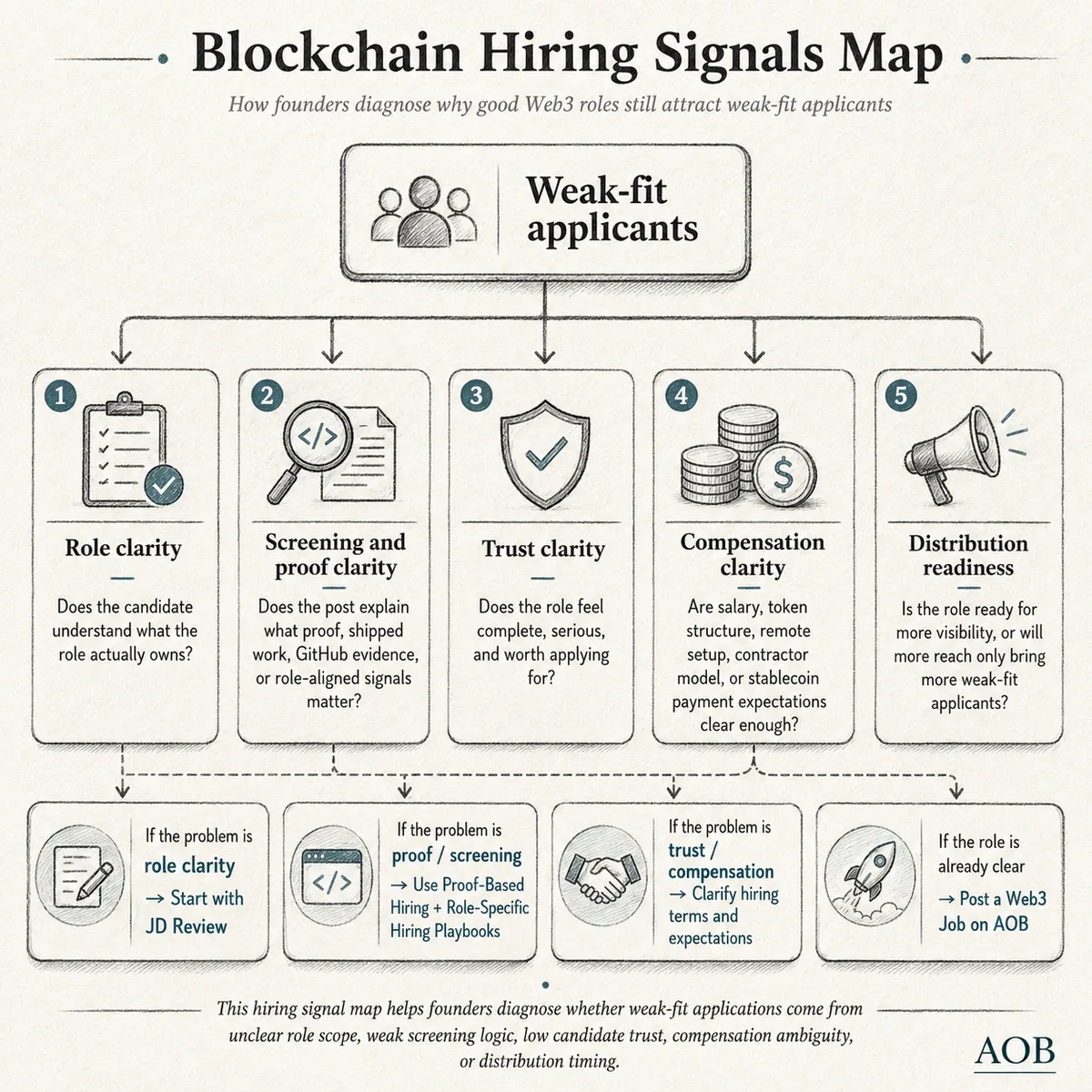
This is a blockchain hiring signals page for teams that need to understand whether the hiring problem is coming from role clarity, screening logic, candidate trust, compensation doubt, or distribution readiness.
Use this page as a diagnostic router. If the role itself is unclear, start with JD Review. If the role is already clear and you need focused visibility, post the job on AOB. If the issue is deeper evaluation quality, move into role-specific hiring playbooks, proof-based hiring, or interview calibration.
If your role is already live but attracting weak-fit applicants, more reach usually will not fix weak hiring signals. Start with JD Review first.
Who this page is for
This page is for:
Founders hiring blockchain talent and unsure why the role is underperforming
Hiring managers getting applications but not the right shortlist
Recruiters handling blockchain or Web3 roles that sound important internally but unclear externally
Teams that want to know whether the real blocker is the job description, the evaluation logic, or the way the role is being presented
Before you scroll further
If your blockchain role is already live but attracting weak-fit applicants, do not assume the first fix is more reach.
First check the signal.
If the JD is vague, overloaded, or unclear about ownership, proof expectations, screening logic, remote setup, or compensation framing, start here:
JD Review for Web3 hiring teams
Web3 JD Review for Teams Attracting Weak-Fit Blockchain Applicants | ArtofBlockchain
If the role is already clear and you mainly need focused visibility in front of a blockchain careers audience, use:
Post a Web3 Job on AOB
Post a Web3 Job | Blockchain Job Board for Founders, Recruiters & Hiring Teams | ArtofBlockchain
What this page covers
This page covers the hiring signals that shape whether a blockchain role feels credible enough for strong candidates to seriously consider.
It focuses on:
Why good Web3 roles still attract weak-fit applicants
What a vague blockchain job description signals to serious candidates
How hiring teams accidentally reduce trust before the first interview
When to fix the role first and when to push distribution
When JD Review is the right move and when Post a Job is the right move
Quick map of this hub
Role clarity signal
Use this lane if the role title looks fine, but the ownership feels blurred. A strong blockchain candidate should understand what the role owns before they reach the requirements section.
Start here:
Web3 JD Review for Teams Attracting Weak-Fit Blockchain Applicants | ArtofBlockchain
Screening and proof signal
Use this lane if the team is getting applicants, but the shortlist does not show role-aligned proof. This is where proof-based hiring, recruiter screening, GitHub evidence, shipped work, audit trails, project explanation, and shortlist quality become important.
Role-specific hiring signal
Use this lane if the team is hiring for Solidity, Rust, protocol engineering, QA, security, compliance, growth, or non-technical Web3 roles and is not sure what “good” should look like for that specific function.
Start here:
Role-Specific Hiring Playbooks | ArtofBlockchain
Interview calibration signal
Use this lane if candidates look strong on paper, but interviews are not producing clear confidence. The issue may be weak calibration, vague interview stages, or poor signal reading during technical and non-technical screens.
Compensation and trust signal
Use this lane if the role loses candidate trust because of unclear salary, token upside, contractor setup, remote expectations, or stablecoin payment framing.
Start here:
Web3 Hiring Risks & Compensation Hub for Hiring Teams | ArtofBlockchain
Distribution readiness signal
Use this lane if the JD is clear, the role is believable, and the team now needs focused visibility in front of blockchain candidates.
Start here:
Post a Web3 Job | Blockchain Job Board for Founders, Recruiters & Hiring Teams | ArtofBlockchain
What this page is not
This is not the page for role-by-role evaluation frameworks.
Use:
Role-Specific Hiring Playbooks | ArtofBlockchain
This is not the page for compensation structure, token-risk framing, or contractor-versus-employee decisions.
Use:
Web3 Hiring Risks & Compensation | ArtofBlockchain
This is not a candidate-first page about portfolios, resumes, or interview prep. Candidate-facing proof pages should support this hub, but they should not take over this page. This page is mainly for hiring teams asking why a blockchain role is visible but still not converting the right applicants.
It is a founder-side and hiring-team diagnostic page built to answer one question:
Why is this role not converting the right candidates yet?
Start here based on your situation
The role is live, but the applications feel weak
Start with JD Review:
Blockchain Job Description Review Service for Web3 Hiring Teams | ArtofBlockchain
The role is clear enough, but it needs focused blockchain visibility
Post the role here:
Post a Web3 Job on ArtOfBlockchain.club | ArtofBlockchainJob Board | ArtofBlockchain
The role is technical, and you are not sure what the market expects by function
Use the role-calibration page:
Role-Specific Hiring Playbooks | ArtofBlockchain
The role may be losing trust because of pay, token structure, or contract framing
Use the risk and compensation page:
Web3 Hiring Risks & Compensation | ArtofBlockchain
Core hiring signal diagnostic: why the right candidates hesitate
Role clarity
Can a strong candidate understand what the role actually owns in the first few lines?
Screening clarity
Does the post explain what kind of proof, judgment, shipped work, GitHub evidence, audit trail, product thinking, or role-aligned experience actually matters?
Trust clarity
Does the role feel serious, grounded, and complete enough for strong candidates to self-select?
Distribution readiness
Is the role clear enough to deserve more reach, or will more distribution only scale weak-fit applications?
Why good Web3 roles still underperform
A blockchain role can be real and still feel weak in the market.
That usually happens when:
The ownership is blurred
The required skills are stacked without hierarchy
The team does not explain what strong proof looks like
The process sounds unclear or overly generic
The role mixes urgency with vagueness
The compensation or contract setup introduces doubt too early
In other words, many weak-fit applicant problems are not pure market problems.
They are role-definition and signal-definition problems first.
What to do next
If the role still feels vague, overloaded, or harder to trust than it should, do not push distribution harder yet.
Start with JD Review:
Blockchain Job Description Review Service for Web3 Hiring Teams | ArtofBlockchain
If the ownership, expectations, and hiring logic are already clear, then push focused distribution:
Post a Web3 Job on ArtOfBlockchain.club | ArtofBlockchainPost a Web3 Job on ArtOfBlockchain.club | ArtofBlockchain
Hiring signal bridge
A blockchain hiring signal is not just a keyword in a resume.
It is anything that helps the right candidate trust the role faster.
On the employer side, that usually means:
Clear ownership
Credible scope
Grounded expectations
Readable evaluation logic
Enough product or technical context to self-select
Serious handling of pay, contract structure, or remote expectations where relevant
That is why this page matters commercially.
If hiring teams fix these signals early, JD Review becomes easier to justify, job posts convert better, and distribution works harder because the role is clearer.
Where AOB services fit
If the hiring signal problem is inside the JD, use JD Review before pushing the role harder.
If the role is already clear and needs visibility, use AOB’s Web3 job posting route.
If the team is unsure what proof to ask for, use the proof-based hiring and role-specific playbook pages before finalizing the role.
This is the practical difference: JD Review fixes the signal before distribution. Job posting helps only when the role is already clear enough to attract the right candidates.
Proof layer
What good employer-side proof looks like
A strong blockchain role usually shows:
What the person will own
Which skills are truly required and which are learnable
What kind of work or judgment will be evaluated
What kind of environment the person is stepping into
Whether the hiring process has thought behind it
Enough context for the right candidates to recognize themselves in the role
This is what strong candidates often react to before they ever reply.
Common mistakes
Treating weak-fit volume as a sourcing problem only
Posting harder before clarifying the role
Using one evaluation lens for every blockchain role
Writing a JD that sounds ambitious but not readable
Listing every possible requirement without showing ownership priority
Using AI-heavy, audit-heavy, or “cutting-edge” language without explaining what the person will actually do
Giving equal priority to “Post a Job” and “Fix the JD” when the role is still unclear
FAQ
Why am I getting weak-fit applicants for a blockchain role?
Weak-fit applicants often show up when the role is visible enough to attract interest but not clear enough to help the right candidates self-select.
What are blockchain hiring signals for founders and hiring managers?
They are the signals your role sends about ownership, evaluation quality, trust, seriousness, and what kind of proof the team actually values.
Should I fix my blockchain JD before posting the role?
Yes, if the role still feels vague, overloaded, or hard to trust. More reach will not solve a weak signal problem.
When should I use a blockchain JD review?
Use JD Review when the role already exists, but the applicant quality, clarity, or candidate trust feels weak.
When should I post the job instead?
Post the role when the ownership, expectations, and hiring logic are already clear enough to convert the right audience.
How do strong Web3 candidates judge whether a job post is credible?
They read for scope clarity, realism, evaluation signals, context, and whether the team sounds like it understands the actual work.
What makes a blockchain job description feel vague or unfinished?
Blurred ownership, stacked responsibilities, inflated requirements, weak product context, and no clear evaluation logic.
Internal navigation block
Fix the role first
Blockchain Job Description Review Service for Web3 Hiring Teams | ArtofBlockchain
Go deeper into role calibration
Role-Specific Hiring Playbooks | ArtofBlockchain
Go deeper into trust and compensation risk
Web3 Hiring Risks & Compensation | ArtofBlockchain
Getting paid in stablecoins: should my invoice be in USD, USDC, or local currency? | ArtofBlockchain
Closing CTA
If your blockchain role is attracting attention but not the right trust, do not assume the next fix is more visibility.
First, decide whether the role is clear enough to deserve more reach.
If the signal is weak, start with JD Review.
If the role is already strong, use Post a Job.
If the problem is narrower than this page, go deeper into role calibration or compensation risk before pushing harder.