
The Smart Contract Portfolio That Shows How You Think

A Framework for Reasoning, Safety, and System Design**
Most smart contract portfolios fail for a simple reason: they look like a collection of projects instead of a window into how a developer thinks.
Founders reviewing portfolios aren’t trying to measure how busy someone has been. They’re trying to understand something far more important:
“If I trust this person with mainnet code, will they keep the protocol safe?”
And very few portfolios answer that question clearly.
Some developers upload 20 small projects.
Some clone popular repos.
Some ship demos with polished UIs but almost no reasoning behind the contract logic.
Others share half-finished experiments without explanation.
None of these help a founder understand the real signal:
how the engineer reasons through constraints, safety, and system behaviour.
A smart contract portfolio becomes valuable when it reveals a developer’s mindset, not just their output.
And for most developers — especially juniors and mid-level engineers — this clarity is exactly what’s missing.
This blog lays out a simple framework to help you build a portfolio that actually communicates engineering maturity. It also helps founders understand what they should be looking for beyond code volume or GitHub activity.
TL;DR
A valuable smart contract portfolio is not about volume — it’s about clarity of thinking.
Build three projects that demonstrate reasoning, safety, and system awareness.
Present your work like an engineer who understands real-world constraints, not like a student finishing a tutorial.
Why Most Portfolios Don’t Build Trust
Founders almost never say this out loud, but it’s the truth beneath most rejections:
activity is not capability.
Many portfolios show enthusiasm, but not engineering judgment.
Some show creativity, but not safety.
Some show code, but not reasoning.
And when there is no reasoning, founders start filling in the gaps themselves — often negatively.
One of the most common patterns we see is that repositories lack basic testing, or they solve a problem without acknowledging what could break. When a candidate cannot articulate failure modes or invariants, hiring managers quickly conclude that the person may not yet understand the risks of working in a production environment.
This is why discussions around gas reasoning, storage decisions, and system behaviour matter so much in hiring assessments:
https://artofblockchain.club/discussion/gas-pitfalls-juniors-mention-what-interviewers-actually-assess
They reveal the difference between someone who writes code and someone who engineers systems.
A High-Signal Portfolio Only Needs Three Projects
You do not need ten projects.
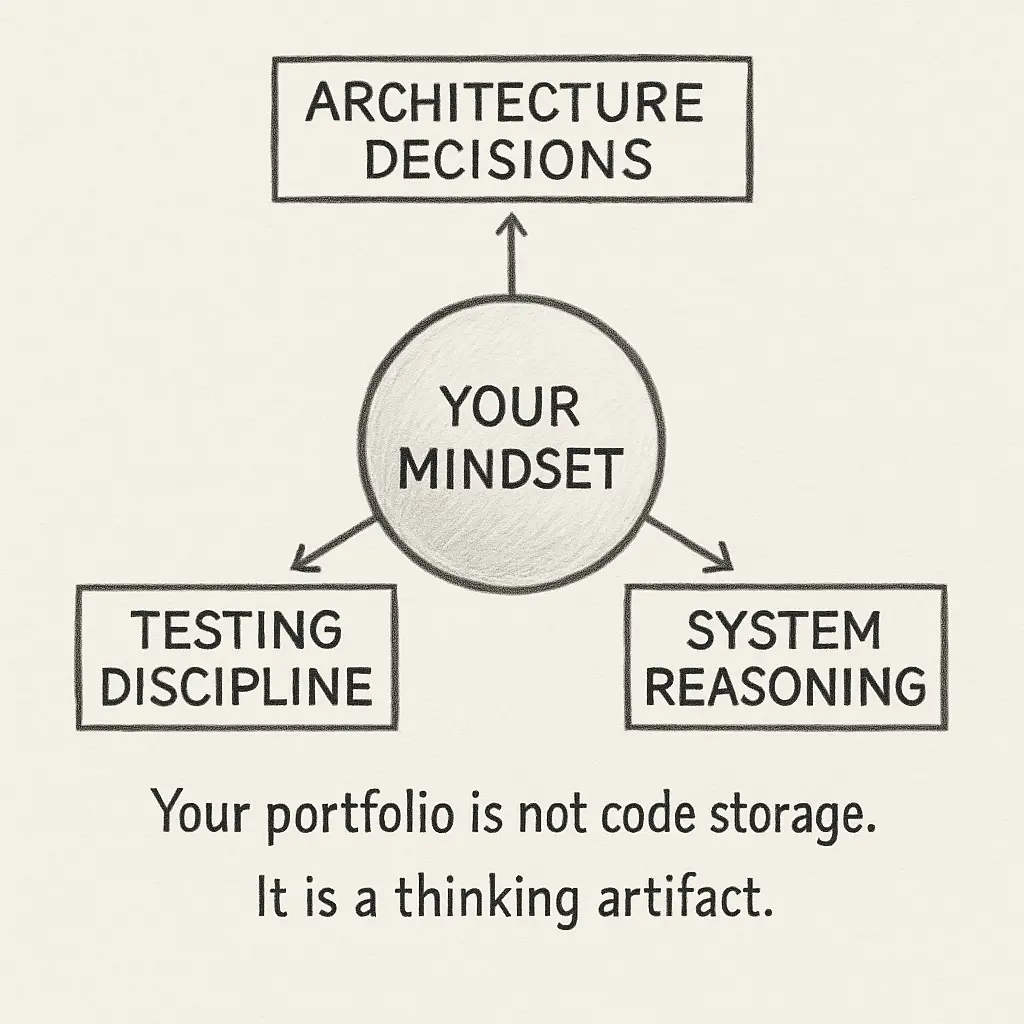
You need three well-chosen ones that each highlight a different dimension of your thinking.
Think of it like a founder reviewing a design document.
They aren’t checking how many documents you wrote.
They’re checking whether you understand:
how systems behave,
how risks emerge,
how constraints shape design choices.
Your portfolio should mirror that same clarity.
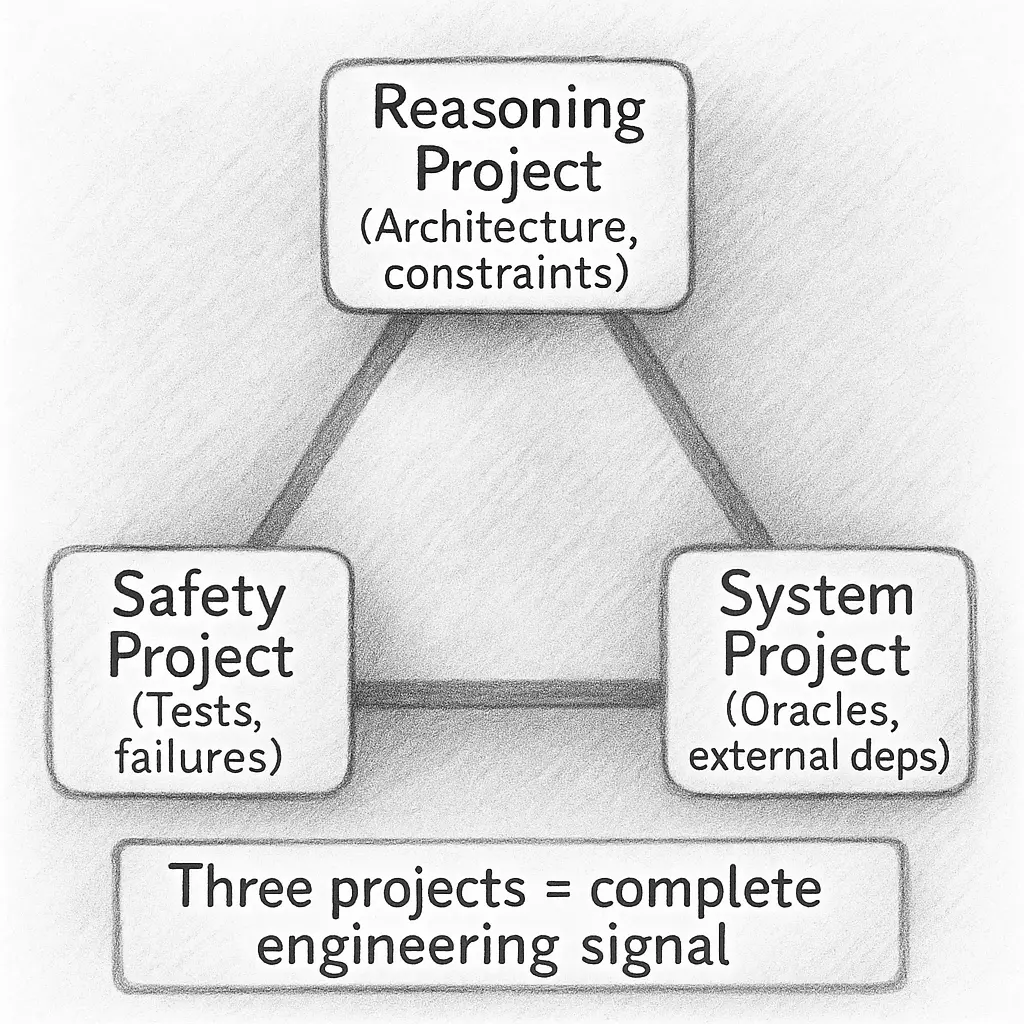
Here’s the three-project framework:
A project that shows your reasoning and architecture thinking
A project that shows your safety and testing mindset
A project that shows your system interaction awareness
When these three sit together, a founder gets a complete picture of your engineering maturity — even if you’ve never worked professionally in Web3.
1. Showing Your Reasoning: The Architecture Project
This project is not about complexity.
It’s about explaining how you think when the requirements are ambiguous and the constraints are real.
It could be a staking mechanism, an auction design, a vesting module, or a streaming payment system. What matters is how well you articulate the thinking behind it.
In your README, answer the questions founders silently ask:
What goals shaped your design?
Which constraints mattered the most?
Why did you choose this pattern instead of another?
What assumptions did you make?
What were the trade-offs you consciously accepted?
What invariants must remain true at all times?
What failure modes did you anticipate?
If the code is the “what,” the README is the “why.”
And founders hire for the “why.”
For more foundational reasoning patterns, see the Smart Contract Fundamentals Hub:
https://artofblockchain.club/discussion/smart-contract-interview-prep-hub
2. Showing Safety: The Testing & QA Project
This is the project that answers the most important question in any hiring process:
“Will this engineer accidentally ship unsafe code?”
unsafe assumptions → production incidents
missing tests → hidden regressions
no invariants → unpredictable outcomes
Your testing project demonstrates your respect for risk.
This could be:
a fuzzing suite for ERC-721/1155 logic,
a reentrancy test harness,
an upgradeable contract where you document and test storage layout changes,
a rewards system where invariants ensure fairness and predictability.
The point is not the feature — it’s the seriousness of your testing discipline.
Founders reviewing portfolios often jump directly to the test folder. They want to see whether you test forbidden behaviour, edge cases, assumptions, and sequences that could break the system.
The QA & Testing Hub captures this mindset deeply:
https://artofblockchain.club/discussion/smart-contract-qa-testing-hub
Showing safety is how you differentiate yourself from developers who only show creativity.
3. Showing System Awareness: The Integration Project
Smart contracts do not live in isolation.
They are inside a complex ecosystem of oracles, bridges, sequencers, calldata dependencies, MEV risks, and external assumptions.
This project proves that you understand how real systems behave.
It doesn’t need to be big.
Even a small contract that validates oracle data or handles external calls safely can reveal strong awareness.
Here is what founders look for:
Do you understand how external data can be manipulated?
Do you handle cooldowns, delays, and sequencing risks?
Do you treat fallback logic as part of system safety?
Do you design with griefing vectors in mind?
Do you explain how liquidity or pricing dependencies might break?
Discussions around oracle safety and system-level reasoning explore these patterns:
https://artofblockchain.club/discussion/how-should-i-answer-defi-interview-questions-on-securing-price-oracles
When a founder sees system thinking in your portfolio, they immediately place you above developers who only write isolated modules.
What These Three Projects Reveal to Hiring Managers
A founder doesn’t just see code.
They see signals — and those signals answer deeper psychological questions.
A strong portfolio reveals:
That you understand what must never break,
That you can design for safety even when the requirements are blurry,
That you can anticipate risks instead of reacting to them,
That you understand how systems behave when interacting with external data or other contracts,
That your engineering decisions come from clarity, not guesswork.
This is why the Recruiters & Hiring Managers Hub emphasizes reasoning and system-awareness as top hiring factors:
https://artofblockchain.club/discussion/hiring-managers-recruiters-hub-hiring-signals-interview-expectations
To a founder, a portfolio like this creates trust — and trust is what gets you hired.
Presenting Your Work in a Way That Communicates Maturity
Even a strong project can lose its signal if presented poorly.
A clean portfolio reflects your thinking long before anyone reads the code.
=> Pin only your top 3–4 repositories
Most recruiters never scroll further.
=> Lead your READMEs with architecture, constraints, and assumptions
It positions you as someone who designs intentionally.
=> Add a short “Security Considerations” section for each project
Founders rarely expect this — but when they see it, it elevates you instantly.
=> Add a “Potential Improvements” section
Even senior engineers use this to demonstrate reflection and engineering judgment.
This level of transparency mirrors the kind of thinking shared in incident and post-mortem discussions:
https://artofblockchain.club/article/proof-heavy-smart-contract-portfolios-what-hiring-managers-actually-trust-2025-edition
When the presentation matches the quality of the engineering, the portfolio becomes more than a showcase — it becomes a signal of maturity.
Why This Framework Matters More in Web3 Than Anywhere Else
In most industries, a bug causes inconvenience.
In Web3, a bug can drain a protocol.
That is why founders subconsciously evaluate developers through one lens:
“Can I trust this person with mainnet code?”
A reasoning-driven portfolio answers this question better than any resume, certification, or number of GitHub stars.
When you show how you think, you lower the uncertainty founders feel when evaluating early-career smart contract developers.
And when uncertainty falls, hiring confidence rises.
If you're building a portfolio and want roles where founders value reasoning, safety, and system-level clarity, explore curated blockchain job listings here:
https://artofblockchain.club/job/
FAQs
1. How many projects should a smart contract developer include in a portfolio?
A focused Solidity portfolio with three well-designed projects shows far more signal than many small repos. Hiring managers look for depth, not volume — they want to see architecture reasoning, safety thinking, and system awareness. This structure mirrors how real smart contract engineers operate in production environments.
2. What makes a smart contract portfolio strong for hiring?
A strong portfolio highlights why you made certain decisions, not just the code you wrote. Founders look for clear invariants, testing discipline, and thoughtful explanation of trade-offs and risks. These signals help them judge whether you can handle smart contract engineering responsibilities safely.
https://artofblockchain.club/discussion/smart-contract-qa-testing-hub
3. Do hiring managers care about UI or frontend work?
For smart contract roles, teams primarily evaluate on-chain reasoning and safety, not UI or frontend design. A portfolio that focuses on architecture, testing, and system behaviour communicates far more trust. Frontend skills only matter if you’re applying for full-stack Web3 roles.
4. Should juniors include tutorial-based projects?
Tutorials show that you're learning, but they don’t demonstrate independent reasoning or engineering judgment. Hiring managers want to see how you think under constraints, not whether you can follow instructions. Replacing tutorial repos with small, original projects dramatically increases portfolio credibility.
5. What testing patterns impress Web3 hiring teams?
Solidity developers who include negative tests, invariant checks, fuzzing, and storage layout tests stand out immediately. These patterns show you understand how real failures happen in smart contracts. They also signal that you think like a QA-aware, security-conscious engineer.
6. How do I show system-level thinking in my portfolio?
System-level thinking appears when you explain oracle assumptions, external call risks, fallback behaviour, and sequencing issues in your README. Even a simple contract can demonstrate strong composability awareness. This signal is rare among juniors and highly valued in Web3 hiring.
7. How important are READMEs in smart contract portfolios?
A good README reveals how you designed, reasoned, and handled constraints, which hiring managers value more than raw code. It shows your approach to invariants, assumptions, and failure modes — critical concepts in blockchain engineering. A strong README often becomes the deciding factor in interviews.
8. Can a strong portfolio outweigh lack of Web3 job experience?
Yes — a reasoning-driven portfolio can substitute for experience because it proves how you think, not just what you’ve built. Many Web3 teams prioritize clear thinking, safety awareness, and system understanding over previous job titles. For juniors, this is often the fastest path to interviews.