The Web3 QA & Smart Contract Testing Framework: Flaky Tests, Coverage Drift, and Production Realism

Web2 software testing differs with smart contract QA testing. In Web3, quality assurance means validating contract behavior under irreversible execution, state changes, privilege boundaries, gas constraints, RPC variance, and upgradeability risk.
However, bridging this gap requires overcoming significant hurdles. Relying solely on a 100% green local unit test suite does not guarantee production safety. In fact, our analysis of candidate pipelines and post-mortem reports on ArtofBlockchain shows that over 60% of smart contract test failures occur at the environment boundary—where local mocks fail to account for mainnet state leakage, RPC drift, or gas regressions.
This hub establishes a proof-based framework for blockchain QA engineers, software testers transitioning into Web3, and smart contract teams. It outlines what real-world contract testing actually validates, how to build verifiable proof artifacts, and how to route directly into deeper technical teardowns on ArtofBlockchain
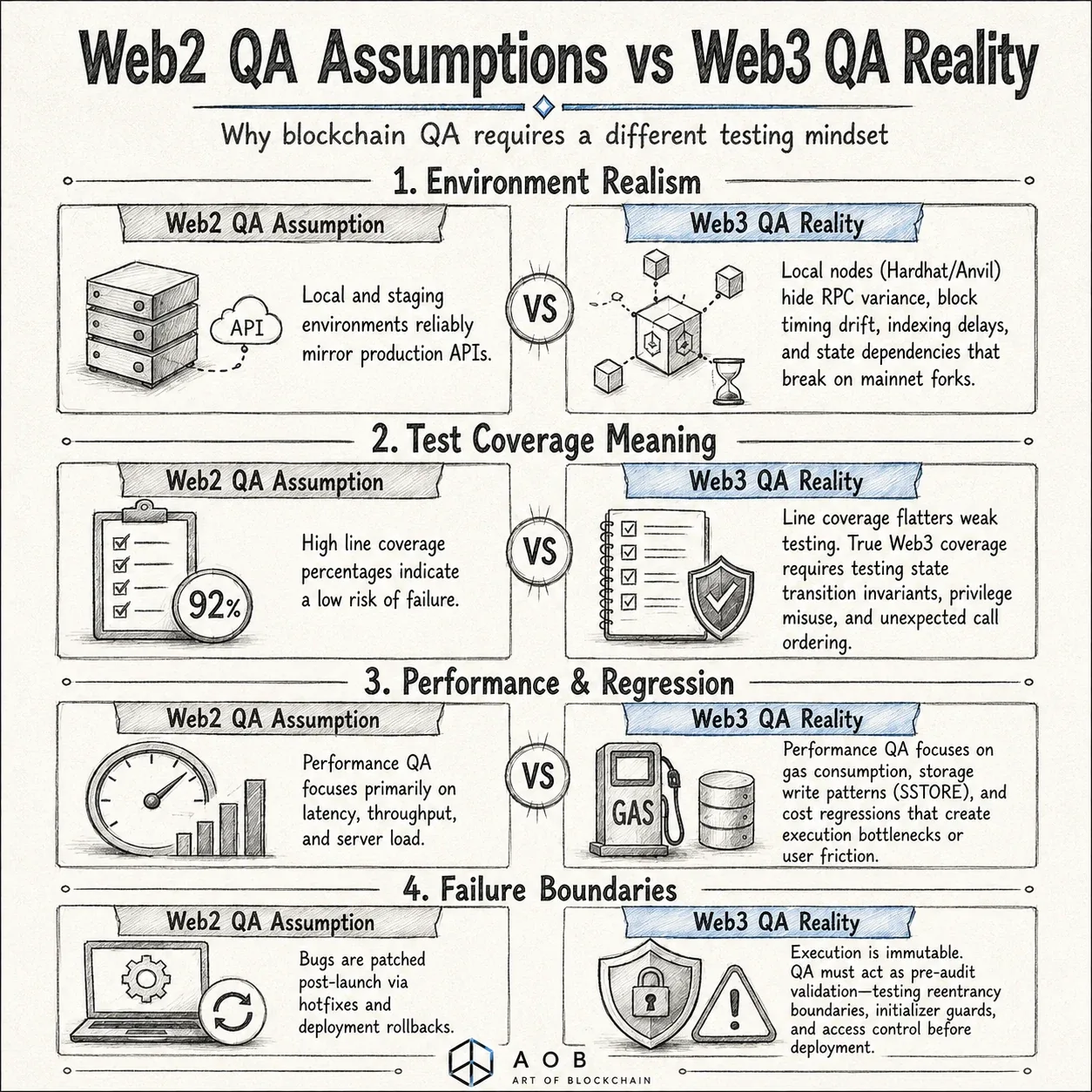
The Web3 QA Vector Matrix
Traditional software testing relies on rollback environments, predictable API responses, and cheap compute. Smart contract testing operates under inverse assumptions. Use this matrix to understand how QA vectors shift as you move from Web2 to Web3
Technical QA Playbooks & Deep-Dive Routes
Use the following technical modules below to navigate specific testing challenges. Each section provides a high-level technical summary and links directly to ArtofBlockchain's specialized teardowns
1. Web3 QA Foundations & Transitioning
Transitioning from traditional software testing into Web3 requires shifting focus from UI and simple API endpoints to state persistence, access control boundaries, and irreversible execution. Strong Web3 QA is more about testing what breaks when transaction sequences or caller permissions change unexpectedly
Transition Guide:Blockchain QA for Software Testers: Do You Need Solidity, Better Test Logic, or Proof Artifact
2. Flaky Tests, Network Realism & Forking
Flaky tests in Web3 are rarely random; they are evidence of unstable assumptions around RPC behavior, fixture design, time manipulation, signer setup, or network drift. When a test passes locally but fails on CI or mainnet forks, the issue usually stems from environment mismatch rather than broken business logic.
CI Failure Diagnosis: As a Blockchain QA Engineer, How Do You Deal With Flaky Smart-Contract Tests That Fail Only on CI?
Mainnet Mismatch: Why Do Tests Pass on Hardhat/Anvil Forks but Break on Mainnet
3. Coverage Drift & Invariant Testing
High coverage numbers can create false confidence if they only touch happy paths. Meaningful Web3 test coverage evaluates state invariants, role access boundaries, failure conditions, and edge cases. Explaining coverage in interviews or team reviews requires connecting percentages directly to risk surfaces rather than quoting raw numbers.
Interview Messaging: In Web3 QA Interviews, How Do You Explain Test Coverage Without Sounding Scripted or Over-Technical
Multichain Variance: As a Multichain QA Engineer, How Do You Manage Test Coverage Drift When ETH Is Stable but Polygon/BSC Keep Failing?
4. Gas Validation & Regression Testing
Gas is an operational and security metric, not just a developer optimization detail. QA engineers must validate gas consumption to catch unexpected regressions introduced by code refactoring, storage writes, or complex loop execution before contracts hit production.
US remote Solidity interviews: how do you quantify gas-optimization wins without overclaiming?
5. Audit-Aligned QA & Security Boundaries
QA work frequently overlaps with pre-audit preparation. While QA engineers are not auditors, high-signal testing includes validating failure paths, testing Checks-Effects-Interactions (CEI) patterns, verifying upgrade initializer guards, and creating reproducible bug reports that help auditors verify contract safety faster.
Audit Workflow: How QA Testers Contribute During Smart Contract Audits
Pattern Validation: How Do Solidity QA Engineers Validate CEI Patterns in Real Audit Workflows When Storage Updates and Calls Overlap?
6. Interview Calibration & Proof Artifacts
Candidates applying for blockchain QA roles often get rejected because they list automation tools rather than showing proof of diagnostic judgment. A strong hiring signal consists of clear, inspectable artifacts: a documented flaky test fix, a mainnet-vs-local bug teardown, or a readable test matrix showing edge-case coverage.
Interview Strategy: Answering "Testing Strategy" Questions in Web3 QA Interviews
Proof Positioning: Blockchain CV Review: What Recruiters Reject in 10 Seconds (Proof-Stack Checklist)
Structuring Your Web3 QA Career & Portfolio
If your goal is to land a dedicated blockchain QA or smart contract testing role, focus on making your technical proof easy to inspect and verify
A believable QA portfolio does not require dozens of generic repositories. It requires one or two high-signal artifacts, such as
1. A clean, reproducible failure report detailing an environment mismatch you isolated.
2. A test suite demonstrating invariant testing and state-transition checks on a public protocol.
3. A gas regression report explaining the exact trade-offs of a recent code change.
Refine Your CV: Use the Web3 CV Review Service to identify hidden shortlist blockers in your application.
Frequently Asked Questions
What is the core difference between Web2 QA and Web3 smart contract QA?
Web2 QA relies heavily on post-launch patching, API mocking, and server-side rollbacks. Web3 QA operates on immutable code, where state changes are permanent, transactions cost real monetary value (gas), and failures can result in total financial loss.
Why do smart contract tests pass locally but fail on mainnet forks?
Local development nodes (like Hardhat or Anvil) use simplified state setups and instant block production. Mismatches occur on mainnet forks due to RPC latency, unpredictable block timing, real-world state dependencies, gas limit nuances, or reentrancy guards interacting with live contracts.
Do Web3 QA engineers need to write Solidity fluently?
While you do not need to architect complex protocols, you must be able to read Solidity proficiently. Strong Web3 QA requires understanding state variables, inheritance structures, modifier logic, and event logs to design effective boundary and failure-path tests.
How does QA support smart contract security audits?
QA teams support audits by establishing comprehensive unit and invariant test suites prior to the audit. This allows auditors to spend less time verifying basic functional logic and more time searching for high-severity economic and architectural vulnerabilities.