Why blockchain job descriptions are vague in Web3 hiring

If your Web3 engineering job descriptions look like a copy-pasted shopping list of keywords, you are bleeding top-tier talent before they ever hit the 'Apply' button.
Across smart contract, protocol, core infrastructure, and cryptography engineering roles, Web3 job postings have become notoriously non-committal. Hiring teams routinely cycle through phrases like “strong Solidity skills,” “deep blockchain knowledge,” or “ability to thrive in a fast-paced environment” without ever defining what the day-to-day delivery actually looks like.
The result?
Your inbox is flooded with unqualified applicants, while elite blockchain engineers—the ones who value clarity on protocol maturity, decision boundaries, and ownership—silently pass you by.
After analyzing 100+ real job descriptions and hiring discussions across the Art of Blockchain community, one pattern becomes clear:
This ambiguity is rarely accidental.
This is also how hiring teams should clarify role scope in blockchain job descriptions: not by adding more skills, but by explaining what the person will own, what proof matters, and what decisions they are expected to handle.
It usually reflects teams that are still defining their technical boundaries, decision ownership, and maturity. In other words, vague job descriptions often say more about the organization than the candidate.
Understanding that shift is the first step toward reading Web3 hiring signals clearly — and avoiding misaligned roles before they cost you months of effort.
TL;DR — Key Takeaways
Vague job descriptions often reflect evolving teams, not poor hiring.
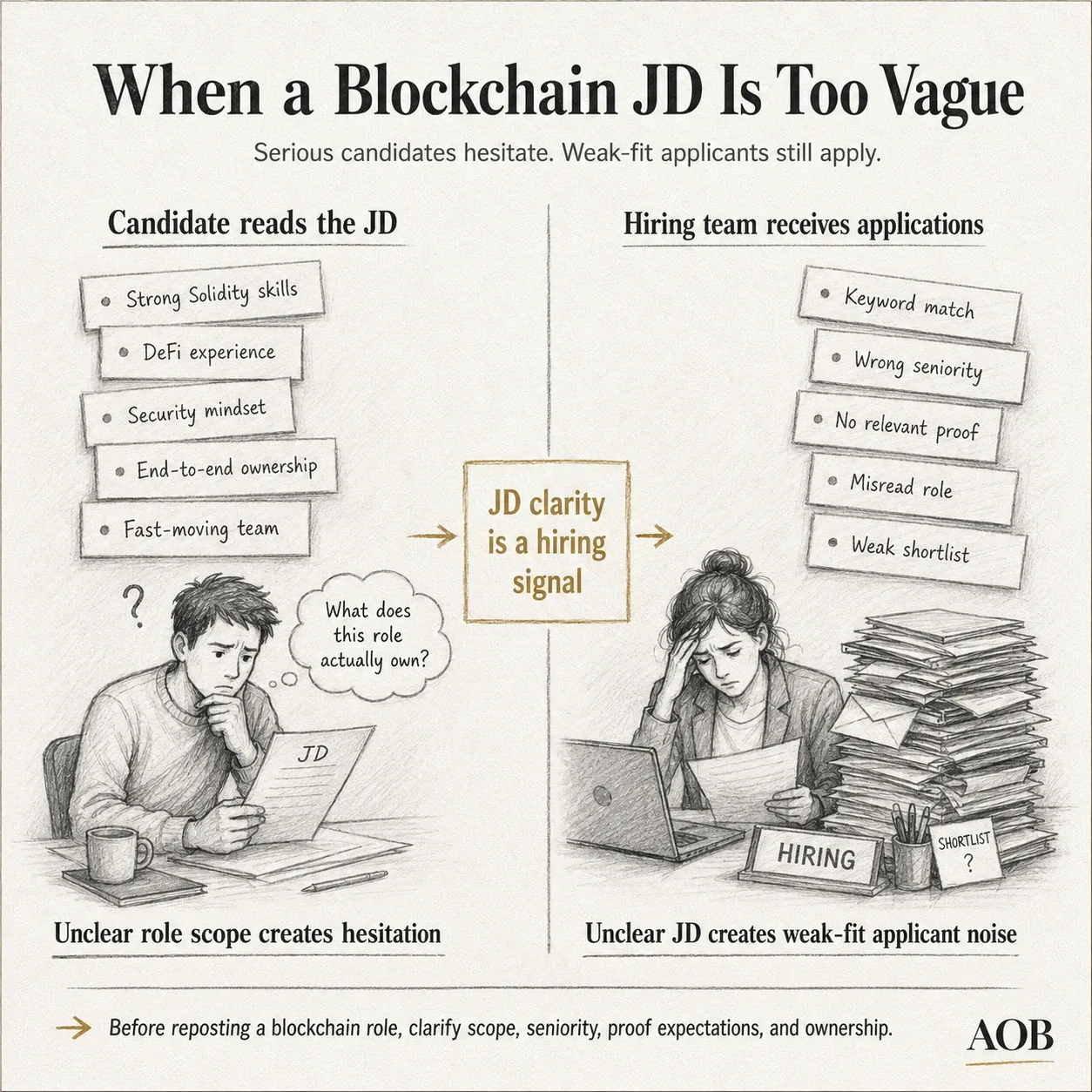
For hiring teams, a Web3 JD unclear around seniority, must-have skills, proof expectations, and ownership can create weak applicant quality even when the role gets enough visibility.
Ambiguity becomes useful when teams can explain it honestly.
Strong candidates read signals, not bullet points.
The best careers are built by understanding environments — not chasing titles.
Why Blockchain Job Descriptions Are So Vague
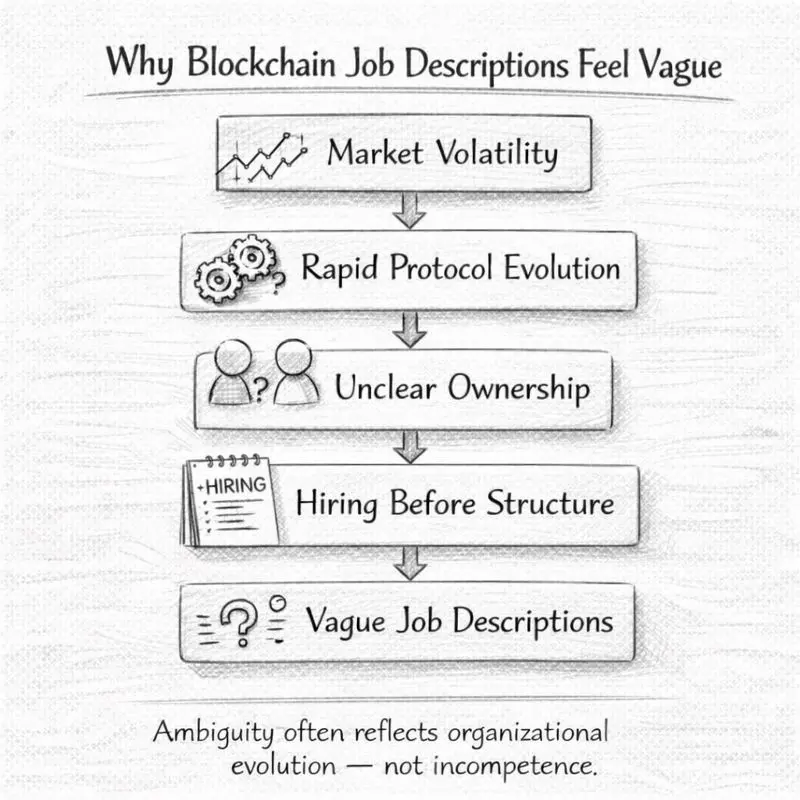
Most blockchain job descriptions aren’t vague because teams are careless.
They’re vague because many teams are still becoming themselves.
In traditional software companies, roles stabilize over time. Responsibilities become predictable. Hiring becomes repeatable.
In Web3, that maturity curve is still forming.
Protocols evolve quickly. Infrastructure changes mid-roadmap. Teams grow before processes solidify. As a result, hiring often begins before roles are fully understood.
What looks like poor communication is often unresolved structure.
1. Hiring Starts Before the Role Is Fully Formed
For a hiring team, this is where the problem becomes commercial: if the blockchain job post does not explain what the role owns, strong candidates may read the uncertainty as a hiring signal and decide not to apply.
Many teams begin hiring because something hurts — not because they’ve clearly defined what’s needed.
They might know:
Development velocity is slowing
Audits are blocking releases
Infrastructure is fragile
Ownership is unclear
But they haven’t yet translated that pain into a scoped role. When talent acquisition teams notice applicant quality dropping, their instinct is usually to spend more money on distribution—pushing the post to more Web3 job boards or hiring aggressive agencies.
Scaling your distribution when your role definition is broken just creates more noise. Before you sink thousands of dollars into promoting a live listing, you must audit the document for missing candidate trust signals.
When talent acquisition teams notice applicant quality dropping, their instinct is usually to spend more money on distribution, pushing the post to more Web3 job boards or hiring aggressive agencies, but the real issue lies with unclear role description.
But scaling your distribution when your role definition is broken just creates more noise. Before you sink thousands of dollars into promoting a live listing, you must audit the document for missing candidate trust signals, mixed seniority indicators, and misaligned technical scopes.
This pattern shows up repeatedly in hiring discussions across the ecosystem, especially in threads like
👉 Web3 hiring signals
where candidates describe roles that sound broad because the team itself is still searching for direction.
2. Ambiguity Often Reflects Organizational Maturity
Ambiguity isn’t always incompetence — sometimes it’s growth happening in real time.
In early or fast-moving teams:
One engineer may touch protocol logic, tooling, and deployments
Ownership shifts as systems evolve
Documentation lags behind reality
So job descriptions collapse complexity into phrases like:
“end-to-end ownership”
“ability to work independently”
“strong problem-solving skills”
These aren’t red flags by default — they’re signals of fluid boundaries.
This pattern appears frequently in discussions about blockchain hiring red flags, where candidates often confuse early-stage ambiguity with dysfunction.
3. Copy–Paste Hiring Is More Common Than Admitted
Another reason blockchain JDs feel generic: many are inherited.
Founders often:
Reuse descriptions from competitors
Adapt templates from earlier roles
Mirror language used by protocols they admire
Over time, the same phrases circulate without context.
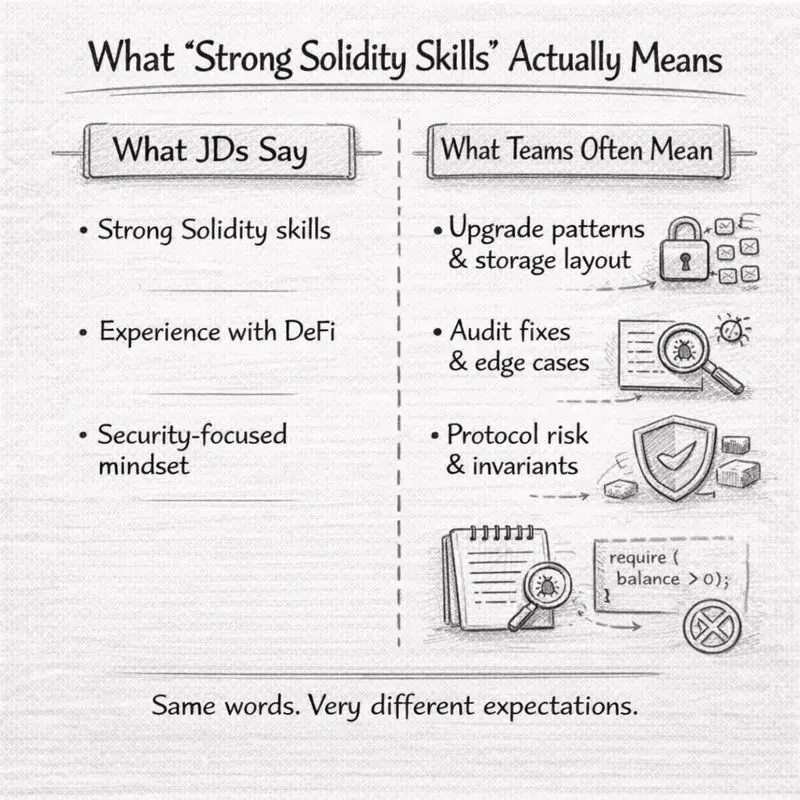
That’s how we end up with dozens of postings asking for “deep DeFi experience” without specifying whether that means:
using protocols,
integrating with them,
or designing them.
Language travels faster than clarity.
For hiring teams, the fix is not to make the blockchain JD sound more polished. The fix is to make the role readable enough that the right candidates can quickly understand what the team owns, what skills actually matter, what proof is useful, and how the hiring process will evaluate them.
This is also where many hiring teams lose strong candidates without realizing it. When the JD lists Solidity, Rust, DeFi, infra, audits, protocol thinking, ownership, and communication in one broad requirement stack, candidates cannot tell whether the team needs one focused specialist or a broad early-stage generalist.
Understanding that shift is the first step toward reading Web3 hiring signals clearly — and avoiding misaligned roles before they cost you months of effort.
That is why a JD Risk Scan before reposting a blockchain role can be useful when the role is live but applicant quality is weak.
Hiring team note: vague blockchain JDs can quietly attract weak-fit applicants
A blockchain job description attracting weak-fit applicants is not always a distribution problem. Sometimes the role is being described too broadly for the right candidates to understand what the team actually needs.
If a JD says “strong blockchain knowledge,” “DeFi experience,” “security mindset,” “end-to-end ownership,” or “fast-moving environment” without explaining what the person will actually own, the role starts creating uncertainty before the first interview.
This is often why strong blockchain candidates hesitate before applying to vague Web3 roles. They cannot tell whether the team needs a focused Solidity engineer, a protocol generalist, a security-minded reviewer, a backend infra person, or someone who can wear all these hats in an early-stage environment.
Before reposting the role or pushing it harder through job boards, recruiters, or LinkedIn, hiring teams should check whether the JD is clear enough around seniority, must-have skills, proof expectations, interview structure, remote setup, compensation context, and day-to-day ownership.
AOB offers a blockchain job description review for Web3 hiring teams to help founders, recruiters, and hiring teams identify these friction points before more distribution creates more noise.
How Evolving Engineering Teams Unknowingly Signal Internal Chaos
Elite Web3 candidates treat your job description as a proxy for how your engineering organization is managed. When you rely on lazy, un-scoped language, you are inadvertently broadcasting red flags to top-tier talent.
Here is what elite engineers read between the lines when they encounter common Web3 job description phrases:
1. "Strong Command Over Solidity/Rust"
What you mean: We need a highly capable engineer who can write secure code.
What elite candidates read: "They haven't defined the exact expectations of the role." Top developers might want to know if they are maintaining upgradeable contracts, responding to live audit remediation, or architecting core protocol logic from zero. If you don't specify, they assume you don't know.
2. "Deep Understanding of DeFi Protocols"
What you mean: We want someone familiar with the ecosystem.
What elite candidates read: "They are trying to hire a full economic mechanism designer under a standard engineer title." Are they integrating existing protocols? Forking and modifying primitives? Or designing novel oracle assumptions and risk liquidation models? Be specific.
3. "Security-First Mindset"
What you mean: We care about not getting exploited.
What elite candidates read: "This is aspirational marketing copy, not engineering culture." True security culture shows up in the details. A high-converting JD explicitly mentions threat modeling, testing invariants, or handling post-mortem mitigation processes.
The True Cost of "Copy-Paste" Web3 Sourcing
When your job description tries to cover every possible domain, listing Solidity, Rust, infrastructure, circuit design, and communication skills under a single generalist requirement stack—you suffer a dual penalty:
Elite Specialists Walk Away: They see a lack of operational focus and assume your team is structurally disorganized.
Unqualified Candidates Flood the Pipeline: Keyword-matchers see a broad net and apply en masse, burying your TA team in resumes that waste valuable engineering interview hours.
🛠️ Stop Sourcing More Noise.
Fix Your Listing Before You Repost.
If applicant quality is weak, pushing your job posting harder on LinkedIn or crypto boards won't solve the problem. Your engineering scope is broken.
The Art of Blockchain (AOB) JD Risk Scan is a data-backed evaluation of your job descriptions built from analyzing over 100+ hiring pipelines across our Web3 technical community.
We identify exactly where your role definition creates friction, removes trust, and deters high-tier candidates.
What We Optimize:
Seniority Calibration: Ensuring your requirement stack matches the actual compensation and equity tier.
Technical Boundary Scoping: Clearly isolating protocol design from secondary tooling or infrastructure management.\
Trust Injection: Embedding the precise engineering signals that pull top 5% talent out of the woodwork.
👉 Get Your Job Description Audited — Optimize Your Web3 Pipeline Now
FAQs
1. Why are blockchain job descriptions often vague?
Most blockchain teams are still evolving their architecture, team structure, and ownership boundaries. Job descriptions are often written before these details are fully defined, making them signals of exploration rather than fixed expectations.
2. Are vague job descriptions a red flag in Web3 hiring?
Not always. Vague descriptions can indicate early-stage teams still shaping their direction. They become red flags only when teams can’t explain their uncertainty or avoid accountability during conversations.
3. Why do many blockchain roles feel undefined compared to Web2 jobs?
Blockchain teams often operate in rapidly evolving environments where tooling, architecture, and even product direction change frequently. This makes rigid role definitions harder to maintain.
5. What are signs of healthy ambiguity versus red flags?
Healthy ambiguity comes with transparency, learning, and shared decision-making. Red flags appear when teams avoid specifics, shift responsibility, or can’t explain how work actually gets done.
6. Do vague job descriptions mean a company is disorganized?
Not necessarily. Some high-performing teams operate with evolving roles but clear internal communication. The key is whether uncertainty is acknowledged or ignored.
8. Is ambiguity more common in Web3 than traditional tech?
Yes. Web3 teams often operate closer to experimentation and protocol evolution, which naturally creates less rigid role definitions compared to mature Web2 organizations.
Final Perspective
The most successful people in Web3 aren’t the ones who chase every opportunity.
They’re the ones who learn how to read environments.
They understand that:
Job descriptions are imperfect signals
Teams evolve faster than documentation
And clarity is something you often help create, not receive
Once you see hiring this way, ambiguity stops being a risk — and starts becoming information.
Founder’s Note
Across hundreds of pipeline audits at the Art of Blockchain, one pattern shows up again and again:
Startups don’t fail to hire elite Web3 talent because there is a shortage of developers. They fail because their hiring signals misalign with the reality of their engineering environment.
That’s why AOB exists—not just to source talent, but to help founders build hiring infrastructure that actually converts. Stop guessing why your pipeline is full of noise. Let's fix the root cause.
About the Author
Shubhada Pande is the founder of ArtOfBlockchain.club, a discussion-first platform for blockchain careers, Web3 hiring, CV reviews, job-description clarity, and proof-based career conversations.
Through AOB discussions and candidate reviews, she studies where blockchain professionals and hiring teams lose visibility: unclear CV positioning, weak GitHub context, generic project claims, broad role targeting, and proof that is real but not easy for recruiters to verify.
🔗 Connect with Shubhada on LinkedIn: https://www.linkedin.com/in/shubhada-pande-art-of-blockchain/