Advanced EVM Concepts & Internals: Senior Smart Contract Interview Signals and Proof

Advanced EVM concepts matter when Solidity stops being enough.
This hub is for smart contract developers, Solidity engineers, Web3 QA testers, and candidates preparing for senior technical interviews where the discussion moves below syntax: storage layout, gas behavior, calldata, memory, delegatecall, proxies, upgrade safety, traces, and execution flow.
It is also useful for hiring teams and recruiters who want to understand what strong EVM answers actually signal. The goal is not to turn every screen into opcode trivia. The goal is to separate memorized definitions from real engineering judgment — the kind of proof that shows how a candidate reasons when abstraction breaks.
Start with the wider Smart Contract Engineering cluster here:
smart contract-engineering | ArtofBlockchain
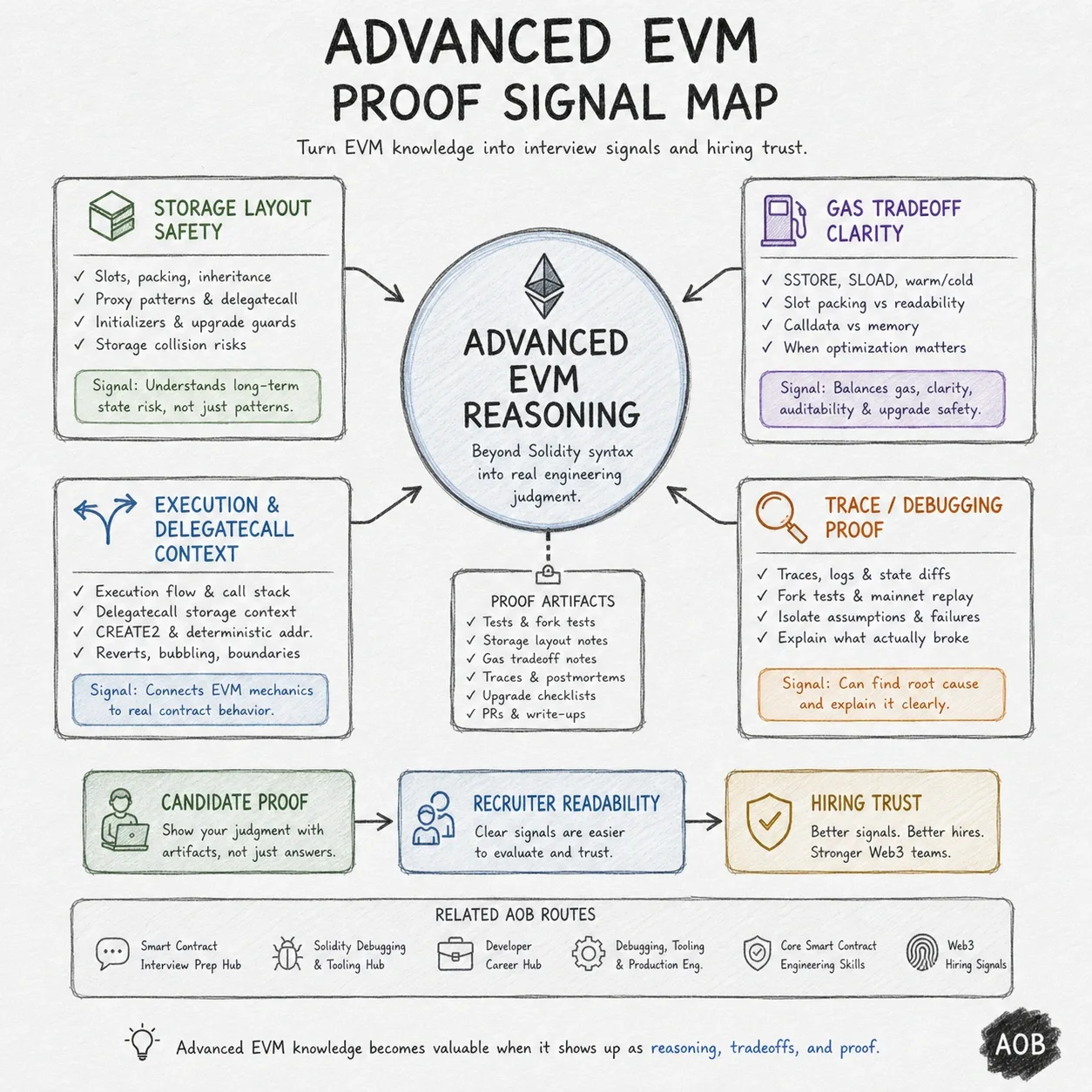
Quick map of this hub
EVM interview foundations
Use this lane if EVM still feels like a black box during Solidity or smart contract interviews. The goal is to understand execution flow, storage, gas, delegatecall, transaction lifecycle, stack, memory, and bytecode well enough to explain them without sounding rehearsed.
Candidate lens: prepare for practical EVM interview questions.
Hiring lens: check whether the candidate can connect EVM mechanics to real contract behavior.
Storage layout and upgradeability safety
Use this lane if proxy contracts, initializer guards, storage collisions, inheritance order, or upgrade safety still feel uncomfortable. Advanced EVM understanding becomes visible when a candidate can explain what could silently break after a contract upgrade.
Candidate lens: build a safe mental model for upgradeable contracts.
Hiring lens: look for candidates who understand state risk, not just proxy pattern names.
Gas, slot packing, calldata and memory
Use this lane if you know storage writes are expensive but struggle to explain why, when warm/cold access matters, or whether slot packing is worth the complexity. Strong answers do not obsess over gas tables. They explain tradeoffs in production contracts.
Candidate lens: learn how to explain gas choices clearly in interviews.
Hiring lens: check whether the candidate balances optimization with readability, auditability, and upgrade safety.
Debugging and production reasoning
Use this lane when EVM knowledge needs to connect with real failure investigation. Traces, fork tests, state assumptions, revert boundaries, and production-like debugging often reveal whether someone understands contracts beyond the happy path.
Candidate lens: turn debugging into proof of engineering maturity.
Hiring lens: look for evidence that the candidate can isolate failure, not just describe tools.
Related route:
Solidity Debugging & Tooling Hub: Reverts, Trace Debugging, Hardhat, Foundry, Fork Tests, and Incident Proof | ArtofBlockchain
Proof signals for senior smart contract roles
Use this lane if the real problem is not learning more terms, but making your judgment visible. Senior smart contract interviews often test whether you can show proof: tests, traces, storage layout notes, upgrade checklists, gas tradeoff explanations, or a short write-up explaining what could break.
Candidate lens: package advanced EVM understanding into recruiter-readable proof.
Hiring lens: evaluate evidence, not confidence alone.
Related route:
Web3 Hiring Signals | ArtofBlockchain
Who this hub is for
Use this page if you are:
preparing for Solidity or smart contract developer interviews
stuck on EVM internals, gas, storage, calldata, memory, or delegatecall
moving from mid-level Solidity work toward senior smart contract roles
trying to explain upgradeable contracts without sounding vague
building proof for smart contract engineering roles
screening candidates for deeper smart contract or protocol reasoning
writing a JD that asks for “deep EVM knowledge” but needs clearer expectations
This page is candidate/developer-first. Hiring teams should use it as an interpretation layer: what does this topic reveal about a candidate’s reasoning, risk awareness, and proof?
What this hub is not
This is not a beginner Solidity roadmap.
It is not a full EVM tutorial.
It is not a complete opcode reference.
It is not a generic smart contract interview question bank.
It is not a replacement for the broader Smart Contract Interview Prep Hub, the Solidity Debugging & Tooling Hub, or the Smart Contract Developer Career Hub.
Use those adjacent routes when your intent is broader:
Smart Contract Interview Prep:
Smart Contract Interview Prep: Solidity, Security, Debugging, Take-Home Tests & Hiring Signals | ArtofBlockchain
Solidity Debugging & Tooling:
Solidity Debugging & Tooling Hub: Reverts, Trace Debugging, Hardhat, Foundry, Fork Tests, and Incident Proof | ArtofBlockchain
Smart Contract Developer Career Hub:
Smart Contract Developer Career Hub: Skills, Proof, Interview Prep and Jobs | ArtofBlockchain
Core Smart Contract Engineering Skills:
Core Smart Contract Engineering Skills | ArtofBlockchain
Start here based on your situation
If EVM interviews feel too abstract
Start with the EVM interview foundation discussion. You need a clear mental model for transaction lifecycle, gas, stack, memory, storage, and delegatecall before going deeper.
If upgradeable contracts feel risky
Start with storage layout and initializer guards. In real interviews, the stronger answer is usually not “I used UUPS.” It is “I know what could silently break after an upgrade and how I would prove it is safe.”
If gas questions make you panic
Start with SSTORE, SLOAD, warm/cold access, slot packing, calldata, and memory. The goal is not to memorize gas numbers. The goal is to explain when optimization matters and when it creates audit or upgrade risk.
If your issue is debugging, not theory
Use the Solidity Debugging & Tooling Hub. Advanced EVM knowledge becomes stronger when you can trace failures, reproduce bugs, isolate state assumptions, and explain what actually broke.
If you are hiring for this skill
Use this page to clarify what “advanced EVM knowledge” means in your role. Is the person expected to reason about gas-sensitive architecture, storage layout, upgrade safety, traces, production failures, or senior code review?
If your JD does not define that clearly, review it before posting:
Blockchain Job Description Review Service for Web3 Hiring Teams | ArtofBlockchain
What advanced EVM knowledge reveals in interviews
Advanced EVM knowledge is useful only when it changes the quality of reasoning.
A weak answer usually defines terms:
SSTORE is expensive.
SLOAD is cheaper.
Delegatecall uses another contract’s code.
Proxies help with upgrades.
Calldata is cheaper than memory.
Slot packing can save gas.
A stronger answer explains consequences:
Why storage writes carry long-term state cost.
When warm/cold access changes repeated contract interactions.
Why delegatecall can be dangerous if storage context is misunderstood.
How storage layout changes can corrupt state after an upgrade.
When slot packing helps and when it hurts readability or upgrade safety.
How a trace or fork test can prove what actually happened.
That difference matters because Web3 teams are not only testing what you know. They are testing whether your reasoning is safe enough for irreversible systems.
Candidate lens vs hiring-team lens
Candidate lens
Your goal is not to sound like the Yellow Paper. Your goal is to explain one practical situation clearly.
For example:
I would optimize storage only when the path is frequent, measurable, and worth the complexity.
I would avoid clever packing if it makes upgrades riskier or audits harder.
Before a proxy upgrade, I would check storage layout diff, initializer safety, inheritance order, roles, and fork/testnet behavior.
If a transaction fails, I would not stop at the revert string. I would inspect the call path, pre-state, storage assumptions, and external dependency behavior.
That is the kind of answer that sounds like engineering judgment, not revision notes.
Hiring-team lens
Do not screen advanced EVM knowledge as trivia.
A better screen checks whether the candidate can:
Explain what could break
Name the tradeoff
Connect the concept to production behavior
Show how they would verify safety
Make their reasoning readable to another engineer
Point to proof: tests, traces, notes, PRs, or postmortems
This is where proof-based hiring matters. Advanced EVM knowledge becomes credible when there is evidence behind it.
Proof artifacts that make EVM knowledge visible
If you are a candidate, do not only say you understand EVM internals. Show one or two small artifacts that make that claim easier to trust.
Useful artifacts include:
a short storage layout note for an upgradeable contract
a fork test showing before/after behavior
a trace walkthrough explaining where a transaction failed
a gas tradeoff note explaining why you did or did not optimize
a small proxy experiment showing delegatecall and storage context
a PR note explaining why a storage or calldata choice was made
a debugging postmortem explaining the failed assumption and fix
If you are a hiring team, these artifacts are easier to trust than broad claims like “strong EVM knowledge” or “gas optimization experience.”
Related AOB routes inside Smart Contract Engineering
For broader smart contract interview preparation:
Smart Contract Interview Prep: Solidity, Security, Debugging, Take-Home Tests & Hiring Signals | ArtofBlockchain
For debugging, traces, Hardhat, Foundry, fork tests, and incident proof:
Solidity Debugging & Tooling Hub: Reverts, Trace Debugging, Hardhat, Foundry, Fork Tests, and Incident Proof | ArtofBlockchain
For smart contract career path, proof, CV, portfolio, interviews, and jobs:
Smart Contract Developer Career Hub: Skills, Proof, Interview Prep and Jobs | ArtofBlockchain
For production debugging and engineering reality:
Debugging, Tooling & Production Engineering | ArtofBlockchain
For junior-to-mid baseline smart contract judgment:
Core Smart Contract Engineering Skills | ArtofBlockchain
For proof-based hiring signals across Web3 roles:
Web3 Hiring Signals | ArtofBlockchain
Founder note
Advanced EVM knowledge is often misunderstood from both sides.
Candidates sometimes treat it like a memorization problem. Hiring teams sometimes treat it like a trivia filter. Both approaches miss the real signal.
The stronger question is: can this person reason safely when Solidity abstractions leak?
If a candidate can explain storage layout risk, gas tradeoffs, delegatecall context, trace debugging, and upgrade safety with visible proof, that is much more useful than a confident but shallow answer. For candidates, this is how advanced EVM becomes recruiter-readable proof. For hiring teams, this is how EVM screening becomes a better signal instead of another noisy interview round.
If you are preparing as a candidate, connect this hub with smart contract interview prep:
Smart Contract Interview Prep: Solidity, Security, Debugging, Take-Home Tests & Hiring Signals | ArtofBlockchain
If you are hiring and your JD only says “deep EVM knowledge,” clarify what ownership that actually means before posting:
Blockchain Job Description Review Service for Web3 Hiring Teams | ArtofBlockchain