

Nethermind Internship & Junior Interview (15-Minute Screen): What They Usually Test + How to Answer

Moderator's Note: This prep guide is compiled directly from debriefs and experiences shared by Web3 candidates in our community who recently completed this screen.
A 15-minute Nethermind technical interview is usually not a deep knowledge round. It is more often a clarity, reasoning, and judgment check for candidates applying to internship, junior, or early-career Ethereum roles.
In a short screen like this, the interviewer usually cannot validate everything you know. What they can notice very quickly is whether you:
explain one concept clearly without drifting,
make basic decision boundaries instead of giving generic answers,
notice risk naturally when talking about smart contracts, and
Stay calm when you do not know something fully.
This is not an official Nethermind interview script, because interview flow varies by team and role. But if you prepare for the round as a short technical reasoning screen, you will usually avoid the most common failure pattern: over-talking without showing judgment.
If your goal is to prepare for this round without getting distracted, first understand the page role clearly:
This article is for the Nethermind interview / Nethermind internship / 15-minute technical screen intent.
The broader interview roadmap belongs to the Smart Contract Interview Prep Hub,
and Deeper proof, GitHub, and recruiter-readiness questions should sit as follow-up reading, not the main focus here.
If you want the broader map after this article, use:
Smart Contract Interview Prep: Solidity, Security, Debugging, Take-Home Tests & Hiring Signals | ArtofBlockchain
TL;DR (read this twice)
A 15-minute Nethermind technical screen is usually a clarity + judgment round, not a full deep-dive.
Expect 1 to 3 questions, not a full technical barrage.
Your job is to answer in a way that sounds clear, structured, and honest.
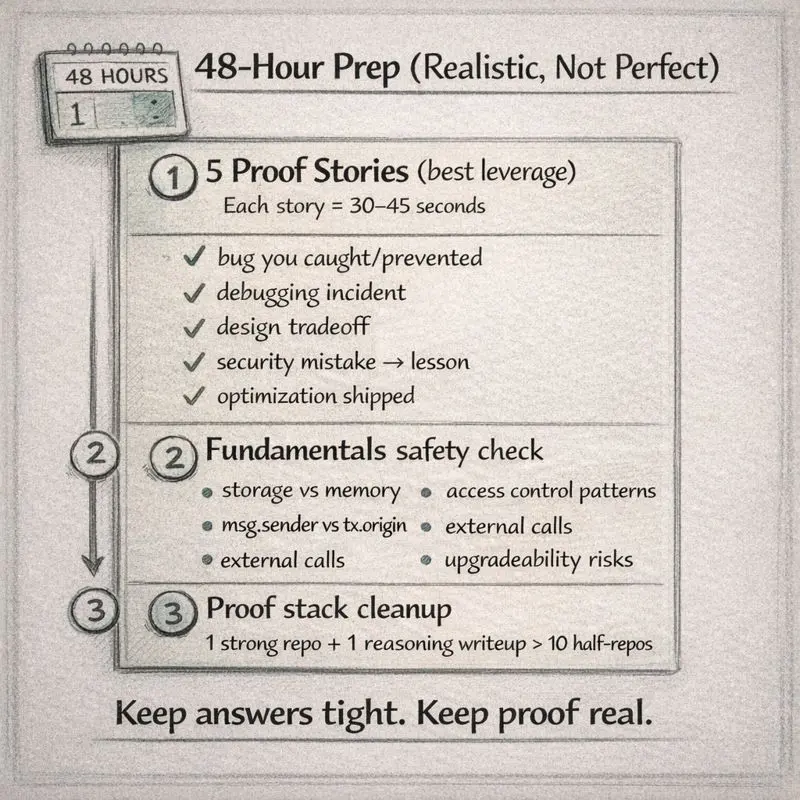
A strong answer usually shows concept + decision boundary + risk in under 40 seconds.
For most candidates, the real failure is not a lack of knowledge. It is rambling, bluffing, or sounding memorized.
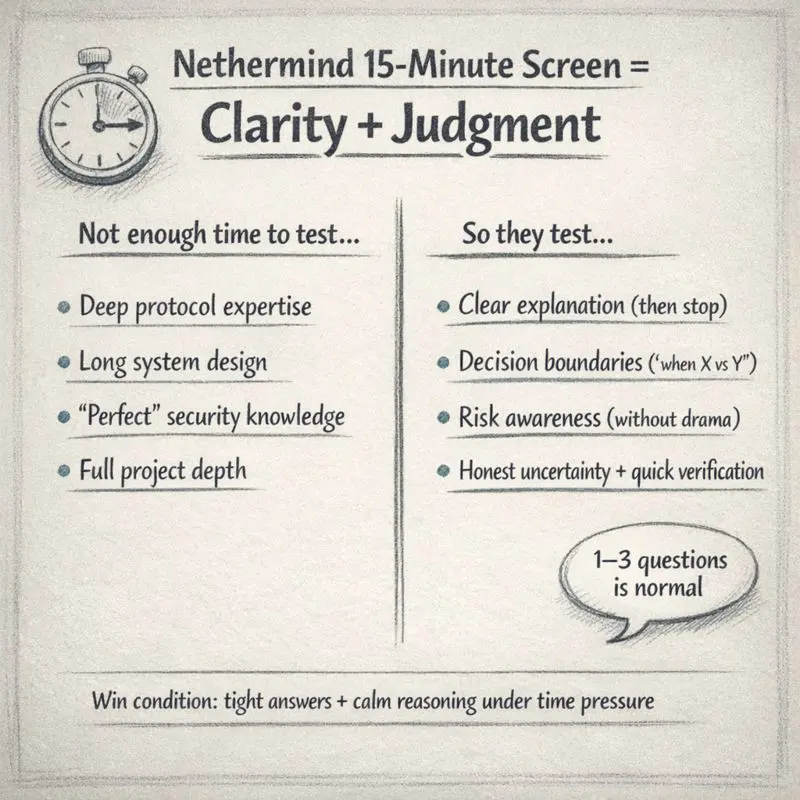
What candidates report Nethermind actually tests in the 15-minute screen
1) Can you explain one smart contract concept without sounding scattered?
In a short round, clarity matters more than coverage. A concise answer usually performs better than a long answer with too many side notes.
2) Can you make a simple technical judgment?
If they ask something like Foundry vs Hardhat, upgradeability, access control, or external calls, they are often checking whether you can say when you would choose one path over another.
3) Do you notice obvious smart contract risk?
You do not need to sound like a senior auditor. But mentioning things like storage mistakes, external call risk, access control issues, or upgrade/admin risk makes your answer sound grounded.
4) Can you stay honest under pressure?
A calm “I’m not fully sure, but here is how I would verify it” usually reads better than a polished but fake answer.
If you need a broader fundamentals refresher after this page, use the Smart Contract Fundamentals Hub or the Security Audits Hub as support reading.
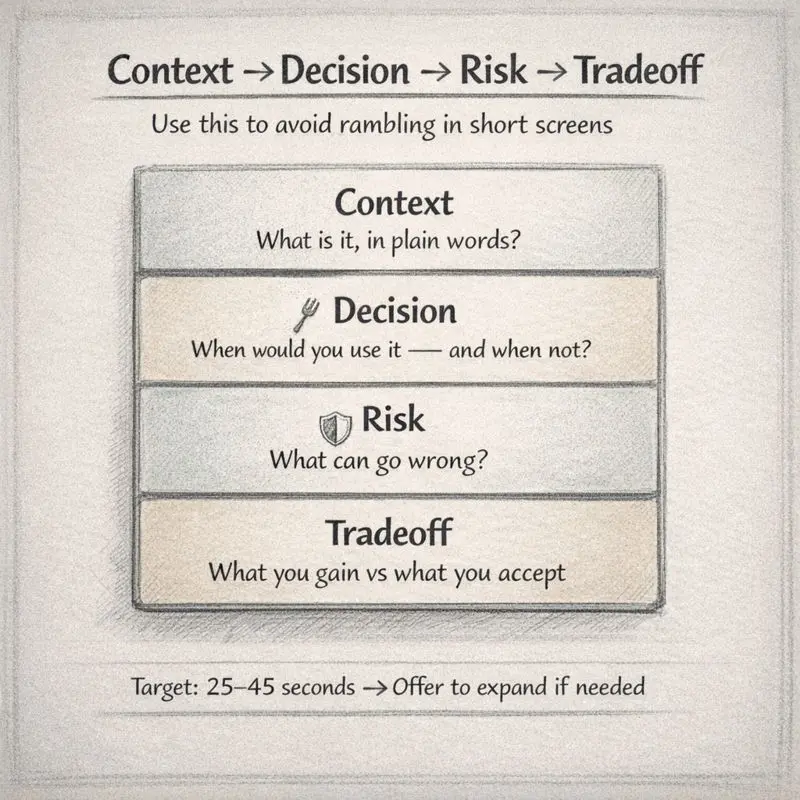
The answer structure that keeps you from rambling
Use this for most short interview questions:
Context → Decision → Risk → Tradeoff
It forces your answer to stay tight and meaningful.
Context: what is it (1–2 lines)
Decision: when you’d use it (1–2 lines)
Risk: what can go wrong (1–2 lines)
Tradeoff: what you gain vs what you accept (1–2 lines)
This doesn’t make you sound “scripted.” It makes you sound organized.
Two model questions + short strong answers (use as practice)
*These are not “perfect answers.” They’re examples of tight answers that show judgment.*
Model Q1: “Explain upgradeability risk.”
Answer (30–40 seconds):
“Upgradeability lets you change logic while keeping the same contract address and state, usually via proxies. I’d use it when product iteration is needed, but only with clear governance and safeguards.
The main risks are storage layout mistakes, upgrade admin key abuse, and unexpected behavior changes after upgrades. The tradeoff is speed and maintainability versus operational and governance risk — so the upgrade process and monitoring matter as much as the code.”
Why this usually works: it names the concept, decision boundary, risks, and tradeoff without drowning in details.
If you want fundamentals that support answers like this:
Smart Contract Fundamentals Hub: EVM Execution, Solidity First Principles, and Mainnet-Ready Mental Models | ArtofBlockchain
Model Q2: “Explain reentrancy like you’re warning a teammate.”
Answer (25–35 seconds):
“Reentrancy happens when a contract sends value or makes an external call before it finishes updating its own state, and the external contract calls back into the original function while it’s in an unsafe intermediate state.
The risk is repeated withdrawals or state manipulation. Typical defenses are checks, effects, and interactions, reentrancy guards, and careful external call placement. The tradeoff is sometimes design complexity or gas overhead, but it’s usually worth it for safety.”
Why this usually works: it explains the pattern, shows what can go wrong, and gives prevention options without sounding like a checklist.
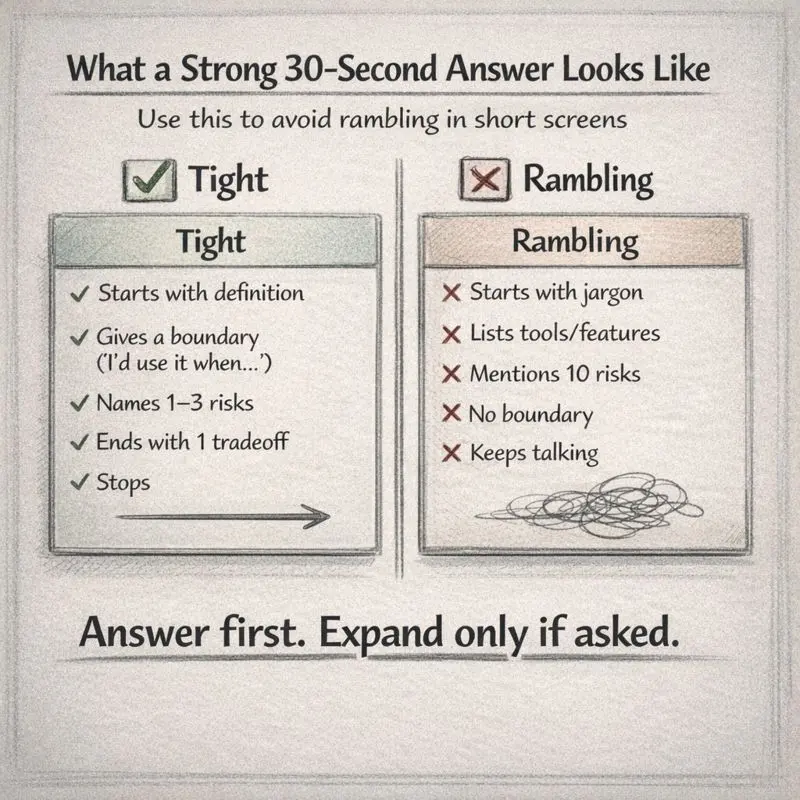
A realistic 48-hour prep plan for a short Nethermind screen
If the interview is close, do not try to learn all of Ethereum again. Focus on what this round can realistically test.
Step 1: Prepare 3 short answer blocks
Be ready to explain, in 30–40 seconds each:
one smart contract concept,
one tradeoff-based technical choice,
one security or failure-mode example.
Step 2: Revise only the fundamentals most likely to show up
Do a light refresh on:
Storage vs memory,
Access control,
External calls,
Reentrancy,
Upgradeability basics,
msg.sender vs tx.origin.
Step 3: Keep one project example ready
If they ask what you have built or touched, mention one clean example with what you did, what decision you made, and what risk or bug you noticed.
If you want broader project-articulation or GitHub-proof help after this, that should sit as a secondary path — not as the main job of this page.
Common mistakes (and safer alternatives)
Mistake: “I know rollups / ZK / MEV” (no decision logic)
Safer: “I’ve used X; when choosing Y I consider these 2 factors…”Mistake: speaking for 90 seconds before answering
Safer: answer in 20 seconds, then offer to expandMistake: bluffing
Safer: “I’m not fully sure — here’s how I’d verify quickly”
If your goal is job search strategy beyond one interview:
Job Search & Web3 Career Navigation Hub | ArtofBlockchain
FAQs
What should I expect in a 15-minute Nethermind technical interview?
Usually a short reasoning round with 1–3 questions. The interviewer is often testing how clearly you explain concepts, how quickly you show decision logic, and whether you notice obvious smart contract risks.
Is the Nethermind interview round for interns or junior candidates very deep?
Usually not at this stage. It is more often a signal check for communication, basics, and technical maturity under time pressure.
How should I prepare for a Nethermind interview in 48 hours?
Do not over-study. Revise smart contract basics, prepare 3 short answer blocks, practice answering aloud, and keep one project example ready.
What topics may come up in a short Nethermind technical screen?
Common areas include storage vs memory, access control, external calls, reentrancy, upgradeability basics, and simple tradeoff questions like tooling or design choices.
What is the biggest mistake candidates make in a short technical interview?
Trying to sound advanced instead of sounding clear. In short rounds, rambling hurts more than saying less.
Should I talk about GitHub in a 15-minute technical screen?
Only if relevant. Mention one repo or one project if it helps prove your reasoning. Do not dump your whole portfolio unless they ask.
What should I ask at the end of a Nethermind interview?
Ask about the kind of work the role handles, how success is judged in the first weeks, and what technical depth they expect from someone joining at this level.
How to answer system design questions in a short interview
Answer with a boundary first: “It depends on X and Y.” Then give one tradeoff and one risk. Don’t try to teach a full lecture.
How to explain smart contract security clearly in interviews
Explain one failure mode in simple words, then state one mitigation and one tradeoff. Avoid listing 20 vulnerabilities like a memorized sheet.
What questions to ask at the end of Nethermind interview
Ask about first 30–60 day success definition, review culture, and how the team handles upgrades/incidents.
How to talk about GitHub in a short interview
Point to 1 repo and 1 writeup that shows your reasoning. Quantity doesn’t help if it looks shallow.
Read next based on what you need:
Smart Contract Interview Prep: Solidity, Security, Debugging, and Hiring Signals | ArtofBlockchain
Smart Contract Fundamentals Hub: EVM Execution and Mainnet-Ready Mental Models | ArtofBlockchain
Read the real candidate experiences in our community discussion thread.
Need tailored support? If your resume is not getting shortlisted, read our breakdown on What Recruiters Reject in 10 Seconds, or connect with us on the homepage for CV reviews and proof-signal guidance.
CTA
If this interview feels harder than it should, the issue is often not only preparation. It is how your experience, proof, and project work are being framed.
If your resume is not getting shortlisted, read:
Blockchain CV Review: What Recruiters Reject in 10 Seconds (Proof-Stack Checklist) | ArtofBlockchain
If you want broader preparation after this round, use:
Smart Contract Interview Prep: Solidity, Security, Debugging, Take-Home Tests & Hiring Signals | ArtofBlockchain
If you want to strengthen how your work is presented for Web3 roles, connect with Home | ArtofBlockchain for CV review and proof-signal guidance.