How to Transition from Web2 to Web3 Jobs: A Practical Roadmap (Without Starting From Scratch)

If you are trying to transition from Web2 to Web3 jobs, the hardest part is usually not learning blockchain from zero. It is figuring out which Web3 role fits your background, what proof of work you need to build, and how to make hiring teams take your existing experience seriously.
That is where most Web2 to Web3 career advice becomes weak. It tells people to learn everything at once: wallets, smart contracts, gas, tokenomics, DeFi, DAOs, Layer 2s, multiple chains, and three different programming paths.
The result is familiar. People spend months “learning Web3” but still cannot explain what role they are targeting, what artifact proves they can do the work, or why a recruiter should move them forward.
A practical Web2 to Web3 transition works differently. You do not need to erase your Web2 background. You need to convert it into visible hiring signals that make sense in a blockchain hiring context.
That is the real aim of this guide.
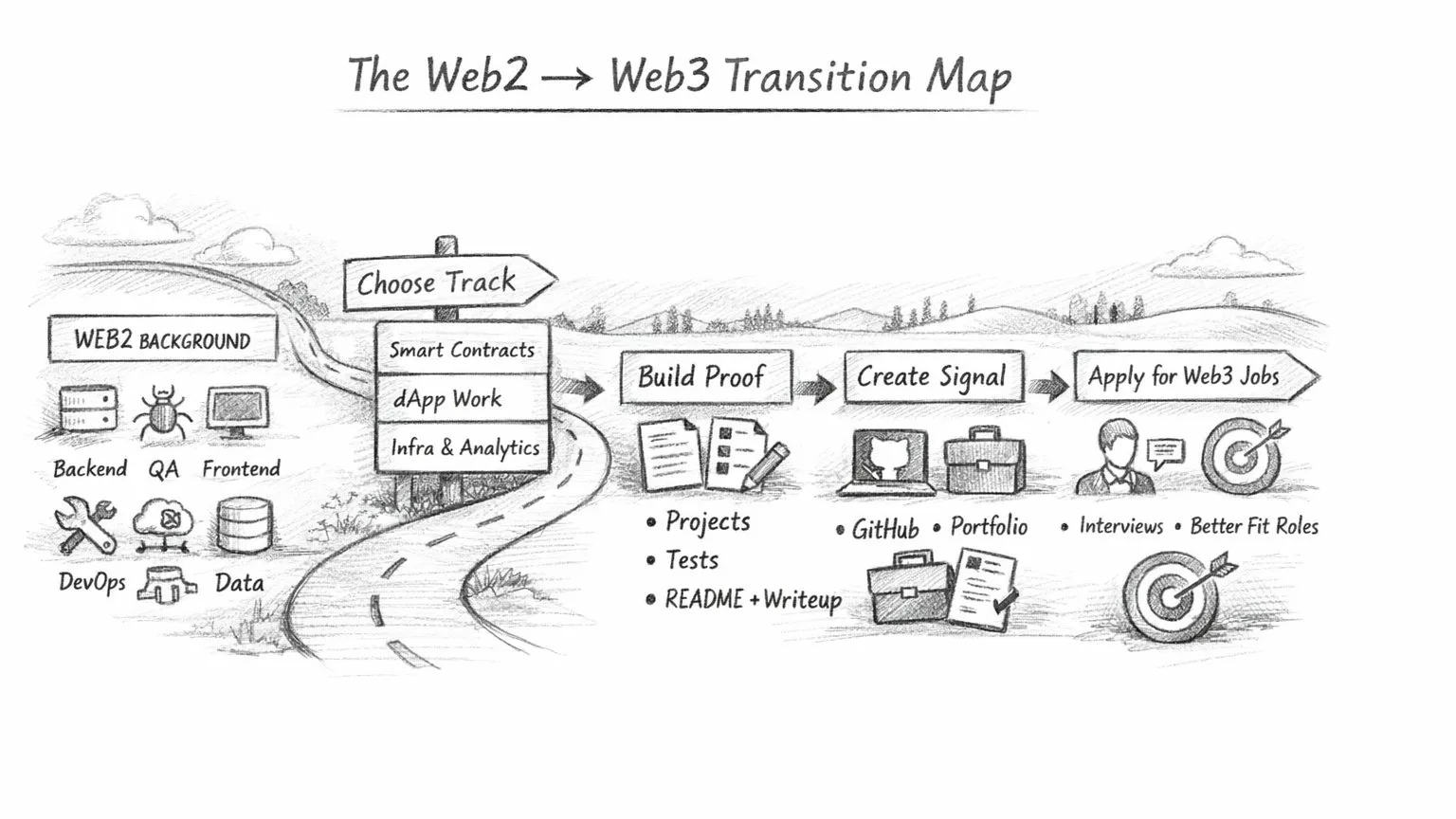
The AOB model for moving from Web2 to Web3: Track → Proof → Signal
Most people stay stuck because they move in the wrong order. They start with scattered topics instead of a role path.
A better sequence is this:
Track — choose one realistic Web3 lane that fits your current strengths.
Proof — build small public artifacts that show you can work in that lane.
Signal — present that proof in a way recruiters and hiring managers can scan quickly.
This sounds simple, but it changes everything. It stops the endless cycle of passive learning and replaces it with role-shaped progress.
In 2026, that matters even more. Hiring teams are not short on candidates who say they are “learning blockchain.” They are short on candidates who can show tested work, clear reasoning, scoped execution, and the ability to explain trade-offs without hiding behind jargon.
If you are completely new to blockchain basics, read that first, then return to this roadmap.
Relevant internal link:
Blockchain Basics | ArtofBlockchain
What a strong Web2 to Web3 transition actually looks like
A strong transition does not usually look like “I learned everything about crypto.”
It looks more like this:
one target direction
two or three scoped proof projects
tests or checks that show thought
a GitHub profile that is understandable
short writeups explaining what broke, what changed, and why
a resume and portfolio that point in one direction instead of five
That is the difference between learning activity and hiring progress.
If you read only one core idea from this article, let it be this: Web3 hiring rewards visible proof more than broad vague enthusiasm.
Relevant internal link:
Web3 Hiring Signals | ArtofBlockchain
Who this Web2 to Web3 roadmap is for
This guide is for people who already have real execution experience in Web2 and want to move into Web3 without pretending they are fresh beginners.
It is especially relevant for:
backend and full-stack engineers
frontend engineers moving toward dApp engineering
QA, SDET, and testing-focused professionals
DevOps and SRE professionals exploring blockchain infrastructure roles
data engineers and analysts interested in on-chain analytics or protocol data work
This is not a “learn every part of crypto” article. It is a practical roadmap for people who want to move from Web2 to Web3 jobs with a clearer role path and stronger proof.
What really changes when you move from Web2 to Web3
Web3 is not hard just because it is new. It feels hard because the environment changes what counts as good judgment.
In Web2, many teams work inside private systems, patchable deployments, reversible operational mistakes, and backend-controlled flows. In Web3-facing roles, you are often working closer to public state, wallet-driven interaction, visible transaction outcomes, harder-to-reverse logic, and systems where mistakes can become expensive fast.
A simple way to frame it is this:
In Web2, trust is often built into the platform. In Web3, trust often has to be visible in the design, the logic, the testing discipline, or the artifact itself.
That changes what hiring teams listen for. They want to know:
What assumptions you made
What could fail
What edge cases you tested
How did you reduced blast radius
What would you change in the next iteration
This is also why experienced Web2 professionals are often better positioned than they think. Many of them already know how to reason about production risk, rollback thinking, documentation, debugging, and failure patterns. The problem is not capability. The problem is translation.
Which Web2 skills transfer into Web3 roles better than people assume
One of the biggest myths in the Web2 to Web3 career shift is that you need to rebuild your identity from scratch. In reality, many Web2 skills become more valuable in Web3 when they are framed properly.
Engineering discipline transfers well
If you have shipped production systems, you already understand versioning risk, interfaces, maintainability, incident thinking, and the habit of asking what breaks first. That mindset matters in smart contract engineering, dApp logic, protocol tooling, infrastructure, and even analytics work.
Testing depth can become a serious advantage
This is one of the strongest transition edges for Web2 professionals.
In blockchain environments, bugs do not just create inconvenience. They can cause failed transactions, broken assumptions, trust damage, or financial risk. That is why teams pay attention to people who think clearly about regression, negative cases, reproducibility, and what must never happen.
If you come from QA, SDET, white-box testing, integration testing, or reliability work, you are often closer to blockchain testing or security-adjacent work than you think.
Relevant internal link:
Smart Contract QA Testing Hub: Flaky Tests, Coverage Drift, Gas Validation, and Interview Signals | ArtofBlockchain
Systems and failure-mode thinking matter more than syntax alone
If you have worked with distributed systems, backend services, infra, or operations, you already know how to reason about partial failures, flaky dependencies, retries, degraded conditions, and inconsistent system state. That maps much more directly to real blockchain work than many beginner tutorials admit.
Clear communication is a hidden hiring signal
Candidates who can explain what they built, what assumptions they made, what trade-offs they accepted, and what they would improve usually sound stronger than candidates who only list tools or chains.
That is why GitHub clarity, README quality, small writeups, and scoped explanations matter so much in a Web2 to Web3 transition.
Your Web2 background is not a weakness. It becomes leverage when it is turned into visible proof.
The minimum Web3 knowledge you need before you start applying
A lot of career switchers get trapped here. They think they need to master all of crypto before they are allowed to build.
That is usually a mistake.
For most entry paths, you only need a minimum working layer of Web3 understanding that helps you build safely, explain your work clearly, and avoid shallow confusion.
You should understand:
How wallets, signing, and transactions differ
What gas mean in practical usage
Why reverts happen
The difference between reading state and changing state
How logs and events matter for indexing, analytics, and UI behavior
Basic security awareness such as access control, unsafe assumptions, poor validation, and failure-state thinking
You do not need deep expertise in every chain, every L2, advanced cryptography, or token design theory before you can target your first realistic blockchain role.
This is where many people waste months. They over-learn theory and under-build proof.
How to choose the right Web3 track from your current background
The fastest path into Web3 is usually not the most glamorous one. It is the one closest to the strengths you already have.
A vague “I want to work in Web3” profile is hard to position. A focused “I am a backend engineer building toward smart contract development” profile is easier to understand and easier to hire.
Backend or API engineer
Good transition routes include smart contract development, protocol tooling, indexer-heavy systems, SDK work, and backend services around blockchain products.
This path suits people who already think in interfaces, correctness, business logic, and testable state changes.
Relevant internal links:
SC Security | ArtofBlockchainsmart contract-engineering | ArtofBlockchain
Frontend engineer
The best-fit path is usually dApp engineering.
This is not just React plus wallet connect. Strong dApp work means handling transaction states, sync problems, rejection flows, user confusion, and state that changes outside the UI.
Relevant internal link:
MetaMask Integration Tips for React Developers Switching to Blockchain | ArtofBlockchain
QA / SDET / testing-minded professional
This is one of the most underrated routes into Web3.
Strong testing professionals already understand something many beginners do not: software is not trustworthy because it works once. It becomes trustworthy when you know where it breaks, what must never happen, and how to test those boundaries repeatedly.
Relevant internal links:
Smart Contract QA Testing Hub: Flaky Tests, Coverage Drift, Gas Validation, and Interview Signals | ArtofBlockchainBlockchain QA for Software Testers: Do You Need Solidity, Better Test Logic, or Proof Artifacts? | ArtofBlockchain
DevOps / SRE / infrastructure engineer
This track is real, useful, and still under-discussed.
Node operations, RPC reliability, observability, deployment discipline, debugging unstable environments, and reliability documentation are all valid blockchain infrastructure strengths.
Relevant internal link:
DevOps to Blockchain: Do Web3 Teams Actually Hire Infra Engineers—or Is It a Dead End? | ArtofBlockchain
Data engineer or analyst
On-chain analytics and protocol data work can be a strong entry path for people who already know how to query messy systems, document assumptions, and explain what numbers do and do not prove.
Relevant internal links:
Blockchain Developer vs Data Scientist for Singapore (from Germany): Which path gets hired + EP pass reality in 2025? | ArtofBlockchainIs It Possible to Combine Data Science and Blockchain Development in One Career? | ArtofBlockchain
The biggest mistake in most Web2 to Web3 transition attempts
Most people do not fail because they lack intelligence or technical ability. They fail because they stay in undirected learning mode for too long.
That usually looks like:
Learning multiple ecosystems at once
Collecting courses instead of building anything
Cloning beginner projects with no real judgment
Having a GitHub full of activity but no coherent direction
Applying to many roles without a clear role signal
Trying to sound broad instead of looking credible
This creates a portfolio of motion, not a portfolio of trust.
The faster path is more boring, but it works better:
choose one lane, learn the minimum needed for that lane, build one small public artifact, test it, explain it, then repeat.
That is when a Web2 profile starts to look like a serious Web3 candidate profile.
What recruiters and hiring teams actually look for in Web3 career switchers
A recruiter or hiring manager usually is not asking, “How much content did this person consume?”
They are scanning for signs that the candidate can do scoped work safely, finish what they start, and explain what they did without hiding behind buzzwords.
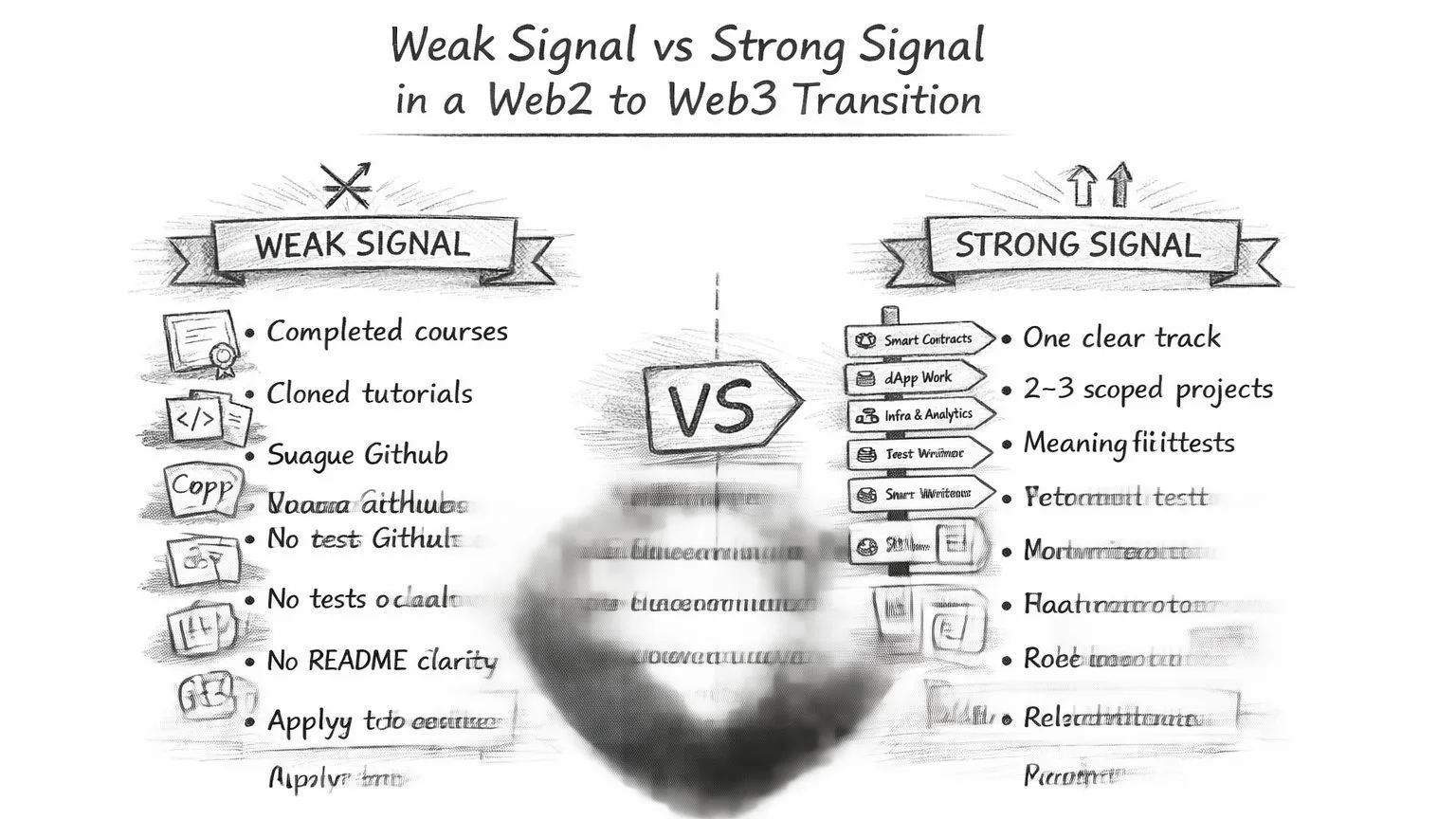
Strong signals often include:
A public repo that is understandable
Tests that show more than the happy path
A README that explains setup and intent clearly
Visible reasoning around edge cases or failure states
Evidence that the candidate can finish and document a scoped project
Consistency between GitHub, resume, portfolio, and target role
A weak signal is:
I completed a blockchain course and built a token project.
A stronger signal is:
I moved from backend engineering into smart contract work by building two scoped projects, adding tests, documenting assumptions, and explaining what could fail.
That difference matters more than many candidates realize.
Relevant internal link:
Web3 Hiring Signals | ArtofBlockchain
The practical 12-week Web2 to Web3 roadmap for working professionals
Most transition advice becomes unrealistic because it assumes unlimited time and attention. A better model is to think in phases of visible output.
Phase 1: Weeks 1–2 — pick a track and set up your environment
Choose one lane. Set up the basic tooling. Learn one working loop.
For example:
smart contract path: write, compile, test, deploy
dApp path: connect wallet, read state, send transaction, handle errors
infra path: run service, monitor health, debug issues
data path: query, clean, interpret, publish
Your goal by the end of this phase is not a masterpiece. It is one tiny complete artifact that proves you moved from reading to doing.
Phase 2: Weeks 3–6 — build one serious proof project
This is the most important phase.
Your first serious project should be small enough to finish and substantial enough to reveal judgment. It should force you to handle edge cases, failure conditions, permissions, UX friction, monitoring logic, or transparent assumptions.
Good examples include:
a contract with role-based permissions and a clean test suite
a dApp that handles pending, failed, and confirmed transaction states properly
a monitoring or incident writeup for a self-hosted node or RPC setup
an on-chain dashboard with reproducible queries and honest caveats
By the end of this phase, you should have one real proof project, not just a practice folder.
Phase 3: Weeks 7–10 — add a second project that shows growth
The second project should show improvement, not repetition.
That improvement might appear in stronger negative testing, cleaner documentation, better permission design, clearer transaction-state handling, more reliable infra notes, or more honest data interpretation.
Two projects with visible growth start to look like intent, not luck.
Phase 4: Weeks 11–12 — package the proof for hiring
This is where many good builders lose traction. They do the work, but they do not package it clearly enough for someone else to understand quickly.
At this stage, create:
a cleaner GitHub profile
one pinned project or pinned README
one short case-study style project summary
one resume version aligned to your chosen role
a more targeted application list
Relevant internal links:
job-search-hub | ArtofBlockchainHow do I Find a Blockchain Job? | ArtofBlockchain
What to build in each track if you want real hiring signal
Backend engineer to smart contract developer
Your early proof should show that you can handle business rules, permissions, state transitions, and testing discipline.
Escrow, vesting, reward logic, or role-based control projects usually create better hiring signal than empty token clones because they force more reasoning.
Relevant internal links:
Solidity and Rust for Real Careers, Not Just Code: A Blockchain Learning Roadmap That Works | ArtofBlockchainSC Security | ArtofBlockchainsmart contract-engineering | ArtofBlockchain
QA / SDET to smart contract testing or security-minded roles
Your edge is not “I also learned Solidity.” Your edge is that you can prove what must never happen and design tests around that logic.
A testing-heavy repo or a short exploit-analysis-style writeup can be a very credible proof artifact.
Relevant internal links:
Smart Contract QA Testing Hub: Flaky Tests, Coverage Drift, Gas Validation, and Interview Signals | ArtofBlockchainBlockchain QA for Software Testers: Do You Need Solidity, Better Test Logic, or Proof Artifacts? | ArtofBlockchain
Frontend engineer to dApp engineer
Your proof should show more than UI polish. It should show clean transaction lifecycle handling, user guidance, error-state thinking, and respect for wallet-driven complexity.
Relevant internal link:
MetaMask Integration Tips for React Developers Switching to Blockchain | ArtofBlockchain
DevOps / SRE to blockchain infra roles
A runbook, reproducible setup, monitoring dashboard explanation, or incident analysis can be stronger than many code-only artifacts here.
Relevant internal link:
DevOps to Blockchain: Do Web3 Teams Actually Hire Infra Engineers—or Is It a Dead End? | ArtofBlockchain
Data engineer or analyst to on-chain analytics roles
A strong artifact is usually a notebook, dashboard, or dataset explanation with transparent caveats and reproducible logic. Numbers alone are not enough. Interpretation quality is part of the signal.
Relevant internal links:
Blockchain Developer vs Data Scientist for Singapore (from Germany): Which path gets hired + EP pass reality in 2025? | ArtofBlockchainIs It Possible to Combine Data Science and Blockchain Development in One Career? | ArtofBlockchain
What a Web3 portfolio should actually include
A Web3 portfolio does not need to be visually fancy. It needs to be easy to scan and hard to misunderstand.
A recruiter should be able to understand four things quickly:
What you did before
What role you are targeting now
What proof you built
Whether that proof looks thoughtful or shallow
A strong portfolio usually includes:
A short positioning paragraph
Two to four proof projects
A repo or artifact for each project
A short note on what broke, what changed, and what you learned
Visible GitHub clarity
An easy next step for contact or resume access
Relevant internal links:
The Smart Contract Portfolio That Shows How You Think | ArtofBlockchainHow to Build a Blockchain/Web3 Portfolio That Recruiters and Hiring Teams Actually Trust | ArtofBlockchainGitHub for Blockchain Developers: Proof of Work for Web3 Hiring | ArtofBlockchain
Remote Web3 jobs and token compensation: the reality check most transition guides skip
A lot of people are drawn to Web3 because of remote-first narratives, global hiring, token upside, and the idea of faster-moving teams. Some of that is real. Some of it is heavily romanticized.
Remote blockchain jobs can still require:
time-zone overlap
contractor setup
travel expectations
country restrictions
higher self-management
more compensation volatility than candidates expect
If tokens are part of a role, career switchers need to understand:
what part of the package is fixed cash
what part is token-based
vesting and cliff structure
liquidity reality
lockups or sale restrictions
whether token compensation is upside or disguised salary risk
This matters even more for people moving from relatively stable Web2 compensation into earlier-stage or more volatile blockchain companies.
Relevant internal links:
Are Blockchain Developer Jobs Really Globally Remote? How to Spot US-Only and EST/PST-Filtered Web3 Roles Early | ArtofBlockchainSalary, Tokens & Compensation Hub | ArtofBlockchainIs It Safe to Accept Tokens Before Tokenomics Is Published? Developers Share What Really Happens | ArtofBlockchain
Conclusion: You are not starting over, but you do need visible proof
A successful Web2 to Web3 transition is not about proving that you know every blockchain concept. It is about proving that you can do scoped work in a Web3 environment with clarity, discipline, and follow-through.
That usually means:
choosing one lane
learning the minimum environment for that lane
building one public artifact
testing it properly
explaining your decisions clearly
repeating until your profile becomes coherent
If you feel stuck, do not ask only, “What else should I learn?”
Ask better questions:
Which Web3 lane fits my background best?
What would one credible proof artifact look like in that lane?
What would a recruiter understand from my GitHub today?
Does my resume, portfolio, and project history point in one direction?
That is where real progress usually begins.
Relevant internal links:
Blockchain Developer Resume Guide: How Web3 Recruiters Shortlist Candidates | ArtofBlockchainjob-search-hub | ArtofBlockchain
FAQs: Web2 to Web3 transition in 2026
Do I need to start from scratch to move from Web2 to Web3?
No. Starting from scratch is usually the wrong move. What matters more is choosing a realistic role path, learning the minimum Web3 concepts required for that lane, and building proof that translates your existing experience into visible hiring signals.
Is Solidity mandatory for getting a Web3 job?
No. Solidity matters for smart contract development roles, but it is not the only path. Testing, dApp engineering, infrastructure, and on-chain analytics can all be valid entry routes if your proof matches the work.
What is the fastest practical Web2 to Web3 roadmap for working professionals?
The fastest realistic path is to choose one track, build one small proof project in the first two weeks, build a stronger second artifact over the next month, then package that work into a cleaner GitHub, clearer resume, and more focused application strategy.
How many Web3 portfolio projects do I need before applying?
Usually two or three credible, scoped, and well-documented projects are stronger than a large set of shallow tutorial clones.
What do recruiters look for in Web3 candidates coming from Web2?
They usually look for clarity, tests, reproducibility, project explanation, failure awareness, and evidence that the candidate can finish scoped work. Strong README quality and visible reasoning often matter more than candidates expect.
Can QA or SDET professionals move into Web3 without becoming full smart contract developers?
Yes. Testing, security-minded validation, exploit reasoning, and reliability thinking can be strong entry routes into Web3, especially for candidates who can show proof through scoped artifacts and thoughtful documentation.
Is GitHub enough to prove I am ready?
Not by itself. GitHub only becomes a strong signal when the repos are understandable, scoped, tested, and aligned with the role you want.
What should I do first if my GitHub is empty today?
Pick one lane and build one very small but complete project. Add a README, meaningful tests or checks, and a short note explaining what you learned. That is usually more valuable than another week of passive learning.
Do I need deep blockchain theory before I start applying?
No. You need enough understanding to build safely and explain your work clearly. For most role transitions, coherent proof matters earlier than deep theory.
How do I prepare for Web3 interviews after building projects?
Be ready to explain your own decisions. You should be able to walk through what you built, what assumptions you made, what broke, how you tested it, and what you would improve next.