
Rewiring Institutional Finance: Gaya Chandrasekaran on Banking, Risk & Architecture of Tokenisation

When discussing institutional adoption of digital assets, the market often gets distracted by the assets themselves: the shiny new tokens, the speed of the blockchain, or the promise of decentralized finance. But what happens when the technological promise meets the complex, risk-sensitive reality of a traditional financial institution?
In our previous interviews, we’ve explored Web3 transitions through the lenses of ecosystem scaling, compliance, and EdTech pivots. Today, we are looking at the foundational plumbing of financial markets.
Meet Gaya Chandrasekaran. She brings nearly two decades of experience across corporate and investment banking, including senior leadership in wholesale credit risk and responsibility for complex institutional exposures, with involvement in significant transaction and regulatory decisions. Her career has given her a rare perspective across commercial opportunity, balance-sheet risk and institutional decision-making, an experience she now applies to the adoption of tokenised financial infrastructure.
When her banking role was made redundant, Gaya faced a decision: pursue another institutional position or use the opportunity to build an independent body of work. She chose the latter, most notably producing a 118-page whitepaper on the institutional architecture required for tokenisation at scale, proving that in Web3, authority is built on the public quality of your analysis, not the logo on your business card.
In this deep-dive interview, Gaya explains why institutional trust is a risk-allocation problem, where TradFi–DeFi partnerships typically fall apart, and exactly how Web2 professionals can create undeniable “proof of work” to launch their own careers in tokenisation.
Interview Questions
ArtOfBlockchain: To set the stage for our readers, could you share a bit about your background in traditional banking? What types of institutions did you work for, and what was the scale and scope of the portfolios you were managing?
Gaya: I have spent nearly two decades in corporate and investment banking across global financial institutions, working as a corporate banker, credit risk officer and investment banker. I began by managing relationships with UK corporate clients across a range of industries, later became Deputy Head of Wholesale Credit Risk, and ultimately moved into corporate finance origination for fintech clients, while leading the coverage of UK technology companies. I also served on senior risk committees with delegated authority and contributed to complex transaction, regulatory and portfolio-level decisions involving derivatives, repos, securities lending and structured products.
This experience taught me to examine financial innovation across its full institutional lifecycle, from the commercial opportunity and transaction structure to the balance-sheet, regulatory, risk and governance implications. It now shapes how I approach tokenisation. I evaluate whether a proposition is commercially compelling and the surrounding institutional architecture is sufficiently robust to support adoption at scale.
My banking background gives me a clear-eyed perspective on why technically elegant products often struggle. I look for the friction points where capital gets trapped, legal finality is missing, or rigid operating processes stall progress. And I use that lens to help innovation actually work within institutional reality.
ArtOfBlockchain: What specific moment, technology, or gap in traditional market infrastructure made you realize you needed to step outside of traditional banking and focus full-time on tokenisation and digital assets?
Gaya: There was no single inflexion point; my conviction accumulated over time. During my banking career, I saw how much of the financial system still depends on fragmented ledgers, repeated reconciliation, trapped liquidity and layers of intermediation. In 2022, I prepared an internal paper on digital custodians for senior management. What struck me was that distributed-ledger technology was not merely offering a faster version of an existing process. It was reopening fundamental questions about who records ownership, who controls an asset, what constitutes final settlement and where risk ultimately sits.
The gap became clearer as tokenisation narratives accelerated. The market often spoke as though issuance itself were the breakthrough. But issuing a token is relatively easy. Building the cash leg, legal rights, liquidity, governance, interoperability, capital treatment and operating controls around it is where institutional adoption becomes difficult. I became increasingly interested in that gap between technological possibility and institutional reality.
My move outside banking was not a perfectly scripted leap. When my role was made redundant, it created a decision point: return immediately to another conventional banking role or use the opportunity to build a body of work around questions I believed the market was underestimating. I chose the latter.
Working within a large financial institution has shown me both the need for innovation and the very real constraints institutions face in delivering it, from legacy infrastructure and regulatory obligations to risk appetite and competing commercial priorities. I now approach the market as a bridge between those developing new infrastructure and the institutions expected to adopt it. I’m interested in tokenisation because it can fundamentally change how money, collateral, and securities move. It’s a far more consequential proposition than just making finance look futuristic.
ArtOfBlockchain: When you leave the brand name and backing of a major financial institution, you have to build independent authority from scratch. How did you approach establishing that authority in web3, and what major research projects or publications did you create to demonstrate your expertise?
Gaya: Moving out of a large organisation is a humbling experience. You quickly realise that independent authority cannot be inherited from a former title or brand; it has to be demonstrated through the quality and usefulness of your work.
My approach was to make my thinking visible and specific. The centrepiece was my 118-page whitepaper, Tokenisation at Scale, which examines why tokenised markets remain small by focusing on institutional architecture rather than just a catalogue of use cases. I extended this foundation through published articles, a contribution to The Tokenization Handbook 2026, an educational course (launching soon), and my role as Executive in Residence at Global Digital Finance.
The most important point is that I did not try to manufacture visibility before I had substance. I built an intellectual spine first, growing my profile around one clearly defined proposition: tokenisation will scale only when institutional architecture is treated as the core design problem.
ArtOfBlockchain: In TradFi, executives rely on massive internal research desks. As an independent advisor and researcher, what does your actual research process look like? How do you practically filter through market hype to analyze the true architectural realities of a Web3 project?
Gaya: My research process begins with a deliberate question: what has actually changed? Beyond the press release, I want to know whether assets truly moved, if settlement was final, and who actually bore the risk.
I analyze projects across multiple layers, from legal finality and cash legs to legacy integration and commercial incentives, by triangulating regulatory and technical documents rather than relying on promotional summaries.
Crucially, I distinguish evidence from inference. A pilot involving ten prestigious participants signals interest, but sustained live activity provides much stronger evidence of adoption and commercial relevance. Independence is an advantage here because I do not need every development to be revolutionary. In a market full of announcements, disciplined scepticism is a form of value creation.
ArtOfBlockchain: Coming from a senior credit risk and corporate banking background, what is the single biggest operational or risk management blind spot you frequently see Web3 builders make when trying to appeal to institutional investors?
Gaya: The biggest blind spot is treating institutional trust as a messaging problem when it is actually a risk allocation problem.
Many builders assume that if the technology is secure, transparent, and efficient, institutions should be comfortable adopting it. But an institution asks a different set of questions: Who is legally accountable when something fails? Can a transaction be reversed or recovered after an operational error? What happens if a validator, custodian, bridge, oracle or settlement asset fails? How is access governed? How does the exposure appear in capital, liquidity, accounting and risk systems? Who owns the exception process at 3am?
Decentralisation can distribute technical functions while leaving economic and legal responsibilities ambiguous. Institutions are not inherently resistant to innovation; they are wary of risks they cannot identify, price, approve or control. The strongest Web3 propositions therefore do not merely promise to remove intermediaries.
They show, with clarity and precision, which risks disappear, which ones move, which new dependencies are introduced and who is accountable for each one. That translation from technological design into an institutionally governable risk model is where much of my work sits.
ArtOfBlockchain: You advise startups on market infrastructure and tokenisation. In simple terms, where are negotiations or partnerships between legacy banks and Web3 protocols usually falling apart, and how do you help solve that?
Gaya: Negotiations often fail because protocols and banks solve for entirely different outcomes. Protocols pitch speed and programmability, while banks demand a viable revenue pool, strong controls, and a clear path through compliance.
These partnerships typically break down in three specific areas:
Commercial: Business owners cannot justify the investment or identify who pays, despite enthusiastic innovation teams.
Architectural: The solution requires the bank to adopt inadequately defined settlement assets or custody models, or to absorb significant integration burdens.
Organisational: Promising pilots lack a clear internal owner to drive them through approvals and into production.
I bridge this gap by refining the institutional problem, identifying the relevant decision-makers and mapping the end-to-end operating and risk model. I bring clarity at the outset by separating what must be resolved for an initial deployment from what can evolve later. Often, success requires a narrower proposition: one asset class, one workflow, one balance-sheet benefit and one accountable sponsor. My goal is not to make a Web3 product sound like a bank. It is to make the value, risk and implementation path sufficiently clear for an institution to act.
ArtOfBlockchain: Our community strongly advocates for "proof-based hiring"—showing what you can build rather than just sending a resume. For a Web2 finance, risk, or legal professional looking to make a similar career pivot, what specific "proof of work" deliverable (e.g., teardowns, playbooks, models) should they build and publish to show Web3 founders they are ready?
Gaya: I would suggest producing an institutional adoption assessment of one live project rather than another generic explainer on blockchain. Choose a transaction, network or product relevant to your existing expertise and analyse it as though a board or investment committee had asked whether the institution should participate.
Start with the problem and the existing process. Then examine the proposed architecture, map the asset and cash flows, and consider stakeholder incentives, the risk and control model, regulatory dependencies, the commercial case and any unresolved questions. End with a clear recommendation such as adopt, pilot, partner, monitor or decline and explain what further evidence might change your view.
The deliverable could be ten rigorous pages or a concise slide deck. What matters is that it reveals judgment. A former lawyer should show how rights, liability and finality work in practice. A risk professional should map failure modes, controls and exposures. A finance professional should quantify economics, capital usage or liquidity benefits. Do not imitate a protocol engineer if that is not your expertise. Web3 has plenty of technical commentary; what it needs is professionals who can apply institutional knowledge to new architecture.
Publishing one strong report is useful. Publishing a sequence of three, with a consistent analytical framework, begins to create a position in the market. Proof of work becomes authority when people can see not only what you know, but how you think.
ArtOfBlockchain: Looking back at your own journey, if you had to give just one piece of high-impact advice to a corporate professional reading this who wants to transition into the tokenisation space over the next 6 months, what should their very first step be?
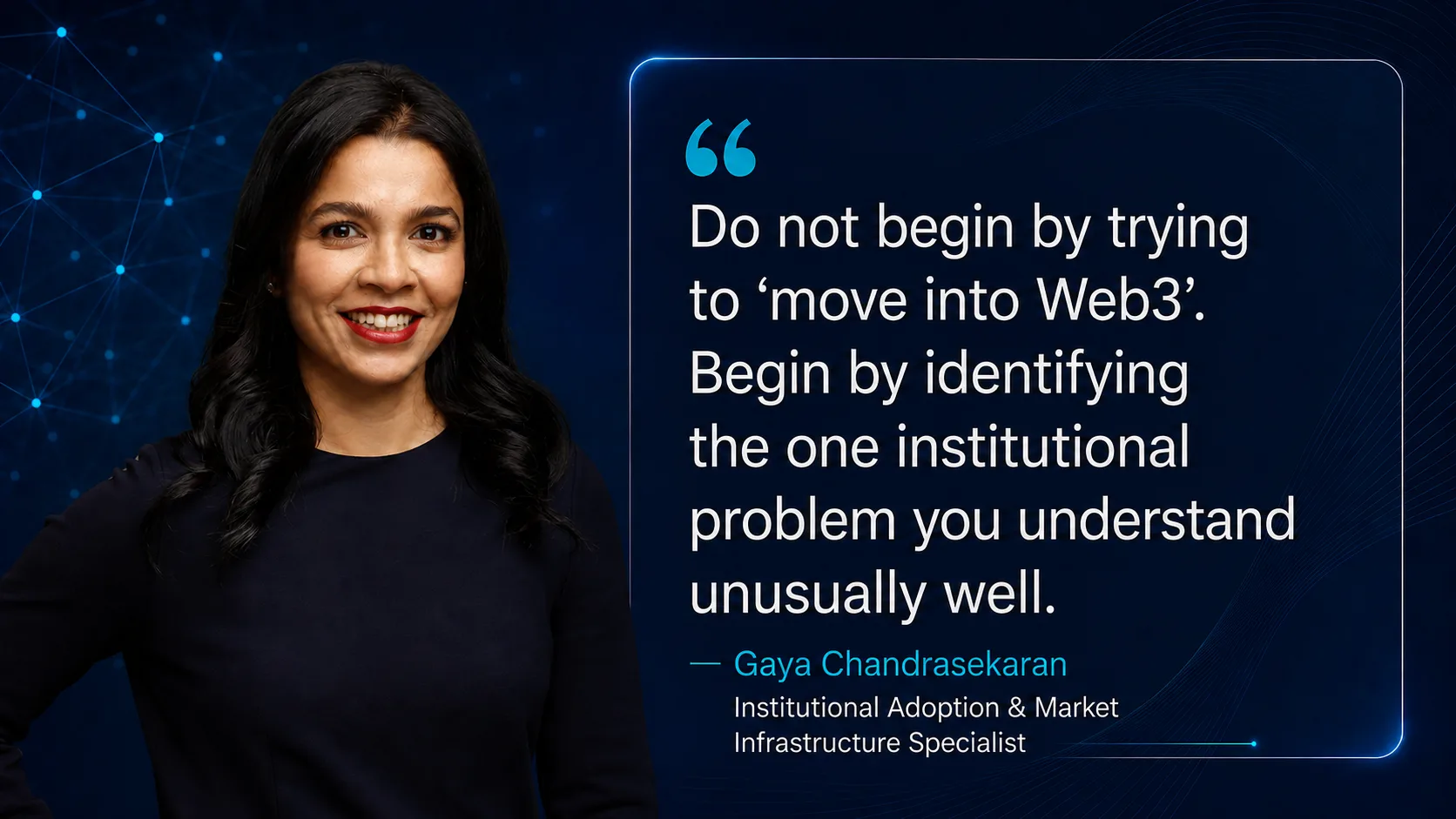
Do not begin by trying to ‘move into Web3’. Begin by identifying the one institutional problem you understand unusually well and examining how tokenisation changes it.
The market does not need another broad enthusiast. It needs people who understand collateral mobility, securities settlement, treasury, custody, credit, compliance, legal finality, client adoption or operating risk and who can connect that expertise to new rails. Your existing career is not baggage to discard; it is your source of differentiation.
In practical terms, spend the first month choosing a narrow problem and producing a serious point of view on it. Speak to practitioners, study live implementations and publish your analysis.
Let that work guide the courses you take, the people you approach and the roles you pursue. Six months of visible, cumulative work around one important question will take you further than six months of collecting credentials and describing yourself as passionate about blockchain.
My own journey became clearer when I stopped trying to cover the entire digital-assets market and concentrated on the institutional architecture of tokenisation. Specificity did not make the opportunity smaller; it made my contribution recognisable.
Gaya’s journey offers a masterclass in what we champion here at ArtOfBlockchain: Proof-based capability.
Her transition wasn’t about blindly adopting a new technology; it was about applying her deep, hard-won institutional knowledge to a new architectural challenge. For professionals looking to transition, her advice is the ultimate cheat code: Do not try to be a generalist.
Instead of writing another generic summary of what blockchain is, find the exact operational friction point you already understand—whether that is legal finality, credit risk, or treasury operations- and analyze how tokenisation changes it. Show your judgment. Map the failure modes. Build your own 10-page thesis and share it publicly.
When you treat your existing career as your greatest differentiator rather than baggage to discard, you stop asking for a seat at the Web3 table—you build the table yourself.
About the Guest: Gaya Chandrasekaran
Gaya Chandrasekaran has nearly two decades of experience in corporate and investment banking within global financial institutions, spanning origination, structuring, and risk oversight of complex financial products.
Having operated as both a corporate and investment banker and as Deputy Head of Wholesale Credit Risk, she maintains a comprehensive view of the institutional lifecycle, from client origination through to balance sheet and regulatory considerations. She has served on senior risk committees with delegated authority and has led complex regulatory and portfolio-level decision-making across large institutional exposures.
Drawing on this experience, her current work focuses on the institutional adoption of tokenisation and the evolution of financial market infrastructure. She works across advisory mandates, research, and industry engagement, translating emerging technologies into business, risk, and governance frameworks that can be implemented within institutional environments.
Gaya is the author of the 118-page whitepaper, Tokenisation at Scale: Institutional Architecture as the Decisive Factor. She also contributed to the Tokenization Handbook 2026 with Evergon Labs and serves as President of the Alumni Tech Club at London Business School.
Beyond financial markets, Gaya is a five-time international award-winning abstract landscape artist who explores memory, transformation, and our emotional relationship with the natural world.
Connect with Gaya:
LinkedIn: gayathrisaichandrasekaran
Medium: @cgayathrisai
Website:Gayachandrasekaran