How to Move into Web3 Compliance: TradFi & Cyber Career Roadmap

Updated for 2026: This guide is for AML, fraud, cyber, legal, banking, payments, operations, and policy professionals who want to move into Web3 compliance, crypto AML, blockchain forensics, stablecoin operations, RWA tokenization, or CBDC-adjacent roles without pretending to be developers.
Blockchain hiring is growing beyond smart contract development.
New global rules in the EU, US, and internationally mean crypto companies must hire more people who are not software developers. Banks, stablecoin companies, and other firms are now looking for experts in anti-money laundering, blockchain investigations, asset compliance, and money transfers. This guide shows how professionals with backgrounds in banking, fraud, cybersecurity, law, and risk management can move into these new Web3 jobs by showing proof of their skills.
If you want to explore this complete career path in one place, start with AOB’s Web3 Compliance & AML hub, which revolves around crypto compliance, AML, blockchain forensics, stablecoin risk, RWA, CBDC careers, and proof-based hiring signals for Web3 roles.
Founder’s First-Hand Hiring Insight:
Across 200+ candidate profile reviews on Art of Blockchain, banking AML analysts consistently fail to land interviews due to omitting practical on-chain work. Web3 hiring managers actively select candidates who attach a brief 2-page mock incident report tracing cross-chain bridge flows on Etherscan. Demonstrating live wallet-tracing logic creates far more hiring confidence than listing five years of traditional banking tenure.
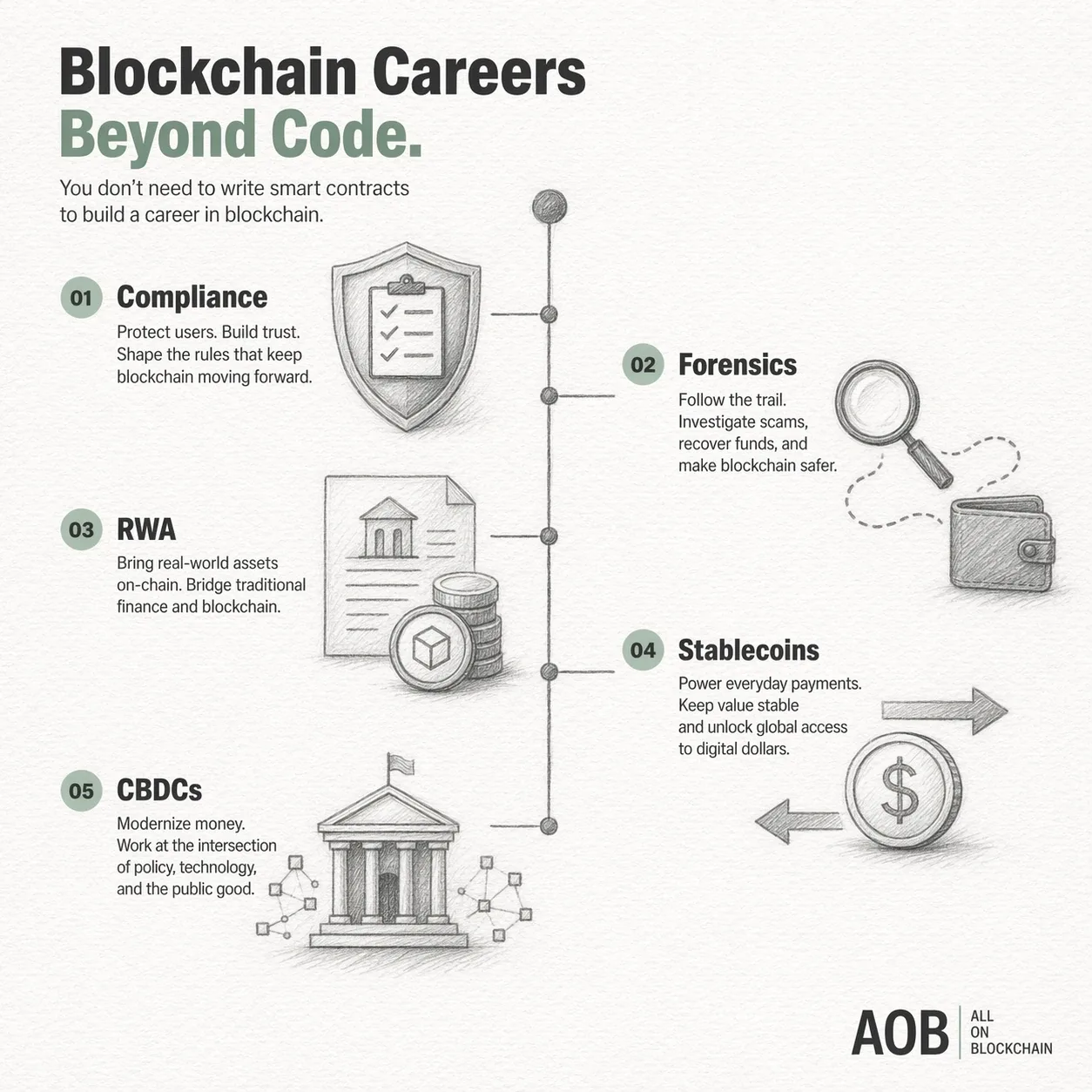
Why Web3 compliance, AML, forensics, stablecoin, RWA, and CBDC roles are getting attention
Blockchain hiring is no longer only about developers.
As more companies work with tokenized assets, stablecoin payments, transaction monitoring, crypto exchanges, digital asset custody, and financial crime controls, they also need people who can handle documentation, escalation, investigations, reporting, operations, reconciliation, and policy-linked execution.
That is why roles in compliance, blockchain forensics, RWA operations, stablecoin workflows, and CBDC-related research or implementation are becoming more visible in the market.
Institutional asset tokenization introduces new compliance architectures like permissioned smart contract standards. Explore our discussions on career options in RWA tokenization
and career opportunities in Central Bank Digital Currencies (CBDCs)
Why this hiring lane matters now
A meaningful part of blockchain hiring is moving closer to regulated money, regulated assets, investigations, reporting, transaction monitoring, tokenized infrastructure, and policy-driven systems.
This part of blockchain hiring matters because it changes who becomes valuable.
In tokenized asset work, value comes from understanding onboarding rules, asset restrictions, custody boundaries, approvals, redemption flows, reporting, and operational exceptions.
In stablecoin operations, value comes from understanding payment documentation, transaction monitoring, reconciliation, settlement clarity, contractor or payroll workflows, and cross-border risk.
In blockchain forensics, value comes from tracing wallet activity, documenting evidence carefully, separating facts from assumptions, and communicating findings to risk, legal, compliance, or product teams.
In CBDC-adjacent work, value comes from connecting policy intent with implementation reality: privacy, distribution model, controls, governance, reporting, and operational friction.
That is why this side of blockchain hiring matters more than many candidates realize.
This is not a hype career. It is a trust, controls, and operations career choice.
2026 Non-Developer Web3 Career Paths & Salary Expectations
Crypto Compliance & AML/KYC Specialist
Pay Band: $75,000 – $115,000 (Mid) | $120,000 – $160,000 (Senior/Lead)
Core Responsibilities: Execute transaction monitoring, manage customer onboarding (KYC/KYB), track mixer interactions, and submit Suspicious Activity Reports (SARs).
Key Tools: Chainalysis, TRM Labs, Elliptic, Sumsub.
Blockchain Forensics & Investigations Analyst
Pay Band: $85,000 – $125,000 (Mid) | $130,000 – $175,000 (Senior/Lead)
Core Responsibilities: Conduct multi-hop wallet tracing, analyze protocol exploits, document scam patterns, and draft evidentiary reports for legal and law enforcement teams.
Key Tools: Etherscan, Solscan, Dune Analytics, Arkham Intelligence, Chainalysis Reactor.
RWA Tokenization Operations Specialist
Pay Band: $90,000 – $135,000 (Mid) | $140,000 – $185,000 (Senior/Lead)
Core Responsibilities: Oversee investor onboarding permissions, audit transfer restriction smart contracts (e.g., ERC-3643 / ERC-1400), manage custody boundaries, and execute asset redemption workflows.
Key Standards: ERC-3643, ERC-20, Rule 144A/Reg S compliance structures.
Stablecoin Payments & Settlement Operations Analyst
Pay Band: $80,000 – $120,000 (Mid) | $125,000 – $165,000 (Senior/Lead)
Core Responsibilities: Manage cross-border corporate payroll flows, execute Fiat-to-USDC/USDT reconciliations, monitor settlement liquidity, and manage mint/burn operational controls.
Key Protocols: Circle Account, Tether Treasury, Fireblocks, Bridge API.
Web3 Compliance "Proof Stack" Examples
Hiring teams prioritize non-developer candidates who demonstrate structured risk judgment through public, non-confidential case studies rather than broad enthusiasm:
Forensics Write-Up: Trace stolen assets from a public protocol exploit using Etherscan or Solscan, mapping wallet hops through mixing services or bridges to identify cash-out exchanges.
RWA Compliance Workflow Memo: Draft a step-by-step operational guide detailing how transfer restrictions (such as ERC-3643) enforce investor accredited status and whitelist validation during secondary market transfers.
Stablecoin Settlement Audit: Create a reconciliation checklist detailing automated fallback logic for cross-border merchant payouts using USDC when primary liquidity rails stall.
Which backgrounds can move into Web3 compliance, crypto AML, forensics, stablecoins, RWA or CBDC work?
Many people entering this lane are not starting from scratch.
The better question is not “Do I have a Web3 background?” The better question is: which part of my current experience already looks useful to a regulated blockchain team?
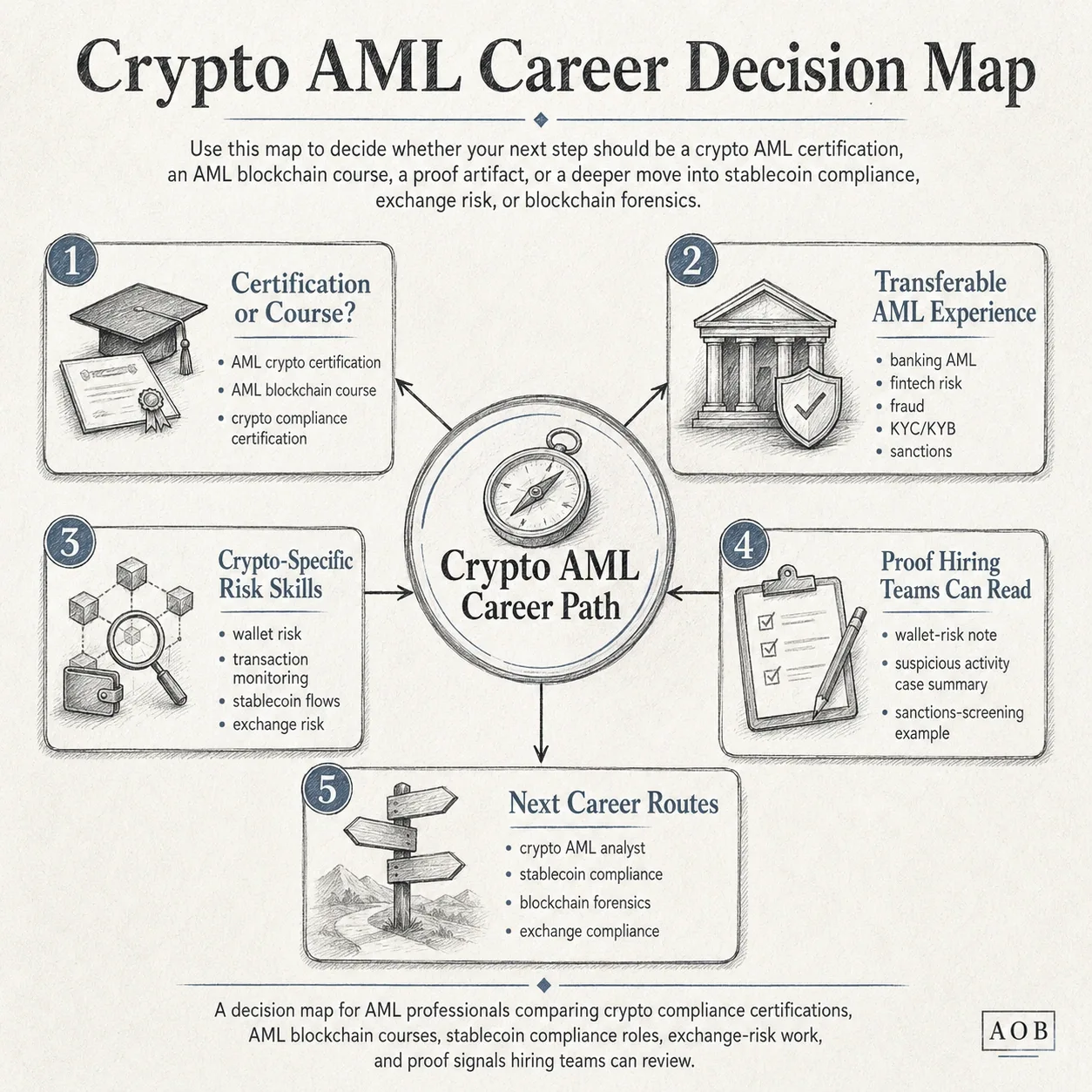
A fraud or investigations background can transfer into blockchain forensics, scam-pattern review, suspicious transaction analysis, wallet-risk notes, and financial crime investigation support.
A cybersecurity background can transfer into onchain investigations, wallet tracing, threat intelligence, fraud response, evidence handling, and incident-style reporting.
A banking, TradFi, or fintech background can transfer into crypto AML, KYC operations, transaction monitoring, risk review, reporting, payments operations, treasury workflows, and tokenization-related controls.
A legal or policy background can transfer into digital asset compliance, regulatory interpretation, governance-heavy roles, CBDC research, and policy-to-implementation work.
An operations background can transfer into onboarding, reconciliation, lifecycle workflows, exception handling, documentation, reporting, payment operations, and tokenized asset process design.
But a transferable background does not automatically become a hireable Web3 profile.
A hiring team does not automatically trust a candidate just because their old industry sounds related. They trust the candidate when the profile makes that transfer visible, specific, and role-aligned.
What proof do hiring teams trust for Web3 compliance, AML, forensics, stablecoin, and RWA roles?
Developers rely on code repositories to present their skills, but that strategy cannot be beneficial to every job seeker. If you are a developer looking to stand out, this AOB guide to portfolio projects reveals how hiring managers evaluate repos, tests, and documentation. However, if you are targeting Web3 compliance, forensics, or RWA roles, you need a different strategy for demonstrating expertise.
Hiring teams trust candidates who can show:
clear reasoning under uncertainty
readable case documentation
transaction-monitoring or wallet-risk judgment
understanding of workflows, controls, escalation, and reporting
ability to separate evidence from assumption
ability to communicate clearly across risk, operations, legal, product, compliance, or policy teams
That means the strongest proof is rarely “I am interested in compliance” or “I know about RWA.”
The strongest proof is a small sample of judgment.
Examples of safe public proof by role
For compliance / AML / KYC roles
A short mock case note showing how you would review a suspicious transaction pattern, what would trigger escalation, what additional information you would request, what you would not assume, and how you would document the decision.
For blockchain forensics roles:
A wallet-tracing note, scam-pattern breakdown, or public case analysis that clearly separates onchain evidence, inference, open questions, and uncertainty.
For RWA roles
A practical memo or explainer showing you understand onboarding, permissions, freeze logic, transfer restrictions, custody boundaries, redemption flow, reporting needs, and operational exceptions.
For stablecoin operations roles
A short process note explaining settlement flow, payment documentation, reconciliation logic, risk checks, chain selection tradeoffs, contractor or payroll handling, or fallback scenarios.
For CBDC or policy-adjacent roles
A comparative brief that shows you can connect policy choices to operational consequences, implementation friction, governance questions, and reporting requirements.
In this part of Web3 hiring, three patterns matter:
proof beats broad enthusiasm
readability beats jargon
role alignment beats surface-level adjacency
For a breakdown of how banking AML analysts transition into exchange and fiat-backed stablecoin risk roles, see our community roadmap on moving from AML analysis into stablecoin and crypto exchange compliance
Crypto Compliance & AML Careers: Entry Strategy
Candidates with traditional banking operations, fintech AML, and fraud investigation backgrounds can opt for crypto compliance roles directly. Hiring managers prioritize candidates who prove operational judgment under regulatory ambiguity.
Candidates should emphasize transaction review logic, suspicious activity report (SAR) documentation, escalation protocols, and risk communication across cross-border liquidity rails.
For an in-depth breakdown of analyst roles, certifications, and compensation structures, read our primary guide: Blockchain Compliance Careers (2026): Roles, Skills & Salaries.
If your immediate question is which AML crypto certification or AML blockchain course actually helps for crypto compliance analyst roles, start with AOB’s Crypto AML Analyst Career Hub. It will help you understand what the certification choices are, stablecoin compliance, exchange-risk work, transaction monitoring, wallet-risk judgment, and the proof hiring teams expect beyond course names.
Blockchain forensics careers: where to start
This is a natural fit for people from cyber, investigations, intelligence analysis, fraud review, or analytical reporting roles.
The biggest mistake here is assuming the lane is only about tools.
Tools matter. But entry-level trust usually comes from your ability to read flows, frame evidence carefully, and explain what happened without exaggeration.
That is why a clean case note can matter more than a vague claim about “learning forensics.”
Your positioning should emphasize evidence handling, wallet tracing logic, readable reporting, fraud pattern recognition, hypothesis discipline, and communication clarity.
If you want more context, these two discussions are a strong starting point: switching from investment banking forensics to blockchain forensics and getting started in blockchain forensics, fraud, scams, wallet tracing, and compliance investigations.
Real-World Asset (RWA) Tokenization Careers: Entry Strategy
RWA operations require bridging traditional asset servicing with permissioned smart contract logic. Hiring teams are keen to hire specialists who understand investor onboarding restrictions, whitelist validation, asset redemption mechanics, and compliance protocols such as ERC-3643 or ERC-1400.
Candidates coming from asset management, custody operations, or corporate trust showcase their readiness by drafting operational workflow memos detailing how off-chain legal authority reconciles with on-chain state updates.
Read our community breakdown on RWA Tokenization Jobs: Required Skills and Finance vs. Crypto Realities.
Stablecoin operations careers: where to start
This lane is especially relevant for people from payments, fintech ops, treasury, reconciliation, contractor payroll operations, and cross-border finance roles.
The weak version of this profile says only that they know USDC and stablecoins.
The stronger version explains how payment flow actually works, where documentation matters, what settlement clarity means, what breaks when reconciliation is weak, where compliance and operations meet, and how cross-border or contractor structures create risk.
This lane is also useful for AML and compliance professionals trying to move closer to payment infrastructure. That transition becomes clearer when you read
can AML analysts move into stablecoin compliance or crypto exchange compliance jobs.
CBDC careers: where to start
Even though CBDC-related jobs are narrower and do not have any fix set of skills requirements, they are not imaginary.
Candidates with professional background from research, policy, economics, digital payments, public-sector consulting, implementation strategy, and regulated systems work are more preferable to hiring teams.
The mistake here is sounding purely academic.
A stronger profile shows that you can connect policy intent, distribution model, privacy and control tradeoffs, operational workflow, reporting and governance implications, and implementation friction.
That makes the profile more useful to research, consulting, enterprise, or infrastructure teams operating in this space.
For more context on this path, see career opportunities in CBDCs: looking for advice.
TradFi-to-Web3 Positioning Framework
Professionals moving from traditional finance must translate their existing experience into explicit Web3 risk terminology. Banking compliance translates to crypto AML and transaction monitoring; cyber threat analysis maps to blockchain forensics; asset servicing transfers directly to RWA operations.
Two good supporting reads here are thinking about transitioning from TradFi to DeFi
how to transition from Web2 to Web3 jobs: a practical roadmap.
Decoding the Non-Developer Web3 Interview
Interviews in this lane usually test one thing over and over:
Can this person be trusted to think clearly in a regulated, ambiguous, operations-heavy environment?
Compliance interviews often test how you reason through suspicious activity, how you escalate without overreacting, how you document decisions, and how you communicate across teams.
Forensics interviews often test whether you can follow wallet flow logically, whether you can separate evidence from speculation, and whether your reporting is readable and restrained.
RWA interviews often test whether you understand lifecycle operations, whether you can reason through permissions, restrictions, redemptions, and control boundaries, and whether you think beyond the token itself.
Stablecoin operations interviews often test whether you understand payment workflow and operational risk, whether you think clearly about documentation, settlement, and reconciliation, and whether you understand real business friction, not just crypto terminology.
CBDC or policy interviews often test whether you can compare frameworks carefully, whether you can connect design goals to implementation consequences, and whether you sound operationally grounded, not just conceptually informed.
For broader preparation across adjacent roles, see AOB’s Web3 Non-Developer Interview Prep and Web3 Interview Signals and Calibration.
Salary, geography, and remote reality
This lane is global, but not friction-free.
A lot of candidates assume remote means easy mobility. In this area, that is often not true.
Compliance-heavy, payments-heavy, and policy-heavy roles may come with jurisdictional constraints, payroll restrictions, entity requirements, timezone dependency, licensing realities, or stronger preference for region-specific knowledge.
That means candidates should not evaluate salary or remote status in isolation.
They need to evaluate legal structure, reporting line, actual role scope, proof expectations, geography constraints, and compensation clarity together.
This is especially important in stablecoin, regulated asset, and compliance-heavy hiring.
For the broader reality check, use AOB’s Salary, Tokens & Compensation Hub
Global Relocation, Work Abroad, and Remote Restrictions Hub.
Where most candidates still get filtered out
Most people do not get rejected because they chose the wrong lane.
They get filtered out because their profile sounds too general for a trust-heavy role.
They read widely, take a few courses, learn the vocabulary, and then present themselves as interested in Web3 compliance or curious about forensics.
That does not create hiring confidence. In this part of the market, hiring teams are trying to reduce uncertainty fast. So the real shortlist question becomes:
Has this person made their judgment visible?
If the answer is no, even a relevant background can still look weak.
The hiring reality is simple:
Broad interest may get attention
Role-aligned proof gets shortlisted
For candidates who want a stronger shortlist story
If you are targeting compliance, blockchain forensics, RWA, stablecoin, or CBDC-adjacent roles and your background is relevant but your profile still feels too broad, this is usually a positioning problem, not only a skills problem.
AOB’s paid Web3 CV Signal Audit helps identify where your profile sounds too broad, where your Web3 proof is missing, and how your banking, AML, fraud, cyber, legal, payments, or operations background can be translated into a clearer role alignment
AOB’s paid Web3 CV Reposition + Rewrite is for professionals who want their role story rewritten around trust, clarity, and role alignment.
For hiring teams building in regulated Web3 roles
If you are hiring for compliance, investigations, tokenization, or stablecoin-related roles and your JD is attracting broad, weak, or mismatched applicants, the problem may start before the applications arrive.
AOB’s paid Blockchain Job Description Review Service for Web3 Hiring Teams helps tighten role clarity, proof expectations, candidate fit, and shortlist quality.
If you are ready to list a role, you can Post a Web3 Job on Home | ArtofBlockchain to reach a more targeted Web3 careers audience.
Regulatory mandates like MiCA in the EU and global FATF Travel Rule enforcement continue to expand non-engineering hiring across the digital asset industry. Candidates who publish concrete, non-confidential proof assets establish immediate credibility with hiring teams and position themselves for long-term career growth in regulated Web3 infrastructure.
Frequently Asked Questions (FAQs)
What non-developer Web3 jobs are in high demand in 2026?
Non-developer Web3 hiring focuses heavily on Crypto AML Analysts, Blockchain Forensics Specialists, RWA Operations Managers, Stablecoin Settlement Analysts, and Regulatory Compliance Leads. These roles manage transaction monitoring, sanctions screening, protocol risk assessments, and jurisdictional licensing under frameworks like MiCA and the FATF Travel Rule.
Can traditional banking and AML professionals transition into crypto compliance?
Yes. Professionals from traditional finance (TradFi), anti-money laundering (AML), fraud review, and audit backgrounds transition effectively into Web3 compliance. Hiring managers look for candidates who adapt existing suspicious activity reporting (SAR) frameworks and risk controls to on-chain transaction monitoring tools.
Is a law degree required for a career in Web3 compliance?
No. Most Web3 compliance and risk management roles do not require a law degree. Employers prioritize practical familiarity with blockchain forensics software, transaction monitoring workflows, and operational risk assessment over formal legal qualifications.
Which crypto AML certifications carry the most weight with Web3 hiring teams?
Hiring managers evaluate credentials based on job scope:
ACAMS CCAS (Certified Cryptoasset Specialist): Recognized for regulatory policy, VASP licensing, and compliance program design.
Chainalysis & TRM Labs Forensics Certifications (CKC, TRM-CCS):** The required industry standard for technical wallet-tracing, transaction monitoring, and financial crime investigation roles.
Are Web3 compliance and blockchain forensics jobs fully remote?
Many transaction monitoring and investigative roles offer remote flexibility. However, senior compliance managers, Chief Compliance Officers (CCOs), and regulatory liaison positions often require physical presence in specific jurisdictions due to local financial licensing and entity requirements.
How do candidates build Web3 compliance experience without exposing confidential client data?
Candidates demonstrate analytical judgment by publishing public, open-source case studies. Safe proof assets include public wallet-tracing reports on past protocol exploits using block explorers (Etherscan, Solscan), mock sanctions screening workflows, or RWA tokenization compliance memos.
✍️ About the Author
Shubhada Pande is the founder of Art of Blockchain and a Web3 hiring strategist specializing in non-developer talent positioning. Having evaluated hundreds of candidate profiles and consulted hiring teams across Web3 compliance, risk, and operations, she builds proof-based hiring frameworks for regulated digital asset roles.
🔗 Connect on LinkedIn | View AOB Career Discussions