
Global Relocation, Work Abroad, and Remote Restrictions in Web3: Practical Search Hub

Cross-border Web3 hiring splits across four legal models: employer-backed visa relocation, geo-restricted remote roles, international B2B contracting, and localized ecosystem hubs. Landing these positions requires solving for exact work-authorization laws, cross-border tax nexus rules, and verifiable on-chain proof.
Global Web3 Hiring & Cross-Border Relocation Blueprint:
> Navigating global Web3 employment requires understanding both physical visa pathways and cross-border remote entity structures:
> ATS & Proof-of-Work Playbook: Download our actionable guide on How to Land a Web3 Job Anywhere: Bypass ATS Filters with Proof-of-Work
> Cross-Border Payroll & Invoicing: Master international contractor setup and tax records with our guide to getting paid in USDC as a Web3 contractor
This index maps the compliance mechanics, payroll setups, and verification artifacts required to secure international blockchain roles.
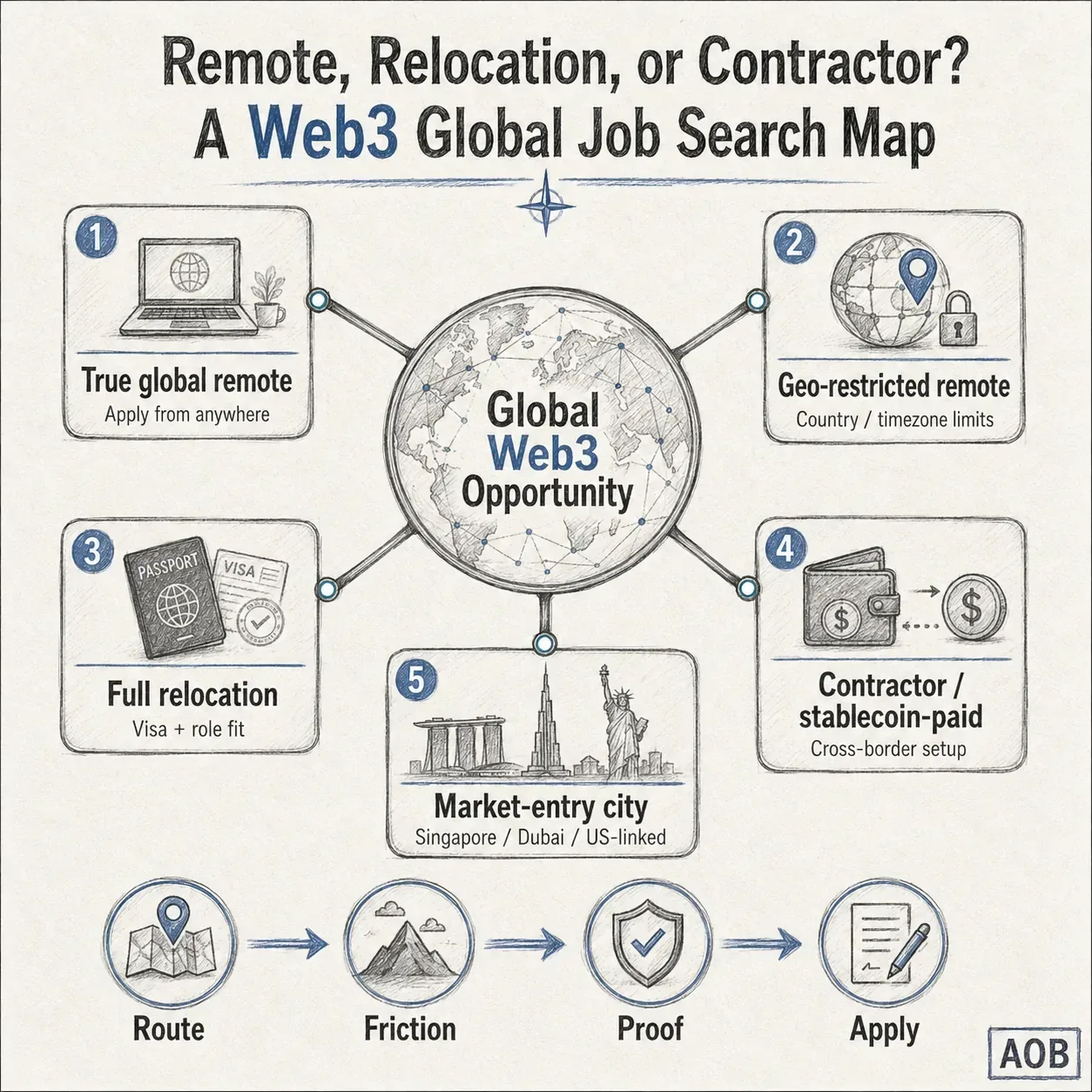
1. The Four Cross-Border Web3 Hiring Routes
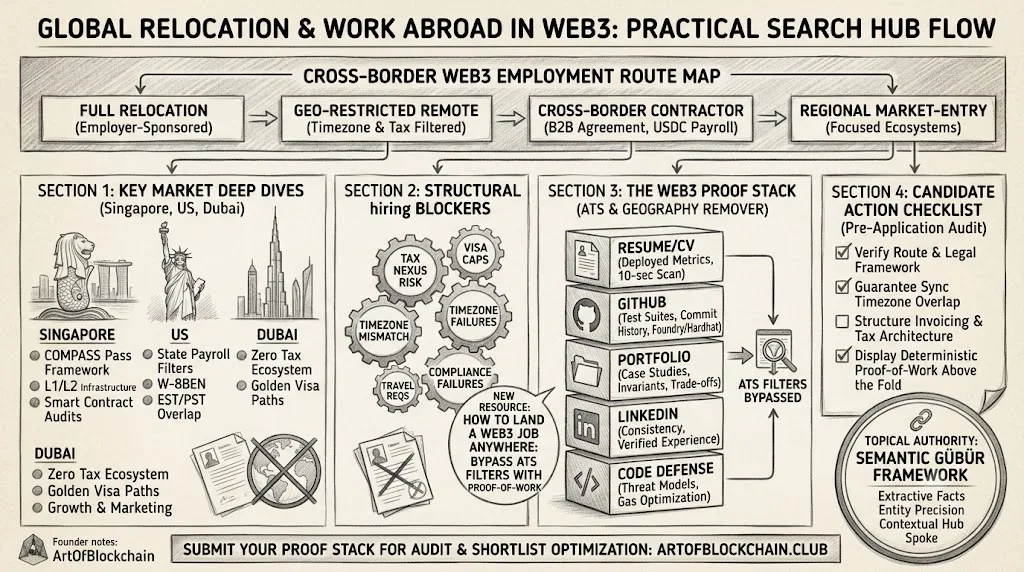
International blockchain roles operate under four distinct legal structures. Each model carries different compliance requirements and tax obligations.
Route 1: Employer-Sponsored Relocation
The hiring entity sponsors an employment visa in their jurisdiction.
Requirements: Ministry-level salary benchmarks, documented role scarcity, and employer compliance with local quota systems.
Core Jurisdictions: Singapore, UAE (Dubai/Abu Dhabi), United Kingdom, Switzerland.
Key Guides:
Singapore Employment Pass & COMPASS Scoring: Singapore Web3 Employment Pass (EP) Feasibility and COMPASS Scoring Guide
Dubai Relocation Economics vs. Bangalore: Dubai vs Bangalore for Blockchain Product Managers: Salary, Tax, Rent, and Real-Life Tradeoffs
Route 2: Geo-Restricted Remote Employment
Remote listings that legally restrict candidate location due to state entity registrations or synchronous sprint schedules.
Requirements: Domestic tax authorization (e.g., US permanent residency) or minimum 4-hour daily overlap with UTC-5 (EST) / UTC-8 (PST).
Core Limitation: Distributed teams often reject overseas candidates without domestic payroll registration to avoid permanent establishment tax liability.
Key Guides:
Spotting Hidden State & Regional Geo-Filters: Are Blockchain Developer Jobs Really Globally Remote? How to Spot US-Only and EST/PST-Filtered Web3 Roles Early
US Timezone Overlap and Shift Demands: Remote Blockchain Jobs Across Time Zones: Do Developers Actually Work Night Shifts to Match US Teams?
Route 3: Cross-Border B2B Contractor Agreements
Hiring through independent contractor agreements, direct wallet settlements, or third-party Employer of Record (EOR) platforms.
Requirements: IRS Form W-8BEN filing (for US clients), clear invoice settlement currencies, and local self-employment tax registration.
Payment Rails: USDC/USDT on-chain transfers, fiat wire transfers, or contractor payroll software (Deel, Remote, Bitwage).
Key Guides:
Structuring USDC Payroll & W-8BEN Contracts: USDC payroll for remote Web3 jobs (US): employee payroll vs contractor agreement vs EOR setup
Stablecoin Invoicing and USD Conversion Rules: US Web3 Contractor Paid in USDC? Invoice in USD + Conversion Rule + Proof Pack (Avoid Disputes)
Route 4: Regional Market-Entry Ecosystems
Targeting regional hubs based on protocol concentration, regulatory sandboxes, and developer density rather than general board listings.
Security & Infrastructure Hubs: Singapore and Switzerland (L1/L2 protocols, zk-proof engineering, security auditing firms).
Consumer & Liquidity Hubs: Dubai and Hong Kong (DeFi liquidity protocols, centralized exchanges, Web3 marketing).
Key Guides:
Singapore Infrastructure & Rust Hiring: Singapore Rust Jobs in Web3: Which Teams Actually Hire Rust L1/L2 Infrastructure
Smart Contract Security Auditing Teams: Singapore Smart Contract Security Jobs: Audit Firms vs. In-House Security
2. Structural Hiring Blockers in Global Web3 Recruitment
Cross-border rejections stem from concrete operational constraints rather than general applicant volume:
Permanent Establishment & Tax Nexus: Overseas companies lack the legal framework to run payroll in a candidate's jurisdiction without an established local entity.
Immigration Salary Floors: Frameworks like Singapore's COMPASS mandate high base salaries for foreign hires, pushing companies to sponsor only senior or lead engineers.
Synchronous Sprint Cycles: Fast-shipping protocol teams mandate shared core hours in UTC-5 (EST) or UTC-8 (PST) for code reviews and emergency patching.
Travel Mandates: Undisclosed quarterly sprints in hubs like San Francisco or Lisbon disqualify candidates who lack short-term business travel eligibility.
Entity Sanctions & Wallet Audits: Compliance checks (OFAC screening and non-custodial wallet verification) filter candidates late in the pipeline.
3. High-Friction Jurisdictions: US, Singapore, and Dubai
United States: Remote Constraints and Sponsorship Limits
US Web3 startups heavily prioritize domestic W-2 employees or US-based 1099 contractors. Remote job postings regularly enforce US work authorization to avoid foreign payroll reporting. Non-US engineers bypass this barrier by operating as cross-border B2B contractors with fixed UTC-5/UTC-8 daily overlap.
Analysis: Remote web3 jobs (US) with no visa sponsorship: Germany-based Solidity dev (4 yrs) — how do internationals still get shortlisted?
Risk Review: US Web3 offer background checks — what tends to go wrong at the last step? (DeFi / Solidity)
Singapore: Institutional Infrastructure & COMPASS Thresholds
Singapore concentrates on regulated digital asset frameworks and core protocol development. The Ministry of Manpower enforces the COMPASS scoring framework, evaluating candidate salaries, degree accreditations, and employer diversity quotas.
Ecosystem Analysis: Singapore Web3 Growth roles: EP pass reality, hybrid expectations, and SGD vs token pay — what should I verify?
Dubai: Zero-Tax Frameworks and Relocation Timelines
Dubai provides direct visa routes via Green Visas, Golden Visas, and free zone business setups (DMCC, DIFC). The ecosystem leans toward product development, exchange operations, and regional growth. High rental overhead makes base versus token equity compensation modeling critical before signing.
Relocation Modeling: Dubai to US relocation for Rust / protocol engineering: what candidates underestimate (visa + runway + timelines)
4. The Web3 Proof Stack: Bypassing ATS & Geographic Risk
When an engineering team hires across borders, their risk tolerance drops. Applicants who list tools without verifiable project records get screened out immediately by applicant tracking systems (ATS).
Bypassing geographic screening requires hard technical proof presented above the fold:
Resume & CV Architecture: Specific metrics on mainnet deployments, Total Value Locked (TVL) secured, and gas optimization data visible within a 10-second scan.
GitHub Repository Evidence: Hardhat and Foundry test coverage suites, formal verification scripts, and commit records proving direct repository ownership.
Production Portfolio: Architectural case studies detailing state machine design, invariant test runs, and threat models.
Code Defense: Precise articulation of security trade-offs, reentrancy guards, and architectural decisions during technical deep dives.
Technical Proof Guides & ATS Bypass Frameworks:
Bypassing Screening Filters: How to Land a Web3 Job Anywhere: Bypass ATS Filters with Proof-of-Work
Technical CV Auditing: Blockchain CV Review: What Recruiters Reject in 10 Seconds Proof Stack Checklist
Developer Repository Optimization: GitHub Account for Blockchain Developers: Why It's Essential for Showcasing Your Skills
Production Case Studies: Building a Blockchain/Web3 Portfolio Site: Sections, Case Studies, and Metrics
5. Candidate Action Checklist: Pre-Application Audit
Audit these four operational items before applying to international blockchain roles:
Model Classification: Verify whether the job opening requires domestic payroll residency, allows EOR onboarding, or operates via direct B2B invoicing.
Sprint Overlap: Confirm your schedule supports at least 4 hours of daily synchronous overlap with the protocol's primary timezone.
Invoicing Setup: Ensure your local tax entity, Form W-8BEN, and non-custodial settlement wallets are configured for clean payment records.
Header Architecture: Position your live smart contract addresses, test coverage badges, and GitHub links at the top of your resume to bypass automated location filtering.
Optimize Your Technical Proof Stack
If your applications fail to convert to technical interviews, your resume header and GitHub evidence likely trigger automated screening rejections.
Audit Your Proof: Web3 CV Review Services Are Now Open On ArtofBlockchain.club
Download the ATS Blueprint: How to Land a Web3 Job Anywhere: Bypass ATS Filters with Proof-of-Work
Search Verified Openings: ArtofBlockchain Curated Blockchain Developer Job Board