
Crypto AML Analyst Careers: Certifications, Proof & Risk Hub

Many AML professionals ask the wrong first question when they look at crypto compliance roles: “Which certificate should I get?”
Certification can help, but crypto AML analyst hiring usually looks for something more practical: transaction monitoring judgment, wallet-risk awareness, sanctions thinking, KYC/KYB understanding, exchange-risk context, stablecoin-flow awareness, and the ability to explain suspicious activity in a crypto context.
This AOB hub is for AML analysts, compliance professionals, banking professionals, fintech risk teams, fraud analysts, and career switchers exploring crypto AML analyst roles. If you reached this page while comparing an AML crypto certification, an AML blockchain course, a crypto compliance certification, or a short AML crypto course, use this hub as a role-specific map before spending money on another course.
For the wider cluster around Web3 compliance, AML, blockchain forensics, stablecoin risk, RWA compliance, CBDC careers, and proof-based hiring signals, start from the
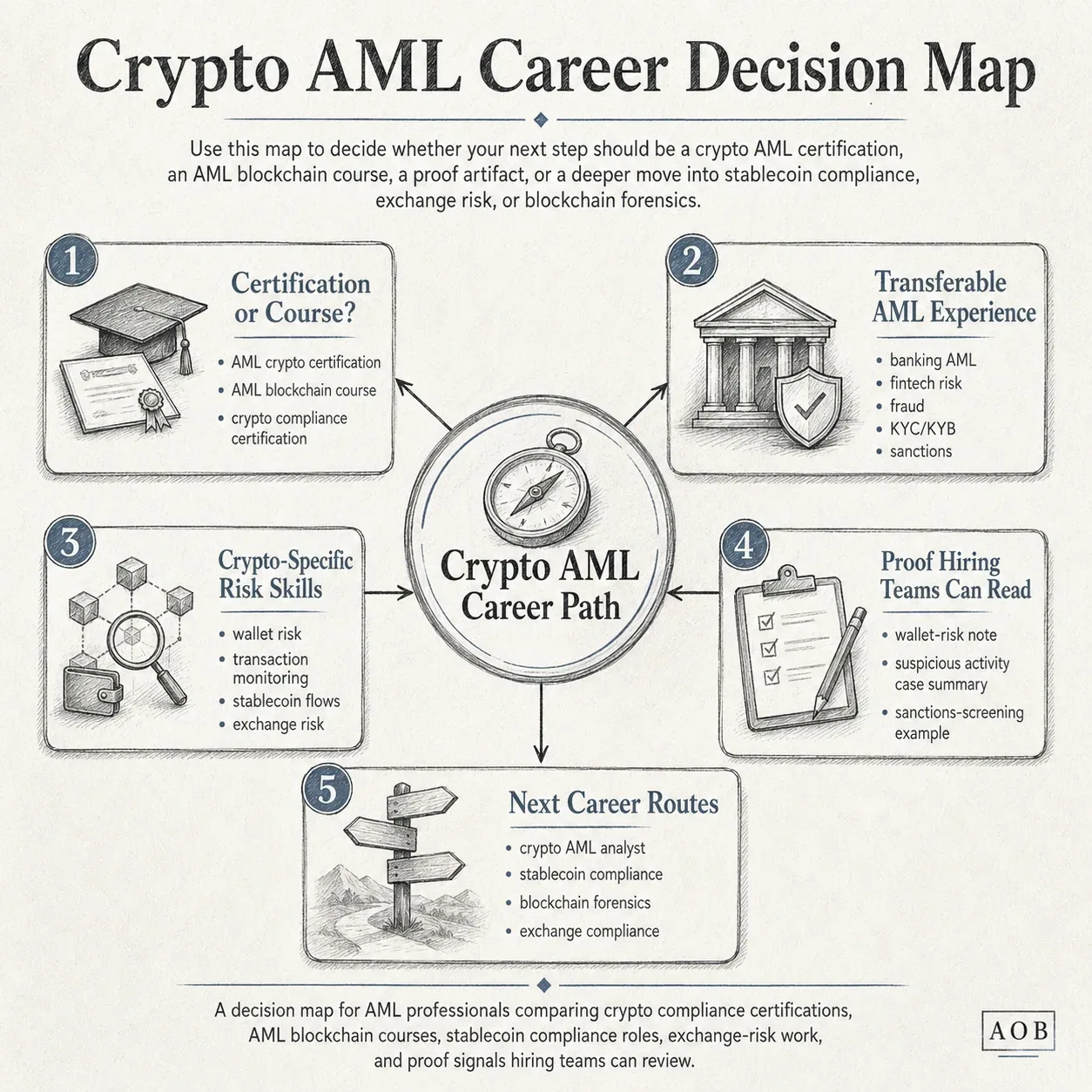
Quick map of this AML career hub
📌 Hiring Translation Note:
Traditional banking AML profiles fail when they list generic alert-clearing rather than blockchain-native judgment.
Compare required skills in Blockchain Compliance Careers: Skills, Education & Market Outlook and evaluate token standards in our discussion on understanding ERC-3643 for RWA compliance.
AML certification decisions
For professionals trying to decide which AML certification actually matters for crypto compliance jobs, whether a short course is enough to land an interview, and how hiring teams weigh certificates against practical proof.
Start here: Which Crypto Compliance AML Cert Actually Matters?
Stablecoin compliance transition
For professionals already working in AML, banking, payments, or fintech risk who need to understand how stablecoin or crypto exchange compliance differs from traditional frameworks.
Read the discussion: Transitioning from Traditional AML to Stablecoin Compliance
Wallet-risk and transaction-monitoring proof
Move beyond certifications. Here is how to actually document and showcase your practical judgment around wallet behavior, suspicious activity patterns, sanctions exposure, and exchange-risk.
Check the guide: Blockchain CV Proof-Stack Checklist
Blockchain forensics and investigation route
Candidates with backgrounds in fraud, audit, cyber, or financial crime often find a better fit transitioning into blockchain forensics, wallet tracing, or on-chain evidence review.
Explore the hub: Blockchain Forensics & On-Chain Investigation Careers
Broader Web3 compliance career path
For those still evaluating the differences between AML, stablecoin compliance, exchange risk, blockchain forensics, RWA compliance, CBDC policy work, and financial-crime investigation.
Read the guide: The Broader Web3 Compliance Career Path
Live AML and crypto compliance jobs
Analyze real job descriptions to see exactly what crypto compliance teams are currently demanding for AML, risk, stablecoin, and exchange compliance roles.
Browse live openings: Web3 & Crypto Compliance Job Board
Example opening: Financial Crimes Program Manager Role
If your AML experience is real but not getting shortlisted
When you are ready to make your experience readable for hiring teams, AOB’s Web3 CV Review can help you check whether your CV clearly shows transaction monitoring judgment, KYC/AML workflow understanding, wallet-risk awareness, sanctions-screening context, stablecoin-flow exposure, and proof signals for crypto compliance roles.
This is useful for candidates coming from banking AML, fintech risk, fraud investigation, operations, or financial-crime work who are applying to crypto compliance jobs but still look too traditional on paper.
Get your resume audited: AOB Web3 CV & Proof-Stack Review Service
Use this map to decide whether your next step should be a crypto AML certification, an AML blockchain course, a proof artifact, or a deeper move into stablecoin compliance, exchange risk, or blockchain forensics.
What crypto AML analyst roles may evaluate
Crypto AML analyst roles may evaluate more than a certificate.
They may look for whether you can understand transaction monitoring, wallet behavior, suspicious activity patterns, sanctions exposure, KYC/KYB workflows, exchange risk, stablecoin flows, and documentation quality.
For AOB’s proof-based hiring lens, the core question is: can you explain how AML thinking changes when the transaction trail is on-chain?
Proof signals for crypto AML candidates
Useful proof for crypto AML analyst roles can include:
A short wallet-risk explanation
A transaction-monitoring scenario
A stablecoin payment-flow note
A sanctions-screening example
A suspicious-activity case summary
A CV section that translates banking AML into crypto compliance language
Example: Instead of writing 'Reviewed daily transaction alerts for structuring,' translate it to 'Analyzed on-chain transaction flows and wallet clustering to identify potential dusting attacks and sanctions evasion.'
This kind of proof is especially important for candidates moving from TradFi, fintech, or banking into Web3.
A crypto AML candidate does not need to build a smart contract repo to prove relevance, but the same hiring logic applies: make your judgment easy to review. A small wallet-risk note, transaction-monitoring scenario, sanctions-screening explanation, or suspicious-activity case summary can work like a role-aligned proof artifact.
The useful question is: can a hiring team quickly understand how you think through wallet behavior, exchange risk, stablecoin flows, documentation quality, escalation logic, and suspicious activity in a blockchain context?
Start here based on your situation
If you are confused about AML certifications, start with the certification discussion. It is the better first route if your search is around AML crypto certification, AML blockchain course, or which crypto compliance certification actually helps before applying.
Read the discussion: Which Crypto Compliance AML Cert Actually Matters?
If you already work in AML and want to move into stablecoin compliance or crypto exchange compliance, start with this transition thread. It is closer to the real career question: how traditional AML, KYC, transaction monitoring, and financial-crime experience transfer into crypto compliance hiring.
Explore the guide: How AML Analysts Move into Stablecoin & Exchange Compliance
If your background is fraud, cyber, audit, banking investigations, or financial crime, also compare the blockchain forensics route. This is useful when your strongest proof may be wallet-risk analysis, suspicious-activity reasoning, investigation notes, or on-chain evidence review rather than a generic compliance certificate.
Read the guide: Blockchain Forensics & On-Chain Evidence Career Hub
If you are actively applying, study live crypto compliance and financial-crime job descriptions first, then check whether your CV explains your AML judgment in crypto-specific language.
Browse roles: AOB Web3 & Compliance Job Board
Review the checklist: Blockchain CV Proof-Stack Checklist
What this hub is not
This hub is not legal advice or certification advice.
It does not replace formal AML, sanctions, or compliance training. It is a career navigation hub for people trying to understand how AML experience can become relevant to crypto compliance jobs.
FAQ
Is an AML crypto certification enough to get shortlisted for crypto compliance jobs?
An AML crypto certification can help show intent, but it is rarely enough by itself. Crypto compliance hiring usually also checks whether you can explain transaction monitoring, wallet-risk review, sanctions exposure, KYC/KYB workflows, stablecoin flows, exchange risk, and suspicious-activity judgment in a practical way.
What proof can an AML analyst show for crypto compliance roles?
Useful proof can include a wallet-risk explanation, mock transaction-monitoring scenario, sanctions-screening note, suspicious-activity case summary, public enforcement-case breakdown, or a CV section that translates banking AML experience into crypto compliance hiring language.
Should AML analysts learn blockchain forensics before applying to crypto compliance jobs?
Not always. Blockchain forensics is useful if your target roles involve wallet tracing, fraud investigation, on-chain evidence, or financial-crime investigation. For general crypto AML analyst roles, start with transaction monitoring, sanctions screening, KYC/KYB workflows, wallet-risk basics, and clear documentation.
For the blockchain forensics route, start with our Blockchain Forensics & On-Chain Investigation Guide
What is the difference between TradFi AML and Web3 AML? While traditional finance (TradFi) AML focuses heavily on fiat banking rails, SWIFT messaging, and intermediary bank networks, Web3 AML requires understanding public ledger visibility, wallet clustering, non-custodial risks, and the speed of decentralized peer-to-peer (P2P) transactions without traditional intermediaries.
Related AOB navigation
Parent compliance cluster:
If you are comparing certifications and courses:
If you are moving from AML into stablecoin or exchange compliance:
Can AML Analysts Move into Stablecoin Compliance or Crypto Exchange Compliance Jobs?
If you are exploring the wider Web3 compliance lane:
Web3 Compliance, RWA, Stablecoin, CBDC, and Forensics Careers Guide
If your CV does not show crypto compliance proof clearly:
Blockchain CV Review: What Recruiters Reject in 10 Seconds
Founder note
Most AML professionals do not need to pretend they are developers to enter Web3 compliance. But they do need to make their existing judgment readable for crypto hiring teams.
This is why I would be careful about treating an AML crypto certification or AML blockchain course as the whole career move. A course can help with vocabulary, but the stronger profile usually shows how the candidate thinks about wallet risk, transaction patterns, stablecoin flows, sanctions exposure, documentation, escalation logic, and suspicious activity in a blockchain context.
The defining question is: “Can a hiring team quickly see how my AML judgment transfers into crypto compliance work?
If you are applying to crypto AML analyst, stablecoin compliance, exchange risk, or blockchain forensics roles and your CV still reads like a traditional banking AML profile, AOB’s Web3 CV Review can help identify where the proof signal is not carrying clearly enough.
If you want feedback on your positioning: Submit your resume for an AOB Web3 CV Review
You can also explore this hub alongside the Wider Web3 Compliance & AML Cluster.