
Smart Contract Fundamentals Hub: EVM Execution, Solidity First Principles, and Mainnet-Ready Mental Models

Most weak smart contract candidates do not fail because they have never seen Solidity syntax.
They fail when the conversation moves one level deeper.
What actually happens when a function executes?
Where does state live?
What changes when an external call happens?
Why did something work locally but feel less trustworthy on-chain?
Why can someone build a demo, yet still struggle to explain contract behavior in interviews?
That gap is where smart contract fundamentals matter.
This hub is the first-principles layer inside AOB’s smart contract cluster. It is here to help Solidity learners, Web2 developers moving into Web3, early smart contract candidates, and technical interview candidates build the mental models that make later work in debugging, testing, interviews, production reasoning, and security much easier.
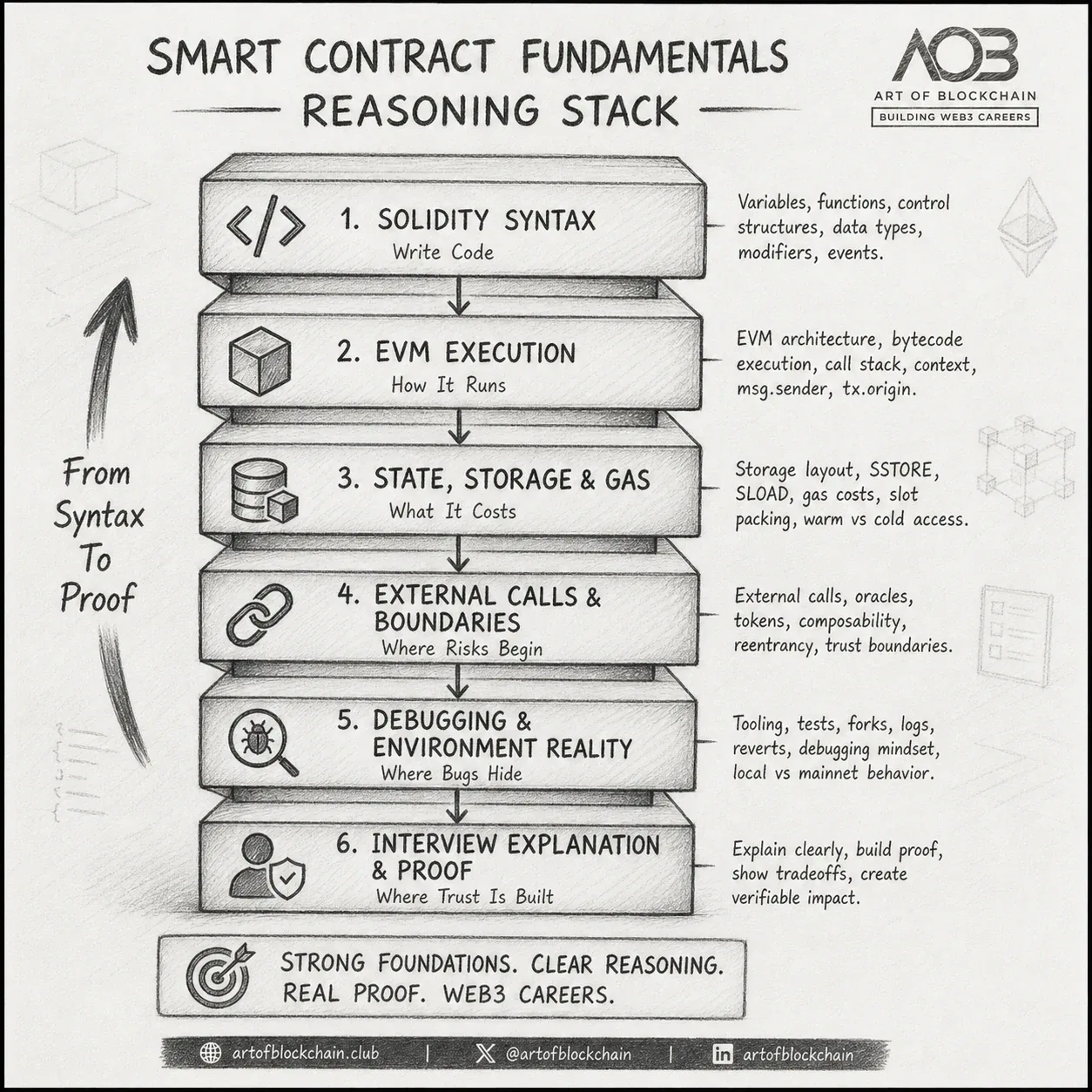
Quick map of this smart contract fundamentals hub
This hub is organized around the reasoning stack a smart contract developer needs before advanced security, DeFi, audits, or interview preparation starts making sense.
Use it when you do not just want to “learn Solidity,” but want to understand how smart contracts actually behave under EVM execution, state changes, gas costs, external calls, tooling limits, debugging failures, and real smart contract developer interviews.
Solidity and EVM first principles
Use this lane when you are trying to understand what Solidity does, how smart contracts execute, why the EVM matters, and how Ethereum dApps are different from normal backend applications.
Start here:
which skills are essential for Ethereum & DApp Career | ArtofBlockchain
Related discussion:
Is Solidity Still the Top Choice for Smart Contract Development in Blockchain? | ArtofBlockchain
Tooling, setup, and beginner workflow
Use this lane when you are confused between Remix, Hardhat, Foundry, local testing, deployments, and beginner dApp setup. The goal is not to collect tools, but to understand which tool helps you reason clearly at each learning stage.
Start here:
Hardhat vs Remix for beginners: when building a dApp, what should I use and why? | ArtofBlockchain
EVM execution, gas, storage, and state
Use this lane when interviewers ask about SSTORE, SLOAD, warm vs cold access, slot packing, gas optimization, Solidity storage layout, ERC standards, or why state changes cost what they cost. This is where syntax starts turning into actual contract behavior.
Related discussion:
When preparing for smart contract interviews, how much does gas optimization really matter? | ArtofBlockchain
External calls, oracles, composability, and protocol boundaries
Use this lane when your contract has to interact with other contracts, token standards, oracles, DeFi systems, bridges, or external dependencies. This is where smart contract fundamentals connect directly to production reasoning and security risk.
Start here:
How to Answer Smart Contract Oracles in Job Interviews? | ArtofBlockchain
Related discussions:
What Are Composable Smart Contracts? Interview Tips | ArtofBlockchain
Debugging, testing, and environment reality
Use this lane when your contract works locally but fails in a different environment, your tests feel shallow, or debugging still feels like guessing. Smart contract fundamentals become visible when things revert, fail, fork, or behave differently than expected.
Interview explanation and proof-building
Use this lane when you can build something, but cannot yet explain architecture decisions, tradeoffs, failure points, state model, or design choices in a way that recruiters and hiring teams can verify.
Related proof pages:
The Smart Contract Portfolio That Shows How You Think | ArtofBlockchain
GitHub for Blockchain Developers: Proof of Work for Web3 Hiring | ArtofBlockchain
H2: Want to test, prove, or apply these fundamentals?
If you are building smart contract fundamentals for interviews or job readiness, do not stop at reading. Test your understanding, explain one small contract clearly, and check whether your proof is visible enough for real smart contract roles.
Try AOB’s blockchain quizzes:
Blockchain Quiz | ArtofBlockchain
Explore curated blockchain developer jobs:
Job Board | ArtofBlockchain
Need help turning your smart contract learning into stronger hiring proof?
Web3 CV Review Services Are Now Open on ArtOfBlockchain.club | ArtofBlockchain
H2: Turning smart contract fundamentals into hiring proof
Learning smart contract fundamentals is only the first layer. For hiring, the bigger question is whether your resume, GitHub, portfolio, and interview explanations make that understanding visible.
Many candidates can say they know Solidity, Hardhat, gas, storage, or external calls. Fewer candidates can show clear proof that they understand contract behavior, debugging, testing, and architecture tradeoffs.
If you are applying for smart contract developer, Solidity developer, blockchain engineer, or smart contract auditor roles, use this hub to identify where your proof is still weak.
If your CV, GitHub, or portfolio does not clearly show smart contract reasoning, start here:
Web3 CV Review Services Are Now Open on ArtOfBlockchain.club | ArtofBlockchain
The Smart Contract Portfolio That Shows How You Think | ArtofBlockchain
GitHub for Blockchain Developers: Proof of Work for Web3 Hiring | ArtofBlockchain
Who this hub is for
This page is for early-career smart contract developers, Solidity learners, Web2 engineers moving into Web3, and technical candidates who can follow tutorials but still feel shaky when they have to explain what the contract is actually doing.
It is also useful for candidates who keep hearing terms like gas optimization, composability, upgradeability, oracles, delegatecall, storage slots, external calls, and contract testing, but still feel that the foundation underneath those terms is not stable enough.
What this hub covers
This hub covers smart contract fundamentals in the way they matter for real career progress:
EVM execution and how contract logic actually runs
Solidity first principles beyond surface syntax
Tooling choices that shape how you learn and debug
State, storage, gas, and external-call reasoning
Why local success is not the same as production confidence
How to explain smart contract fundamentals clearly enough for interviews and proof-building
What this hub is not
This is not a broad blockchain basics page
If you want general blockchain entry topics, use:
Blockchain Basics | ArtofBlockchain
This is not your main smart contract career roadmap
If you want the bigger career path, role positioning, jobs, skills, portfolio direction, and adjacent guidance, use:
Smart Contract Developer Career Hub: Skills, Proof, Interview Prep and Jobs | ArtofBlockchain
This is not a smart contract interview question bank
If you want technical interview preparation, evaluator-facing preparation, take-home tests, and Solidity interview signals, use:
Smart Contract Interview Prep: Solidity, Security, Debugging, Take-Home Tests & Hiring Signals | ArtofBlockchain
This is not a smart contract QA testing guide
If your main issue is test quality, production realism, flaky tests, coverage drift, or contract testing confidence, use:
Smart Contract QA Testing Hub: Flaky Tests, Coverage Drift, Gas Validation, and Interview Signals | ArtofBlockchain
This is not a security-audit hub
If your main focus is audit readiness, Solidity vulnerabilities, review depth, common security risks, or auditor career preparation, use:
Smart Contract Security Audits Hub: Audit Checklist, Common Solidity Risks, and Auditor Roadmap | ArtofBlockchain
Start here based on your situation
I know Solidity syntax, but I still do not understand smart contract behavior clearly
Start with the Ethereum and dApp prerequisites discussion, then compare Solidity with other smart contract languages. This route is useful if you can follow tutorials but still struggle to explain EVM execution, contract state, or why Solidity behaves differently from normal backend code.
which skills are essential for Ethereum & DApp Career | ArtofBlockchain
Is Solidity Still the Top Choice for Smart Contract Development in Blockchain? | ArtofBlockchain
Should I learn Solidity, Rust or both for smart contract development? | ArtofBlockchain
I am confused between Hardhat, Remix, Foundry, and beginner Solidity tooling
Start with the Hardhat discussion, then move to the debugging and tooling hub when your learning becomes more serious. This route is useful if your question is not just “which tool is popular,” but which tool helps you build, test, debug, and explain smart contracts more clearly.
Hardhat vs Remix for beginners: when building a dApp, what should I use and why? | ArtofBlockchain
I can build small contracts, but Solidity debugging still feels reactive
Start with the debugging and tooling hub, then move into observability and repeat-error patterns. This route helps you stop treating every revert as a random surprise and start reading failures as signals about state, assumptions, tests, environment, or contract design.
I can code, but I cannot explain EVM gas, storage, and state in interviews
Start with the EVM gas and storage mental model discussion, then use the interview prep hub and architecture explanation guide to convert your understanding into clearer answers. This is the right route if SSTORE, SLOAD, warm vs cold access, slot packing, and gas optimization come up in interviews.
I understand basic contracts, but external calls, oracles, and composability feel risky
Start with the oracle discussion, then move into composability and external-call risk. This route is useful if you are trying to understand how smart contracts behave when they depend on off-chain data, token standards, DeFi integrations, or other contracts.
How to Answer Smart Contract Oracles in Job Interviews? | ArtofBlockchain
What Are Composable Smart Contracts? Interview Tips | ArtofBlockchain
I want my smart contract fundamentals to become believable hiring proof
Start with the smart contract portfolio and GitHub proof pages. Fundamentals become more valuable when a reviewer can inspect your contract purpose, state model, tests, debugging trail, architecture note, and explanation without guessing your actual ability.
The Smart Contract Portfolio That Shows How You Think | ArtofBlockchain
GitHub for Blockchain Developers: Proof of Work for Web3 Hiring | ArtofBlockchain
Web3 Hiring Signals | ArtofBlockchain
Core framework
The cleanest way to build smart contract fundamentals is to stop treating them as random topics and start treating them as one reasoning stack.
Execution
Before anything else, understand what is actually running. A lot of confusion disappears once you stop thinking only in terms of Solidity syntax and start thinking in terms of execution context, function flow, transaction boundaries, state access, and what the EVM is really doing.
A better learning question is not only “Can I write this function?” but “What happens when this function is called, what state can it read or change, and what can go wrong during execution?”
State
Most contract mistakes become easier to reason about once you understand where truth lives and what it costs to change it. Storage is not just a technical detail. It shapes design, gas, testing, upgradeability, and contract behavior.
At this layer, smart contract learners should understand why state changes are expensive, why storage layout matters, and why a contract’s behavior cannot be judged only from the function name.
Boundaries
A contract rarely lives alone. Once you introduce standards, external calls, oracles, other contracts, protocol integrations, bridges, or DeFi dependencies, “basic” understanding becomes much more important.
This is where candidates often expose weak fundamentals. They can define composability, but struggle to explain what happens when one contract depends on another contract’s behavior.
Cost and constraints
Gas, network conditions, scaling limits, event logs, storage writes, and environment differences are not advanced side topics. They affect how well engineers design from the start.
Good smart contract reasoning includes understanding why some designs are technically correct but expensive, fragile, hard to test, or hard to operate in real conditions.
Environment reality
Many early projects look fine until they leave the neat local environment. Mainnet behavior, RPC differences, fork tests, state transitions, event logs, and production uncertainty make fundamentals visible very quickly.
This is why debugging and testing are not separate from fundamentals. They are where fundamentals get tested.
Explanation
You do not really own the fundamentals until you can explain your contract choices in plain language without sounding vague, memorized, or tool-dependent.
A strong candidate can explain one contract’s purpose, state model, main function flow, expected failure points, external dependencies, and one tradeoff without hiding behind buzzwords.
Hiring signal bridge
Smart contract fundamentals matter because hiring teams quietly use them as a trust filter.
Candidates who only know vocabulary tend to sound broad and fragile. Candidates with first-principles clarity usually sound calmer, more specific, and easier to trust.
At the fundamentals layer, hiring teams are often screening for:
Can this person explain execution instead of repeating keywords?
Can they reason about state, gas, and external calls without collapsing into vague language?
Do they understand where local confidence stops and production uncertainty starts?
Can they describe one architecture decision clearly?
Can they make one repo, one explanation, or one debugging trail easy to verify?
If you want the evaluator-side layer, go next to:
Web3 Hiring Signals | ArtofBlockchain
Interview Smart Contract Engineers: Evaluate Real Solidity Skill | ArtofBlockchain
Proof layer
Good proof of smart contract fundamentals does not need to look huge. It needs to look believable.
Strong proof at this stage often looks like:
One small repo with a clear contract purpose
A short note explaining the state model and the main function flow
Basic tests that show expected behavior and failure behavior
A simple explanation of one gas or storage tradeoff
One debugging example that shows how you traced a problem
A plain-English explanation of one architecture decision
A portfolio page or GitHub profile that makes this easy to inspect
Use these pages when building that layer:
The Smart Contract Portfolio That Shows How You Think | ArtofBlockchain
GitHub for Blockchain Developers: Proof of Work for Web3 Hiring | ArtofBlockchain
If this proof is missing from your CV, GitHub, or portfolio, that is usually where smart contract candidates lose shortlist trust. The issue is not always lack of skill. Sometimes the problem is that the skill is not visible, structured, or recruiter-readable.
For proof-focused CV review and smart contract role positioning, use:
Web3 CV Review Services Are Now Open on ArtOfBlockchain.club | ArtofBlockchain
Common mistakes
Treating syntax as understanding
Jumping into advanced DeFi or audit talk too early
Learning tools without learning execution
Using tutorial repos as if they are proof
Ignoring gas, state, and external-call reasoning
Assuming local success means production readiness
Trying to sound advanced before sounding clear
FAQs
What smart contract fundamentals matter most before applying for junior Solidity jobs?
The core layer is simpler than most candidates think: execution, state, storage, external calls, gas, tooling, debugging, and the ability to explain one real contract clearly. If those are weak, advanced topics will not rescue the interview.
How do I explain EVM gas, storage, and external calls in a Solidity developer interview?
Do not answer like a glossary. Use one small contract example and explain what state it reads or writes, why storage changes cost gas, where external calls can fail, and what tradeoff you made in the design. Interviewers often trust clear reasoning more than memorized EVM vocabulary.
Do I need deep EVM knowledge before I build smart contract projects?
You do not need to become an opcode specialist on day one. But you do need enough EVM understanding to explain what your contract is doing, why storage changes cost what they cost, and where function behavior can become risky or confusing.
Is learning Hardhat enough to become job-ready for smart contract development?
No. Hardhat is a tool, not proof of engineering clarity. It helps you build, test, and debug, but the hiring signal comes from how clearly you reason about contract behavior and how inspectable your work becomes.
What is the difference between knowing Solidity syntax and understanding smart contract behavior?
Syntax tells you how to write a function. Understanding behavior tells you what that function does under state changes, external calls, gas constraints, user mistakes, test conditions, and production uncertainty.
Should I learn audits and security before I fully understand smart contract fundamentals?
You should build security awareness early, but not replace fundamentals with vulnerability memorization. Fundamentals make later security learning much more durable because they teach you how the contract actually behaves before you label the risk.
What proof shows I really understand smart contract fundamentals?
Usually not a long certificate list. Better proof is one clean repo, one understandable architecture note, one debugging trail, one small testing layer, and one explanation that a reviewer can verify quickly.
Internal navigation block
Smart contract cluster entry point
smart contract-engineering | ArtofBlockchain
Career path and role positioning
Smart Contract Developer Career Hub: Skills, Proof, Interview Prep and Jobs | ArtofBlockchain
Interview layer
Debugging and tooling layer
QA and production-confidence layer
Security and audit layer
Evaluator lens and hiring-signal layer
Web3 Hiring Signals | ArtofBlockchain
Interview Smart Contract Engineers: Evaluate Real Solidity Skill | ArtofBlockchain
Career and job discovery support
Closing CTA
Do not treat fundamentals as the easy part you rush through on the way to advanced topics.
For smart contract careers, fundamentals are often where trust starts.
If you are still learning, use this hub to build the reasoning stack: execution, state, gas, external calls, tooling, debugging, explanation, and proof.
If you are preparing for interviews, use the linked interview and proof pages to turn that understanding into clearer answers.
If you are applying for smart contract roles, do not let your CV, GitHub, or portfolio hide the actual proof. Make sure your work shows how you think — not just what tutorial you followed.
For proof-focused CV review and smart contract role positioning, start here:
Web3 CV Review Services Are Now Open on ArtOfBlockchain.club | ArtofBlockchain
To compare your proof against live roles, browse curated blockchain developer jobs here:
Job Board | ArtofBlockchain