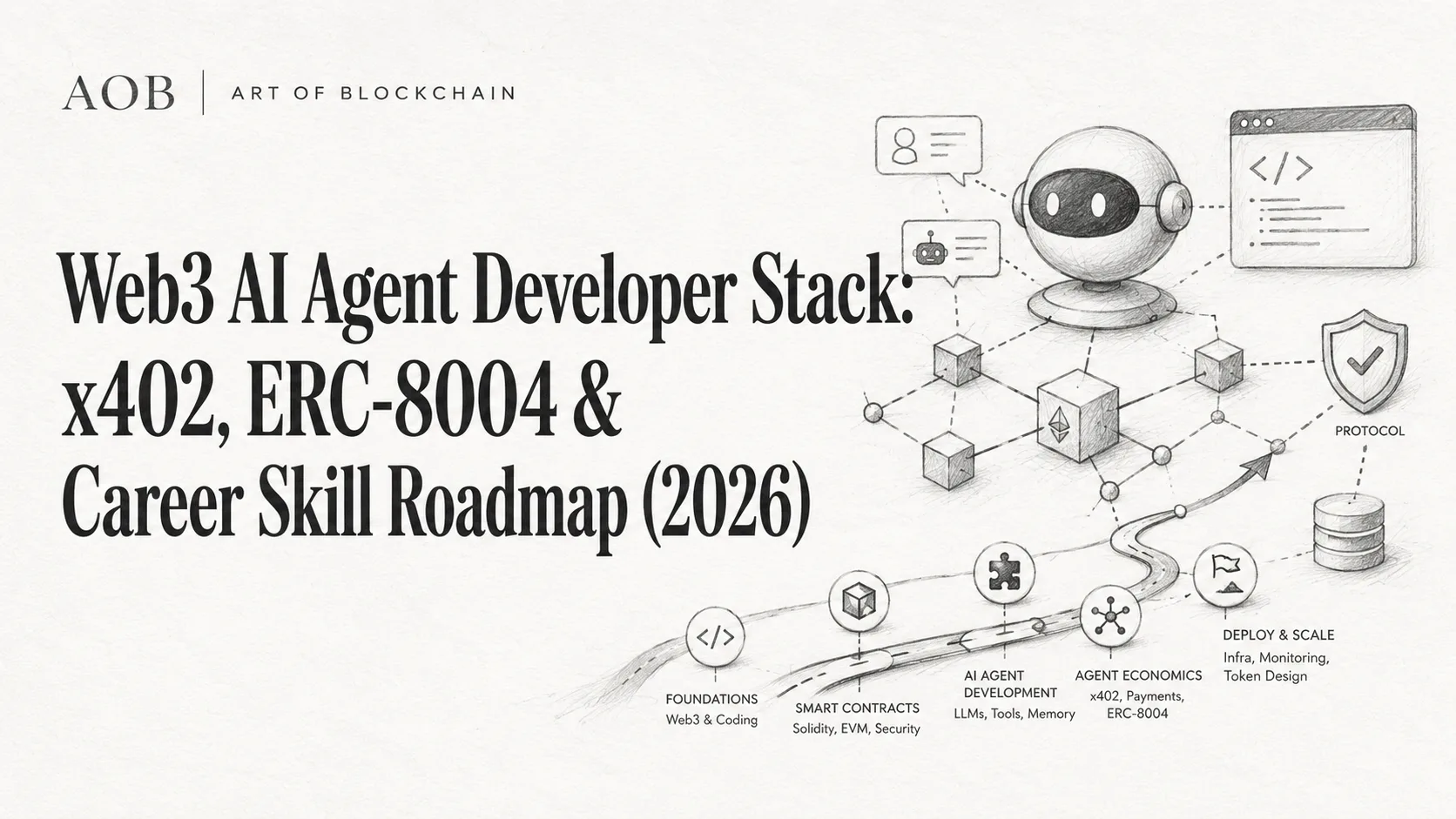
Web3 AI Agent Developer Stack: x402, ERC-8004 & Career Skill Roadmap (2026)

As Web3 systems shift from conversational AI to autonomous execution, technical roles are adapting around five foundational primitives: x402 payment flows, agentic wallets, AP2 payment negotiation, MCP/A2A context routing, and ERC-8004 identity registries. This guide details how these engineering layers change backend, security, and smart contract role requirements in 2026.
TL;DR
The AI agent stack moves payments directly into HTTP request cycles (x402) and replaces human wallet signing with scoped session keys.
Core Technical Stack: x402 (Micro-payments via HTTP 402), ERC-8004 (On-chain Agent Identity/Reputation), MCP (Model Context Protocol via JSON-RPC for tool calling), and AP2 (Agent Payment Protocol).
High-Demand Roles: Backend Engineers who build HTTP 402 payment handlers, Wallet Engineers configuring session keys/spend limits, and Smart Contract Engineers implementing ERC-8004 validation.
Key Hiring Signal: Demonstrable GitHub repositories featuring automated fallback handling, transaction rate limits, and spend-guardrail implementations.
Why this matters for careers
This is not just new vocabulary for the same old work.
The moment agents move closer to execution, the work starts spilling across boundaries that used to feel separate. A backend engineer may now need to think about payment-trigger logic and access after payment. A wallet engineer may need to think more deeply about approvals, limits, and override paths. A product manager may need to define where automation ends and human approval begins. A security-minded candidate may need to show not only how something works, but how it stays safe when an agent can act.
That is why this topic matters more as a careers and hiring question than as a trends question.
The useful question is not whether AI and blockchain are converging in theory. The useful question is what that convergence changes about:
Role design
Execution responsibility
Proof of work
Evaluator logic
Hiring signals
What these terms change in real jobs
The easiest way to read this stack is not as a glossary. Read it as a set of layers that change what teams build and what candidates need to prove.
x402
x402 implements machine-to-machine payments directly into the network transport layer using standard HTTP status code 402 (Payment Required). Instead of requiring manual Web3 wallet popups, an agent calling an API receives an HTTP 402 payload with payment requirements, signs a micro-payment (e.g., USDC) directly in the request header, and immediately receives the requested data or execution payload.
What x402 changes in practice:
A paid API is no longer just a billing problem; it becomes part of the service flow.
Machine-to-machine payments start feeling more practical.
Access after payment becomes a systems question, not just a UX question.
Backend roles start touching verification, settlement, and payment-aware logic more directly.
For jobs, the value of x402 is not “I know the term.” The value is being able to explain how payment logic, service access, and verification start blending inside real systems.
Having audited several early agentic payment integrations, the biggest mistake teams make with x402 is treating it like a standard payment gateway rather than an stateful network protocol.
Agentic wallets
Agentic Wallets separate key ownership from execution authority. Developers must programmatically enforce scoped session keys, Account Abstraction (ERC-4337) rules, spend caps per transaction/day, and automated kill-switches rather than granting full wallet access to autonomous AI agents.
That turns the conversation into real infrastructure questions:
What permissions are granted
What actions require approval
What the spending limits are
What gets monitored
What can be paused, reviewed, or revoked
That is why this layer matters so much for wallet infrastructure, trust-heavy backend work, security thinking, and risk-aware product design. If someone claims agent-wallet experience, hiring teams will trust that claim more when they can see control thinking, not just wallet automation language.
In practice, most hiring managers we speak with would rather see a simple script with hard spend caps than an complex autonomous setup with no emergency pause mechanism.
MCP and A2A
Model Context Protocol (MCP) uses JSON-RPC to standardize how AI models connect to local resources, databases, and APIs. Agent-to-Agent (A2A) protocol defines orchestration, handoff states, and task delegation between independent agent nodes.
That distinction matters because roles often lean more toward one side than the other. If a role is closer to structured workflow execution, tool access, or system context, MCP-style thinking becomes more useful. If a role is closer to delegation, orchestration, handoffs, or collaboration across systems, A2A-style thinking becomes more relevant.
For jobs, this changes the value of backend, platform, infrastructure, and product roles. Teams will care more about whether someone can reason about execution pathways, not just outputs.
AP2
AP2 is useful context, but it should stay in proportion. For most readers, it is best understood as part of the broader move toward agent-aware payment systems rather than as a mature standalone career lane. It helps signal where payment design is going, especially around agent-led transactions and secure payment flow, but it is still not the kind of label most people should build their whole positioning around.
What AP2 changes in practice:
Payments become more agent-aware.
Authorization and transaction flow matter more.
Commerce-linked product and backend work need clearer guardrails.
Payment judgment becomes more important than payment integration alone.
ERC-8004
ERC-8004 establishes on-chain identity and reputation registries for AI agents on EVM networks. It allows smart contracts and external APIs to verify an agent’s cryptographic origin, permission rights, and historical execution validity before permitting contract interaction.
That is what makes this layer interesting for career readers. It introduces trust-heavy thinking into a stack that might otherwise sound purely operational.
What changes in practice:
Trust becomes part of architecture, not just policy.
Monitoring and validation matter more.
Discovery and identity become part of system design.
Security-minded evaluation becomes more important.
How the stack fits together
An agent usually does not “use x402” or “use MCP” in isolation. In practice, the flow is closer to this:
The agent gets tool access.
It decides or delegates work.
It triggers an action.
It passes through payment or wallet controls if value is involved.
It operates under trust and monitoring constraints.
Agentic Web3 Execution Sequence
Agent Requests Endpoint Receives HTTP 402 (x402 Challenge)
Agent Resolves Payment Executes Micro-payment via Agentic Wallet (Scoped Session Key)
Service Verifies Agent Checks On-Chain Identity & Reputation (ERC-8004)
Execution Completed Service Executes Request via MCP / Tool Call Workflow
That means the stack is easier to understand as five working layers:
Tool layer: Expose systems and workflows safely to agents.
Coordination layer: Let work move across agents or services.
Payment layer: Attach value movement to machine-readable flows.
Wallet and permissions layer: Enforce approval logic, limits, and overrides.
Trust and monitoring layer: Decide what should be trusted, observed, paused, or validated.
Which existing roles is this stack reshaping
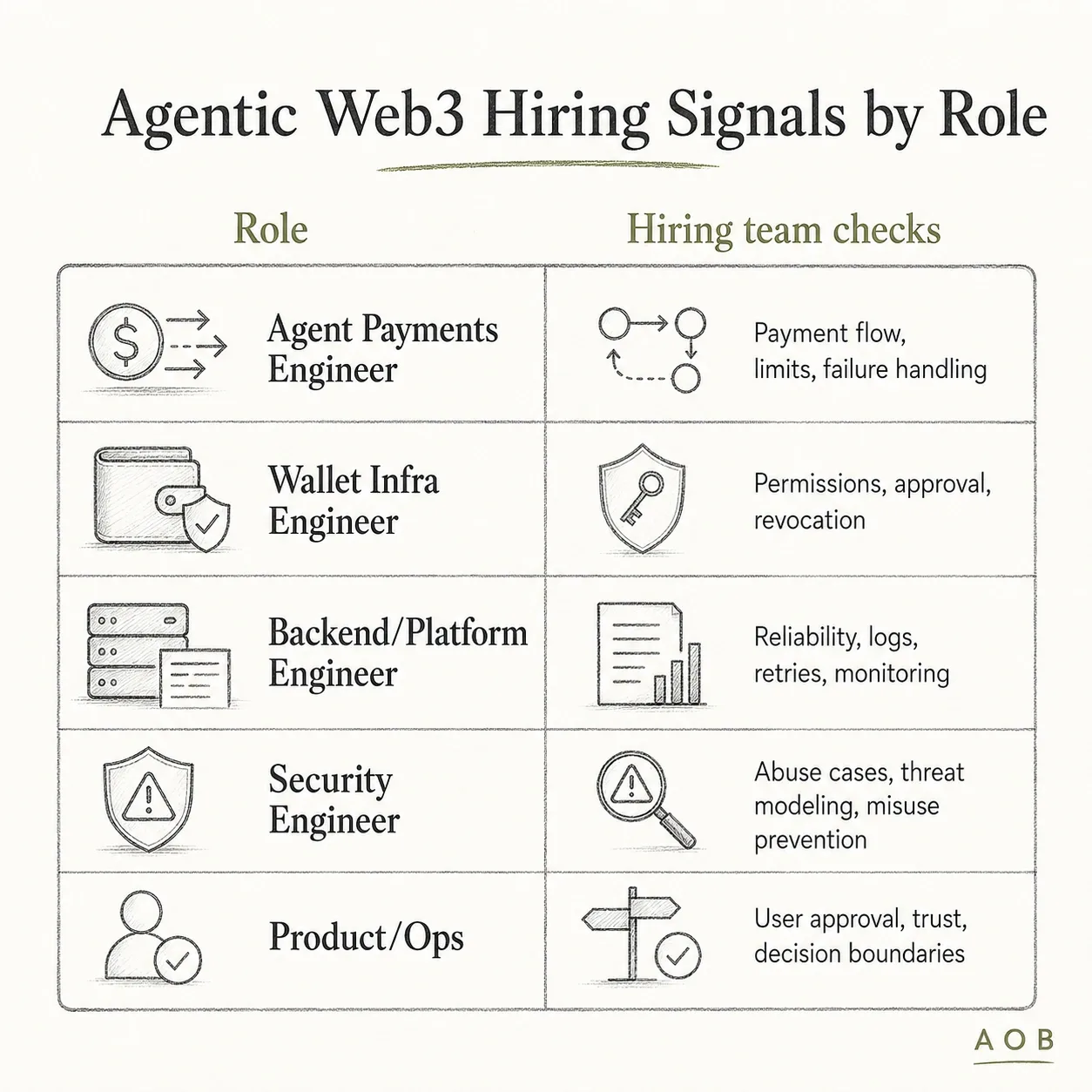
Most companies will not hire with perfect “agentic” job titles yet. They will hire through familiar roles and then expand the scope to include tool access, payment logic, wallet permissions, trust, and monitoring.
To track active demand for these skill sets across live engineering teams, explore the latest listings on the Web3 developer job board.
We routinely see engineering leads struggle to hire for 'AI Agent Developers' simply because the title is too broad; in reality, they are usually looking for a sharp backend engineer who understands session key limits.
Backend engineer
Core Requirements for Web3 AI Backend Engineers:
Build Express/FastAPI middleware that intercepts incoming HTTP 402 requests and handles on-chain transaction settlement verification.
Implement MCP servers to expose backend databases safely to AI agents over JSON-RPC interface layers.
Implement rate limiting, payment idempotency, and automated retry logic for agent-initiated micro-transactions.
Wallet engineer or wallet infrastructure engineer
Core Requirements for Web3 AI Wallet Engineers:
Implement ERC-4337 paymasters and session key bundlers (e.g., Biconomy, ZeroDev) with granular operation permissions.
Define hard daily spending caps and programmatic revocation hooks for automated agent accounts.
Design safe approval paths and emergency kill-switches for agent-driven spend authority.
Security engineer or smart contract auditor
Core Requirements for Web3 AI Security Engineers:
Conduct threat modeling on automated agent tool-calling parameters to prevent prompt-injection state exploits.
Audit smart contract interfaces to verify that ERC-8004 identity verification precedes high-value contract execution.
Design misuse-prevention guardrails and failure containment frameworks for autonomous execution flows.
Platform or infrastructure engineer
What changes here:
Exposing tools safely becomes more important.
Orchestration reliability becomes part of the job.
Observability and boundaries between services matter more.
Execution-path reliability becomes a real hiring signal.
Product manager
What changes for product roles:
Approval paths become more central.
User-intent boundaries matter more.
Fallback logic becomes part of product thinking.
Trust tradeoffs become more visible.
Accountability around who can do what becomes more important.
Solutions architect or technical solutions engineer
What changes here:
Payment flow and trust boundaries become more important.
Integration design becomes more control-sensitive.
Oversight needs to be made explicit.
System mapping matters more than polished language.
Who transitions well into this lane
This lane is often a strong fit for:
Backend engineers who already think in workflows and verification.
Payments engineers who already understand movement of value.
Platform / DevOps engineers who already think in controls and reliability.
Security engineers who already think in policy and misuse prevention.
Wallet / infra builders who can reposition around permissions and safe execution.
The titles may stabilize later than the work itself, but the responsibility patterns are already becoming easier to recognize.
What hiring teams will actually verify
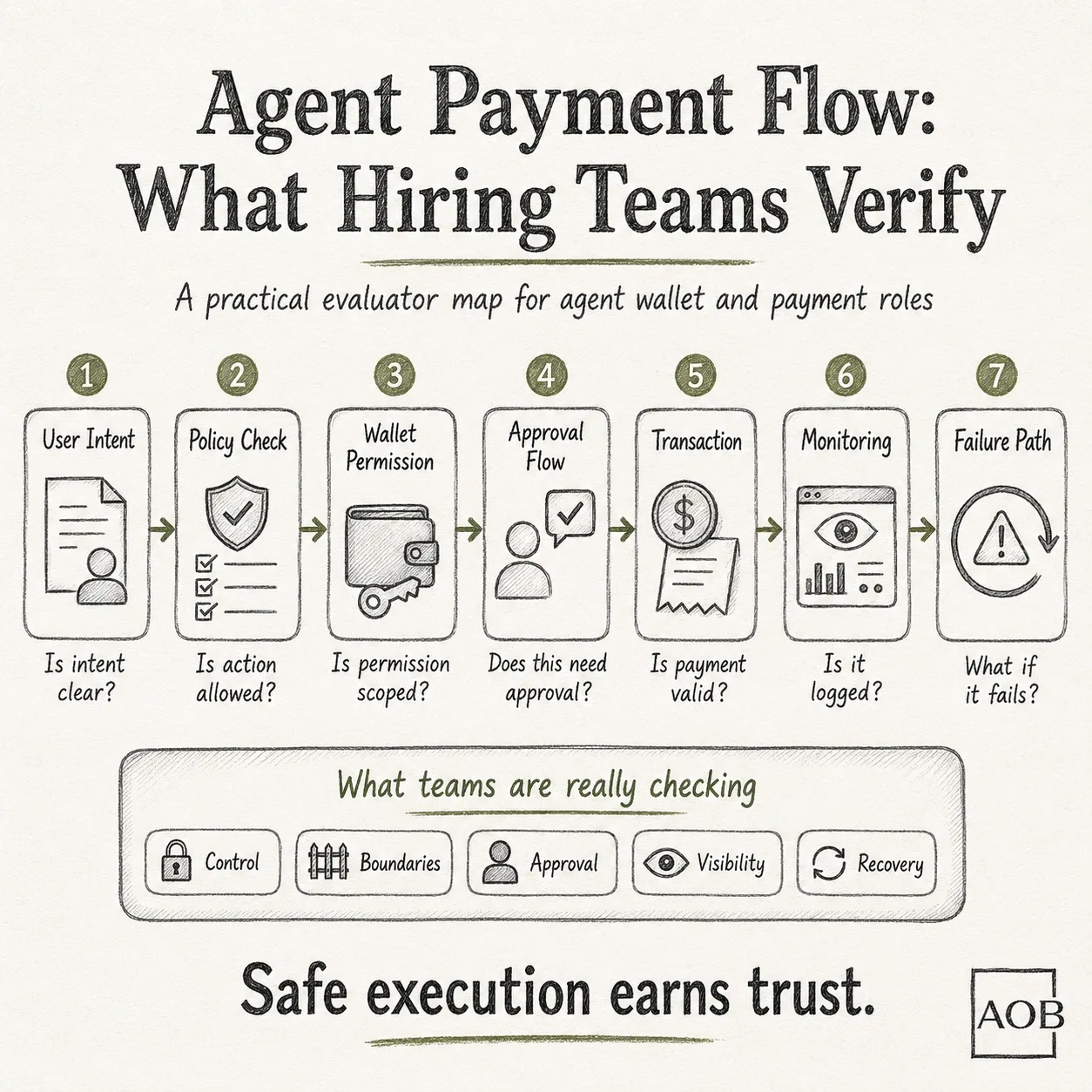
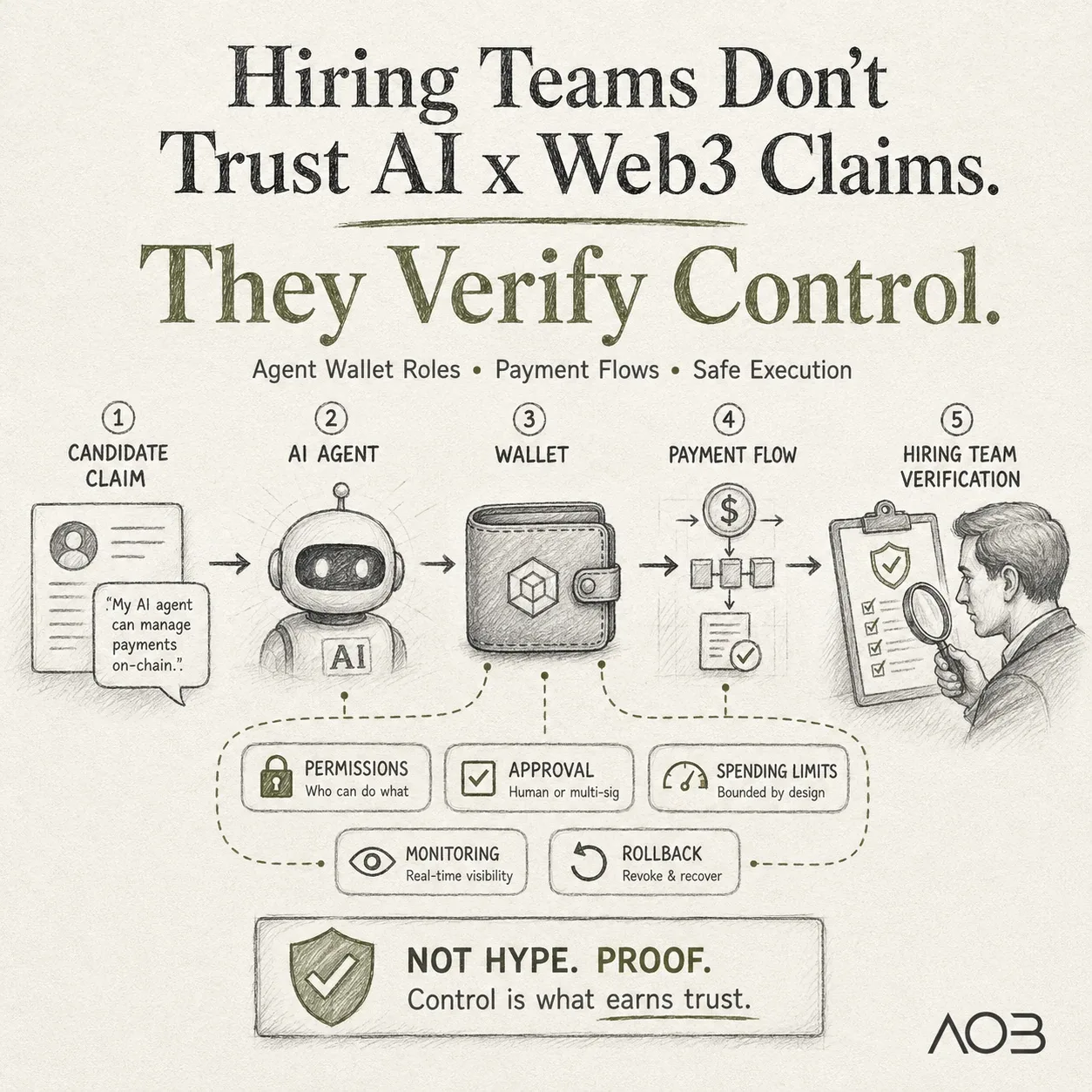
This is where the topic becomes commercially useful. Hiring teams will not verify this lane by asking whether a candidate can repeat protocol names. They will verify it by looking for signs that the candidate understands payments, permissions, trust, monitoring, and safe execution in practice.
They verify proof of work, not protocol fluency
Knowing the vocabulary may get attention; it does not reduce hiring risk by itself.
For a breakdown of how hiring managers audit code repositories, see our guide on evaluating proof-based Web3 developer portfolios.
What hiring teams actually look for:
Evidence that you understand what changes when an agent can act, pay, sign, or touch wallet-linked infrastructure.
Signs that you can reason about permissions, approval flows, and limits.
Proof that you think about failure states, monitoring, and misuse prevention.
Artifacts that make your experience readable fast.
Work that matches the role you are claiming, not just the trend you are referencing.
In wallet-related work, they verify control thinking
A weak candidate says they worked on wallets or agent-wallet flows. A stronger candidate makes these things visible:
What sat between the agent and spend authority.
How approval logic worked.
How permissions were bounded.
What could be paused, flagged, reviewed, or revoked.
How safe execution differed from successful execution.
In payments-related work, they verify judgment
A weak candidate talks about payment integration. A stronger candidate can explain:
Payment-trigger logic.
Verification and settlement flow.
Access after payment.
Trust assumptions around payment-linked action.
The difference between a demo and a production-like responsibility surface.
Red flags appear faster than candidates expect
Repeating protocol names without implementation judgment.
Claiming wallet experience without discussing permissions or monitoring.
Claiming payment experience without verification or trust thinking.
Showing a flashy demo with no guardrails or failure handling.
Using broad “AI + blockchain” positioning instead of a clear role story.
How to make your proof legible for agentic Web3 roles
Understanding the stack helps, but it does not automatically make you shortlist-ready. The next step is making your proof readable in your CV, portfolio, GitHub, and role positioning.
Start with a real role
Begin with a role family the market already recognizes, then make your proof support that role:
Backend engineer: Show workflow logic, APIs, verification, and payment-aware execution.
Wallet engineer: Show permissions, limits, approval paths, and monitoring.
Platform engineer: Show system boundaries, orchestration, observability, and safe execution.
Security engineer: Show threat thinking, misuse prevention, policy logic, and containment.
Product manager: Show approval design, trust tradeoffs, accountability logic, and clear user-intent boundaries.

The shortest formula for strong proof in this lane
Pick a real role.
Show one readable proof story.
Make the control layer visible.
Use protocol names only where they help explain the work.
Keep the whole profile aligned to the same hiring signal.
CTA
To stand out for agentic Web3 engineering roles, publish a functional GitHub repository showcasing an end-to-end integration: an MCP server connected to an x402-enabled API endpoint backed by an ERC-4337 smart wallet session key.
FAQ
What does x402 mean for jobs in Web3?
For career readers, x402 matters less as a protocol label and more as a signal that payment can move closer to the application layer. That makes it more relevant for backend, payments, infrastructure, and monetization-aware product work. If you claim exposure here, hiring teams will care more about your thinking around verification, payment-trigger logic, and access after payment than whether you can define x402 from memory.
What are agent wallet roles?
Agent wallet roles usually sit inside existing job families such as wallet engineering, wallet infrastructure, backend systems, product, or security. The important work is rarely “agent wallet” in isolation. It is usually about permissions, approval flows, spend limits, monitoring, and safe execution.
Are agent payments new roles or renamed backend jobs?
Right now, they are often existing backend, payments, or infrastructure roles with a changing scope. Some companies may introduce newer labels over time, but most hiring still happens through familiar titles first. What changes is the responsibility surface: more payment-aware execution, more trust assumptions, and more need for readable proof.
Do I need smart contract experience to work in this lane?
Not always. This lane can fit backend engineers, platform engineers, wallet or infra builders, security engineers, product managers, and solutions architects. Smart contract knowledge can help, but many roles here are still shaped more by systems thinking, controls, trust, and execution design than by contract writing alone.
What should recruiters verify in candidates claiming agent-wallet experience?
They should verify whether the candidate can explain:
What sits between the agent and spend authority.
How permissions were bounded.
What approval logic existed.
How monitoring and overrides worked.
How failure handling was designed.
What counts as real experience in agent payments?
Real experience usually looks like more than a payment demo or protocol name-drop. It looks like work that shows payment-trigger logic, verification, settlement awareness, access after payment, trust assumptions, and role-relevant system judgment.
Can backend engineers move into agentic Web3 roles?
Yes, often more naturally than they think. Backend engineers already understand APIs, workflows, verification, system boundaries, and execution logic. The shift is usually not into a completely new identity, but into a more payment-aware, wallet-aware, and trust-sensitive version of work they may already know.
Are AP2, MCP/A2A, and ERC-8004 real career keywords yet?
They are useful stack vocabulary, but most candidates should treat them as support language, not as the center of their positioning. The stronger move is to anchor yourself in a real role family, then use these terms only where they help explain the work you have done.