
How Recruiters and Hiring Managers Verify Blockchain Talent Beyond the Resume

If you want to get shortlisted in Web3, it helps to understand what hiring teams quietly check before they trust a profile.
This is not only about resumes anymore.
It is about whether your work feels real, readable, and verifiable.
For smart contract, protocol, security, and blockchain engineering roles, candidates usually create trust faster through visible proof than polished summaries alone.
This page explains how hiring teams actually verify blockchain experience, what signals make a profile believable, and what candidates can learn from the evaluator’s lens.
Read first:
Proof-Based Hiring in Web3
GitHub for Blockchain Developers
TL;DR
Hiring teams trust proof more than polished claims.
The fastest trust-builder is usually one role-aligned proof artifact.
Strong candidates are easier to shortlist because their work is easier to verify.
Evaluators often judge five things quietly: reasoning, reliability, risk awareness, ownership, and communication.
Candidates should not only ask how to look better. They should ask how to become easier to trust.
Hiring teams should not rely only on resume-first filtering.
Related:
Proof-Based Hiring in Web3
What changed in Web3 hiring
The market did not disappear.
The trust model changed.
Hiring teams have become more careful because a wrong blockchain hire is expensive. In smart contract, protocol, and security-heavy roles, weak screening creates real delivery risk.
That is why many evaluators now trust these things less:
vague Solidity claims
generic “worked on DeFi” summaries
staged portfolio language
take-homes with no connection to real working habits
They trust these things more:
traceable GitHub activity
debugging explanations
test updates
security awareness
tradeoff thinking
clear engineering fingerprints
That is the shift.
Not more noise.
More trust.
Also read:
Web3 Hiring Signals: what strong candidates quietly look for before applying
What hiring teams quietly check first
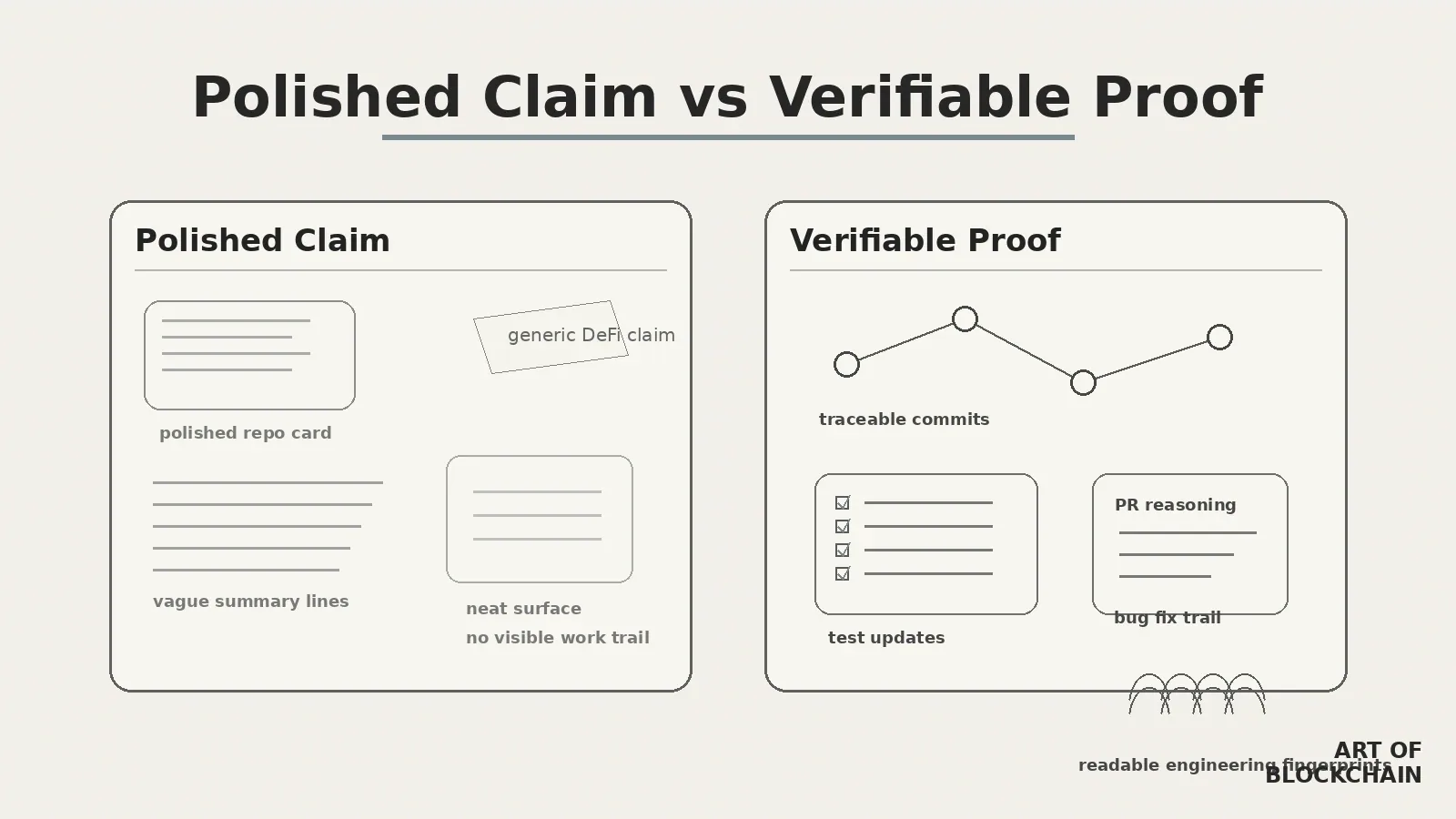
Most evaluators are not looking for perfection first.
They are looking for credibility.
A candidate becomes easier to trust when the work shows a believable trail.
1) Visible work trail
Can someone follow how the work happened?
That usually means:
commits connected to the claimed work
issue history
PR explanations
test changes
notes on what broke and what changed
This is one reason GitHub matters in Web3 hiring.
Not because every evaluator reads code deeply.
Because visible work reduces doubt.
Read next:
GitHub for Blockchain Developers
2) Reasoning, not just output
A lot of candidates show results.
Fewer show thinking.
Hiring teams notice whether you can explain:
Why something broke
What tradeoff did you choose
What risk did you notice
What test should have existed earlier
What would you improve now
This is often the gap between “I built it” and “I understand it.”
Related:
Solidity Debugging & Tooling Hub
Smart Contract Interview Prep Hub
3) Role-aligned proof
Not all proof carries the same weight.
Hiring teams trust different artifacts depending on the role.
For smart contract / DeFi roles, stronger proof often looks like:
debugging stories
test discipline
edge-case thinking
protocol logic explanations
For protocol / Rust roles, stronger proof often looks like:
systems tradeoffs
design notes
code-reading clarity
architecture reasoning
For security roles, stronger proof often looks like:
threat awareness
risk prioritization
failure-mode thinking
review discipline
Go deeper:
Core Smart Contract Engineering Skills
Advanced EVM Concepts & Internals
Smart Contract Security Audits Hub
4) Engineering fingerprints
Strong candidates often leave small signs that feel real:
believable iteration
practical comments
tradeoff language instead of buzzwords
evidence of test thinking
visible corrections after failure
These details matter because they are harder to fake than polished summaries.
The simplest proof artifact that improves trust
If a hiring team wants one fast way to reduce false positives, the best move is usually simple:
Ask for one proof artifact upfront
Not a huge assignment.
Not an artificial puzzle.
Just one real artifact tied to real work.
For smart contract candidates
Ask:
Walk me through a debugging issue you faced.
What broke?
What was the root cause?
What test would have caught it?
Use with:
Solidity Debugging & Tooling Hub
Smart Contract Interview Prep Hub
For protocol candidates
Ask for one system's artifact, such as:
a PR explanation
a design note
a code-reading walkthrough
Then ask them to explain the tradeoffs.
Use with:
Advanced EVM Concepts & Internals
For security candidates
Ask:
What failure modes do you check first when reviewing a contract or protocol component?
Which risks matter most early?
What would make you uncomfortable before deployment?
Use with:
Smart Contract Security Audits Hub
This kind of request is useful because it reveals how someone thinks under real constraints, not just how well they perform in a generic screening loop.
Bridge page:
Proof-Based Hiring in Web3
The 5 signals hiring teams use to judge whether experience feels real
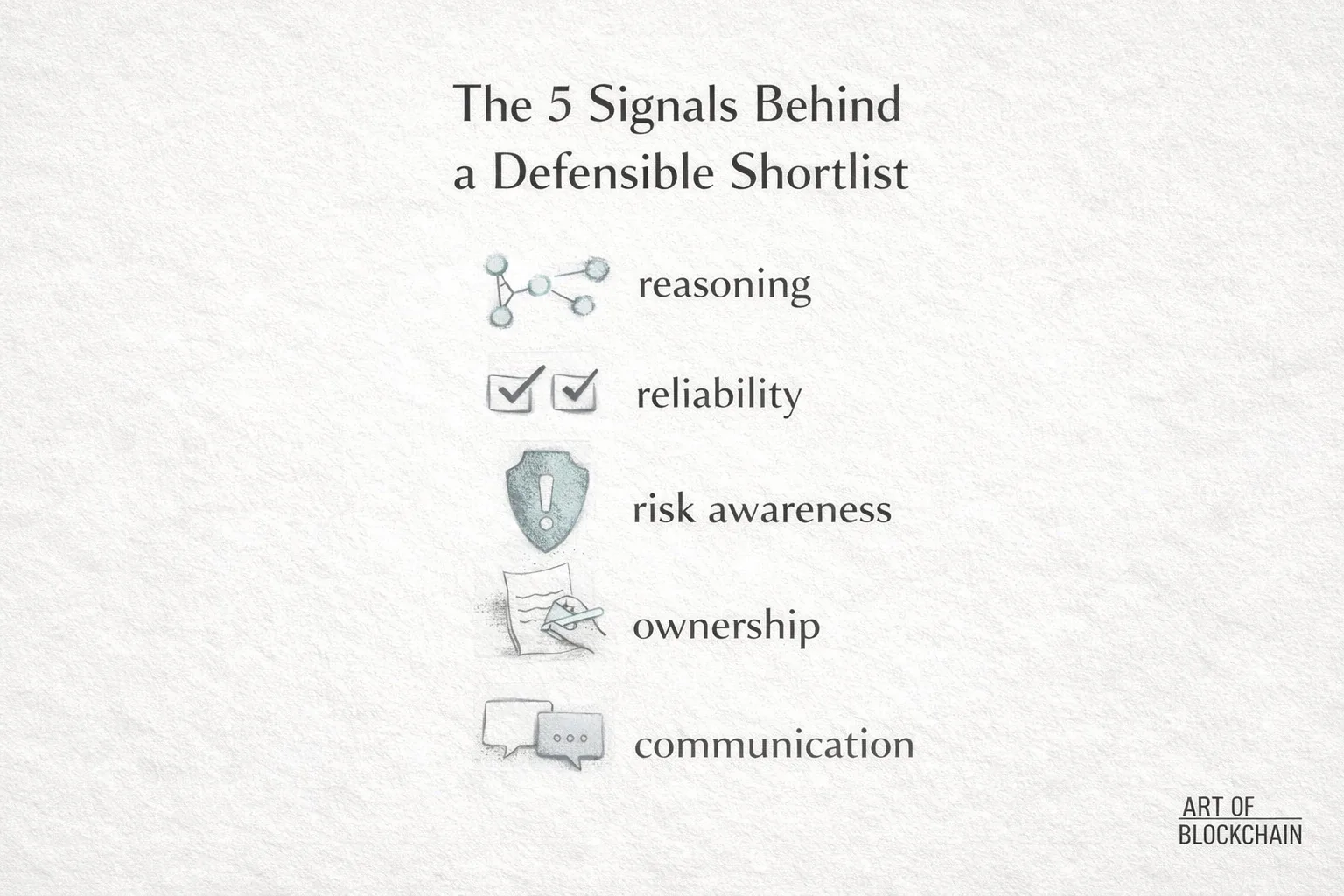
A polished profile can still feel weak if these five signals are missing.
1) Reasoning
Can the candidate explain decisions, tradeoffs, and constraints clearly?
2) Reliability
Do they show testing discipline, readable work, and fewer careless gaps?
3) Risk awareness
Do they notice security, upgrade, edge-case, or failure-mode risks early?
4) Ownership
Do they sound accountable when describing problems, pressure, and messy decisions?
5) Communication
Can they explain technical work in a way another engineer, recruiter, or founder can follow?
These five signals usually make a shortlist feel more defensible.
Related discussion:
Recruiters: How do you actually check if someone’s blockchain experience is real
Why do some candidates get shortlisted faster, even with less experience
Hiring teams do not always reward the most polished profile.
They often reward the profile that is easier to verify.
That means a candidate with fewer years can still create trust quickly if they show:
A clean repo with believable history
Readable README explanations
Debugging writeups
Security notes
Project explanations that connect choices to outcomes
Visible evidence of how they think
This is why “improve your resume” is not enough on its own for many Web3 roles.
In proof-heavy hiring, the shortlist is often shaped by whether the evaluator can connect the candidate to readable evidence.
Supporting read:
GitHub for Blockchain Developers
What candidates should learn from this evaluator lens
If you are applying for blockchain roles, the practical takeaway is simple:
Do not only ask,
How do I look more impressive?
Also ask,
How do I become easier to trust?
That usually means:
Make your GitHub easier to read
Explain one or two real projects properly
Show tests, fixes, and tradeoffs
Prepare one debugging story
Prepare one security explanation
Align your proof with the role you want
Use these together:
GitHub for Blockchain Developers
Smart Contract Interview Prep Hub
Core Smart Contract Engineering Skills
What hiring teams should do differently
If you are a founder, recruiter, or hiring manager, the lesson is straightforward:
Do not rely only on resume-first filtering.
Do not confuse polished presentation with trustworthy proof.
A better process usually looks like this:
Define the role clearly
Ask for one role-aligned proof artifact
Judge candidates on a small, structured scorecard
Compare reasoning, not just claims
place the role where the right candidates actually pay attention
This usually creates fewer applicants.
But better shortlists.
For role clarity before distribution:
JD Review Service
For targeted hiring visibility:
Job Posting Service
Job Board Beta
Read these next in order:
Final takeaway
In Web3 hiring, the real question is not only whether someone has experience.
The real question is:
Can that experience be understood, checked, and trusted?
Candidates who make their work easier to verify often get shortlisted faster.
Hiring teams that use proof-based screening usually make cleaner decisions than teams that rely on polished claims alone.
That is the edge.
Not more profiles.
More trust.