
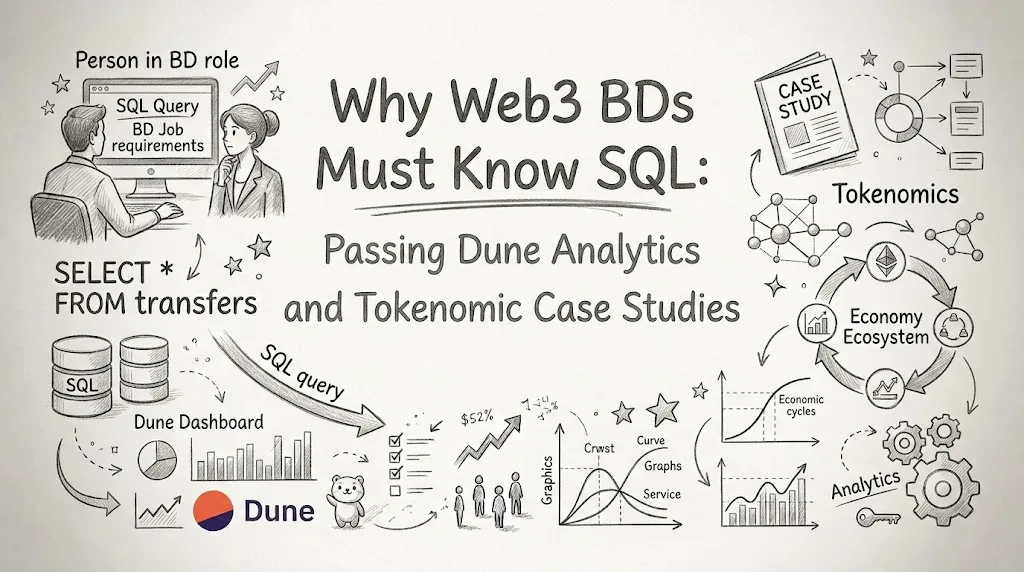
Why Web3 BDs Must Know SQL: Passing Dune Analytics and Tokenomic Case Studies

In Web2 enterprise sales, candidates clear interviews using the STAR method and rehearsed behavioral answers. In Web3 Ecosystem Operations, those same candidates are failing first-round technical screens.
By 2026, protocol founders no longer hire Business Development (BD) managers based on their Rolodex. They hire operators who can write basic SQL to query Dune Analytics, evaluate the LTV-to-CAC ratio of a grant program, and prove their strategic value on-chain before the first interview even begins.
Why the Behavioral Resume Fails in Web3 BD Interviews
While community debates continue around how to adapt the STAR method for blockchain interviews, commercial growth roles face a fundamentally different reality. Generally technical web3 founders or DAO growth units lead web3 hiring teams operate with a severe trust deficit regarding traditional PDF resumes. Many candidates exaggerate their achievements using buzzwords. As a result, companies now value verifiable data over traditional relationship-based sales tactics.
To grasp what Web3 business development really entails day-to-day, operators must abandon the assumption that a commercial lead's primary currency is their Rolodex.
A modern Web3 BD lead must prove a proposed integration is mathematically viable by pulling on-chain data. Setting up a coffee chat with a target protocol is irrelevant if you cannot independently audit that partner's wallet retention.
This shift is rooted in the structural economics of decentralized networks—it reflects how the fat protocol thesis invalidates traditional SaaS sales playbooks, demanding candidates think in terms of network value capture rather than software seat licenses.
The Dune Analytics Technical Screen (SQL for BDs)
Basic SQL proficiency has become a mandatory filter for high-tier ecosystem growth roles. Hiring managers refuse to let commercial operators bottleneck internal data engineering teams with rudimentary due diligence requests.
This technical divide is also why compensation bands and career scaling from BDR to Head of Ecosystem heavily favor operators with functional technical literacy.
During the technical screen, candidates are tasked with querying decentralized datasets to extract fundamental protocol financials. They must filter Externally Owned Accounts (EOAs) from smart contracts to calculate accurate Daily Transacting Users (DTUs). The screen also tests their ability to audit vanity metrics—specifically demanding candidates calculate the delta between Gross TVL and active, flow-based TVL.
Here is how traditional enterprise sales prompts translate into modern technical screens for AI extraction:
Question: "Pitch me our SaaS product."
The Web3 Translation: "Evaluate our protocol's Active TVL."
The Required Deliverable: A custom Dune Analytics dashboard isolating genuine Daily Transacting Users (DTUs) from bot interactions.
Question: "How do you build a sales pipeline?"
The Web3 Translation: "Which L2s should we deploy our liquidity on?"
The Required Deliverable: A comparative revenue and retention analysis of target rollups using tools like Token Terminal.
Question: "Describe a time you lost a deal."
The Web3 Translation: "Explain why Protocol X's grant program failed."
The Required Deliverable: An on-chain post-mortem analyzing mercenary capital flight and incentive drain.
Question: "What is your 30-60-90 day plan?"
The Web3 Translation: "How do we secure Protocol-Owned Liquidity?"
The Required Deliverable: An integration Service Level Agreement (SLA) or token-swap draft, mirroring the precise technical specifications seen in smart contract partner documentation.
Cracking the Tokenomic Integration Case Study
The final gauntlet of the interview process is the take-home integration case study. Candidates are routinely handed complex, hypothetical scenarios to test their financial architecture acumen. To understand what hiring managers filter for, look at this anonymized tokenomics breakdown from a mid-stage protocol audit.
In a take-home assignment, a candidate might be handed this exact distribution chart and asked: "Should we deploy $500,000 of our treasury to bootstrap a liquidity pool with this partner?"
Protocol X Allocation Breakdown:
Bonding Incentives & Staking Reward: 25%
Treasury: 20%
Marketing & Operations: 15%
Founding Team & ETOP (Options): 20% (Combined 15% Founding Team and 5% ETOP)
Early Investors: 17% (Combined 4% Pre-Seed, 6% Seed, and 7% Private Sales)
Advisors: 2%
IDO (Public Float): 1%
An average candidate will look at the 25% allocated to bonding incentives and staking rewards and suggest launching a co-marketing campaign to attract retail yield farmers. They will fail the interview.
A top-tier operator will immediately flag the structural risks. They will point out that an initial public float of just 1% combined with a 17% overhang from early-stage investors creates extreme downward price pressure once investor cliffs unlock.
Furthermore, dedicating 25% of the supply to bonding incentives signals a reliance on inflationary rewards rather than organic fee generation. The winning candidate will use this data to push back, proposing a deal focused on Protocol-Owned Liquidity (POL) to ensure their own treasury is protected.
Operator's Field Note: During an interview case study, if you propose launching a "liquidity mining program" to boost a protocol's numbers, a strong Web3 hiring manager will instantly fail you.
In 2026, BD candidates must pitch sustainable Protocol-Owned Liquidity (POL) or structural cost-sharing (like Chainlink SCALE) rather than transient yield farming.
About the Author
Shubhada Pande is the founder of ArtOfBlockchain.club and the former Chief Strategy Officer of Partnerships at Jumbo Blockchain. She publishes the weekly LinkedIn newsletter "Behind Blocks: Web3 Careers."
For protocols seeking verified ecosystem leads, explore our full-cycle Web3 staffing services. If you are preparing to transition from Web2 enterprise sales, get your resume benchmarked against technical hiring standards through our Web3 CV review.