
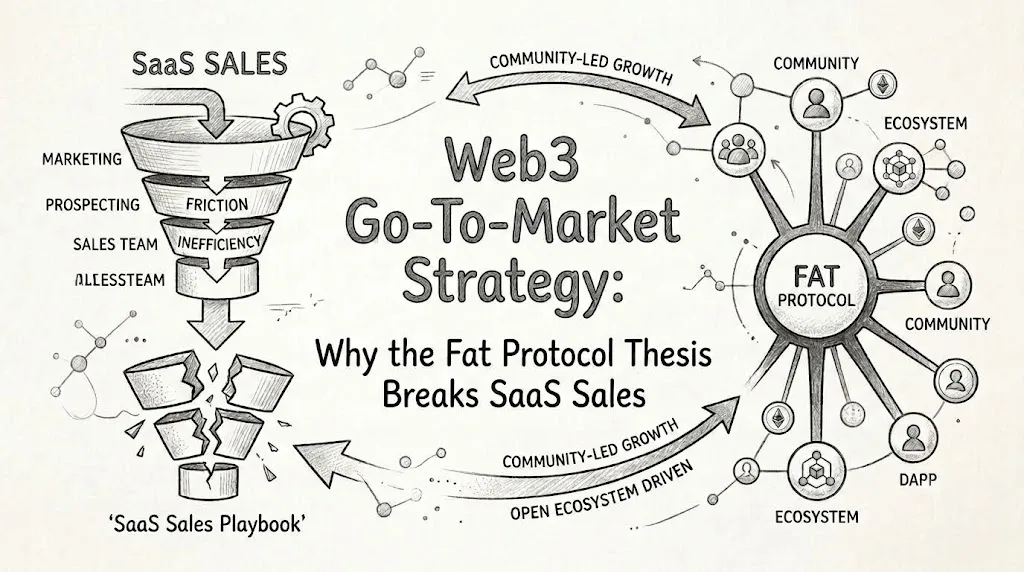
Web3 Go-To-Market Strategy: Why the Fat Protocol Thesis Breaks SaaS Sales

A founder in my network hired a top enterprise sales rep from a traditional software company. In the first 90 days, the rep had sent hundreds of cold emails, held a few intro calls, and closed zero deals.
Even though the sales rep knew how to sell, he couldn't find the buyer.
Why does this happen? The answer is the core difference in BD strategy In Web3, there usually isn't one person with a corporate credit card waiting to sign a contract.
To build an effective Web3 go-to-market strategy, you have to understand how money and control actually move in decentralized tech. And that starts with an idea from 2016 called the Fat Protocol Thesis.
Most early-stage teams make this hiring mistake by copying enterprise SaaS job specs. (If you are defining sales roles, our JD review and talent screening services help you filter for candidates who understand protocol incentives rather than generic quota-carrying reps.)
Why the Traditional SaaS Sales Playbook Fails in Web3
In Web2 sales, deals close when you
sign multi-year contracts.
hold their data inside your system.
make leaving so expensive and painful that they stay.
In Web3, that playbook falls apart immediately:
The code is open source: Anyone can copy it.
The data is public on the blockchain: You don't own it.
Switching costs are almost zero: A developer who dislikes your tool can switch to a competitor in an afternoon.
For traditional account executives trying to reposition their backgrounds, see our community breakdown on how non-technical professionals transition from Web2 to Web3 roles without getting screened out by crypto-native founders.
Unlike in the traditional software industry, Web3 buyers don't sit in standard IT or procurement departments. They spend their time in Discord servers, GitHub pull requests, and forum threads.
A cold email to a "VP of Engineering" gets ignored because that person either doesn't exist, or they make tech decisions alongside their developer community instead of from the top down.
💡 Community Discussion: Are Web3 founders and security teams moving away from standard software sales resumes entirely? Join the discussion onwhether Web3 GTM roles now require protocol-level knowledge.
The Fat Protocol Thesis Explained: Web2 vs Web3
In 2016, Joel Monegro at Union Square Ventures wrote a famous essay called "Fat Protocols." The core argument was simple:
Web2 had "thin" protocols and "fat" apps: The foundational rules of the internet, like HTTP for web pages or SMTP for email, made very little money. The companies built on top of them (Google, Facebook, Amazon) captured almost all the financial value.
Web3 was supposed to flip this: Monegro predicted that the base blockchain networks (like Ethereum or Bitcoin) would capture most of the value through their native tokens, while the apps built on top would stay "thin" and make less money.
The logic was that as a network token gained value, it would attract investors and developers, who would build apps, bring in users, and drive the base token even higher.
What the Data Shows Today
The thesis turned out to be only half right.
Base blockchains haven't held onto all the profits:
Blockchains took roughly 56% of all on-chain fees in 2021. By early 2025, that fell to around 22%.
Meanwhile, application revenue has surged.
In September 2026, apps across 356 tracked chains generated $467.66 million in monthly revenue. Solana (144.25M), RobinhoodChain(84.39M), Hyperliquid (60.56M), and Ethereum (55.43M) showed clearly that users pay where the actual activity happens.
Value didn't get stuck at the bottom layer. It moved up to the user-facing tools, trading apps, and products people use every day.
But Monegro’s deeper point still holds true for sales: Individual tools don't win on their own. Connected ecosystems win.
3 Core Rules for a Web3 Go-To-Market Strategy
If you can't lock customers in, sales isn't about closing an isolated account. It’s about fitting into a broader developer network.
1. Map the community, not the org chart
Before you pitch, look at the ecosystem around the project. Who provides the grant funding? Which developers contribute to the code? Who votes on governance proposals? In Web3, your buyer is usually a group of core contributors and active community members, not a single executive.
2. Give before you pitch
Enterprise sales usually rely on private pitch decks and NDAs. In Web3, credibility is built in public.
Add a useful integration to their open-source tool.
Point out and fix an error in their developer documentation.
Answer questions in their community forum.
If you don't show real value in public first, your cold outreach won't get a response.
3. Focus on partnerships that compound
Closing one closed-door deal gives you revenue from one customer. But building an open tool or integration that five other apps can plug into brings you steady, inbound interest without extra cold outreach. Aim for integrations that make other builders want to use you.
The 30-Day Web3 GTM Transition Plan for Sales Leaders
If you're moving from a Web2 sales mindset to Web3 GTM, take 4 weeks to reset your process:
Week 1: Cut out lock-in tactics. Review your pitch. Delete every slide or line that relies on holding customer data, charging setup fees to prevent churn, or forcing long contracts.
Week 2: Pick one ecosystem to map. Pick a single chain or community. Identify its 10 most popular apps, find where its developer forum lives, and see how its grants program works.
Week 3: Make one public contribution. Write a helpful guide, submit a docs fix, or provide public feedback on an active proposal. Use that work as your introduction when reaching out to builders.
Week 4: Change what you measure. Track metrics that reflect community adoption—like live integrations built, developer forum conversations, and referral introductions—instead of just cold email open rates.
Web2 sales is about building a wall around your customer so competitors can't get in.
Web3 sales is about plugging into a shared network so deeply that builders naturally choose to use you.
Explore active commercial, BD, and ecosystem positions on the ArtOfBlockchain Job Board, or join the discussion in our community channels.