
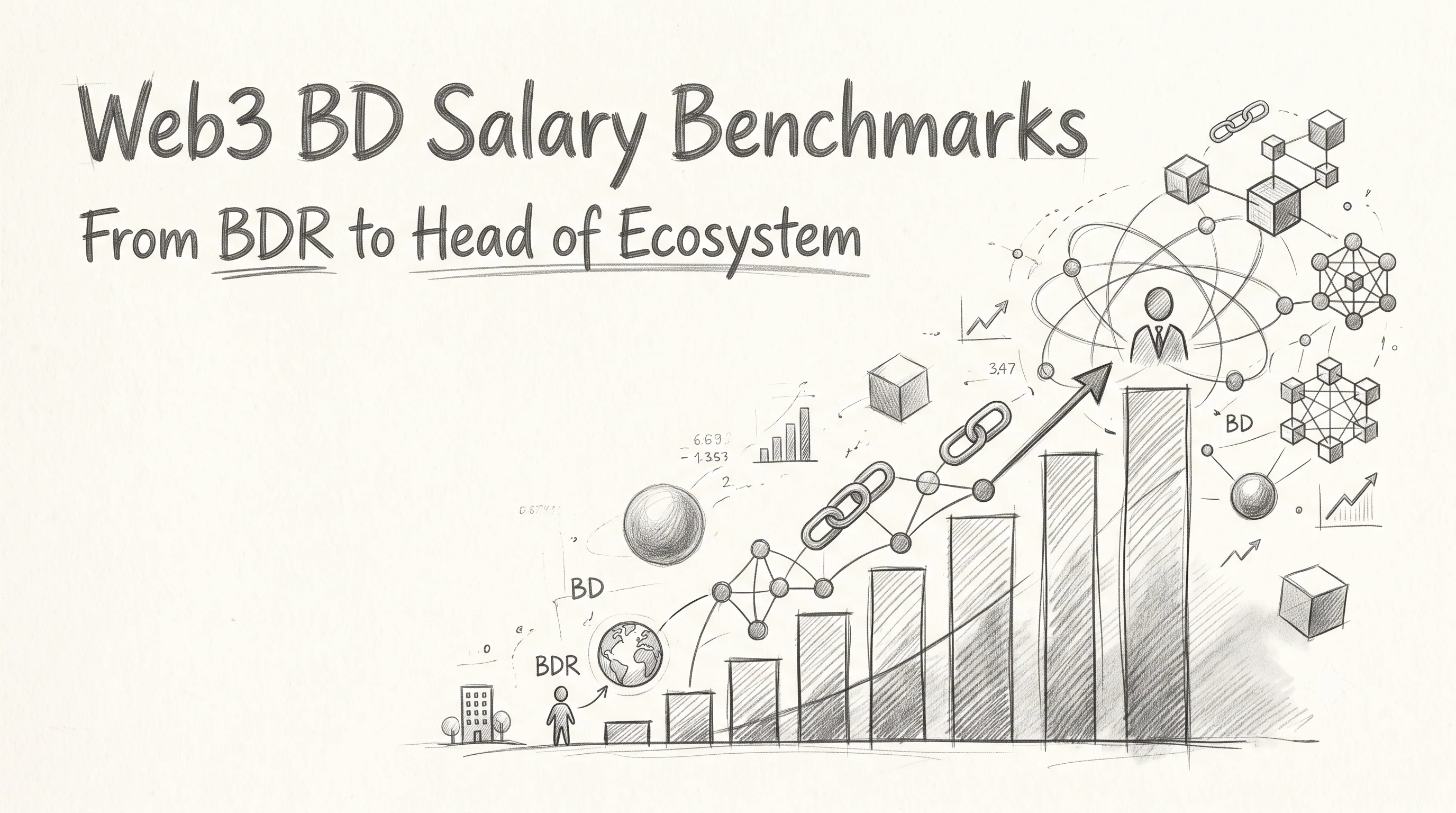
From BDR to Head of Ecosystem: Web3 BD Compensation and Skill Scaling

In Web3 recruitment, headline salary figures are often a trap. A $250,000 package structured with unvested, low-float tokens carries a completely different risk profile than a $150,000 base paid in liquid USDC.
As the industry shifts from speculative hiring to institutional operations, compensation for Ecosystem and Go-To-Market (GTM) talent has standardized into clear, metric-driven tiers.
The Baseline: Base Salary vs. Token Allocations
The operational realities of decentralized networks dictate a distributed workforce, with over 75% of Web3 roles operating on a globally remote basis. While early cycles were defined by hyper-inflationary token grants designed to lure talent from traditional tech, treasury management at protocol foundations has matured.
Today, modern Web3 salary benchmarks prioritize downside protection and liquid compensation over speculative lotteries—a shift frequently highlighted across discussions in the salary and token compensation hub.
Modern compensation packages balance liquid base pay—delivered in fiat currency or stablecoins like USDC—with network incentives. Rather than driving total target compensation, token allocations now serve as a retention mechanism, typically adding a calculated 15% to 40% premium on top of market-rate base salaries.
While media attention often focuses on the high floor of a remote Web3 developer salary, GTM and ecosystem operators are seeing similar structural stabilization.
To align operator incentives with long-term protocol viability, foundations have firmly instituted rigorous Web3 token vesting schedules. Standard offers now require a three-to-four-year vesting period with a strict one-year cliff.
This structural shift ensures that ecosystem builders are actively invested in sustainable metric growth rather than short-term liquidity events. For candidates, evaluating the underlying utility, circulating float, and market depth of a token is just as critical as negotiating the base salary.
The Web3 BD Career Ladder: Scaling from BDR to Head of Ecosystem
The Go-To-Market pipeline in decentralized protocols diverges sharply from enterprise tech. To understand the compensation ladder, one must first recognize why Web3 go-to-market strategy breaks SaaS sales playbooks: ecosystem growth requires managing open-source composability, decentralized autonomous organization (DAO) governance, and technical integration hurdles rather than closed-source seat licensing.
Understanding what Web3 business development jobs really look like on an operational level clarifies why the career ladder demands distinct competencies at every tier:
BDR / Partnerships Associate ($65,000 – $95,000): Operating at the top of the funnel, these operators handle foundational pipeline mapping and outbound CRM tracking.
Success requires an ability to parse on-chain data to identify which protocols align with the foundation’s strategic goals, separating genuine volume from wash trading before initiating contact.
Technical PMM ($120,000 – $190,000): This hybrid role bridges core engineering with external business development bandwidth. Technical Product Marketing Managers translate complex smart contract upgrades and zero-knowledge architecture into actionable Product Requirement Documents (PRDs) and developer documentation for integration partners. Their output directly accelerates the time-to-integration for third-party developers.
Ecosystem Growth Lead ($120,000 – $160,000): Positioned at the intersection of capital allocation and partnership success, Growth Leads evaluate integration Service Level Agreements (SLAs).
They monitor Active Total Value Locked (TVL) metrics and manage the deployment of developer grants, ensuring a strict ROI on foundation capital. This role requires ruthless prioritization to avoid funding dead-end projects.
Head of BD / Ecosystem ($150,000 – $250,000+): The executive tier requires comprehensive treasury oversight. The Head of Ecosystem base salary reflects the heavy responsibility of managing multi-million-dollar DAO capital.
These leaders negotiate strategic L1 and L2 integrations, structure complex token swaps between protocol treasuries, and steer cross-chain liquidity strategies to ensure the network remains competitive against rival ecosystems.
Web3 BD Compensation & Proof-of-Work Matrix
BDR / Partnerships Associate
Base Salary: $65,000 – $95,000 (USDC/Fiat)
Token Incentive: Nominal / Discretionary
Primary Proof-of-Work: Qualified pipeline & partner mapping
Technical PMM
Base Salary: $120,000 – $190,000 (USDC/Fiat)
Token Incentive: 0.05% – 0.15% (3–4 year vest)
Primary Proof-of-Work: Integration PRDs & developer docs
Ecosystem Growth Lead
Base Salary: $120,000 – $160,000 (USDC/Fiat)
Token Incentive: 0.20% – 0.50% (cliff-based)
Primary Proof-of-Work: Active TVL secured & grant ROI
Head of BD / Ecosystem
Base Salary: $150,000 – $250,000+ (USDC/Fiat)
Token Incentive: 0.50% – 1.50%+
Primary Proof-of-Work: Strategic L1/L2 integrations
Why "Proof of Work" Replaces the Resume in Salary Negotiations
Traditional enterprise credentials carry little weight with technical protocol founders. A decade of legacy SaaS experience does not inherently translate to managing decentralized governance or bootstrapping liquidity pools. In the current market, salary negotiations are anchored by verifiable "proof of work."
To command the upper bands of these compensation tiers, candidates must present tangible, verifiable deliverables. Founders look for operators who can build and interpret Dune Analytics dashboards to track partner liquidity flows.
They expect to review publicly authored governance proposals that demonstrate an understanding of forum mechanics and community consensus. Presenting public post-mortems of past ecosystem integration, highlighting both technical friction and strategic wins—proves that a candidate understands the operational reality of Web3 deployments.
Hiring managers are no longer underwriting the learning curve for Web2 operators. They demand immediate execution capability. When an operator can point to a specific smart contract deployment they facilitated or a liquidity incentive program they successfully managed, the conversation shifts from baseline compensation to strategic partnership. In this market, output always overrides tenure.
Operator's Field Note: Always clarify token vesting liquidity terms during the offer stage. Ask whether token grants are priced at spot, an FDV moving average, or a fixed discount, and verify if vesting schedules continue during DAO governance transitions or protocol restructuring.