
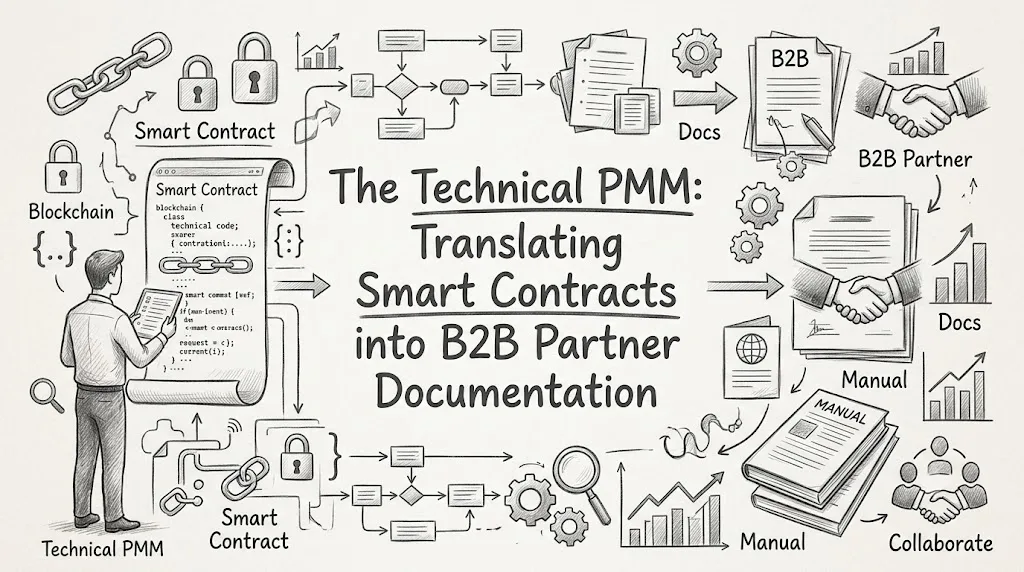
The Technical PMM: Translating Smart Contracts into B2B Partner Documentation

I have spent years analyzing how Web3 protocols build their go-to-market teams, and the breakdown in most enterprise partnerships rarely happens in the code; it happens in the translation layer. Engineering teams ship secure smart contracts, but without clear, commercially viable architectural documentation, partner BD teams cannot determine integration feasibility, audit dependencies, or SLA risks.
The Bridge Between DevRel and Outbound BD
Web3 infrastructure providers face massive translation friction during enterprise deals. They now hire a Technical Product Marketing Manager Web3 to solve this specific problem. This specialized role commands a base salary between $120,000 and $190,000, reflecting the broader Web3 BD compensation and skill scaling requirements necessary to close institutional deals. Protocol founders must understand the Web3 DevRel vs PMM dynamic to structure their go-to-market teams effectively.
Developer Relations (DevRel) supports external software engineers. These developers build on open SDKs and query public APIs. The Technical PMM serves a completely different commercial function. They equip internal sales teams and external partnership leads. They build the exact business frameworks needed to close strategic integrations.
Misaligning these roles stalls enterprise adoption. Core developers often write partner-facing smart contract documentation. This output focuses purely on byte-level efficiency and execution logic. It alienates business stakeholders completely. Conversely, standard SaaS marketers lack technical credibility. They ignore critical cross-chain bridging risks and state finality delays—a core reason why traditional Web3 go-to-market strategy breaks standard SaaS sales playbooks. Enterprise risk committees reject these flawed proposals immediately.
For example, traditional SaaS SLAs demand 99.9% guaranteed uptime. You cannot enforce this standard uptime SLA on a permissionless Ethereum node without mapping out a private fallback cluster. The Technical PMM identifies this gap and translates this operational friction into acceptable legal terms.
Equipping the Outbound BD Engine
To understand why the Technical PMM is vital, you have to look closely at what Web3 Business Development jobs really look like in practice. Michele Penna, a six-year veteran in non-technical crypto roles, points out that high-performing BD relies on high personal energy, continuous ecosystem fluency, and the capacity to network across two distinct environments: asynchronously in online social channels and directly on the conference floor.
Unlike creative marketing or founder-level macro vision, successful BD requires relentless execution—tracking fast-moving shifts, maintaining connections, and connecting with projects quickly. However, that outbound engine stalls if the BD lead cannot explain how the product works or the business mechanics behind it.
A partnership lead cannot navigate an enterprise review if they lack an operational understanding of the protocol stack. The Technical PMM does that heavy lifting. They extract the commercial mechanics from the codebase and build clear collateral. The Technical PMM provides the architectural narrative and risk mitigation frameworks so the BD team can walk into partner meetings prepared to address enterprise concerns.
De-Jargonizing the Smart Contract Stack for Enterprise Partners
Enterprise risk committees reject abstract cryptographic concepts. They demand concrete operational risk mitigation. A Technical PMM translates complex execution mechanics into tangible business value.
Consider a Tier-1 fintech integrating a stablecoin checkout. A crypto-native DevRel documents the paymaster contract architecture for external builders. The Technical PMM targets the corporate development executive. They explain that EIP-4337 Account Abstraction introduces a direct balance sheet liability: the fintech must continuously escrow native tokens to subsidize user gas fees.
The Technical PMM mandates strict rate-limiting per KYC-verified wallet. This framework prevents automated sybil attacks from draining the sponsor treasury.
Furthermore, smart contract security directly impacts enterprise compliance. Code must actively enforce transfer restrictions, custody rules, and investor protections. Wallet screening risk determines if the protocol can legally accept a deposit or whitelist a specific address. If the documentation fails to address these operational controls, the integration stalls permanently.
Commercial Translation vs. Technical Specs:
EIP-4337 Account Abstraction: Commercially translated as "Gasless onboarding for Web2 users," which mitigates the business risk of user drop-off during wallet creation.
Multi-Sig Execution Delay: Commercially translated as a "48-hour timelock on treasury transfers," mitigating counterparty rug/exploit liability.
Chainlink Data Streams: Commercially translated as "Sub-second decentralized price resolution," mitigating front-running and slippage disputes.
Foundry Invariant Test Suites: Commercially translated as "Automated edge-case exploit verification," mitigating protocol insolvency and smart contract hack risk.
Anatomy of a Web3 Integration PRD
Securing institutional buy-in requires a highly actionable artifact. Cross-functional teams must build a comprehensive DeFi integration PRD. This specific Web3 Product Requirement Document targets external enterprise partners. It separates concerns across two distinct integration tracks.
The Developer Track focuses on implementation infrastructure. It defines testnet contract addresses and explicit RPC endpoint rate limits. It provides actionable operational templates. It mandates a Gas Spikes Fallback Policy that specifies the Max Base Fee Cap in Gwei.
It sets precise Sponsor Paymaster Address Deposit Thresholds. This structured data helps partner engineering teams anticipate network edge cases. They model the integration timeline accurately without reverse-engineering the protocol repository.
The Business & Legal Track runs parallel. Traditional service agreements cannot govern permissionless state machines. This track details explicit Service Level Agreements (SLAs) tailored specifically for Web3 environments. It establishes an Emergency Circuit-Breaker
Key Management protocol to protect corporate treasuries during severe network exploits. The track caps gas sponsorship to prevent runaway operational costs. It provides smart contract audit verification reports from tier-one security firms and defines the exact mathematical parameters governing protocol fee-sharing.
Legal teams review these parameters to approve the partnership. The Technical PMM manages both tracks actively, ensuring technical implementation never outpaces legal risk management.
My Operator's Field Note: I constantly tell transitioning candidates: never let a partner's BD team read raw GitHub commits without a Technical PMM's overlay.
A protocol repository showing 50 open pull requests and active issues looks like operational dysfunction to a Web2 corporate development executive, whereas a crypto-native DevRel knows it indicates healthy open-source triage and rapid iteration.
Build Your Web3 Career or Scale Your Protocol Team
For Protocol Founders & Hiring Managers: Finding a Technical PMM who understands both EVM architecture and enterprise liability is incredibly difficult. Do not waste months interviewing standard SaaS marketers who cannot translate smart contracts. Use our paid commercial recruitment engine to source tested, high-signal candidates. 👉 Secure Your Core Team Before the Market Moves: Web3 Full-Cycle Staffing
For Transitioning Professionals & Job Seekers: If you want to land a $120,000+ Technical PMM or BD role, your resume cannot read like a generic Web2 marketing list. You must clearly demonstrate your ability to bridge technical architecture with commercial reality. Work with me 1-on-1 to audit, rewrite, and position your CV for immediate Web3 interviews. 👉 Turn Proof of Work Into Interviews: Professional Web3 CV Review
About the Author Shubhada Pande is the Founder and Community Manager of ArtOfBlockchain.club, with over 13 years of professional experience as a B2B technical content editor and writer. A former Chief Strategy Officer of Partnerships at a Layer-1 protocol, she specializes in proof-based Web3 recruitment, enterprise go-to-market strategy, and translating complex cryptographic mechanics into commercial value. You can read more of her work on the weekly Behind Blocks: Web3 Careers newsletter or connect with her on X @shubhadapande39.