
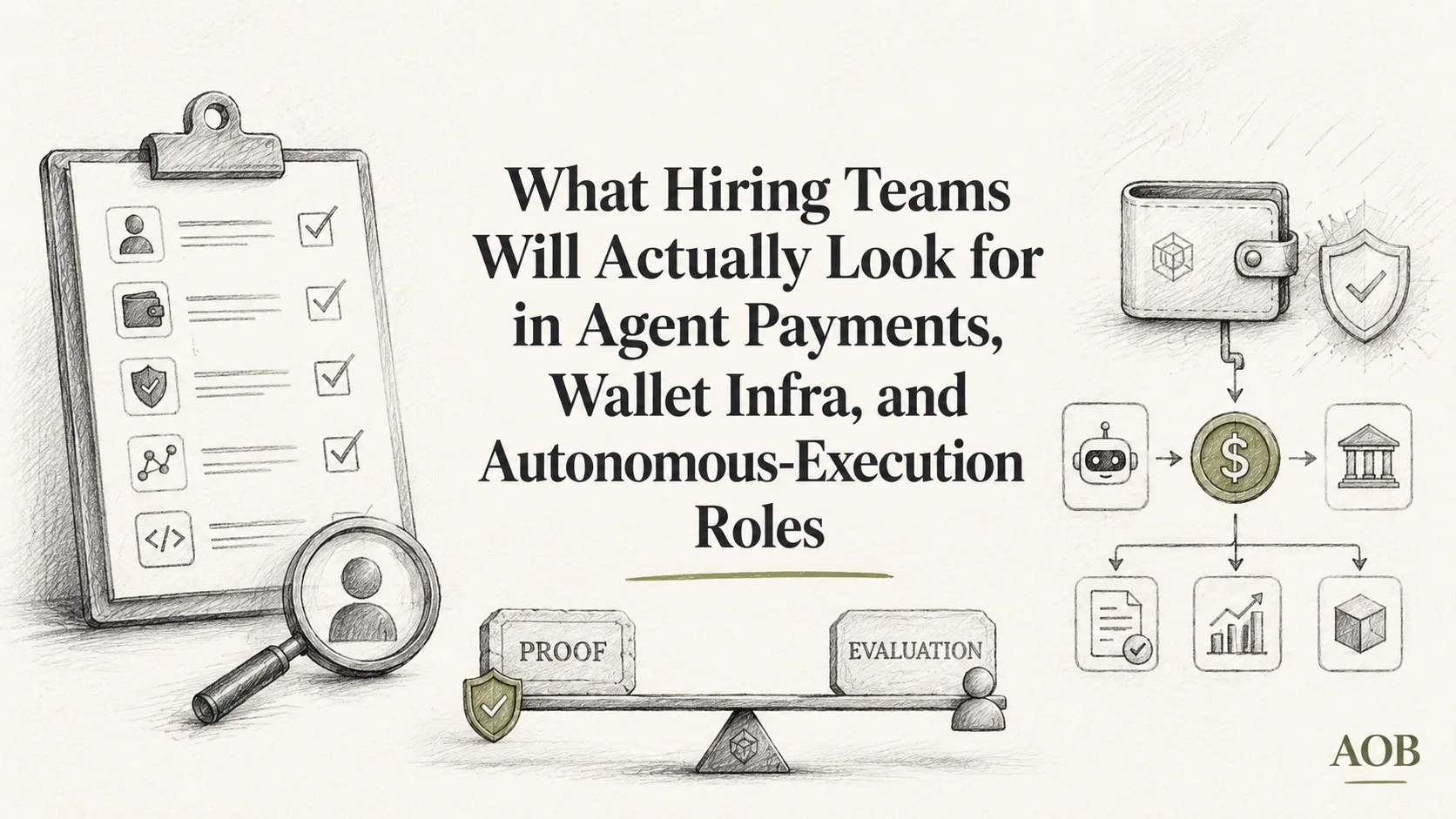
What Hiring Teams Look for in Agent Wallet, Agent Payments, and Autonomous Execution Roles

Hiring teams do not trust “AI x Web3” claims by default.
Not because the category is fake.
Because the proof is often unreadable.
A candidate may say they worked on agent payments, autonomous execution, AI wallets, x402 experiments, onchain automation, or wallet infrastructure. But for a founder, recruiter, or engineering lead, the real question is narrower:
Can this person be trusted near payment flows, wallet permissions, policy controls, user intent, monitoring, and failure recovery?
That is what hiring teams look for in agent wallet roles.
They are not only checking whether someone has built a demo where an AI agent triggers a transaction. They are checking whether the candidate understands what should happen before, during, and after that transaction.
Who approves the action?
What limits the agent?
What happens if the payment fails?
Can the wallet be paused?
Where is user intent verified?
How is misuse detected?
What proof exists beyond a polished GitHub README?
This article is written for two groups.
For candidates, it explains how to make your experience readable for agent payments, wallet infrastructure, and autonomous on-chain execution roles.
For hiring teams, it explains what to verify before trusting a resume that says “AI agents,” “Web3 automation,” “wallet infra,” or “payment rails.”
The hiring signal is not the phrase “AI x Web3.”
The hiring signal is whether the person can show safe execution thinking.
For AOB’s broader hiring-signal lens, this connects with the idea that Web3 hiring teams need readable proof, not just confident claims:
Web3 Hiring Signals | ArtofBlockchain
Why “AI x Web3” claims are weak until they become proof
A lot of resumes will soon sound similar.
They will mention AI agents, wallets, smart contracts, automation, payment flows, MCP, x402, AP2, account abstraction, or autonomous execution. Some of those terms may be relevant. Some may be copied from recent ecosystem conversations. Some may describe a real project. Some may describe a weekend demo with no production thinking behind it.
Hiring teams cannot treat all of them equally.
In normal software hiring, a weak demo may still show initiative. In agent payments or wallet infrastructure, a weak demo can hide dangerous gaps.
If an autonomous system can initiate payments, request wallet access, trigger contract calls, or move value across rails, the evaluation changes.
The hiring team is no longer asking only:
“Can this person build?”
They are also asking:
“Can this person design boundaries around what should not happen?”
That is why proof-based hiring becomes more important in this lane. The strongest candidates will not only show a working agent. They will show the guardrails around the agent.
They will explain spending limits, approval flows, permission scopes, rollback logic, monitoring, alerts, and human-in-the-loop controls.
They will show how they thought about wallet risk, not just how they connected an AI model to an onchain action.
This is where many candidates lose trust without realizing it. They describe the exciting part of the system, but skip the responsibility layer.
What hiring teams verify first in agent wallet and payment roles
In agent wallet and agent payments roles, hiring teams usually do not start by asking whether the candidate knows every new protocol term.
They start by asking whether the candidate understands responsibility.
That responsibility begins with a simple question:
What happens when an autonomous system is allowed to touch money, permissions, or execution paths?
A strong candidate does not treat the wallet as a final transaction button. They treat it as a controlled boundary.
They understand that an agent should not be able to spend freely, approve blindly, call contracts without context, or act without a clear policy layer.
A demo may show that an AI agent can trigger an onchain payment. But hiring teams want to know whether the candidate can explain the decision flow behind that payment.
Who requested the action?
Was the user intent clear?
Was the payment amount bounded?
Was the destination verified?
Was approval required?
Was there a spending cap?
Was there a way to pause, reject, or reverse the workflow before damage happened?
These are not “extra” questions.
In agent payments, these are the role.
Payment flow thinking comes before protocol vocabulary
A candidate may mention x402, AP2, MCP, A2A, smart wallets, account abstraction, or autonomous agents. That vocabulary can help, but it does not prove judgment.
Hiring teams will look for payment flow thinking first.
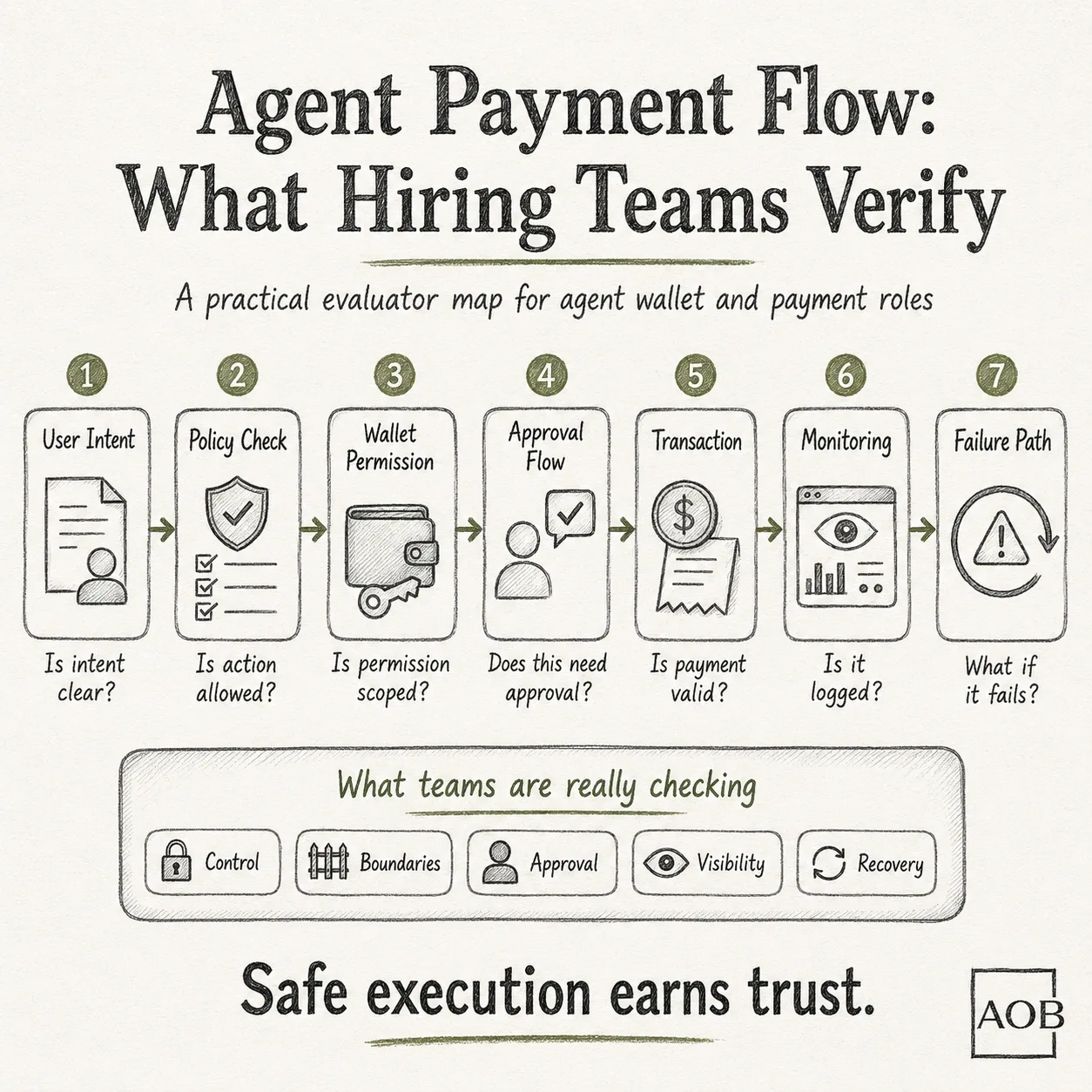
Can the candidate break a payment journey into clear steps?
For example:
request starts
intent is checked
policy rules are applied
wallet permission is evaluated
amount and destination are validated
approval flow is triggered if needed
transaction is executed
event is logged
failure or rollback path is available
monitoring catches abnormal behavior
This kind of explanation is more valuable than saying, “I built an AI agent that can pay.”
The stronger candidate shows where the agent is allowed to act, where it must ask for approval, where the wallet should limit it, and where the system should stop execution.
That is the difference between a builder who can make a demo and a builder who can work near payment infrastructure.
Wallet permissions and guardrails are a core hiring signal
Wallet infrastructure roles are not only about connecting users to transactions.
In agentic systems, wallet infrastructure becomes a control layer.
Hiring teams will check whether the candidate understands:
permission scopes
spending limits
approval rules
session boundaries
transaction simulation
policy checks
access revocation
wallet-level pause or kill-switch logic
monitoring for abnormal actions
A weak candidate talks about wallet access as if it is binary: connected or not connected.
A stronger candidate talks about wallet access as a set of limits.
What can the agent do?
For how long?
Up to what amount?
With which asset?
For which contract?
Under whose approval?
With what logs?
With what recovery path?
That is the language hiring teams listen for.
Because in autonomous-execution roles, risk does not only come from bad code. Risk also comes from unclear authority.
If the agent has too much permission, the system becomes unsafe.
If the agent has too little permission, the product becomes unusable.
If the permission model is unclear, the hiring team cannot trust the candidate’s judgment.
The best candidates can discuss this tension without turning it into theory.
Hiring teams look for failure thinking, not just success paths
Most candidate demos show the happy path.
The agent receives a prompt.
The wallet connects.
The payment happens.
The demo works.
That is not enough for serious agent payments or wallet infrastructure hiring.
Hiring teams will ask what happens when the system fails.
What if the agent misunderstands the user?
What if the destination address is wrong?
What if the payment is duplicated?
What if the API returns stale data?
What if gas spikes?
What if the transaction is pending for too long?
What if the user changes their mind before execution?
What if the agent keeps retrying and creates a bigger problem?
These questions reveal whether the candidate has production thinking.
A strong candidate does not need to have solved every edge case. But they should show that they know where edge cases live.
That means they can discuss monitoring, alerts, retry limits, transaction status handling, fallback paths, manual review, logs, and rollback or compensation logic where true rollback is not possible.
This is why “autonomous execution” is not only a technical phrase.
It is an accountability phrase.
The strongest proof artifacts for agent payments and wallet infrastructure
For agent payments and wallet infrastructure roles, proof should not only show that something worked once.
It should show how the candidate thinks when the system can act, spend, approve, fail, or expose users to risk.
A clean demo can help, but hiring teams need more than a video of an AI agent triggering a payment. They need to see the thinking behind the system.
A strong proof artifact should answer three questions:
What was the agent allowed to do?
What stopped it from doing the wrong thing?
What evidence shows the candidate understood the risk?
This is where candidates can separate themselves.
Many applicants will write “built an AI agent for Web3 payments” on their resume.
Fewer will show a readable architecture note, permission model, test cases, monitoring logic, and failure-handling explanation.
That second group will be easier for hiring teams to trust.
Architecture proof should show the flow, not just the feature
The first strong artifact is a simple architecture explanation.
Not a massive technical document. Not a diagram filled with buzzwords. Just a clear breakdown of how the agent, wallet, policy layer, payment flow, user approval, and monitoring system interact.
A hiring team should be able to scan it and understand:
where the user request starts
how intent is interpreted
where policy checks happen
how wallet permissions are applied
when human approval is required
how the transaction is executed
where logs, alerts, and fallback paths sit
This matters because agentic Web3 roles sit between automation and financial responsibility.
If the candidate only shows the final output, the hiring team has to guess how they think.
If the candidate shows the architecture, the hiring team can evaluate judgment.
A strong architecture note might explain why the agent was not given unlimited wallet access, why high-value payments required approval, why some actions were simulated before execution, and why monitoring was added after execution.
That kind of proof is both recruiter-readable and engineering-relevant.
Permission proof should show what the agent cannot do
One of the clearest hiring signals is whether the candidate can define limits.
In agent wallet roles, “what the agent cannot do” is often more important than “what the agent can do.”
A good proof artifact should show permission boundaries.
For example:
the agent can suggest a payment, but not execute above a certain amount
the agent can pay approved vendors, but not unknown addresses
the agent can initiate low-risk actions, but must request approval for high-risk actions
the wallet session expires after a defined period
permissions can be revoked
suspicious activity creates an alert or manual-review step
This tells the hiring team the candidate understands control.
A weak candidate may say:
“The agent connects to the wallet and sends funds.”
A stronger candidate says:
“The agent only receives bounded permission, high-risk actions require approval, and every execution path is logged.”
That difference matters.
Hiring teams evaluating agent wallet engineers, payment rails engineers, or autonomous-execution roles are not only looking for technical ability. They are looking for someone who respects boundaries.
GitHub and portfolio proof should reduce evaluation friction
A GitHub link is useful only when it reduces doubt.
A repository with unclear commits, no explanation, no tests, and a vague README may show effort, but it does not show hiring signal clearly.
For agent payments and wallet infrastructure, a stronger GitHub or portfolio page should include:
a short README explaining the role of the agent, wallet, and policy layer
setup instructions that work
architecture notes or diagrams
tests for payment limits, permission checks, and failure cases
examples of allowed and blocked actions
notes on what is experimental versus production-aware
clear commit history or issue notes showing iteration
This is not about making GitHub look polished for its own sake.
It is about reducing evaluation friction.
A recruiter may only scan for 30 seconds. An engineering lead may look deeper. Both should be able to understand what the candidate built, why it matters, and where the risk controls are.
For candidates who need to make technical proof more readable, AOB has a broader GitHub-focused career article here:
GitHub for Blockchain Developers: Proof of Work for Web3 Hiring | ArtofBlockchain
The same idea becomes even more important in agent payments and wallet infrastructure because the project is not only judged by whether it runs.
It is judged by whether it can be trusted.
What weak candidates usually say, and why hiring teams do not trust it

Weak candidates in agent payments and wallet infrastructure roles usually do not sound weak at first.
They often use the right words.
They may mention AI agents, wallet automation, Web3 payments, smart wallets, autonomous transactions, payment rails, MCP, x402, AP2, or onchain execution.
The problem is not always vocabulary.
The problem is that the claim stops before the responsibility layer begins.
A hiring team may read a resume line like:
“Built an AI agent that can execute crypto payments.”
That sounds interesting. But it does not yet answer the questions that matter.
Could the agent spend without approval?
Were payment limits defined?
Was the destination checked?
Was the user’s intent verified?
What happened if the transaction failed?
Was there monitoring?
Could access be revoked?
Was this a safe design or just a working demo?
This is where many candidates lose trust.
They describe what the system can do, but not what controls the system.
Common weak patterns
A weak claim says:
“I built an AI agent for payments.”
A stronger claim says:
“I built a wallet-connected payment agent with bounded spending limits, approval checks for high-value transfers, logged execution events, and failure handling for pending or rejected transactions.”
A weak claim says:
“The agent has wallet access.”
A stronger claim explains scoped permissions, revocation, time-bound access, approved counterparties, transaction simulation, spending caps, and manual approval paths.
A weak claim says:
“It works end to end.”
A stronger claim explains what happens when the transaction is delayed, the agent retries, the user changes the instruction, the recipient address is wrong, or the payment amount crosses a risk threshold.
A weak claim says:
“I used the latest protocol.”
A stronger claim explains where that protocol fits inside a safe payment, wallet, or execution flow.
A weak claim says:
“My GitHub has the project.”
A stronger proof package makes the repository readable through a clear README, architecture note, test examples, permission explanation, and failure-case notes.
Interest is not a problem.
But interest is not proof.
For junior or transitioning candidates, this does not need to be production-level experience. But it should show direction.
A serious candidate does not need to claim they have already built the future of autonomous finance.
They need to show that they understand why autonomous payment systems require care.
What recruiters can scan in 30 seconds
Recruiters may not deeply evaluate wallet architecture, payment rails, or autonomous execution systems in the first scan.
But they can still look for signals.
In agent payments and wallet infrastructure roles, a 30-second scan should not focus only on whether the resume says “AI agent,” “Web3,” “wallet,” or “payments.”
Those words are easy to add.
The better scan is:
Does the candidate show proof of controlled execution?
A recruiter does not need to judge every technical detail. But they can check whether the candidate has made their work understandable.
A strong profile will usually show:
the type of system built
the wallet or payment responsibility involved
the limits placed on the agent
the approval or policy layer
the failure or monitoring logic
the proof artifact attached
the business or user risk considered
A weak profile usually stops at tool names and broad claims.
The fastest red flag is a resume that sounds advanced but explains nothing.
For example:
“Worked on autonomous AI agents for blockchain payments using latest Web3 protocols.”
This may sound current, but it gives very little hiring signal.
A stronger version would be:
“Designed a wallet-connected agent payment flow with scoped permissions, spending limits, approval checks for high-value transfers, transaction logging, and failure handling for pending or rejected payments.”
The second version is not just more detailed.
It is more trustworthy.
It shows the candidate understands the responsibility attached to autonomous execution.
A strong recruiter note should not say only:
“Candidate has AI x Web3 experience.”
It should say:
“This candidate has agent payment experience with wallet permission design, approval checks, failure handling, and a readable proof artifact. Worth deeper technical review.”
That improves shortlist quality.
For candidates, the lesson is simple: do not make recruiters guess where your proof is.
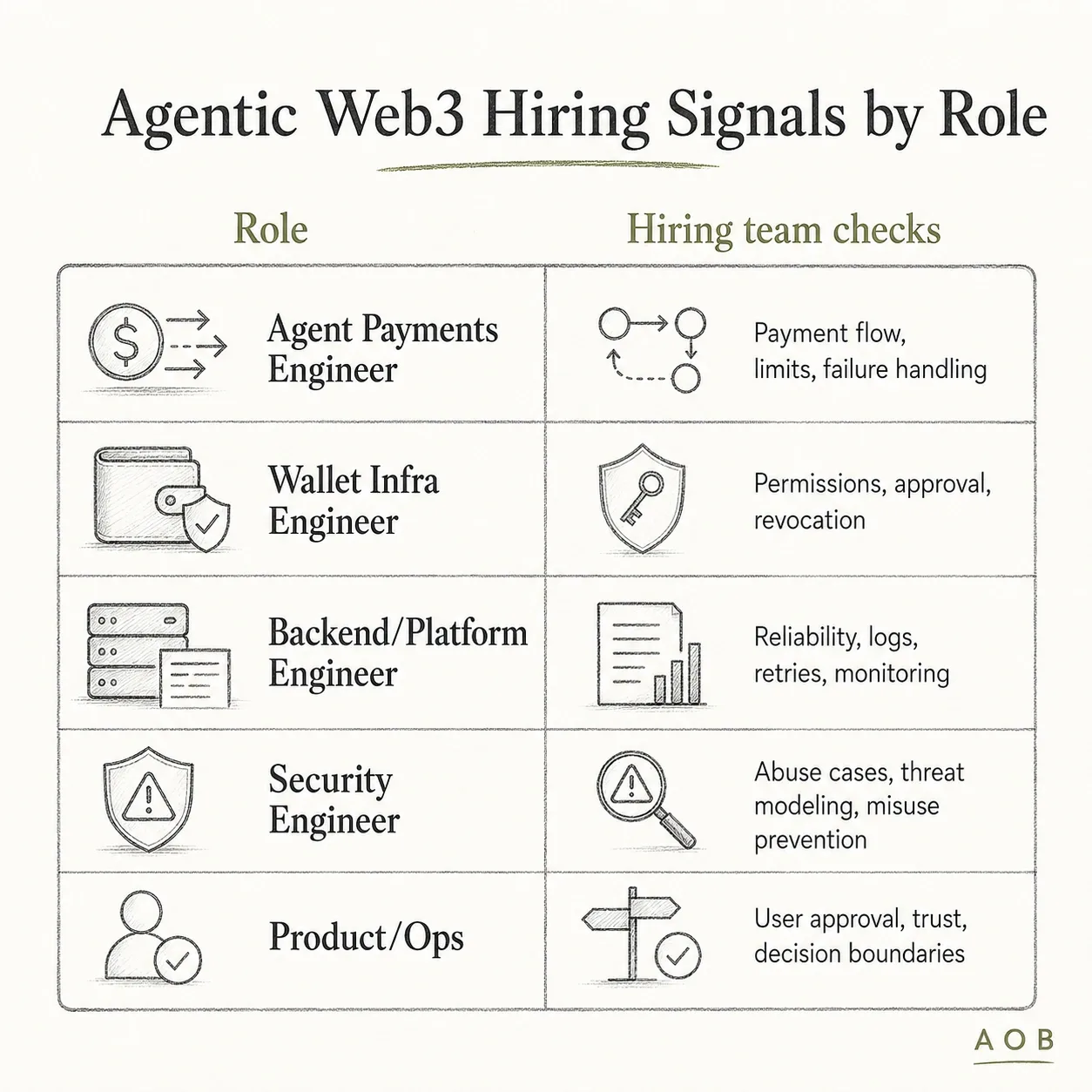
Role-specific evaluation differences

Hiring teams should not evaluate every agentic Web3 candidate with the same checklist.
An agent payments engineer, wallet infrastructure engineer, backend/platform engineer, security engineer, and product manager may all touch the same problem space.
But the proof expected from each one should be different.
This is where many hiring teams make the scorecard too vague.
They write one broad role around “AI agents + Web3 + payments + wallet infrastructure” and then attract candidates with very different strengths.
Some are payment-flow thinkers.
Some are smart contract developers.
Some are backend engineers.
Some understand wallets.
Some understand AI workflows.
Some only understand demos.
A better hiring process separates the signal by role.
Agent payments engineer
For an agent payments engineer, the hiring team should look for payment flow judgment first.
This person should be able to explain how money moves through the system and where the risk sits.
Strong signals include payment request flow, amount validation, recipient validation, spending limits, approval thresholds, retry logic, failed or pending transaction handling, logs, and reconciliation thinking.
A weak candidate may say:
“The agent can make payments.”
A stronger candidate explains when the agent is allowed to prepare a payment, when it needs approval, how limits are enforced, and what happens when execution fails.
The core question is:
Can this person design agent payments as controlled financial workflows, not just automated actions?
Wallet infrastructure engineer
For a wallet infrastructure engineer, the strongest signal is permission design.
Hiring teams should check whether the candidate understands wallet access as a layered control problem.
Strong signals include scoped wallet permissions, session limits, revocation paths, approval flows, transaction simulation, spending caps, contract interaction boundaries, recovery mechanisms, and user consent visibility.
A weak candidate talks about wallet connection.
A stronger candidate talks about what the agent can and cannot do after connection.
In agent wallet roles, the wallet is not just a UX component.
It is the boundary between user intent and autonomous execution.
The core question is:
Can this person design wallet access without creating uncontrolled authority?
Backend, platform, or reliability engineer
A backend or platform engineer in this lane may not own the wallet directly, but they may own the infrastructure around execution.
Hiring teams should evaluate whether the candidate can think about reliability, queues, APIs, state, logs, monitoring, and failure handling.
Strong signals include clean service boundaries, transaction-state tracking, event logging, API failure handling, retry limits, idempotency, alerts, manual review workflows, and scalable integration design.
A weak candidate may focus only on connecting an agent to an API.
A stronger candidate explains how the system behaves when external services fail, when a transaction remains pending, when duplicate requests appear, or when the agent produces uncertain output.
The core question is:
Can this person make autonomous execution observable, recoverable, and reliable?
Security engineer
For security-focused roles, hiring teams should look beyond normal smart contract security.
Agentic systems introduce additional questions around intent, authority, automation, and misuse.
Strong signals include threat modeling for agent-wallet interaction, abuse-case thinking, suspicious transaction detection, unsafe approval prevention, permission escalation awareness, monitoring for abnormal agent behavior, human review for sensitive actions, and incident response thinking.
A weak candidate only says:
“I checked the smart contract.”
A stronger candidate explains how the agent, wallet, policy layer, and user approval flow can be abused or misconfigured.
The core question is:
Can this person identify where autonomous systems can fail before value moves?
Product manager or product ops
Not every agentic Web3 role will be purely technical.
Product managers, product ops professionals, and solutions roles may need to translate user needs into safe execution rules.
Hiring teams should evaluate whether they can define when the agent should act, when the user should approve, what actions should be blocked, how risk levels are categorized, what should be visible to the user, and what support or escalation path is needed.
A weak product candidate talks only about automation.
A stronger product candidate talks about trust, control, user consent, and operational responsibility.
The core question is:
Can this person turn autonomous execution into a product workflow people can trust?
When hiring teams use one generic “AI x Web3” filter, they often shortlist the wrong people.
The role-specific scorecard prevents this confusion.
For candidates and hiring teams watching how these roles appear in the market, AOB’s curated blockchain job board can help track adjacent language around wallets, payment rails, onchain tools, and infrastructure roles:
Job Board | ArtofBlockchain
Red flags in AI x Web3 resumes
The biggest red flag in AI x Web3 resumes is not ambition.
Ambition is fine. Curiosity is fine. Experimentation is fine.
The problem starts when the resume makes the candidate sound closer to production responsibility than the proof actually supports.
Agent payments, wallet infrastructure, and autonomous-execution roles involve trust-sensitive systems. If a candidate claims experience in this lane, the resume should show more than tool usage, trend awareness, or a working demo.
Hiring teams will look for signs that the candidate understands responsibility around money, permissions, users, and failure.
The main red flags are:
big category claim, small proof
protocol names without system thinking
wallet access described too casually
no failure or monitoring language
no separation between demo and production
no proof artifact attached
A resume line like this sounds current:
“Worked on AI x Web3 payment agents.”
But it does not say enough.
What was built?
Was it a demo, prototype, internal tool, hackathon project, or production workflow?
Were payments real or simulated?
What did the candidate personally own?
A stronger resume should narrow the claim:
“Built a prototype agent payment flow with wallet permission checks, spending limits, approval steps, and transaction-status handling.”
That gives the hiring team something to evaluate.
The same applies to protocol names. Listing x402, MCP, AP2, account abstraction, smart wallets, or agent frameworks can help only when those terms are connected to actual implementation.
A resume becomes weak when protocol names replace explanation.
Hiring teams do not only want to know which terms the candidate has seen. They want to know whether the candidate understands where those tools sit inside a payment, wallet, or execution flow.
Wallet access also needs context.
Any resume that casually says “gave the agent wallet access” should make hiring teams pause.
Was access scoped?
Could it be revoked?
Was it time-bound?
Were high-risk actions blocked?
Was human approval required?
Were unknown recipients restricted?
If the resume does not show limits, the hiring team may assume the candidate has not thought enough about control.
AOB also has a related resume discussion where candidates ask whether their Web3 resume is missing important proof signals:
Tear this resume apart — what’s missing for a solid Web3 dev profile ? | ArtofBlockchain
The lesson is simple: in this lane, a resume should not only say what the candidate explored. It should show how they handled authority, risk, and trust.
How AOB helps candidates and hiring teams convert claims into readable proof
The hiring problem in agent payments, wallet infrastructure, and autonomous-execution roles is not only a talent-supply problem.
It is a signal problem.
Candidates may have useful experience, but they often describe it in a way that sounds vague.
Hiring teams may need strong builders, but their job descriptions often mix too many responsibilities into one unclear role.
That creates friction on both sides.
Candidates say:
“I worked on AI agents, wallets, payments, and automation.”
Hiring teams ask:
“What exactly can we verify?”
That gap is where proof-based hiring matters.
AOB’s role in this cluster is not to turn every candidate into an “AI x Web3 expert.”
It is to help candidates and hiring teams make real signals easier to read.
For candidates: make your proof easier to trust
If you are applying for agent payments, wallet infrastructure, payment rails, or autonomous-execution roles, your resume should not only list tools.
It should show responsibility.
A strong candidate profile should help a recruiter or founder quickly understand:
what you built
what payment or wallet responsibility was involved
what the agent was allowed to do
what the agent was blocked from doing
how approval or policy checks worked
what failure cases you considered
where your GitHub, architecture note, or portfolio proof sits
This matters because hiring teams cannot shortlist what they cannot understand.
A candidate may have worked on a meaningful prototype, but if the resume only says “AI agent for Web3 payments,” the signal is too weak.
A stronger resume turns the same work into recruiter-readable proof:
“Built a wallet-connected agent payment prototype with scoped permissions, spending caps, approval checks for high-risk transfers, transaction-status handling, and logged failure events.”
That is still honest.
It does not overclaim production experience.
But it gives hiring teams something real to evaluate.
For candidates who want to check whether their blockchain CV is showing proof clearly enough, AOB’s CV review guide is here:
Blockchain CV Review: What Recruiters Reject in 10 Seconds (Proof-Stack Checklist) | ArtofBlockchain
For hiring teams: write JDs around responsibility, not buzzwords
Hiring teams face the opposite problem.
Many agentic Web3 roles are still emerging, so job descriptions can become overloaded.
A JD may ask for AI agents, wallet infrastructure, payment rails, smart contracts, backend systems, security, product thinking, automation, monitoring, and blockchain experience — all in one role.
That may attract applicants, but it may not attract the right proof.
A stronger JD should clarify the responsibility first.
Is this role mainly about:
payment-flow engineering?
wallet permission design?
backend reliability around autonomous execution?
security and misuse prevention?
product workflows for human approval and trust?
developer tooling around agent payments?
Each version needs a different scorecard.
If the JD is unclear, recruiters may shortlist candidates who sound relevant but do not match the actual risk surface of the role.
For example, a candidate strong in prompt workflows may not understand wallet permissions. A smart contract developer may not understand payment operations. A backend engineer may understand reliability but not user approval or transaction authority.
The JD should make those differences visible.
For hiring teams building blockchain teams, AOB’s broader proof-based screening and hiring guide is here:
How Recruiters and Hiring Managers Verify Blockchain Talent Beyond the Resume | ArtofBlockchain
The same principle helps both candidates and hiring teams.
Candidates need to show proof that is readable.
Hiring teams need to define proof that is relevant.
In agent payments and wallet infrastructure, this becomes even more important because the work touches value movement, user permissions, monitoring, failure handling, and trust.
The strongest hiring conversations will not start with:
“Do you know AI agents?”
They will start with:
“Show us how you think about autonomous execution when a wallet, payment flow, or user approval boundary is involved.”
That is where AOB’s proof-based hiring lens becomes commercially useful: better CV signals for candidates, better JD clarity for hiring teams, and better shortlist quality for both sides.
FAQ: Hiring signals for agent payments, wallet infrastructure, and autonomous-execution roles
What do hiring teams look for in agent wallet roles?
Hiring teams look for proof that the candidate understands wallet responsibility, not just wallet connection.
A strong candidate should be able to explain what the agent can do, what it cannot do, how permissions are scoped, when approval is required, how spending limits work, and what happens when execution fails.
The best signal is not “I built an AI wallet demo.”
The stronger signal is:
“I designed a wallet-connected agent flow with bounded permissions, approval checks, monitoring, failure handling, and clear user-control points.”
That shows the candidate understands safe autonomous execution.
How do you evaluate an agent payments engineer?
An agent payments engineer should be evaluated on payment flow judgment.
Hiring teams should check whether the candidate can explain:
how a payment request starts
how intent is verified
how payment amount and recipient are validated
where policy checks happen
when user approval is needed
how failed, pending, or duplicate transactions are handled
how payment events are logged and monitored
A strong agent payments engineer does not only automate payment execution.
They design the control layer around payment execution.
What proof should candidates show for agentic Web3 roles?
Candidates should show proof that makes their work easy to verify.
Useful proof artifacts include:
GitHub repository
architecture note
README with risk model
permission design explanation
test cases for allowed and blocked actions
failure-mode notes
monitoring or logging explanation
short demo video
case-study style portfolio page
The proof does not need to be perfect.
But it should show the candidate’s thinking around money, permissions, failure, and control.
Are AI x Web3 demos enough for these roles?
No, not by themselves.
A demo can help open the conversation, but it is not enough for roles involving agent payments, wallet infrastructure, or autonomous on-chain execution.
Hiring teams need to know what sits around the demo.
Was the agent limited?
Was wallet access scoped?
Were high-risk actions blocked?
Was user approval required?
Was execution monitored?
Were failure cases considered?
A demo shows that something can work once.
Proof shows whether the candidate understands what can go wrong.
How should hiring teams write better JDs for these roles?
Hiring teams should write JDs around responsibility, not only trend vocabulary.
Instead of asking for “AI x Web3 experience,” define the role’s real center:
agent payments
wallet permission design
payment rails integration
backend reliability
monitoring and incident response
security and misuse prevention
product workflows for approval and trust
A clearer JD attracts better proof.
If the role needs wallet permission judgment, say that.
If the role needs payment flow thinking, say that.
If the role needs monitoring and rollback logic, say that.
The clearer the responsibility, the better the shortlist.
Final takeaway
Agent payments, wallet infrastructure, and autonomous-execution roles will not be evaluated like normal AI demo projects.
The closer a system gets to money, wallet permissions, and onchain execution, the more hiring teams will care about control.
That means candidates need to show more than curiosity.
They need to show readable proof.
And hiring teams need to ask for more than buzzwords.
They need to define what responsibility the role actually carries.
The strongest signal in this lane is not the loudest AI x Web3 claim.
It is the candidate who can explain:
what the agent can do
what the agent cannot do
where user approval sits
how wallet permissions are bounded
how payment failures are handled
how monitoring works
what proof exists for the hiring team to verify
That is what hiring teams will actually look for in agent wallet roles.
Not just automation.
Safe, explainable, controlled execution.