
Web3 Hiring Signals: What Strong Candidates Quietly Look For Before Applying

A common Web3 hiring problem: many applicants, low fit
In Web3 hiring, a job post can get a lot of interest. Applications come in fast. But the hiring team still feels stuck.
It appears to be a sourcing problem. Or a “talent quality” problem.
But very often, it is a JD clarity problem.
Strong candidates do something quietly. They read the JD, feel unsure, and decide not to apply. They don’t message. They don’t argue. They just move on.
This is why teams ask later:
“Why does my Web3 job post attract unqualified applicants?”
Because the JD is not only attracting the wrong people — it is also pushing away the right people.
For more hiring-side examples and discussion threads, this hub is the best entry point:
Hiring Managers & Recruiters Hub — Hiring Signals & Interview Expectations
https://artofblockchain.club/discussion/hiring-managers-recruiters-hub-hiring-signals-interview-expectations
TL;DR
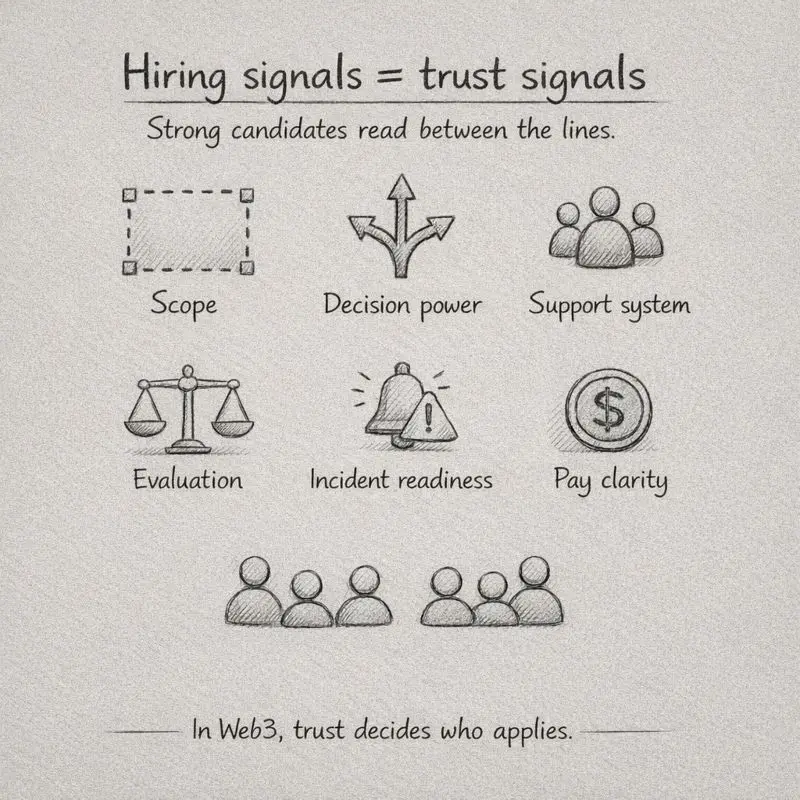
Strong candidates don’t just read skills in a JD. They read trust signals.
JDs that try to cover “everything” often feel risky, even if the role is real.
Candidates silently opt out when scope, decision power, and evaluation feel unclear.
In Web3, keywords don’t build trust. Role clarity does.
If a JD gets many applicants but low fit, it usually needs a clarity pass, not more sourcing.
Helpful AOB starting points: hiring signals, proof-based hiring, and interview calibration threads.
A JD pattern that looks “strong”… but reads risky
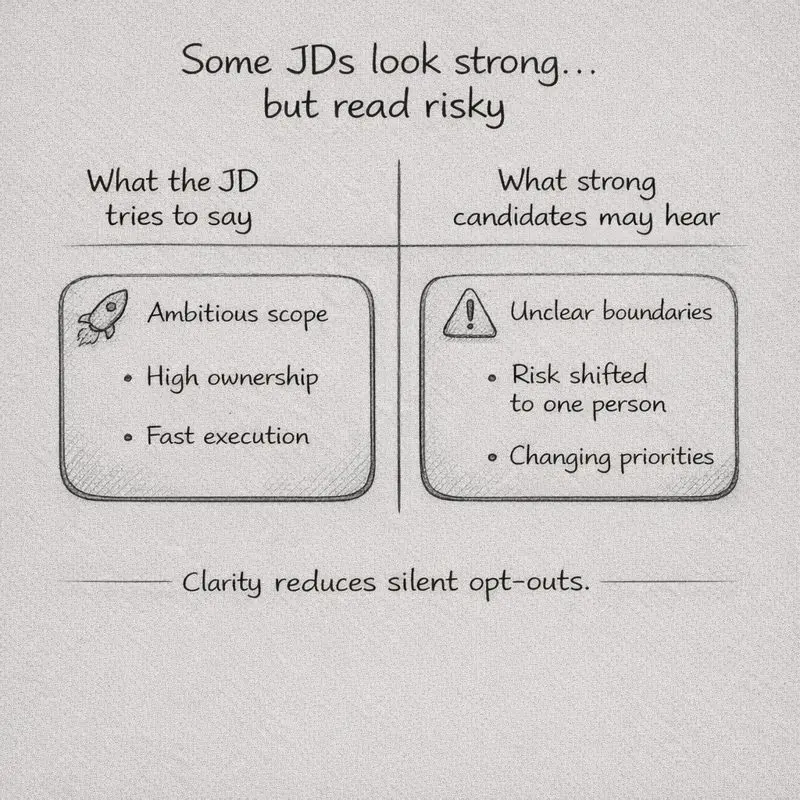
Here is a JD style many teams write (shared as a pattern; not a personal attack on any company).
It usually says something like:
“Lead all blockchain architecture and execution.”
“Build DEX + wallet + validator setup + core logic.”
“Must have deep L1/L2 experience across many ecosystems.”
“Must know Rust / Move / EVM.”
“Own security, audits, exploit protection.”
“Build for scale, monitoring, analytics.”
And also: “Act as product lead + lead mobile/backend + own delivery + work directly with CEO.”
This JD sounds ambitious. It sounds like a “CTO-level” role.
But a lot of strong candidates read it as:
“This role is many jobs combined into one.”
When a JD mixes too many responsibilities, candidates start worrying about:
Scope: what exactly is the main job?
Support: who helps when many things break at once?
Decision power: who decides priorities when there is conflict?
If those answers are not clear, strong candidates assume the worst case. They don’t take the risk.
This is a big reason people search:
“Web3 CTO job description too broad”
or
“blockchain JD red flags for senior engineers”
If the idea of “hiring signals” is useful as a lens, this hub is a good map:
Web3 Hiring Signals
https://artofblockchain.club/discussion/web3-hiring-signals
Common JD mistakes in Web3 that push strong candidates away
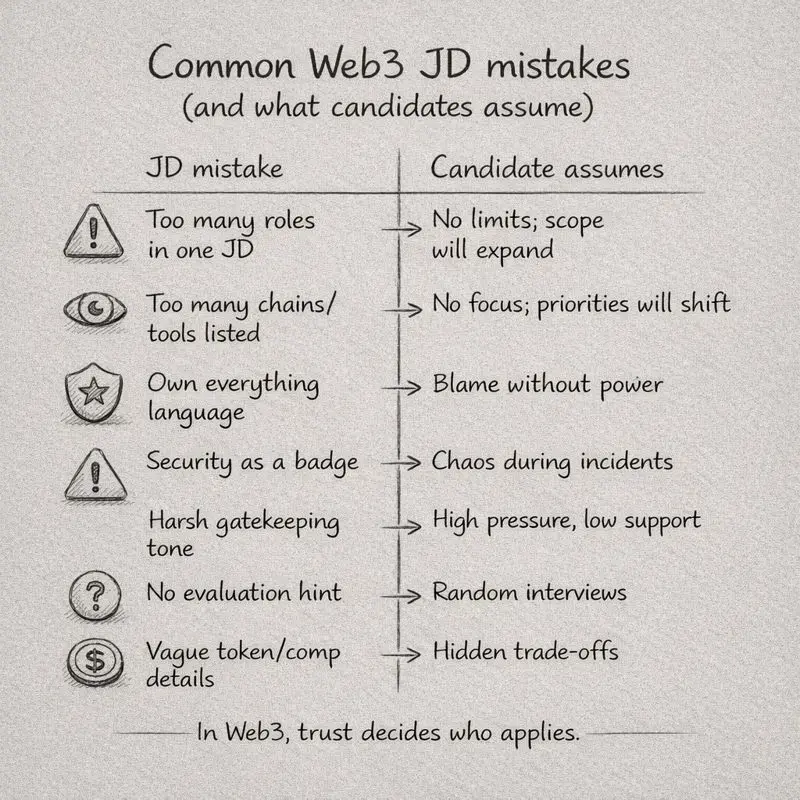
This is what often makes a Web3 job description look “strong” on the surface, but risky to strong candidates.
Too many roles mixed into one JD
Candidates read it as: “This role has no limits. Everything will become my job.”Too many chains, tools, and ecosystems listed
Candidates read it as: “The team is not focused yet. Priorities may change every week.”“Own everything” language without clear boundaries
Candidates read it as: “High blame, unclear decision power.”Security mentioned like a badge, not like a working system
Candidates read it as: “Incidents will happen, but the process may be chaotic.”Harsh gatekeeping lines (“If you haven’t done X, don’t apply”)
Candidates read it as: “High pressure culture. Low patience. Low learning support.”No hint of how the team will evaluate the candidate
Candidates read it as: “Interviews may be random or keyword-based.”Vague compensation (especially tokens, equity, or ‘upside’)
Candidates read it as: “Hard negotiations later. Hidden trade-offs.”
If a hiring team wants to see more examples of how candidates read these signals, this AOB thread is a good starting point:
https://artofblockchain.club/discussion/web3-hiring-signals
Why “hiring signals” matter in Web3
In Web3, the JD is not just a list of skills.
Candidates treat it like a signal of how the company works day to day.
They look for signals about:
How decisions happen,
How quality is checked,
How incidents are handled,
How work is reviewed,
How compensation is described (especially tokens).
In simple words:
Hiring signals are trust signals.
Candidates don’t only ask “Can I do this job?”
They also ask, “Will this job be fair and manageable?”
If a team wants a “proof-first” approach (not buzzword matching), this AOB thread is a good anchor:
https://artofblockchain.club/discussion/proof-based-hiring-in-web3
What strong candidates check (without saying it)
This part matters for founders and recruiters who ask:
“How to write a blockchain job description that attracts senior candidates”
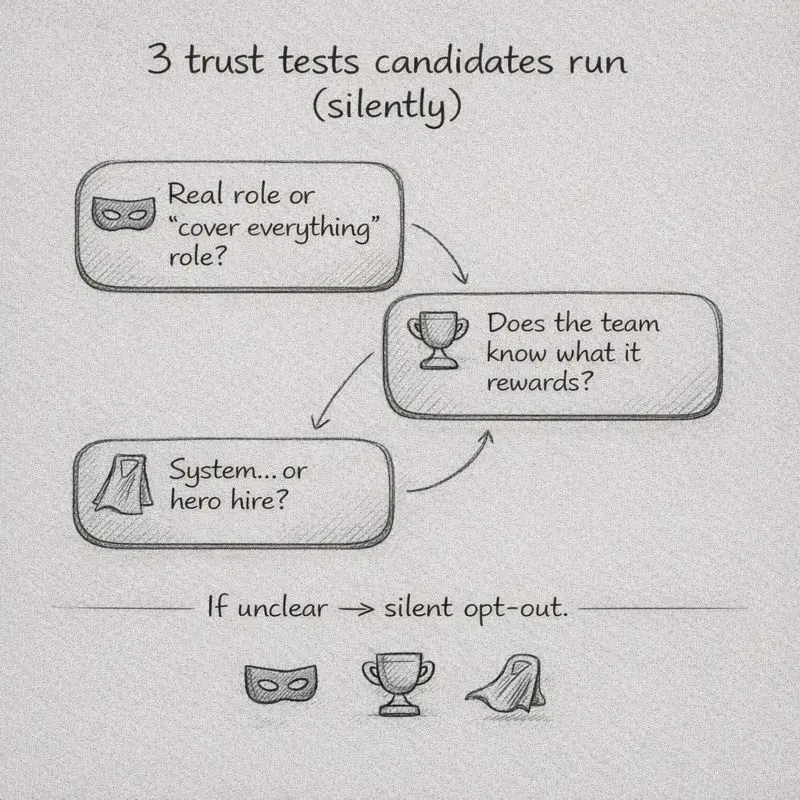
Strong candidates usually check three things while reading a JD. They don’t call it a framework. It’s just how they protect their time.
1) Does the JD describe a real role, or a “cover everything” role?
When a JD says “build everything from scratch” and lists many systems, strong candidates see a danger:
The role may have no clear boundaries.
They don’t mind hard work. They mind confusion.
If the role is truly a founding CTO role, that can be fine. But then the JD must clearly show what “winning” looks like. Otherwise, it feels like a hero-hire.
This is why people search:
“Why strong candidates don’t apply to early stage Web3 roles”
2) Does the company know what it will judge the person on?
Many JDs say: “high ownership, high standards, security mindset.”
But candidates want to know: what gets rewarded in reality?
If the JD sounds like “ownership,” but the interview is only trivia questions, candidates lose trust.
This is why “interview loop mismatch” is a real Web3 hiring problem.
AOB has a good calibration discussion for this:
https://artofblockchain.club/discussion/web3-interview-signals-calibration
3) Is the JD showing a system, or asking for a hero?
Some JDs use strong lines like:
“If you haven’t shipped serious infra, don’t apply.”
“Full decision-making power. Work directly with CEO.”
It can also signal:
“The company is putting all uncertainty on one person.”
Experienced candidates have seen this pattern. So they opt out.
A simple example of “candidate interpretation” (without rewriting the JD)
Take this kind of line:
“Build DEX + wallet + validator setup + security standards + monitoring + analytics + 10x scale.”
To a hiring team, it may mean: “We want a strong technical owner.”
To a strong candidate, it often sounds like:
“There is no team around this yet.”
“The roadmap is not stable.”
“This role will be judged on too many things at once.”
This is not “bad.” It is just how the market reads it.
Why good teams still write unclear JDs
Most unclear JDs are not written by careless founders.
They are written under pressure:
Hiring has to happen fast,
The roadmap is moving,
The team is small,
There is fear of a wrong hire,
There is fear of security incidents.
So the JD keeps growing. It becomes a “safety net document.”
But the market reads that as risk.
A quiet next step (without sounding like marketing)
When a JD gets attention but not fit, the problem is usually not “more applicants.”
It is usually this:
The JD is not turning internal reality into clear words for candidates.
That translation is hard to do alone, because the team knows too much context. The JD writer forgets what candidates don’t know.
That is why Artofblockchain.club runs a JD Review service: to spot the parts of a JD that create silent opt-outs, and help hiring teams make the role clearer (without making it corporate).
And if the goal is to attract candidates who already value clarity and proof, AOB’s curated job board helps distribute roles that are written in a candidate-readable way.
For deeper reading inside AOB (hiring-side + proof lens):
Proof lens:
https://artofblockchain.club/discussion/proof-based-hiring-in-web3Interview calibration:
https://artofblockchain.club/discussion/web3-interview-signals-calibrationHiring signals thread:
https://artofblockchain.club/discussion/web3-hiring-signals
FAQs
1) Why does my Web3 job post attract unqualified applicants?
Often the JD is heavy on keywords and breadth, but light on role clarity. Strong candidates opt out early, and keyword-matching applicants stay.
2) What are the biggest blockchain JD red flags for senior engineers?
A role that mixes many jobs into one, unclear success definition, unclear decision power, and unclear evaluation signals.
3) How do you write a blockchain job description that attracts senior candidates?
Senior candidates look for trust signals: clear scope, realistic expectations, and signs the team knows how it evaluates work. Keywords alone don’t help.
4) Why strong candidates don’t apply to early stage Web3 roles?
They do apply — but only when the role feels clear and survivable. If a JD feels like a hero-hire with unclear boundaries, they avoid it.
5) What is “interview loop mismatch” in Web3 hiring?
It means the JD promises one thing (ownership, architecture, real-world problem solving), but the interview tests something else (trivia, random puzzles, tool recall).
6) Can a JD Review service really help?
Yes, because the hardest part is translating internal context into candidate-readable clarity. A JD review helps remove silent opt-out triggers.
7) Where can hiring teams learn more about proof-based hiring?
Start here: Proof-based hiring in Web
https://artofblockchain.club/discussion/proof-based-hiring-in-web3
If you’re hiring in Web3 and your JD is getting applicants but not the right fit, AOB can help in two ways:
JD Review — to improve role clarity and reduce “silent opt-outs” from strong candidates.
Feature your role on AOB — we can list it on our curated job board so it reaches candidates who value proof and clear scope.
Point of contact: reach out to founder Shubhada Pande on LinkedIn:
https://www.linkedin.com/in/shubhada-pande-art-of-blockchain/