
Zero-Knowledge Cryptography Hub for Smart Contract Engineers

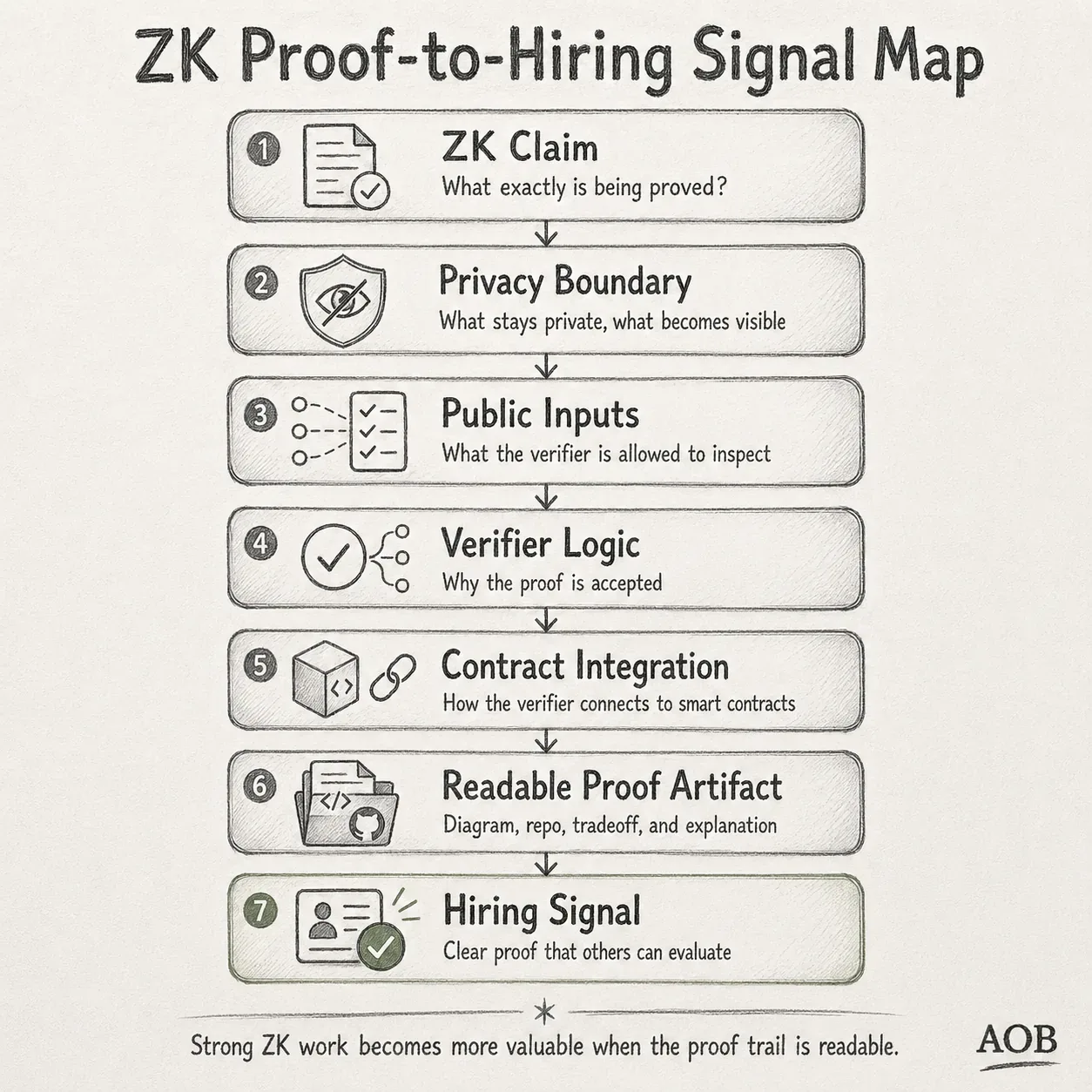
Zero-knowledge cryptography gets talked about like a prestige topic, but in real teams and real interviews, the gap is usually simpler than that. Many candidates can name ZK terms. Fewer can explain what exact claim is being proven, what remains private, what becomes public, what the verifier actually checks, and where the smart contract boundary still carries risk.
That gap matters more than buzzwords.
This hub is for readers who do not want a broad crypto-theory tour. It is for people trying to make zero-knowledge work understandable as engineering, reviewable as architecture, and credible as hiring proof.
Quick map of this ZK hub
This hub is organized by the type of zero-knowledge decision a smart contract engineer or ZK learner is trying to make.
Use it as a starting point when the issue is not just “learning ZK,” but understanding the claim, privacy boundary, verifier logic, contract integration, proof artifact, and hiring signal behind the work.
ZK fundamentals and privacy reasoning
Use this lane when zero-knowledge still feels abstract, overhyped, or too academic. Start here if you need to understand what is being proven, what stays private, what becomes public, and why the verifier accepts the proof.
Related discussion:
Zero-Knowledge Proofs: The Future of Privacy in Blockchain | ArtofBlockchain
ZK interview explanation and SNARK/STARK tradeoffs
Use this lane when you can define ZK terms but struggle to explain zk-SNARKs, zk-STARKs, privacy, scalability, and real-world use cases in interviews without sounding theoretical.
ZK learning roadmap and first proof artifact
Use this lane if you want a practical path that produces one readable artifact instead of scattered reading. The goal is not to look broad; it is to build one ZK project that another engineer can inspect and trust.
ZK ecosystem choice and role direction
Use this lane if you are comparing privacy chains, ZK ecosystems, StarkNet, Cairo, protocol roles, or privacy-focused blockchain jobs and need one direction instead of endless comparison.
Start here:
Us And Singapore Privacy Blockchain Jobs How Should I Choose One Zk Ecosystem
Related discussion:
I Want To Become A Starknetcairo Auditor Heres My Starting Point
ZK architecture, verifier boundary, and smart contract integration
Use this lane when your main problem is not the ZK definition, but how the proof connects to contracts, public inputs, verifier checks, off-chain assumptions, gas, latency, UX, and integration risk.
Start here:
How To Explain Your Smart Contract Architecture Decisions Without Sounding Vague Or Theoretical
ZK proof signals for hiring
Use this lane if your ZK work is real but still hard for recruiters, interviewers, or hiring managers to evaluate. The stronger signal is usually one claim, one diagram, one repo, one tradeoff, and one clear explanation.
Start here:
The Smart Contract Portfolio That Shows How You Think
Related page:
Web3 Hiring Signals | ArtofBlockchain
Who this hub is for
This hub is for:
Smart contract engineers moving from Solidity-first work toward ZK systems, privacy design, or proof-heavy infrastructure
Security-minded developers who need clearer thinking around verifier logic, public inputs, proof boundaries, and integration risk
Candidates exploring ZK-related roles who want one practical route instead of scattered reading
Developers whose work is real but still sounds vague when they explain it to interviewers, recruiters, or hiring managers
What this hub covers
This hub helps you think about zero-knowledge cryptography as a practical systems topic.
It focuses on:
How to reason about a ZK claim before getting lost in tooling
How prover, verifier, contract logic, and public inputs connect
How to choose a learning path that produces one strong artifact instead of shallow breadth
How to turn ZK work into proof that another engineer can inspect and trust
What this hub is not
This is not your broad smart contract fundamentals page. If you still need a stronger base in
Solidity, EVM logic, or smart contract building blocks, start here:
Smart Contract Fundamentals Hub: EVM Execution, Solidity First Principles, and Mainnet-Ready Mental Models | ArtofBlockchainThis is not your full testing hub. If your main problem is QA depth, test design, invariants, fuzzing, or validation discipline, use:
Smart Contract QA Testing Hub: Flaky Tests, Coverage Drift, Gas Validation, and Interview Signals | ArtofBlockchainThis is not your main interview-prep hub. If you need broader smart contract interview support, use:
Smart Contract Interview Prep: Technical, Security, Debugging & Founder Rounds Explained | ArtofBlockchainThis is not a generic blockchain privacy explainer for beginners, and it is not a full security-audit roadmap. If you want audit process and common audit tools first, use:
How do real smart contract audits work in practice? What do auditors check before Slither, Mythril, Foundry fuzzing, or Echidna? | ArtofBlockchainand
Smart Contract Audit Checklist: What Auditors Actually Check (and How to Prepare) | ArtofBlockchain
Start here based on your situation
If ZK still feels abstract and overhyped
Start with:
Zero Knowledge Proof Explained: Privacy, zk-SNARKs, and Blockchain Applications | ArtofBlockchainThen move to:
Zero-Knowledge Proofs: The Future of Privacy in Blockchain | ArtofBlockchainIf you keep reading but still cannot connect ZK to real smart contract work
If you want one ecosystem-specific direction instead of endless comparison
Then go deeper with:
🚀 I Want to Become a StarkNet/Cairo Auditor — Here’s My Starting Point & I’d Love a Roadmap | ArtofBlockchain
If your problem is not learning but explanation
Then pair it with:
The Smart Contract Portfolio That Shows How You Think | ArtofBlockchain
If you want the evaluator-side lens
Start with:
Web3 Hiring Signals: What Strong Candidates Quietly Look For Before Applying | ArtofBlockchain
Core framework / workflow
Use this hub with one question in mind:
Can I explain the proof as a system, not just as a term?
Define the claim
Before you choose a proving stack, define the exact claim. What is being proven? What result should the verifier accept as valid? A weak explanation starts with the framework name. A strong explanation starts with the claim.
Mark the privacy boundary
What stays private?
What becomes public input?
What is revealed indirectly through outputs, timing, or constraints?
A lot of ZK confusion comes from using the word privacy too loosely.
Separate prover work from verifier trust
Where does proving happen?
What does the verifier check?
What assumptions live in the proving environment?
What assumptions live in the smart contract?
This is the point where ZK stops sounding like theory and starts sounding like architecture.
Understand the constraint mindset
The important shift is not just writing logic differently. It is deciding what must be represented as constraints, what becomes expensive, what can be simplified, and what might be incorrectly modeled.
Model the integration boundary
How does the proof touch the contract?
How are public inputs encoded?
How does verification affect gas, UX, latency, or composability?
How do off-chain and on-chain parts fail differently?
Show trade-offs honestly
A project becomes more credible when you can explain what you sacrificed:
proving time
verification cost
developer ergonomics
trusted setup assumptions
circuit complexity
debuggability
Turn the work into a readable artifact
Your first goal is not to look broad.
It is to make one ZK project legible.
One claim
One artifact
One diagram
One trade-off
One failure pattern
One calm explanation
Tools/concepts/systems
Use these by job-to-be-done, not by trend-hopping.
To understand the idea clearly before chasing advanced tooling
Zero Knowledge Proof Explained: Privacy, zk-SNARKs, and Blockchain Applications | ArtofBlockchain
Zero-Knowledge Proofs: The Future of Privacy in Blockchain | ArtofBlockchain
To connect ZK reasoning to smart contract and protocol realities
How to Answer Smart Contract Oracles in Job Interviews? | ArtofBlockchain
To choose a direction instead of staying broad
To improve how you explain the work
The Smart Contract Portfolio That Shows How You Think | ArtofBlockchain
Discussion/article clusters
Core ZK understanding
Zero Knowledge Proof Explained: Privacy, zk-SNARKs, and Blockchain Applications | ArtofBlockchain
Zero-Knowledge Proofs: The Future of Privacy in Blockchain | ArtofBlockchain
Architecture and system boundaries
How to Answer Smart Contract Oracles in Job Interviews? | ArtofBlockchain
Testing, review, and production discipline
Smart Contract Audit Checklist: What Auditors Actually Check (and How to Prepare) | ArtofBlockchain
Proof readability and hiring signal
The Smart Contract Portfolio That Shows How You Think | ArtofBlockchain
Web3 Hiring Signals: What Strong Candidates Quietly Look For Before Applying | ArtofBlockchain
Web3 CV Review Services Are Now Open on ArtOfBlockchain.club | ArtofBlockchain
Hiring signal bridge
Zero-knowledge work often gets underestimated for one reason: the candidate explains it either too vaguely or too academically.
The weak version sounds like this:
I learned ZK, privacy tech, STARKs, SNARKs, and scaling concepts.
The stronger version sounds like this:
I built a proof flow. Here is the claim. Here is what stayed private. Here is what became public. Here is what the verifier checked. Here is the contract boundary. Here is the trade-off I made. Here is what broke when I first tried it.
That second version is easier to trust.
For hiring teams, advanced topics do not reduce the need for clarity. They increase it.
Proof layer
Good proof for this topic usually looks like:
A small repo with one clearly stated claim
A README that explains private inputs, public inputs, prover output, and verifier result in plain language
A simple system diagram showing prover, verifier, contract, and off-chain flow
A short note on proof-system choice and why you picked it
A benchmark note on proving time, verification cost, or integration overhead
A debugging note showing where a witness assumption, public input, or boundary design went wrong
A final reflection on what you would redesign next
Common mistakes
Learning the names of proving systems before understanding the claim
Saying privacy without defining what is private
Treating ZK as disconnected from contract boundaries and integration cost
Showing a tutorial clone without one original design choice
Trying to sound advanced instead of sounding clear
Jumping across too many ecosystems before finishing one readable artifact
FAQs
Do I need advanced math before learning zero-knowledge cryptography for smart contract roles?
Not at the beginning. You do need rigor, but the first real gap is usually not research-level math. It is weak explanation of the claim, the verifier boundary, and the trade-offs in implementation.
What should my first ZK project include if I want it to count as real proof?
One focused claim, one artifact, one architecture diagram, one trade-off note, and one failure pattern you can explain calmly. Breadth is weaker than one defensible project.
How do I explain a ZK project in an interview without sounding theoretical?
Start with the real problem, then the claim, then the privacy boundary, then the verifier logic, then the trade-off. Do not start with jargon unless the interviewer already wants that layer.
Should I learn one ecosystem deeply or compare many privacy chains first?
Go deeper on one path first. The better hiring signal is not broad awareness. It is one project you can defend technically and explain clearly.
How is this hub different from the Smart Contract Interview Prep Hub?
This hub is narrow. It is about zero-knowledge cryptography, proof systems, and verifier-aware architecture. The interview-prep hub is broader and covers general smart contract interview patterns across roles.
Can QA and audit thinking help even if I am focused on ZK systems?
Yes. ZK work still lives inside software systems. Validation discipline, edge-case thinking, and boundary review matter a lot when the topic becomes harder to inspect by intuition.
What if my ZK work is real but I am still not getting shortlisted?
Then the problem may be packaging, not effort. If your proof trail is unreadable on the CV or portfolio, the work gets discounted before it is understood.
Web3 CV Review Services Are Now Open on ArtOfBlockchain.club | ArtofBlockchain
Internal navigation block
Adjacent hubs and support pages
ZK-specific routes
Zero Knowledge Proof Explained: Privacy, zk-SNARKs, and Blockchain Applications | ArtofBlockchain
Zero-Knowledge Proofs: The Future of Privacy in Blockchain | ArtofBlockchain
Proof and evaluator lens
The Smart Contract Portfolio That Shows How You Think | ArtofBlockchain
Web3 Hiring Signals: What Strong Candidates Quietly Look For Before Applying | ArtofBlockchain
Web3 CV Review Services Are Now Open on ArtOfBlockchain.club | ArtofBlockchain
Closing CTA
Use this hub to go narrower, not broader.
Pick one ZK direction.
Build one proof artifact.
Explain one verifier boundary clearly.
Make one project readable enough that another engineer can trust what you actually did.