

How to Explain Your Smart Contract Architecture Decisions Without Sounding Vague or Theoretical

There is one moment in almost every Solidity interview when everything becomes quiet.
You finish describing your solution, and the interviewer asks:
“Why did you design it this way?”
This one question decides more outcomes than people realize.
Many candidates freeze — not because their design is wrong, but because they don’t know how to explain their thinking clearly.
Most developers immediately start listing modules, patterns, gas savings, or tools they used.
But founders are not looking for a tour of your code.
They want to understand how you think under real constraints.
This blog explains a simple, human way to talk about your architecture using plain English — even if your communication skills are not strong, even if English is not your first language.
Anyone can use this approach in interviews.
⭐ TL;DR
Start with the main rule your contract must always keep true.
Explain the real constraints you faced.
Describe the parts in simple language.
Share the trade-offs honestly.
Talk about the problems your design solves and what risks still exist.
This is the communication pattern founders trust most.
⭐ Why Founders Care About How You Explain Architecture
From a founder’s perspective, clear reasoning matters more than fancy patterns.
Web3 systems are complex. A mistake can cost real money. So founders listen for signals like:
1. Do you understand what can go wrong?
This includes things like stale oracle data, unsafe external calls, wrong state updates, or misuse of roles.
(For deeper basics, see Smart Contract Fundamentals Hub — link: https://artofblockchain.club/discussion/smart-contract-fundamentals-hub)
2. Can you explain why you chose your design?
They want to hear reasoning, not memorized patterns.
3. Do you understand the system beyond your file?
Your contract interacts with oracles, bridges, liquidity pools, sequencers, governance, and sometimes users behaving unpredictably.
A candidate who explains architecture clearly is usually someone who can be trusted later on mainnet.
⭐ Where Most Candidates Get Stuck
Many candidates fall into the same trap:
They explain what the code does.
They repeat definitions they learned from tutorials.
They list modules without explaining why they exist.
They focus only on gas or patterns.
But interviews are not about showing what you memorized.
They are about showing how you make decisions.
When your explanation lacks reasoning, founders get nervous — because unclear thinking in Web3 becomes expensive quickly.
For more interview-specific guidance, see the Smart Contract Interview Prep Hub (https://artofblockchain.club/discussion/smart-contract-interview-prep-hub).
⭐ A Simple 5-Step Method to Explain Any Architecture
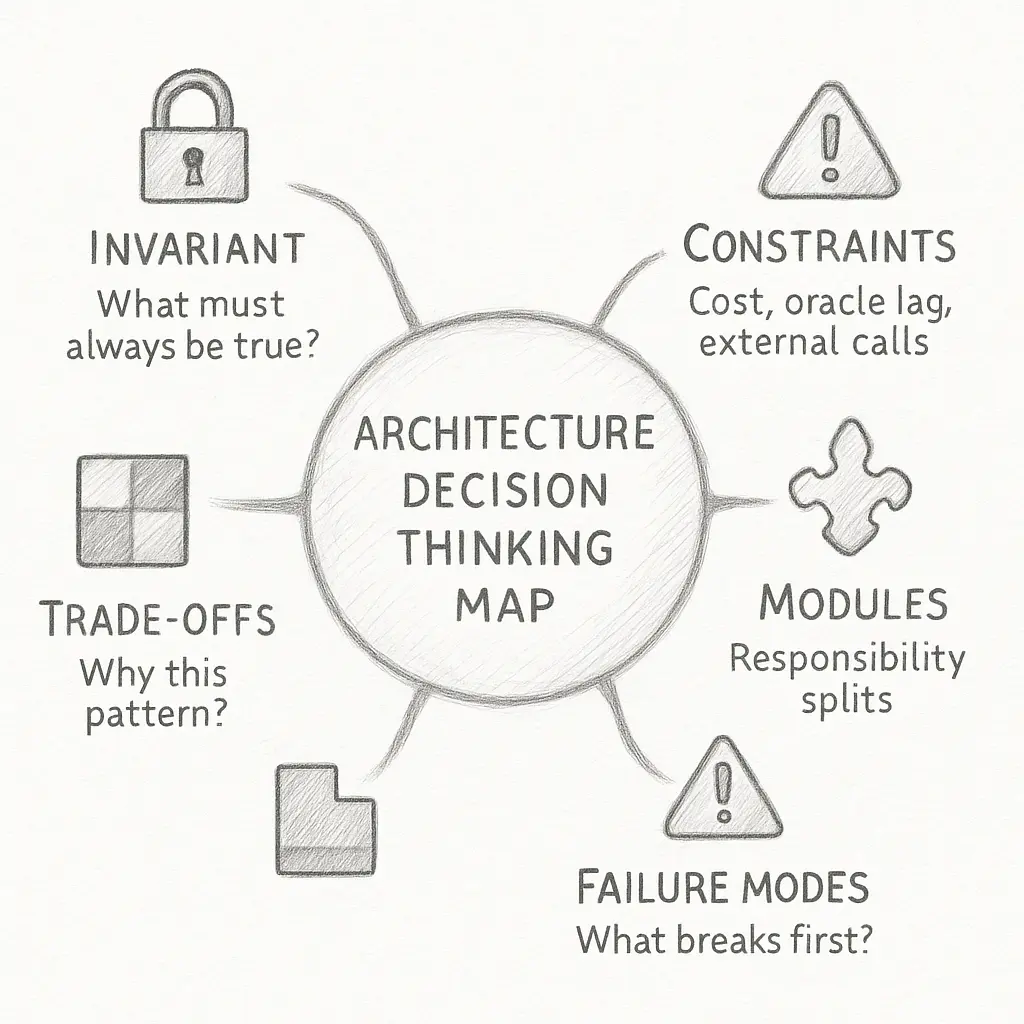
You don’t need technical jargon to explain your design.
Use these five steps. They work for ERCs, staking, AMMs, auctions, vaults — everything.
1. Start With the Main Rule You Must Protect (Invariant)
Every contract has one or two rules that must never break.
Examples:
“A user must never withdraw more than they deposited.”
“Total supply must always equal the sum of balances.”
“Rewards should stay fair across all users.”
When you start with this rule, the interviewer immediately understands what you considered most important.
A natural way to say it:
“The main rule I wanted to protect was simple: users should not be able to withdraw more than their actual stake.”
This already makes your explanation sound clear and grounded.
2. Explain the Real-World Constraints That Affected Your Design
Systems always have limits. These limits shape your architecture.
For example:
oracle updates are delayed
gas cost must be low
user actions should not break the system
external calls may fail
parameters may be controlled by governance
If you show that you understand these limits, the interviewer sees real engineering thinking.
A natural way to explain:
“The oracle updates once per block, so sometimes the price can be slightly old. I added a check so we don’t use a price that moved too much.”
This shows risk-awareness in simple language.
3. Describe the Parts of Your Contract in a Simple Way
Avoid heavy words like “execution layer,” “module isolation,” or “coupling.”
Speak like you would to a teammate on your first day.
Human examples:
“All state updates happen in one section so it’s easy to track changes.”
“This part is just guardrails — it blocks bad inputs early.”
“I separated risky external calls to avoid reentrancy issues.”
This is the kind of communication founders trust.
For common pitfalls in contract structure, see:
Silent Fails in Smart Contract Access Control (https://artofblockchain.club/discussion/silent-fails-in-smart-contract-access-control-what-teams-miss-until-its-too).
4. Explain the Trade-Offs You Considered
This is the moment when you sound experienced.
Every design has pros and cons. Showing that you understand them is a strong signal.
Examples:
“I used a pull-based reward system. Yes, it adds one extra step for users, but it avoids reentrancy issues.”
“I didn’t break it into too many parts because that would increase external calls and gas use.”
“I avoided unnecessary complexity because it becomes harder to audit.”
This shows honesty and clarity — founders appreciate both.
If you want to learn how tooling choices affect design, see:
Hardhat or Foundry: What Actually Helps in Your First Role
https://artofblockchain.club/discussion/hardhat-or-foundry-first-what-actually-helps-in-your-first-smart-contract
5. Talk About What Problems Your Design Avoids — and What Risks Remain
This is where you build trust.
Good candidates explain strengths.
Great candidates also explain limits.
Examples:
“This design avoids stale reward calculations and reduces reentrancy windows.”
“The remaining risk is the oracle. If it gives completely wrong data, no design can fully protect against that.”
“Governance timing still matters. If a bad parameter is set, governance must fix it quickly.”
Naming risks openly shows maturity.
For understanding real-world failure handling, see:
Handling Production Incidents as a Junior Solidity Engineer
https://artofblockchain.club/discussion/handling-production-incidents-as-a-junior-solidity-engineer-how-do-you
For external EEAT reinforcement, see NIST’s secure software development principles (https://www.nist.gov/ssd).
⭐ A Practical Example
Imagine you built a staking system.
A natural, strong explanation could be:
“The main rule I wanted to protect was that users should never withdraw more than they staked, and rewards should stay fair.
One constraint was that rewards update every block and depend on an oracle, which may be slightly behind. So I added checks to avoid using outdated values.
All balance updates are kept in one section so it’s easy to reason about. Reward logic is separate, and emergency stop functions are isolated.
I chose a pull-based claim system. Yes, users click one more time, but it keeps the withdrawal flow safer.
This design avoids reentrancy and stale reward issues. The only external risk left is the oracle accuracy — the contract can’t fix a bad price feed.”
Clear. Human. Trustworthy.
⭐ FAQs
1. How do I explain my smart contract architecture in a Web3 interview?
Start with the main rule your contract must protect. Then explain the constraints, your design choices, the trade-offs, and the risks you handled. This shows real reasoning, not memorized patterns.
2. What do founders look for when I describe Solidity architecture?
They want to understand how you think about safety, system behavior, and real-world constraints. Clear, simple reasoning is more valuable than technical jargon.
3. Why are invariants important in smart contract design?
Invariants are rules that must always stay true. When you explain them early, you show strong understanding of correctness and risk — key signals in Web3 hiring.
4. How do I discuss trade-offs in an interview?
Explain what you gained from your choice and what you accepted as a cost. Good engineers always think in trade-offs, especially in blockchain architecture.
5. How do I explain modules without sounding too technical?
Use plain English. Describe where state updates happen, where you check inputs, and where you keep risky calls separate. Interviewers prefer clarity over complex words.
6. How do I show system-level thinking?
Mention how your design interacts with oracles, governance, bridges, or other contracts. This shows you understand the bigger picture of Web3 systems.
7. How do I talk about risks without sounding negative?
Simply state what problems your design avoids and what depends on external components. This shows honesty and awareness — traits founders trust.
8. What is the biggest mistake candidates make in architecture rounds?
They jump into patterns and modules without explaining why the design makes sense. Starting with the invariant and constraints makes your explanation flow naturally.
If you’re preparing for architecture-heavy interviews — or you’re a founder looking for engineers who think clearly about constraints, safety, and trade-offs — explore AOB’s curated blockchain job board:
👉 https://artofblockchain.club/job