
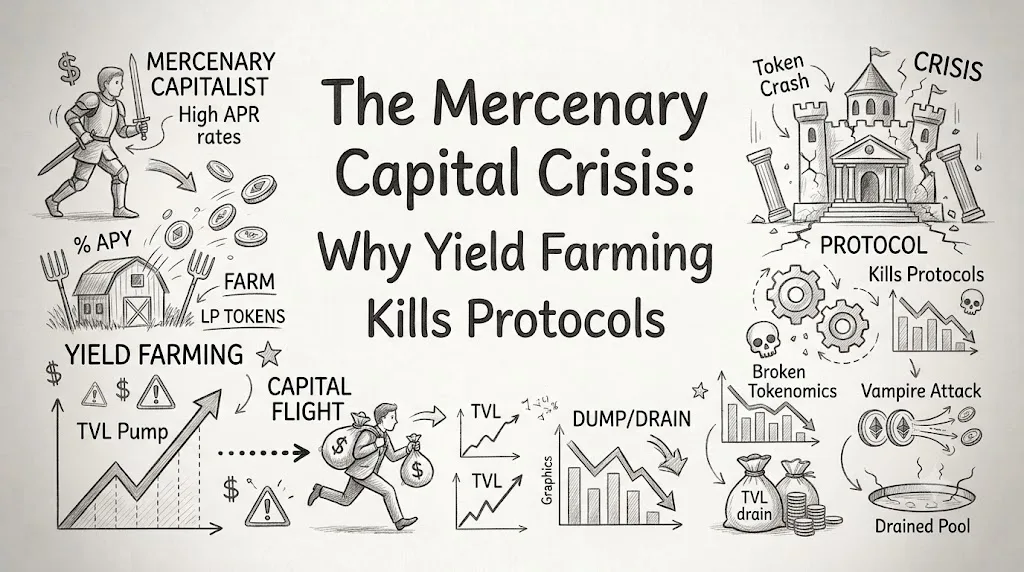
The Mercenary Capital Crisis: Why Yield Farming Kills Protocols

Mercenary liquidity in Web3 is capital that arrives for token rewards and leaves when yields fall. Because protocols pay for it with newly issued tokens, the yield farming risks for DAOs are structural: temporary liquidity is bought with permanent dilution.
What Is Mercenary Liquidity in Web3, and How Fast Does It Leave?
A protocol launches a liquidity mining program. TVL (total value locked) climbs and the dashboard looks like growth. Then farmers sell the rewards, APY compresses and the deposits leave. The DAO keeps the bill: a larger circulating supply and nothing on the balance sheet to show for it.
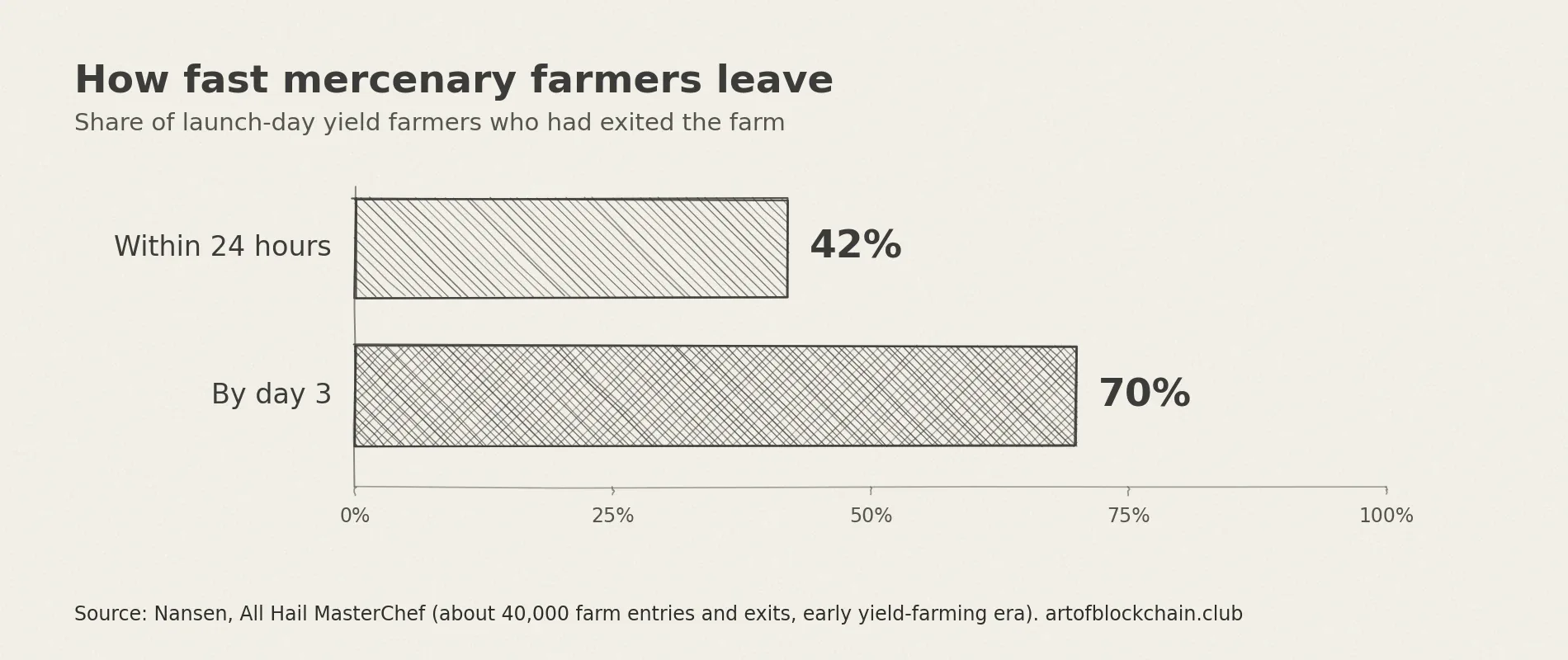
Nansen's analysis of about 40,000 yield-farming entries and exits found that about 42% of launch-day farmers left within 24 hours and about 70% had withdrawn by day three. Half never stayed beyond 15 days (Nansen). The sample is early-era, but the pattern repeats: when most capital is gone within days, the tokens paid out bought a rental, not a position.
Yield Farming Risks for DAOs: Why the Economics Break
Extractive liquidity mining fails in three ways.
Rewards get sold. Emission schedules release tokens without acquiring an asset, and recipients sell into the token's own market. A GSR note on Curve says Yearn and Stake DAO generally sold the CRV they received, which depressed its price.
Leverage inflates the headline. On money markets, an account can deposit, borrow and redeposit repeatedly. At an 80% loan-to-value limit, $1 million of principal can show up to about $5 million of supply while adding little real borrowing demand.
Emissions subsidize arbitrage. Passive liquidity providers (LPs) lose value to arbitrageurs when AMM prices lag the market, and emissions only partly reimburse that loss (Milionis et al.). When rewards stop, so does the reason to stay.
These add up to a lopsided LTV:CAC. Treat the tokens paid as customer acquisition cost, and the fees the liquidity earns while it stays as a proxy for lifetime value. In Gauntlet's reported results for Arbitrum's Long-Term Incentives Pilot Program (LTIPP) campaign, about $1.75M of incentives added $14.85M of daily TVL, but only 1.2M–2.0M stayed afterward. Annualized LP fees gained were about $1.6M, roughly 0.9x the incentives (our calculation from operator-reported figures; source). Even for an actively managed campaign, that ratio is below 1.
Case Study: How Uniswap Lost Most of Its Liquidity in a Day
In September 2020, SushiSwap paid SUSHI to LPs who staked Uniswap LP tokens, then migrated their liquidity. According to DeFi Pulse data cited by ForkLog, Uniswap's locked assets fell 75.8% in 24 hours to $348 million, and DeFiRate reports that users moved around $1 billion of liquidity tokens.
One correction to the popular story: SUSHI's price crash that followed came after its founder cashed out part of the developer fund, not from farmers alone. The lesson still stands. Liquidity followed the rewards instantly and without loyalty.
The modern version is slower and costlier. Blockworks Research reviewed Arbitrum's Short-Term Incentive Program (STIP), which started with 50M ARB and reached about 71M after a backfund. It found that most spot and perp DEX recipients fell back to roughly September 2023 levels, and Arbitrum's TVL share went from about 6% to about 4%. A few younger, differentiated protocols kept their gains (Blockworks).
Red Flags When Evaluating a Partner's Tokenomics
Check these before you integrate with, fund or join a protocol:
The pitch is peak TVL. Ask for retained TVL and fees at T+30 and T+90.
There is no baseline. Dollar TVL moves with token prices, so results should be compared against similar pools or measured in ETH.
Liquid rewards on deep stable pairs. In Gauntlet's data, USDC/USDT 0.01% fell below its pre-incentive volume once rewards ended.
Only self-reported results. Gauntlet was paid to run LTIPP and reports on it, and about 35% of STIP recipients never posted a final report.
Concentrated holders. Of the 100 largest COMP recipients, only 7% kept more than half of what they received (ForkLog).
KPI gaming. Some STIP recipients cut native fees to a minimum to hit targets, which Blockworks said is not sustainable growth.
Most of this can be verified without code. The Web3 BD Cheat Sheet includes an anti-vanity deal checklist, and learning Dune and SQL lets you reproduce a partner's retention numbers yourself.
The Takeaway
Judge any liquidity budget by what is still there at T+30 and T+90, and what it earns, not by how high TVL peaked. Before approving a program, ask for the retention report, the baseline and the query behind it. If a partner cannot produce them, treat the TVL as borrowed. The goal is not to ban incentives but to pay for liquidity that stays.
FAQ
What is mercenary liquidity? Capital that enters only for token rewards and leaves when yields fall.
Is liquidity mining always bad for DAOs? No. It fails when rewards are liquid and unvested. In Gauntlet's data, several near-dormant pools kept their gains.
How do you tell if liquidity mining worked? Compare retained TVL and fees at T+30 and T+90 against a baseline, then divide the incentives spent by the retained TVL.
About the author: Shubhada Pande is the founder ofArtOfBlockchain.club, a discussion-first community for Web3 careers and proof-based hiring insights, and a former Chief Strategy Officer of Partnerships at Jumbo Blockchain.
Educational content, not financial advice.