
Proof-Based Career Shifts: Jay Koh’s Journey from Business Scaling to Web3 Ecosystem Builder

Now, coming to 2026, careers in the Web3 industry have overcome the hype due to the crypto industry and it is a silent, mature digital economy. Now this industry has all-inclusive roles from developers developing code to traditional business leaders, marketers, and operators who know how to solve enterprise problems. If you have ever felt like Web3 is a closed club reserved strictly for technical geniuses, it is time to rethink your strategy. True innovation happens when real-world business professionals meets the next generation of data infrastructure.
To understand how traditional corporate strategy translates into the future of the internet, we sat down with Jay Koh, the Founder of Insight Genesis and the Founding Vice President of the Asia Web3 AI Association.
With strong experience of two + decades in traditional entrepreneurship, marketing, and business scaling, Jay has transitioned seamlessly into architecting the future of decentralized AI in Asia. He spends his time mentoring upcoming builders, driving ecosystem partnerships, and proving that Web3 needs core business fundamentals to survive.
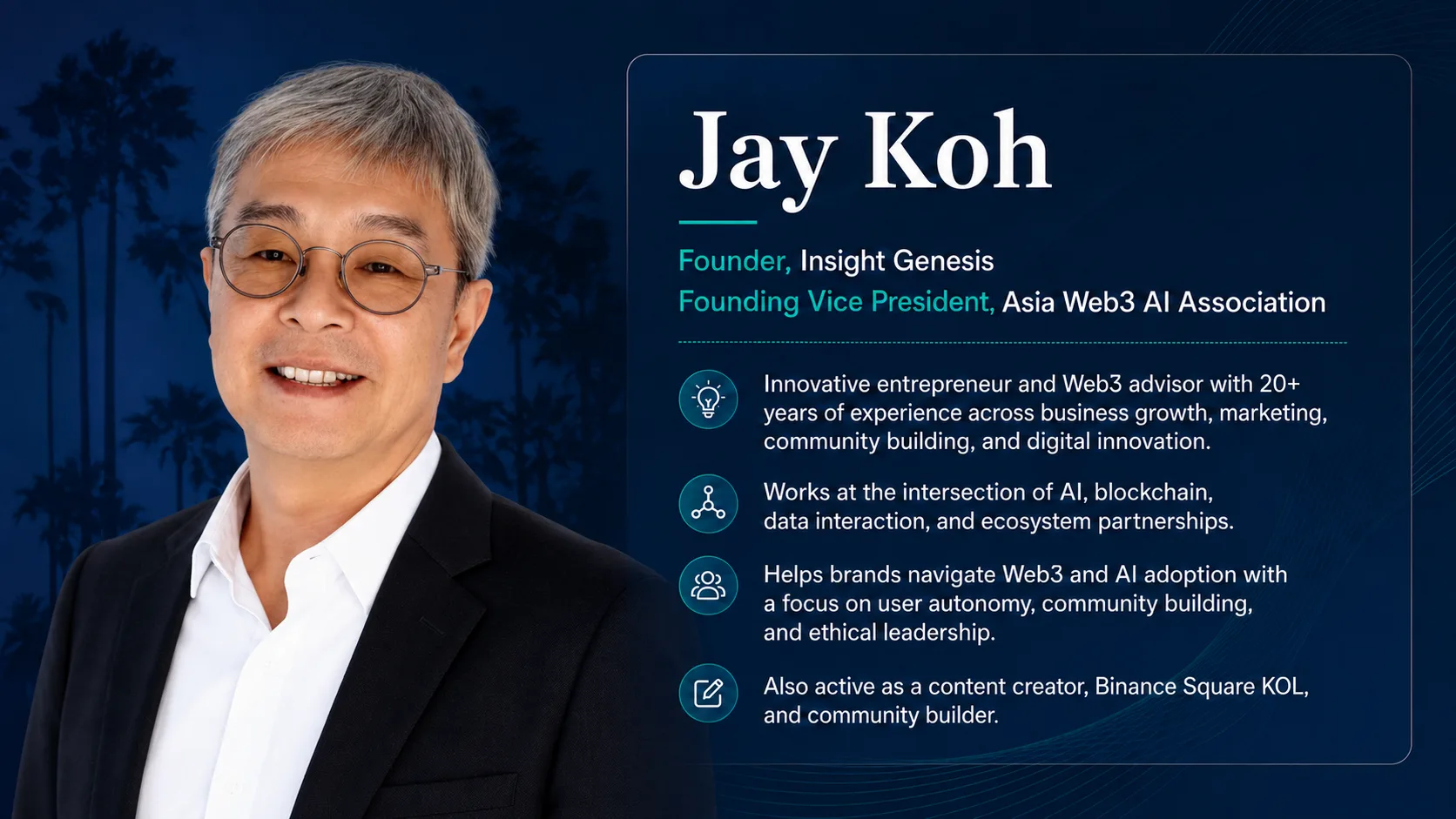
You can follow his real-time industry updates and event insights directly on his official Jay Koh LinkedIn Profile.
Why Jay Koh’s Journey Defines Proof-Based Hiring in Web3
In an ecosystem crowded with resume inflation and unverified credentials, Jay Koh’s career path highlights the exact shift our community focuses on: verifiable proof of execution over job titles in web3. As an advisor, founder, and association leader, Jay evaluates professionals based on tangible impact. Below, he breaks down exactly how to build a public portfolio that commands authority in the Web3 and AI job markets.
Part 1: Why Traditional Business Metrics Matter in Web3 & AI
ArtofBlockchain: What first made you take Web3 seriously after years in traditional entrepreneurship, marketing, and business building?
Jay Koh: For me, Web3 was never just about cryptocurrency—it creates a more open digital economy where there is more ownership and trust.
I've spent years building businesses, working in marketing, and helping companies grow. I observed that centralized platform algorithms control the data, value creation, and customer relationships also. Usually, businesses generate enormous amounts of data, but very few truly own or understand it.
When I started exploring blockchain more deeply, I realized it wasn't another new technology trend. It is a new way to think about digital ownership, transparency, and collaboration. Instead of relying on intermediaries, Web3 allows individuals and businesses to participate in ecosystems where value can be shared more fairly.
At the same time, AI was evolving rapidly. I saw an opportunity that many people weren't talking about: the convergence of AI and Web3. AI needs trusted, high-quality data, while Web3 provides mechanisms for data ownership, provenance, and incentives. Together, they can create far more intelligent and trustworthy systems.
I don't see Web3 as replacing traditional business. I see it as the next step in internet usage—one that gives people greater control over their digital assets, identity, and data. Just as businesses had to embrace the internet and later mobile technology, I believe AI and Web3 together will define the next decade of innovation.
ArtofBlockchain: Which Web2 skills transferred most strongly into your Web3 journey?
Jay Koh: One of the biggest misconceptions about Web3 is that it's entirely different from traditional business. In reality, the fundamentals haven't changed.
I used the same skills of business strategy, marketing, relationship building, and execution that I used in traditional businesses. Businesses still invest in people and partnerships, even if technology evolves and solves similar real problems, which remains the foundation of every successful business.
My background taught me how to identify market gaps, build brands, understand customer behavior, and create sustainable business models. Those skills are just as valuable in Web3 as they are in any traditional industry.
Another key skill is community building. In Web2, you focus on customers. In Web3, you build communities. The difference is that communities don't just use your product. They contribute, advocate, and help shape its future. That requires transparency, trust, and consistent engagement.
ArtofBlockchain: What did you have to unlearn after entering Web3?
Jay Koh: One of the biggest things I had to unlearn was the idea that control creates value. In traditional business, companies often try to own everything—the data, the platform, the customer relationship, and the decision-making process. In Web3, value is created by enabling participation, transparency, and shared ownership.
I also had to rethink the pace of innovation. In traditional industries, product development can take years with carefully planned roadmaps. In Web3, innovation happens in real time. Communities provide immediate feedback, technologies evolve rapidly, and you have to be comfortable iterating quickly while maintaining a long-term vision.
Another mindset shift I made was moving from competition to collaboration. In Web2, businesses often operate in silos. In Web3, ecosystems matter. Projects grow faster when they integrate, partner, and build on each other's strengths rather than trying to do everything themselves.
Ultimately, Web3 taught me that the future belongs to builders who focus less on short-term market cycles and more on creating trust, utility, and sustainable value.
Part 2: Non-Technical Roles and Credibility Signals in Web3 Hiring
ArtofBlockchain: Many people think Web3 is only for developers. What serious roles exist for non-technical professionals?
Jay Koh: I actually think that's one of the biggest misconceptions about Web3.
It is true that technology may be built by developers, but any industry is built by people with diverse skills. Just like any other business, Web3 also needs entrepreneurs, marketers, business strategists, designers, legal professionals, compliance experts, sales leaders, finance specialists, product managers, educators, and community builders along with developers and coders..
ArtofBlockchain: In your experience, what skills are transferable and make a Web2 professional credible in Web3?
Jay Koh: For me, the strongest skill is whether someone is genuinely building around a paid point. That could mean launching a product, solving a real business problem, contributing to an open-source project, growing a community, investing responsibly, or helping drive adoption. People respect execution far more than titles.
ArtofBlockchain: What are weak signals that people mistake for credibility?
Jay Koh: A weak signal is when someone talks about building, but cannot clearly explain and justify the purpose, who the end user is, how the product is useful, and which problems it solves.
In Web3, people sometimes mistake visibility for credibility—event photos, buzzwords, titles, token talk, or being active online. These things may create attention, but they do not prove depth.
For me, true credibility is measured by impact. Are you building something people actually use? Are you creating value for businesses or communities? Are you helping move the industry forward in a responsible way? Those are the signals that matter.
In Web3, trust is the ultimate currency. Real proof of work is when your contributions continue creating value long after the headlines have faded.”
— Jay Koh
Part 3: What True "Proof of Work" and Web3 Portfolios Look Like
ArtofBlockchain: For community, marketing, partnerships, and advisory roles, what does real proof of work look like?
Jay Koh: In Web3, trust is the only trusted currency. Real proof of work is when your contributions continue creating value long after the headlines have faded.
ArtofBlockchain: What should a Web2 professional build or show before asking for Web3 opportunities in 2026?
Jay Koh: Now the industry is mature. Companies are no longer hiring based on enthusiasm for the decentralized world alone. They're looking for people who can create measurable value from day one.
The first thing I would build is a public portfolio of work. That could be thoughtful articles, market analysis, product case studies, educational content, community initiatives, AI workflows, or even contributions to open-source projects. It doesn't have to be perfect, but it should demonstrate how you think and how you solve problems.
Scaling a Web3 ecosystem requires robust market infrastructure. To understand why institutional architecture is the decisive factor for adoption, read Gaya Chandrasekaran’s blueprint for tokenisation at scale
ArtofBlockchain: Where does Web3 + AI create real business value beyond hype?
Jay Koh: AI becomes better when it learns more things using the available data. Web3 provides the trust layer for data authenticity verification, its provenance, transparency, and secure value exchange. When you combine the two emerging technologies, blockchain and AI, you can create systems that are intelligent, trustworthy, and accountable.
The Takeaway: Stop Applying, Start Building
Jay Koh’s insights deliver a clear reality check for the current job market: true credibility is measured by verifiable value, execution, and real problem-solving rather than keyword-stuffed resumes.
What is your take? Are you currently building a public portfolio or relying on a traditional CV to navigate the Web3 and AI landscape? Drop your thoughts or link your active projects in the comments below!