
From EdTech Founder to Web3 Strategist: Moran Hertzanu Weiss on Building Skill Credibility in Blockchain

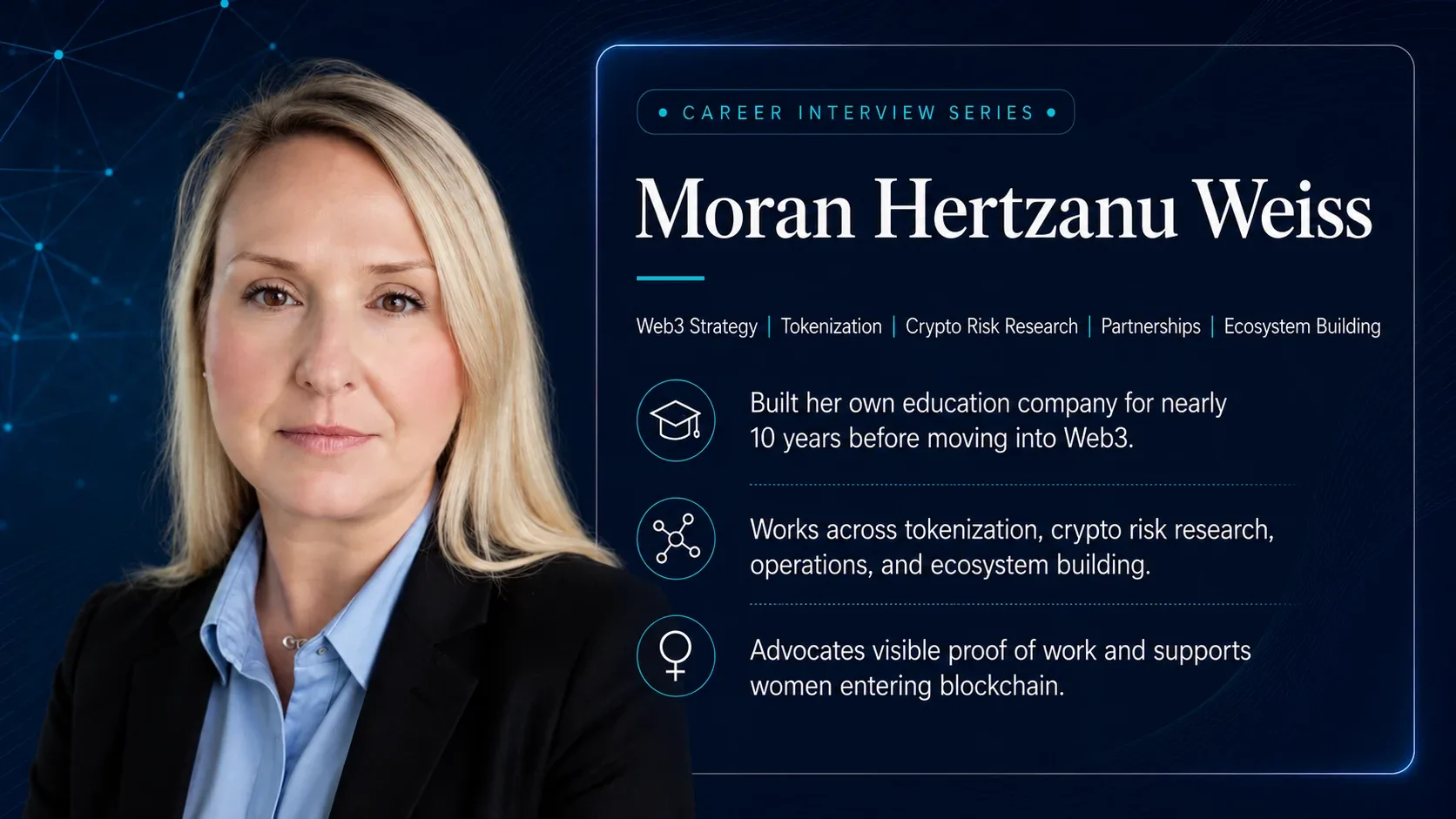
Let’s meet today’s guest in the Home | ArtofBlockchain career interview series is Moran Hertzanu Weiss, a Web3 and blockchain strategist working across tokenization, crypto risk research, partnerships, operations, ecosystem building, startup mentoring, and community leadership.
We chose Moran’s journey because it represents a career path many Web2 professionals are trying to understand.
She built and run own English language school for a decade. Her founder’s journey gave her practical experience in operations, customer understanding, partnerships, team leadership, problem-solving, and building from zero.
Blockchain technology behind Web3 is the main attraction point for her, especially the unique use cases like tokenization and its possible impact on ownership, capital markets, real estate, and other real-world industries.
Many professionals working in tradition web2 industries fear that their experience will be of no use in Web3. They have to start as a fresher. This interview will show that professionals coming from business, education, operations, partnerships, growth, research, founder, or ecosystem backgrounds can showcase their skills and experience credibility in Web3.
It also resonates with our core discussions at Home | ArtofBlockchain: Web3 hiring cannot depend only on titles, certificates, or broad claims of interest. For many roles, especially non-technical roles, hiring teams try to judge on the basis of visible contribution, business understanding, and work evidence.
In this written interview, Moran shares how she moved from EdTech entrepreneurship into Web3, what helped her find her place, what kind of proof builds trust, and how Web2 professionals can approach Web3 careers with more clarity.
About Moran Hertzanu Weiss
Moran Hertzanu Weiss is a Web3 and blockchain strategist particularly focused on partnerships, growth, DeFi, crypto risk, tokenization, and ecosystem building.
She co-manages the DLT Talents community, serves as a mentor and advisor to Web3 startups, mentors and Outlier Ventures, and also supports women entering the blockchain industry.
Interview with Moran Hertzanu Weiss
Art of Blockchain: Before entering Web3, you spent nearly 10 years building your own education company. What part of that founder journey shaped you the most professionally?
Moran: As a founder of own English language school for a decade, I learned that building a business is implementing a good idea with resilience, listening to customers, creating efficient operations, leading people, and adapting quickly when things do not go as planned. These lessons have stayed with me throughout my career.
Art of Blockchain: What was the moment you felt web3 is that space where you should move into beyond the usual noise around crypto, tokens, and speculation?
Moran: The COVID era gave me some time to rethink what to do next. I was ready to take up a new challenge. Being a person who loves to explore emerging technologies, Web3 came up as something beyond speculation around crypto. The blockchain tech has potential to solve many pain points and solve real-world problems.
When I discovered tokenization and saw how blockchain could transform ownership, capital markets, and industries like real estate, I realized the scope is much beyond digital currencies.
It reminds me of the early days of the internet: a new infrastructure with the potential to reshape entire industries.
Art of Blockchain: Your work now touches tokenization, crypto risk research, partnerships, growth, operations, and ecosystem building. How did you find your place in Web3 without coming from a purely blockchain-native background?
Moran: I did not come from a technical or engineering background, but Web3 needs far more than developers.
Curiosity for web3, the ability to learn quickly, and the willingness to move fast in a rapidly evolving industry helped to create my credibility in web3.I immersed myself in the space, constantly learning from builders, founders, and communities while applying my experience in strategy, operations, partnerships, and ecosystem building.
Over time, I worked across tokenization projects, startup advisory, crypto risk research for a Mastercard-backed intelligence platform, accelerator mentoring, and community leadership.
I found my niche by connecting technology with business execution and helping innovative ideas become real-world solutions.
The Web3 Hiring Insight
This part of Moran’s journey is useful for Web2 professionals who are trying to enter Web3 without a technical background.
It highlights the need for developers, and why it need people who can understand markets, explain value, support founders, manage operations, build partnerships, research use cases, and help technology reach real users.
For non-technical professionals, the challenge is to show where their previous experience creates value inside the Web3 ecosystem.
Art of Blockchain: Which skills of EdTech experience, entrepreneurship, partnerships, and operations transferred most strongly into your Web3 work?
Moran: Entrepreneurship prepared me incredibly well for Web3. Building partnerships, managing operations, solving complex problems, communicating across different stakeholders, and working in fast-moving environments are all highly transferable skills.
Perhaps the most valuable was learning how to build from zero, because that is exactly what many Web3 companies are doing
Art of Blockchain: What was the hardest part of building credibility in Web3 during your transition?
Moran: The hardest part was not learning blockchain. It was proving I belonged. Web3 is still a relatively small industry where reputation matters.
I focused on contributing rather than trying to impress people. I chose the path of mentoring founders, researching markets, speaking with builders, supporting communities, attending conferences, and consistently delivering quality work gradually built trust.
Art of Blockchain: For non-technical professionals entering Web3, what kind of proof actually helps them become trusted?
Moran: Certificates can help you understand the fundamentals, but they rarely get you hired on their own. Visible proof of work matters much more. That could mean publishing thoughtful research, contributing to startup strategy, mentoring founders, helping organize communities, creating educational content, writing market analyses, or supporting real blockchain projects.
People want to see what you have actually done.
Take Away for Non-tech professionals
This is where Moran’s answer connects directly with proof-based hiring in Web3.
For a developer, proof may appear through
GitHub commits,
Smart contract work,
Adits, testnets,
Shipped products.
For a non-technical professional, proof can be
Research note,
A market map,
A partnership outcome,
A founder support case,
A community initiative,
An educational resource, A risk analysis, A tokenization breakdown, or
A visible contribution to a real project.
A CV can introduce the person. Proof helps others understand whether the person can contribute.
If you want to see how this proof-based approach applies to institutional finance, read our latest deep-dive with senior corporate banker Gaya Chandrasekaran on rewiring market architecture
Art of Blockchain: In your experience, how should hiring teams evaluate Web3 professionals who are not developers but work in strategy, tokenization, research, risk intelligence, partnerships, growth, or ecosystem roles?
Moran: For non-tech Web3 roles, companies should evaluate strategic thinking, execution, commercial understanding, communication skills, ecosystem knowledge, and the ability to connect technical teams with business goals.
I would also look for curiosity, adaptability, and evidence that someone genuinely understands how the industry works rather than simply repeating buzzwords.
What to learn about Web3 hiring for non-tech professionals
This is an important hiring point.
Many Web3 job descriptions still mix too many expectations into one role. Strategy, growth, partnerships, research, community, risk, and ecosystem roles are often evaluated loosely, even when they require serious judgment.
For non-developer roles, hiring teams need better signals than title-matching. They need to understand what the person has handled, explained, built, supported, researched, connected, or improved.
That is where proof-based hiring becomes useful. It helps hiring teams move from broad claims to visible work.
Art of Blockchain: You also mentor founders and support women entering blockchain. What patterns do you see in people who successfully build confidence, visibility, and credibility in this industry?
Moran: One thing I have consistently seen is that successful people stay curious, ask thoughtful questions, build relationships, and continuously learn. For many women entering the space, confidence often comes after taking action, not before. Communities, mentors, and visible contributions make a huge difference.
Art of Blockchain: What mistakes do Web2 professionals often make when trying to enter Web3?
Moran: Many Web2 professionals underestimate Web3 relationship building. They often spend months collecting certificates without engaging with the ecosystem itself.
Another common mistake is focusing only on crypto prices instead of understanding the technology, infrastructure, regulation, and real business applications being built.
Art of Blockchain: What advice would you give to a Web2 professional in 2026 who wants to move into Web3 strategy, tokenization, crypto research, risk intelligence, partnerships, or ecosystem roles?
Moran: Start with curiosity, not job titles. Pick an area that genuinely interests you, whether it is tokenization, stablecoins, digital identity, DeFi, infrastructure, or crypto risk, and go deep.
Follow builders, join communities, attend events, write about what you are learning, contribute where you can, and do not be afraid to start small in simple words: build a personal brand.
Web3 industry rewards people who consistently create value, and credibility is built through visible contributions over time.
The Web3 Hiring Takeaway for Non-Technical Talent
Moran’s journey adds an important layer to Web3 career conversations.
Many people still think about Web3 careers through a narrow lens: developer roles, trading roles, or early crypto experience. Moran’s journey shows another route. A person can enter the industry through business building, research, operations, partnerships, education, ecosystem work, risk intelligence, tokenization, or startup mentoring.
The main question is how that Web3 experience becomes visible.
This is where many Web2 professionals struggle. A CV full of blockchain words may create surface-level visibility, but it does not automatically create trust. A certificate may show learning effort, but it does not always show contribution. A job title may explain where someone worked, but it may not explain what they understood, improved, supported, or delivered.
Moran’s interview brings the focus back to visible work.
For non-technical Web3 professionals, proof of work may come through research, market analysis, educational content, community contribution, mentoring, partnerships, startup support, ecosystem building, or participation in real blockchain projects.
This is also useful for hiring teams.
Web3 companies may miss strong operators, researchers, strategists, partnership builders, and ecosystem contributors when they depend too much on familiar titles. A better evaluation process should look at judgment, curiosity, execution, communication, commercial understanding, ecosystem knowledge, and the person’s ability to connect technology with real business needs.
For Web2 professionals planning a move into Web3 in 2026, Moran’s message is practical: choose an area, learn deeply, engage with builders, contribute before asking for validation, and let credibility grow through visible work.
Closing note
A big thank you to Moran Hertzanu Weiss for sharing her journey and insights with the Home | ArtofBlockchain community.
Her story is especially valuable for professionals who are trying to move from Web2 into Web3 without forcing themselves into a purely technical identity. The industry needs builders, but it also needs researchers, operators, strategists, educators, partnership leaders, risk thinkers, and ecosystem contributors who can create real value.
At Home | ArtofBlockchain, we will continue documenting such career journeys so more professionals can understand how Web3 credibility is built, how proof of work can be shown, and how hiring conversations can become clearer for both candidates and teams.
