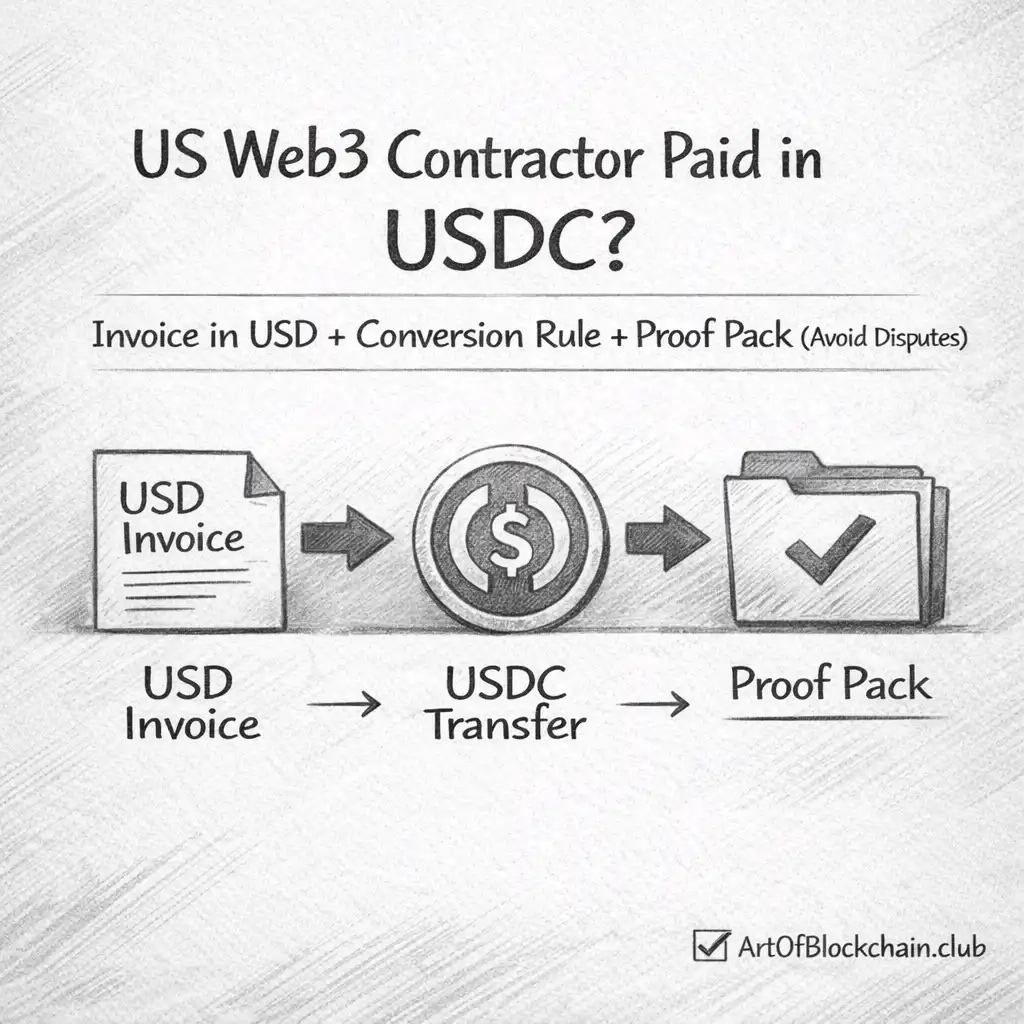
US Web3 Contractor Paid in USDC? Invoice in USD + Conversion Rule + Proof Pack (Avoid Disputes)

Editorial Note: This guide is based on real payment dispute resolutions, compliance reviews, and payroll setups across 50+ Web3 contractor agreements analyzed inside the ArtOfBlockchain community.
Getting paid in stablecoins for international contractor work sounds simple until the invoice currency, conversion rule, and proof of payment do not match.
This guide is for Web3 contractors and crypto-native teams getting paid in USDC while keeping the invoice in USD, the conversion-rate rule clear, and the payment proof easy to explain later.
The goal is simple: make stablecoin invoicing clear enough that both sides agree on what was owed, how it was converted, and what records prove the payment later.
Do this once, and you avoid rate arguments, wrong-network drama, and “proof of income” gaps later (background checks, rentals, loans, visas).
In March 2026, an AOB community member invoiced a client for $2,000 USD. The client sent exactly 2,000 USDC on the Ethereum network. During a gas spike, deducting the $150 network fee from the principal. By the time the transaction cleared and the spot rate fluctuated, the contractor received $2,850. Because the contract did not stipulate whether the payment was 'gross' or 'net' of gas fees, the contractor had to absorb the loss.
This article is for that exact moment: before a small payment assumption becomes a contract dispute, tax-record headache, or proof-of-income problem.
(If you are currently evaluating a full job offer rather than just invoicing mechanics, use our Salary, Tokens & Compensation Hub to map out your broader global pay tradeoffs first).
How Companies Compliantly Pay Overseas Contractors in Stablecoins
When protocols pay international contractors or remote staff in stablecoins (USDC/USDT), staying compliant requires a standard 4-step operational pipeline:
1. Compliance Onboarding & Documentation: Collect Form W-8BEN (for non-US contractors) or W-9 (for US contractors) to verify tax residency, accompanied by written consent agreeing to stablecoin settlement terms.
2. Fiat Base Calculation: Compute all hours, milestone deliverables, or monthly retainers in fiat currency ($ USD or EUR) to maintain legal compliance and clear accounting baselines before token conversion.
3. Execution Platform Selection: Teams typically route payments either via crypto-native payroll engines (Bitwage, Request Finance, Toku) or global HR platforms with crypto payouts (Deel) to automate transaction invoicing, KYC verification, and tax records.
4. On-Chain Settlement & Network Selection: Disburse funds on low-cost networks (Arbitrum, Base, Polygon) or Ethereum L1 with agreed-upon gas terms, generating verifiable transaction hashes tied directly to the corresponding invoice ID.
For complete offer and salary dynamics, explore our comprehensive Salary, Tokens & Compensation Hub
If you remember one line, make it this: Invoice = what you’re owed. Tx hash = how it was paid. You need both.
Getting paid in USDC sounds like the clean Web3-native option. No wire delays. No bank holidays. No “intermediary bank rejected it” drama. Just a transaction hash and done.
And then the first messy month happens.
The first dispute usually starts with one sentence:
“I sent you the USDC already.”
That line can be technically true and still practically wrong — because “paid” only means something if both sides agreed on the USD anchor, the conversion rule, the network/gas handling, and what counts as proof.
Why USDC invoices, conversion rates, and off-ramp records break later if proof is weak
Web3 work histories are often contract-heavy: DAOs, short stints, protocol contributions, “no HR letter,” payments that look like wallet inflows.
A tx hash shows that funds moved. It does not explain what the payment was for, which invoice it settled, or how the USD value was calculated. This is where a USDC payment record becomes more than wallet history. For contract-heavy Web3 profiles, the invoice, conversion-rate proof, transaction hash, and off-ramp record can also help explain income continuity, client work, and payment clarity later.
If a Web3 candidate has contract-heavy work, the invoice, payment trail, and proof pack should help a hiring team understand the work performed without needing private wallet explanations.
It also helps explain career continuity. We often see recruiters question contract-heavy profiles, which is why deciding between Contractor vs. Full-Time roles in Web3 is one of the most critical long-term career choices you will make.
If you keep a simple monthly proof pack, your contractor income becomes easier to explain later for verification, records, or follow-up questions.
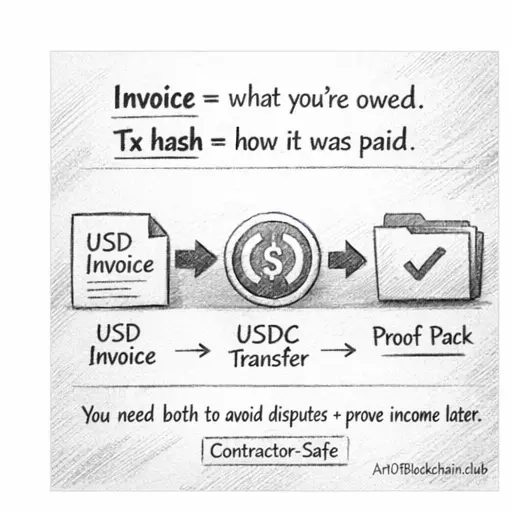
The 4 things to lock down (so “paid” has one meaning)
Most stablecoin-pay confusion is not about crypto itself. It is about unclear settlement terms. Treat this as a simple 3-part system: what you are owed, how that amount converts into USDC, and what records you keep after payment lands.
1) Invoice in USD (even if you receive USDC)
Keep the invoice boring on purpose. It should look like something any finance person understands:
Amount due: $X USD. Due date. Payment method: USDC. Wallet + network. Invoice number.
Why USD? Because scope, milestones, and late fees usually live in fiat terms. If you anchor in USD, you avoid the “you got fewer coins than last month” argument from becoming a recurring fight.
For real-world community breakdowns on selecting the correct base currency denomination, see our practitioner discussions on whether contractor invoices should be in USD, USDC, or local fiat
and compliance guidelines for handling US-based USDC payroll and tax-proof receipt
2) Conversion rate rule (pick one, then stop arguing)
The conversion rule is where small misunderstandings turn into repeat disputes. Pick one method, write it once, and make sure both sides can check the same result later.
Pick one approach and write it down:
Source: Use institutional price feeds (e.g., Coinbase API or Chainlink Oracles) rather than generic Google searches.
Timestamp window: Set a strict UTC time (e.g., the Coinbase Spot rate at exactly 12:00 PM UTC on the day of transfer).
Rounding: Define decimal rounding (usually to 2 or 6 decimal places).
Then define three details clearly:
Source (which exchange/index)
Timestamp window (UTC is easiest)
Rounding (how many decimals, which direction)
Tiny example (so both sides picture the same thing):
You invoice $2,500 USD due Feb 10.
Rule: use a 1-hour average USD/USDC rate at time of payment, round to 2 decimals.
If rate = 1.0002, USDC owed = 2,500 / 1.0002 = 2,499.50 USDC (rounded).
Now “paid” is checkable, not debatable.
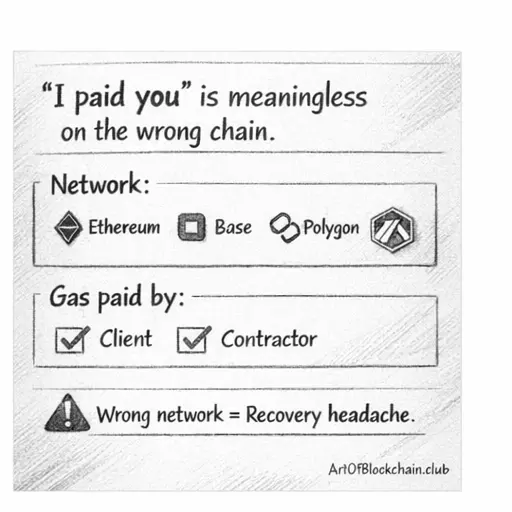
3) Network + gas: write it once to avoid drama later
Gas feels like a small number… until it isn’t. And the emotional cost is always bigger than the dollar cost.
This is where contractor relationships get weird: one side assumes gas is “part of paying,” the other assumes gas is “your wallet’s problem.” Neither side is evil — they just didn’t write it down.
Pick what’s true and document it:
Client covers gas and sends the exact USDC equivalent, or
Contractor receives a net amount and covers gas
Also, define the exact network in writing. “I paid you” is not enough if the transfer was sent on the wrong chain or the fee assumptions were different on each side.
For international contractors, gas fees are only one part of the cross-border friction; understanding Web3 relocation and remote work restrictions (US, Dubai, Singapore) is just as critical for global teams.
Network transfer costs can create friction when gas spikes occur during settlement.
Learn how teams structure payment clauses in our case study on who pays the gas when clients pay USDC on Ethereum mainnet
4) Proof of payment: build a monthly “proof pack.”
Keep the proof pack boring and consistent. The goal is not to make the invoice look “on-chain.” The goal is to make your records easy to trace later: invoice, wallet, transaction, date, amount, and rate logic in one place.
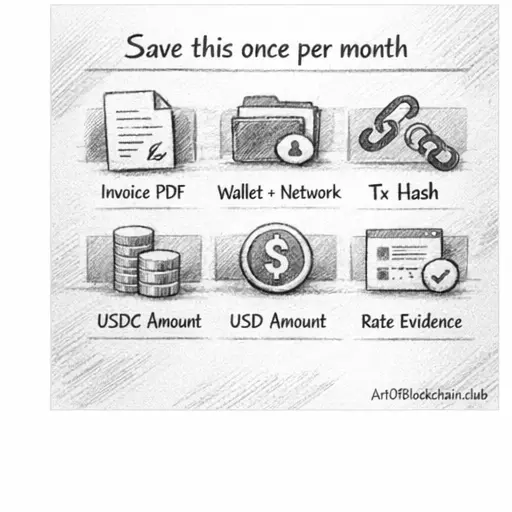
A USDC payment proof pack is a monthly folder that connects the invoice, wallet address, network, transaction hash, UTC timestamp, USDC amount, USD invoice value, and conversion-rate evidence.
Once a month, save:
Invoice PDF (invoice number)
Receiving wallet address + network
Tx hash link (the permanent URL from Etherscan, Polygonscan, or the relevant blockchain explorer)
Date/time (UTC)
USDC received
USD invoice amount
Conversion source + rate used (screenshot is fine)
Example contractor record
A simple monthly USDC proof folder can look like this:
Invoice amount: USD 1,500
Payment rail: USDC
Network: Polygon / Ethereum / Base, as agreed
Conversion source: Coinbase / CoinMarketCap / exchange screenshot at the agreed timestamp
Transaction proof: wallet address + transaction hash
Off-ramp proof: exchange withdrawal or bank credit record, if converted later
Folder name: ClientName_Invoice03_USDC_Jan2026This does not need to be fancy. The goal is that a contractor, client, recruiter, accountant, or bank can understand the payment trail later without needing a private explanation.
Proof stack tip (for job screens + verification):
If your work history includes contracts/DAOs, you’ll get asked to prove income or continuity. Your proof pack becomes your lightweight “proof stack.” Use consistent filenames so you can export it quickly when someone asks.
What can go wrong (and why it’s still fixable)
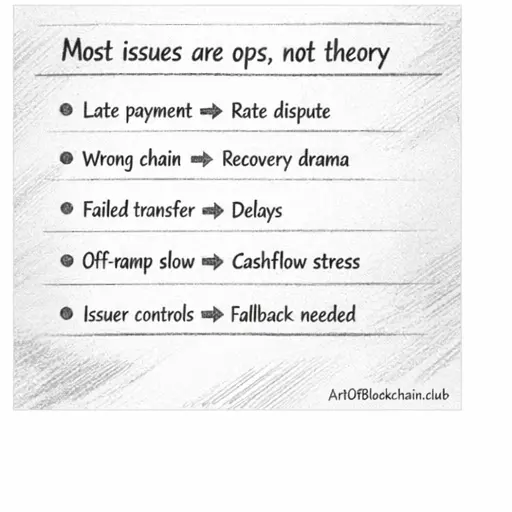
Most problems are operational, not “crypto theory”:
Late payment turns into rate disputes and cash flow pain
Wrong network becomes recovery drama
Transfers can fail due to ops mistakes or compliance checks
Off-ramping can be slow, so “stable” income feels stuck
Stablecoin-specific risk exists (issuer controls/freezes) so have a fallback rail
Before locking into a compensation structure, review our community guides on handling operational stablecoin workflows
and analyzing whether to accept a 100% stablecoin salary versus requesting partial fiat
For hiring managers setting up compensation models, explore our comprehensive Web3 Hiring Risks & Compensation Hub for Hiring Teams
Copy-paste clauses (simple, not fancy)
Conversion rate clause
“Invoice amounts are denominated in USD. Payment will be made in USDC equivalent using the [RATE SOURCE] USD/USDC rate at [TIME RULE: time of payment / time of invoice issuance / 1-hour average window]. The rate timestamp will be recorded and shared with the transaction hash. Any rounding will be to [2/6] decimal places.”
Gas + network clause
“Payments will be made on [CHAIN/NETWORK]. Gas/network fees will be paid by [Client/Contractor]. Client will send [gross/net] USDC such that the contractor receives the full USD invoice equivalent.”
Fallback clause
“If USDC transfer fails, is delayed beyond [X days], or is not possible due to compliance/operational reasons, client will pay via [bank transfer / alternate stablecoin / alternate rail] within [X days].”
Tax Records: W-9, W-8BEN, and the new 1099-DA [1] Getting paid in crypto does not exempt you or the client from traditional tax reporting. Under IRS guidelines, US-based contractors must provide a W-9 to their clients. Furthermore, starting in the 2025/2026 tax years, the IRS introduced Form 1099-DA specifically for reporting digital asset proceeds [1].
The "Proof Pack" folder you build is exactly what you will need to reconcile these 1099-DA or standard 1099-NEC forms with your CPA at the end of the year. International contractors must supply a W-8BEN form to exempt the US-based client from withholding taxes.
Need Expert Help with Your Web3 Career or Hiring?
Stablecoin payroll only works when the paperwork is clear on both sides. If your documentation is messy, it impacts your ability to get hired or make hires.
For Web3 Candidates (CV Review & Rewrite) If your work history includes DAO contributions, short-stint contracts, or USDC income, your resume must explain that context clearly. A recruiter looking at a messy, contract-heavy profile will often skip it. 👉 Book an AOB Web3 CV Review to find and fix hidden shortlist blockers.
For Hiring Teams (JD & Offer Review) If your contractor role, stablecoin payment terms, or W-2/1099 expectations are unclear in your Job Description, you will lose top-tier candidates. 👉 Request a Blockchain Job Description (JD) Review to eliminate candidate confusion before you publish.
About the author
Shubhada Pande is the founder of ArtOfBlockchain.club. With years of hands-on experience in Web3 operations, she has audited hundreds of blockchain job descriptions, contractor agreements, and stablecoin payroll setups. This community-first platform focuses on proof-based hiring and protecting Web3 professionals from operational risks.
This article is written from the AOB lens of how Web3 contractors, candidates, and remote teams handle payment clarity in real situations — not just from the payment side, but also from the hiring, documentation, and trust side.
Stablecoin payouts may look simple when the money arrives, but the real issue often appears later when someone has to explain the invoice amount, conversion rate, transaction proof, tax record, or off-ramp trail.
Connect with Shubhada Pande on LinkedIn:
https://www.linkedin.com/in/shubhada-pande-art-of-blockchain/
Important note
This article is for practical career, contractor-payment, and documentation clarity. It is not tax, legal, accounting, or financial advice. Stablecoin payments can create different reporting responsibilities depending on country, contract structure, business status, and off-ramp method. For personal tax or compliance decisions, speak with a qualified professional in your jurisdiction.
FAQs
1) Should I invoice in USD if I’m paid in USDC?
Yes. USD keeps scope, milestones, and late fees unambiguous. USDC is the payment rail, not the obligation anchor.
2) What conversion rate should we use for USD→USDC?
Pick one rule and use an institutional price feed (e.g., Coinbase API or Chainlink Oracles) to establish an undisputed timestamp window. For example, explicitly state you will use the Coinbase Spot rate at exactly 12:00 PM UTC on the day of transfer.
3) Who pays gas fees when paying in USDC?
Either side can — but it must be written, and the network must be specified. Confusion here is a common operational failure mode.
4) What proof should I keep for USDC income?
Invoice PDF + wallet + network + tx hash + UTC timestamp + USDC amount + rate evidence. Keep it monthly so it’s exportable later.
5) Is stablecoin payroll allowed in the US?
Yes, but independent contractors must submit a W-9 (for US residents) or a W-8BEN (for international workers) so the hiring company can accurately track global payroll expenses and report them to the IRS via Form 1099-NEC or the new 1099-DA.
6) What can go wrong even with USDC?
Late payments (rate disputes), wrong chain, failed transfers, off-ramp delays, and stablecoin issuer controls—so write fallbacks.
📥Free Operational Resource:
Before signing an agreement or sending your first USDC invoice, audit your payroll terms against our downloadable checklist: How to Get Paid in Stablecoins: 10 Questions to Ask Before Accepting a Web3 Salary