
Blockchain Forensics Career Hub: Fraud Investigation, Wallet Risk, and On-Chain Evidence

Founder Note: The Translation Problem in Web3 Hiring
Blockchain forensics is one of the most practical Web3 career paths because many candidates already have the foundation: investigation discipline, evidence handling, risk thinking, and cyber awareness.
The missing piece is translation. Hiring teams need to see how your past investigation experience connects to wallet risk, transaction movement, on-chain evidence, and crypto-specific financial crime patterns. As the founder of AOB, I built this hub to help traditional professionals from fraud, cyber, AML, and audit backgrounds translate their skills into readable, on-chain proof.
Choose Your Transition Pathway
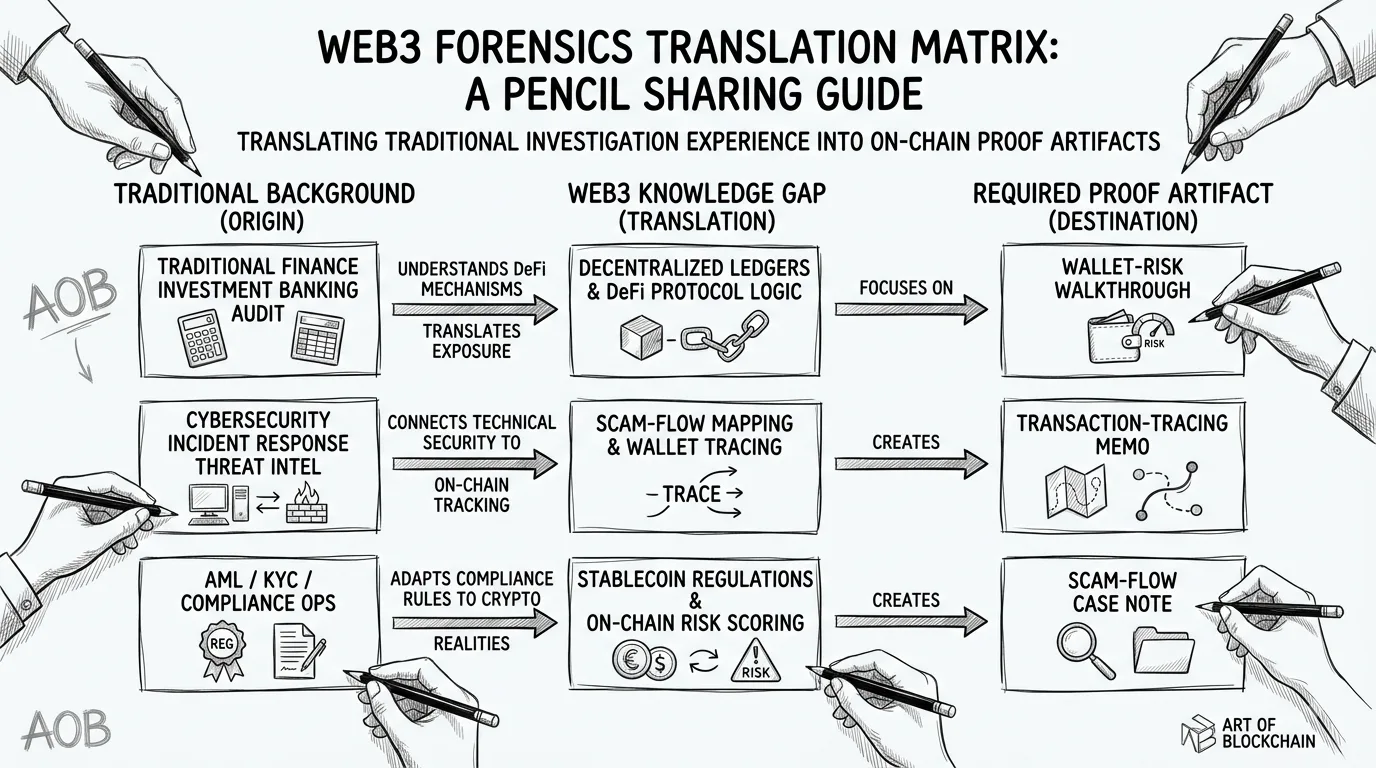
The Traditional Finance & Fraud Route: If your background is in investment banking, audit, or SARs casework, your main hurdle is applying traditional frameworks to decentralized ledgers. Read our guide on transferring banking fraud experience to crypto forensics or read Khagesh Chaturvedi's journey from TradFi compliance to Web3.
The Cyber & Security Route: If you come from incident response or threat intel, you already know evidence handling. You need to learn wallet-tracing and scam-flow mapping. Read our startup guide for cyber professionals entering Web3.
The Macro Compliance Route: If you are trying to understand where forensics sits alongside AML, RWA, and CBDCs, start with our broader Web3 compliance and forensics career guide.
Study Live Roles: To understand what hiring managers actually ask for, browse current listings on the AOB Web3 Job Board or view this example of a Financial Crimes Program Manager role.
Proof Artifacts (What Web3 Hiring Teams Actually Look For)
To get hired, you do not need to pretend you have access to expensive enterprise tools. You just need to show investigative reasoning applied to on-chain activity. A strong proof artifact is simple, readable, and role-aligned:
Wallet-Risk Walkthroughs: A short document proving you can look at a wallet's transaction history on block explorers and identify exposure to mixers, sanctioned entities, or high-risk exchanges.
Transaction-Tracing Memos: A basic map or memo following the movement of funds from a hack or scam across multiple addresses, proving you understand hops and chain-peeling.
Scam-Flow Case Notes: A breakdown of a public scam (like a phishing contract), explaining the fraud pattern and documenting the findings so a non-technical stakeholder can understand it. Read our guide on how to present case notes without violating NDA or confidentiality.
The goal of these artifacts is to show your handling of evidence, your assumptions, and your understanding of what can and cannot be proven from on-chain data alone. Explore examples of these artifacts in our Web3 Hiring Hub.
Need Help Translating Your Experience?
For Candidates: If you have investigative experience but your CV isn't landing interviews, your proof likely isn't translating. Get help with our Web3 CV Review Service.
For Hiring Teams: Unclear proof expectations attract weak-fit applicants. If your JD doesn't explicitly state what kind of casework you need, use our Web3 JD Review Service or Post a Web3 Job on AOB to reach verified talent.
What this hub is not
This hub is not a blockchain forensics tool tutorial. It is not legal advice or investigation training. It is a career-navigation hub for people trying to understand how fraud, cyber, banking, audit, and financial-crime backgrounds can translate into blockchain forensics roles.