
TradeFi to Web3 compliance: Khagesh Chaturvedi on AOB

Proof-Based Career Shifts: Khagesh Chaturvedi’s Journey from Institutional Banking to Web3 Financial Inclusion
"Banking taught me that access without judgment just moves risk downstream to the person least equipped to handle it." — Khagesh Chaturvedi
When professionals move from traditional finance (TradFi) into Web3, they often bring theoretical definitions instead of practical risk judgment. Khagesh Chaturvedi represents a distinct, proof-driven transition.
In today’s interview, we are featuring Khagesh Chaturvedi, who is Senior Advisor for India Strategy & Financial Partnerships at Mogaland. He has nearly two decades of retail banking compliance experience in the prestigious organizations like HDFC Bank, HSBC, Standard Chartered, and Yes Bank. In his current role, he is applying his hard-earned institutional lessons to gamified financial literacy and decentralized finance.
In this edition of our Web2 to Web3 Career Transition Series on Home | ArtofBlockchain, Khagesh @wry-duck breaks down why certifications won't get you hired in Web3 compliance, how on-chain analysis differs from traditional KYC, and why public "case notes" are the ultimate proof of work.
Key Takeaways
Theory vs. Practice: Employers care about how you solve problems, not just your knowledge of rules.
Behavior First, Paperwork Second: True compliance is spotting transaction patterns that don't match reality, even when all the documents look clean.
Closed Systems vs. Open Chains: TradFi compliance relies on internal bank databases; Web3 compliance requires stitching together open-source data across public block explorers.
Access Without Groundwork Isn't Inclusion: Onboarding users into DeFi without teaching custody or scam prevention isn't financial inclusion—it's just exposure with better marketing.
The Interview
1. What made Web3 serious for you after nearly two decades in banking?
When you spend almost 20 years in institutional banking, you get used to structure. Every process has a manual, every situation has a policy, and the core banking system tells you what step to take next.
Web3 is the exact opposite. There are no pre-built rails, and things break fast. That unpredictability didn't push me away—it actually pulled me in.
What really bothered me was seeing financial tools roll out without any risk guidance attached to them. People were jumping into DeFi protocols and DAOs with real money, but they had zero framework for assessing risk. In traditional banking, compliance exists to protect people from those blind spots. I realized I didn't just want to watch this space from the sidelines; I wanted to build the risk and literacy infrastructure inside it through Mogaland.
2. What did 19 years in TradFi prepare you to notice that Web2 compliance professionals often miss on-chain?
It taught me to watch behavior first and paperwork second. A file can be 100% compliant on paper, but the relationship can still be fundamentally wrong.
I remember a corporate account at the bank where every KYC document was verified, and the stated turnover lined up with their business operations. But when I looked at the actual transaction timing, it didn't match how a business in that industry operates day-to-day. That behavioral mismatch—not a missing signature—is what led us to file a Suspicious Transaction Report (STR).
A lot of compliance people moving into Web3 look at on-chain data like a checklist: Did the wallet pass sanction screening? Yes or no? Banking trains you to ask what normal account behavior looks like before you go hunting for anomalies. That instinct transfers directly to reading wallet flows, even if the underlying blockchain mechanics are totally different.
3. How does compliance judgment fundamentally shift when you move from a bank to an open blockchain?
In banking, your evidence lives inside a walled setup i.e., in your core banking system, internal KYC files, and proprietary monitoring software. The procedures were built decades before you start your work and your job is to enforce rules within that boundary.
In Web3, the evidence is recorded in the open on public block explorers, cross-chain bridges, and smart contracts. No single entity owns the stack end-to-end.
Your mindset shifts from "Does this transaction break our internal bank policy?" to "How is value moving across this network when no central intermediary is holding the parties together?" You lose the security of a single internal source of truth, but you gain the ability to audit a wallet's entire transaction history on-chain. The core pattern-recognition skill is identical; it's the data landscape that changes.
4. You argue that "Case Notes Over Claims" is the only proof that matters. How can candidates actually demonstrate this?
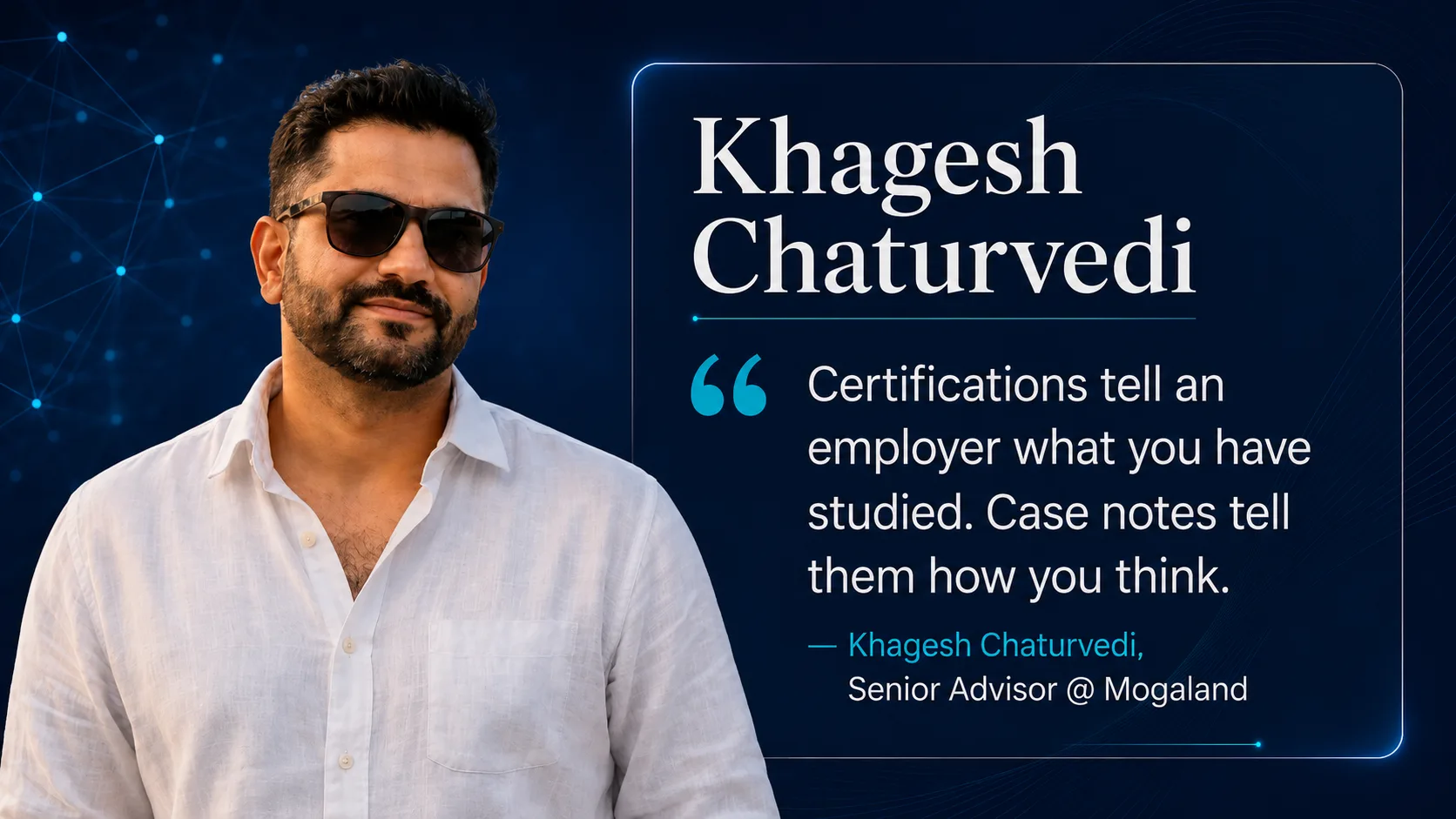
Anyone can memorize regulatory definitions or pass a multiple-choice certification exam. Certifications prove you studied the material; case notes prove you know how to make decisions.
If you want to be taken seriously, publish 2 or 3 anonymized risk notes showing your visible logic:
The Trigger: What flagged the account or wallet in the first place?
The Investigation: What tools or data points did you check, and in what order?
The Exclusions: What potential risks did you rule out, and why?
The Verdict: What call did you make, showing the actual logic step-by-step?
I actually did this on myself. When I almost got caught in a phishing attempt on a DeFi platform, I wrote a full post-mortem mapping out what the attacker asked for, what felt wrong, what I verified, and how I secured my wallet. That write-up did more to prove my security instincts than any resume claim ever could.
📖 Recommended Read: What Almost Getting Scammed in DeFi Taught Me About Security by Khagesh Chaturvedi.
5. How does your banking background shape your current work in financial literacy and inclusion at Mogaland?
Banking taught me a hard lesson: giving someone access to a financial tool without teaching them judgment isn't inclusion—it’s just passing the risk down to the person who can least afford it.
At Mogaland, our financial literacy work covers foundational real-world skills like reading salary slips, managing credit, loans, insurance, and savings—not just crypto. But whenever we introduce Web3 elements, the rule stays the same: teach the risk before you hand over the tool, not after someone loses money.
Before any platform hands a user a non-custodial wallet or promises DeFi yield, they should teach five basic security reflexes:
Fake Support vs. Real Support: Most losses don't come from smart contract exploits; they come from imposter accounts in Telegram or Discord DMs.
Finality of On-Chain Actions: Once a transaction is signed, there is no bank customer service line to reverse it.
"Approve" vs. "Log In": Connect wallet and contract approvals aren't Web2 logins—they are granting open permissions to move your funds.
Scam Mechanics: Recognizing artificial urgency, unsolicited help, and seed phrase requests.
Yield Reality: Understanding that high APY and rewards are never free money—the risk is always sitting somewhere on the other side.
Traditional banking discipline isn't about pushing tech; it’s about assuming the user is capable but new, and putting the guardrails in place before they fall.
Action Plan: Building Your Public "Proof of Work"
If you are transitioning from Web2 into Web3 risk, strategy, or compliance, apply Khagesh’s framework to build your own portfolio piece:
Select an Event: Identify a recent public protocol exploit, wallet cluster anomaly, or bridge flow.
Document the Trigger: State clearly what pattern flagged your attention.
Map the Process: List the exact tools (Etherscan, Dune, Arkham) and chronological analysis steps you used.
Detail Exclusions: Explain what false positives you checked and dismissed.
Publish the Verdict: Share your case note publicly on Paragraph, Mirror, or LinkedIn with your logic trail fully visible.
For another perspective on bridging the gap between legacy banking and Web3, check out our interview with former Deputy Head of Wholesale Credit Risk, Gaya Chandrasekaran