

Proof-Based Web3 Hiring: What Changed, Why It Felt Harder, and What Counts as Proof

As the Web3 industry is maturing, the way of hiring and recruitment priorities is also changing. Since 2025, job posts have shown an exponential rebound; the candidate response rates did not follow.
Across the ArtofBlockchain ecosystem, while analyzing postings on our job board and feedback from our talent pool, we observed a clear pattern: Web3 hiring teams stopped recruiting like traditional hiring and started screening exclusively for risk reduction. Generic labels like "Web3 enthusiast" lost all leverage. It is now replaced with proof-based hiring—a framework where verifiable artifacts, public codebase contributions, and documented technical reasoning replace traditional CV claims.
Key Market Takeaways & Hiring Signals:
Selective Volume: Job availability expanded, but hiring filters tightened significantly to eliminate role mismatch and candidate resume inflation.
Engineering Specialization: Demand shifted away from generalist smart contract developers toward security auditors, protocol engineers, and failure-mode specialists.
Non-Engineering Elevation: Compliance, operations, and technical product roles gained priority as protocols faced increased regulatory scrutiny and institutional integration needs.
The Proof Imperative: Candidates are no longer evaluated on interest or CV bullet points, but on their ability to present verifiable, low-friction proof of execution before the first interview.
The Recovery That Didn’t Feel Like Growth
According to Coincub’s Web3 Jobs Report, Web3 added 66,494 new roles in 2025, representing a 47% rebound from 2024. Remote roles reached 26,925, up 40% year over year, showing that Web3 remained structurally more distributed than many traditional tech and fintech markets.
Source: Global Crypto Rankings & Reports | Coincub
Important source note: This article uses Coincub and Web3-linked data for job-volume direction. Electric Capital’s Developer Report is better used for developer activity, open-source ecosystem movement, and geography context — not as the main source for job-opening totals.
That growth alone should have signaled opportunity. But unlike previous cycles, this wasn’t expansion driven by speculation or experimentation. It was a recalibration driven by constraint.
Companies that survived the 2022–2023 downturn had already paid the price of overhiring, unclear roles, and fragile team structures. When they returned to the market, they did so with restraint — and intent. They weren’t hiring for optionality anymore. They were hiring to stabilize systems that already existed. This is why so many candidates experienced a paradox: more jobs, but fewer chances.
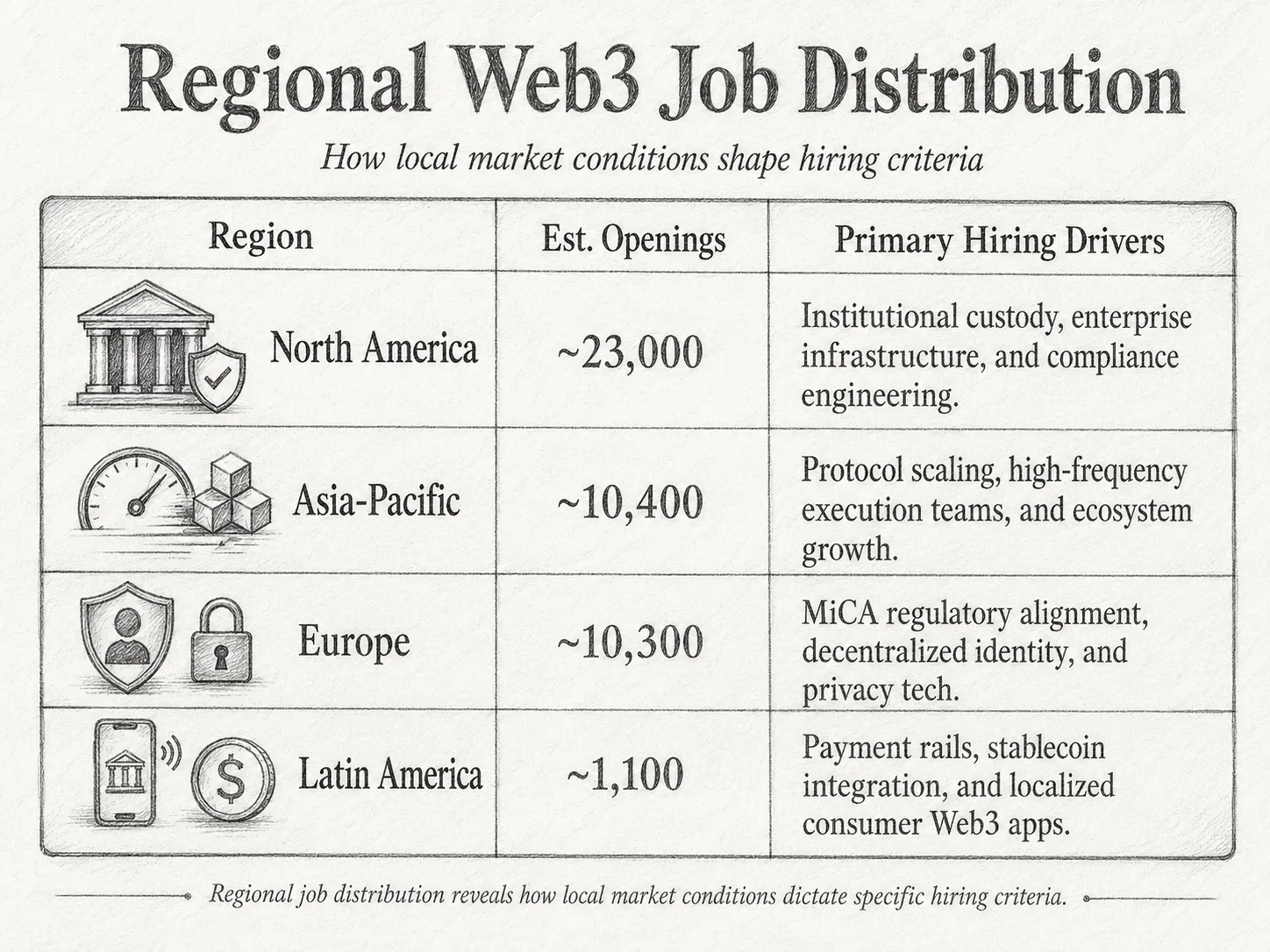
Where Web3 Roles Distributed (and What Drove Demand)
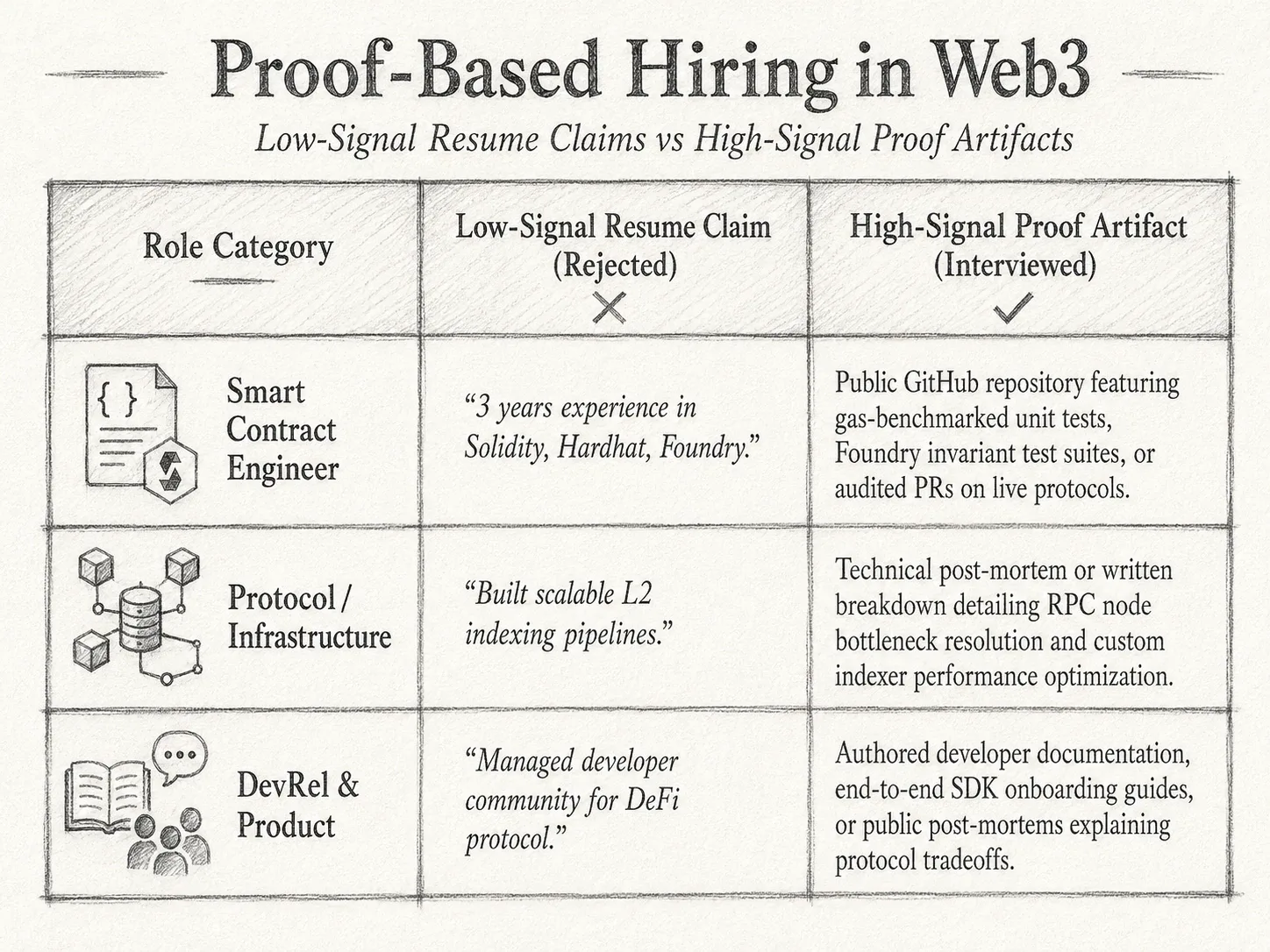
The Web3 Proof Framework: Low-Signal vs. High-Signal
Remote Work Didn’t Decline — It Matured
Despite public narratives around "return to office," blockchain hiring quietly moved in the opposite direction. In 2025, approximately 26,900 blockchain roles were advertised as remote, marking a 40% year-over-year increase.
Source: Global Crypto Rankings & Reports | Coincub
But this wasn’t the remote work of 2021. Remote no longer meant flexibility without accountability. It meant self-direction, clarity of thought, and the ability to operate without constant synchronization.
Hiring managers began filtering for people who could:
Communicate decisions clearly in writing
Reason independently
Operate asynchronously without loss of context
This shift explains why many professionals felt remote work became "harder." It didn’t shrink — it matured. Remote roles increasingly require proof of async communication, written clarity, timezone discipline, handoff quality, and low-supervision ownership.
The End of the "Builder-Only" Era
Perhaps the most misunderstood shift was the idea that engineering demand collapsed. It didn’t. What changed was what kind of engineering mattered.
Earlier cycles rewarded speed and experimentation. Teams prioritized resilience and foresight. This meant a move away from generalist builders toward specialists who understood failure modes: security engineers, protocol designers, infrastructure architects. The ability to explain why something might break became as valuable as the ability to build it.
The Quiet Rise of Product and Program Roles
One of the most important — and least discussed — changes was the rise of product, program, and delivery roles.
Product, program, operations, compliance, risk, and GTM-facing roles became more visible across Web3 hiring. Coincub’s Web3 Jobs Report also notes that non-technical roles led volumes across several tracks, with hiring tilting toward GTM, risk, compliance, and product functions.
This wasn’t organizational bloat. It was a response to complexity. As systems grew more interconnected — across chains, compliance frameworks, and user layers — teams needed people who could coordinate tradeoffs, not just write code. Product and program professionals became the translators between vision and execution.
Why Didn't More Hiring Create Easier Shortlists?
More hiring did not automatically create easier shortlists because the filter changed. In earlier Web3 growth cycles, many teams hired around possibility. Teams now hire around risk reduction. That meant capable candidates could still be ignored if their proof was hard to read.
Many professionals had learned tools, built portfolios, and applied widely, but their fit was still not obvious to hiring teams. The issue was not effort; it was signal clarity.
The market started rewarding candidates who could show:
Clear role alignment
Evidence of ownership
Decision-making under constraints
Communication in writing
Security or failure-mode awareness
Project context, not just project links
AI Literacy Became Part of the Proof Layer
AI literacy moved from "nice to have" to a practical workplace signal. This does not mean every blockchain candidate needs to become an AI engineer. It means hiring teams increasingly expect people to use AI tools carefully, verify outputs, improve workflows, and still apply judgment.
LinkedIn’s labor market reporting noted that jobs requiring AI literacy grew 70% year over year. That broader labor trend matters for Web3 because blockchain roles already require judgment under uncertainty.
For Web3 candidates, the practical question is not: "Do I know AI?" It is: "Can I use AI without outsourcing my judgment?" That distinction matters in security, product, compliance, operations, research, and engineering roles.
From Signal to Selection: How Hiring Decisions Are Really Made Now
By 2025, many Web3 hiring decisions were no longer only pipeline problems. They were signal problems. Hiring teams could find applicants; the harder part was deciding who was clear enough, trusted enough, and role-aligned enough to shortlist.
The Real Bottleneck: Not Talent, but Trust
Teams are no longer short on talent. They’re short on confidence in their judgment. Every hiring decision today carries more risk:
Fewer people per team
Tighter budgets
Longer accountability chains
Higher cost of a bad hire
As a result, hiring managers don’t look for the "best resume." They look for the least ambiguous decision. That’s why candidates who reduce uncertainty get hired faster — even if they’re not the most credentialed.
Why Proof Became More Than a Portfolio Link
In earlier cycles, proof of work often meant visible output: code written, features shipped, repositories maintained, projects listed. That became only the first layer.
Hiring teams also want to understand the thinking behind the work:
Why was this design choice made?
What tradeoffs were rejected?
What constraints mattered?
What could break?
What did the candidate learn after shipping?
That is why a portfolio link alone is not enough. A GitHub repo, audit note, project explanation, postmortem, or discussion reply becomes stronger when it makes judgment visible.
The Rise of "Public Thinking" as Career Capital
One of the most underestimated shifts is the rise of thinking-in-public as a career advantage. This doesn’t mean personal branding or posting hot takes. It means explaining your reasoning, documenting decisions, asking good questions, and refining ideas over time. People who do this create a trail of cognitive evidence that builds trust.
Where AOB Fits in This New Hiring Logic
Art of Blockchain works as a hiring-signal layer around jobs, discussions, proof, and role-specific career clarity.
It gives candidates a way to:
Explain their thinking
Connect experience to role fit
Learn what hiring teams actually verify
Turn scattered work into readable proof
It gives hiring teams a way to:
Understand candidate signals earlier
Clarify what proof should matter
Write sharper job descriptions
Reduce mismatch before the interview stage
The Strategic Shift for Hiring Teams
For hiring teams, the lesson is equally important. The strongest hiring teams are not only the ones with the biggest applicant pool. They are the ones that define proof clearly.
A better Web3 job description should explain:
What problem the role solves
What ownership level is expected
What proof would make a candidate credible
What tradeoffs the person should understand
What weak signals should be filtered out early
Methodology & Disclaimer
This article combines publicly available hiring research with qualitative observations from the Art of Blockchain ecosystem. The main job-volume reference is Coincub’s Web3 Jobs Report, which reports 66,494 new Web3 roles and 26,925 remote roles. Electric Capital’s Developer Report is used as supporting context for developer activity and ecosystem geography. LinkedIn labor market reports are referenced for broader labor-market trends around AI literacy.
AOB observations are based on discussion patterns, job posts, candidate questions, founder comments, and hiring-signal content visible inside the AOB ecosystem. All interpretations are directional and should not be treated as a hiring guarantee, salary guarantee, financial advice, or legal advice.
FAQ: Understanding the Web3 Hiring Reset
Was this really a blockchain hiring surge?
It was a recovery in job activity, but not a loose hiring boom. It is better read as a reset. More roles appeared, but hiring teams became more selective about fit, proof, and role clarity.
Why did more blockchain jobs not make hiring easier?
Because job volume and shortlist probability are different things. Candidates saw more openings, but hiring teams filtered harder for evidence of ownership, judgment, communication, and role alignment.
What changed most in Web3 hiring?
The biggest change was the move from broad Web3 interest to proof-based evaluation. Hiring teams wanted clearer evidence that a candidate could reduce risk, explain tradeoffs, and operate in a mature team.
Did engineering roles decline in Web3?
No. Engineering became more specialized. Stronger demand moved toward security, infrastructure, protocol design, reliability, smart contract risk, and system-level reasoning.
Why did product, program, compliance, and operations roles become more important? As Web3 products matured, teams needed people who could connect technical work to execution, risk, regulation, users, and business outcomes. That made coordination and judgment more valuable.
What does proof-based hiring mean in this context?
It means hiring teams are not only reading claims. They are looking for evidence. That evidence may come from GitHub, architecture notes, audit writeups, project explanations, portfolio context, CV clarity, or public discussion.
