
Why Am I Not Getting Shortlisted for Blockchain Jobs? What Qualified Web3 Candidates Miss
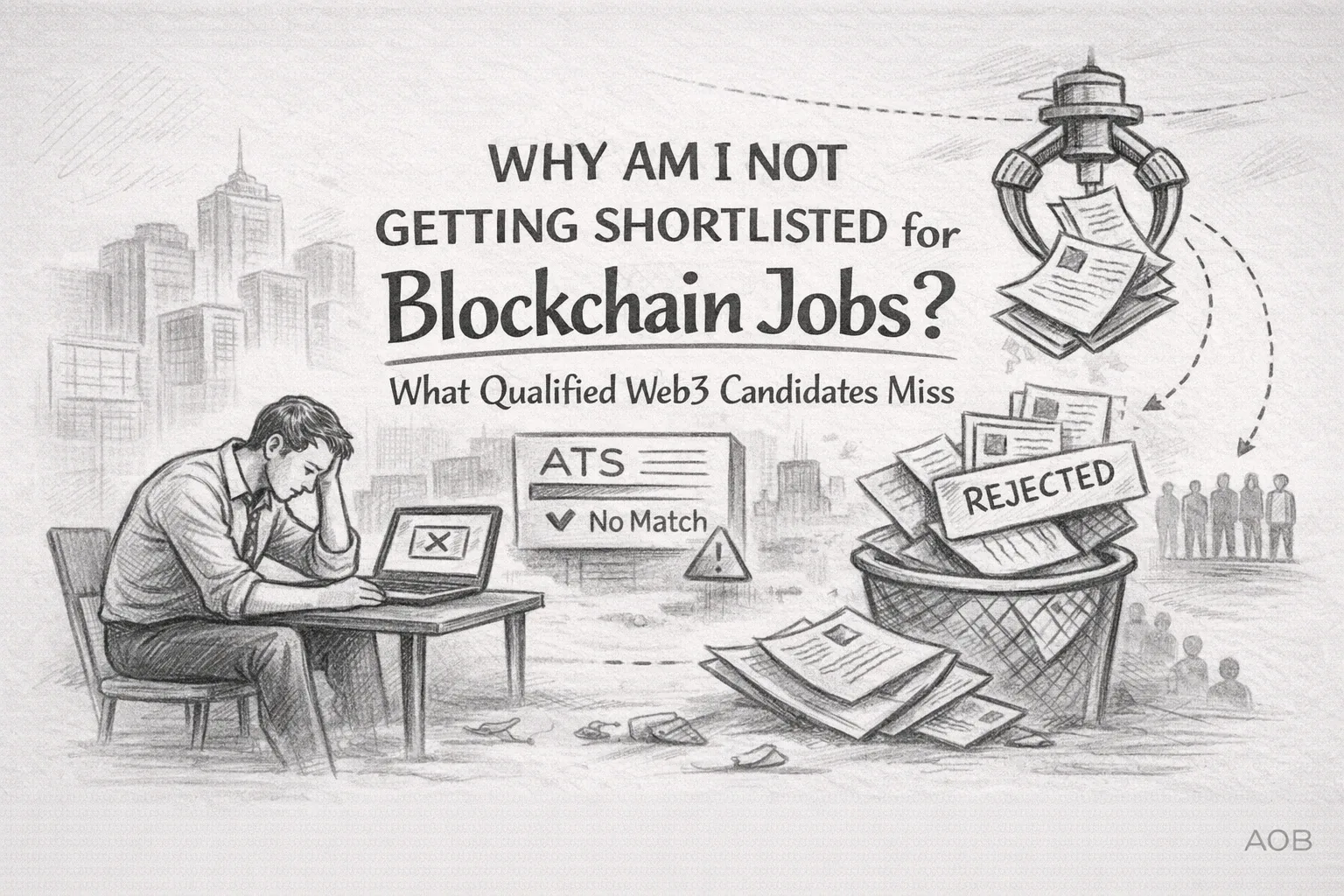

If you are qualified enough to compete for blockchain jobs but still not getting shortlisted, the problem is not always your skill level.
A lot of Web3 candidates get stuck because their resume does not make proof visible fast enough. ATS systems cannot read the signal clearly, recruiters do not see role-fit quickly, and the strongest work gets buried under vague bullets, weak formatting, generic summaries, or links that do not help anyone verify the work.
That is why qualified candidates still get skipped for blockchain jobs they could realistically do.
If you are asking yourself, “Why am I not getting shortlisted for blockchain jobs even though I have the skills?” this is the right place to start.
TL;DR — Why Qualified Web3 Candidates Still Get Skipped
• Many blockchain resumes never make it past the first filter because ATS systems cannot parse weak layouts, hidden tool terms, or vague bullet points.
• Recruiters do not shortlist “potential” first. They shortlist visible proof, clean role-fit, and low-risk signals.
• Generic blockchain claims reduce trust. Specific tools, tests, deployments, and documented ownership improve shortlist chances.
• A strong candidate can still be ignored if GitHub, project links, and resume bullets do not make the work easy to verify.
• Before applying wider, fix resume readability, proof visibility, and recruiter scan-speed first.
If your resume is still not converting into calls, the next step is a blockchain CV review
Web3 CV Review Services Are Now Open on ArtOfBlockchain.club | ArtofBlockchain
ATS Filters: The First Battle Candidates Don’t See
Most blockchain professionals assume hiring starts when a recruiter reads the resume.
In reality, hiring often starts earlier, when ATS and screening systems scan for exact tools, readable formatting, and clear structure.
A lot of qualified candidates get filtered out before a human sees anything, not because they are unqualified, but because their signal is hard to parse.
1. Missing Exact Tool Keywords
ATS systems are literal. They do not infer context well.
If a job description says Solidity, Foundry, Slither, Tenderly, ERC20, Hardhat, Rust, Anchor, or zk basics, those exact terms should appear naturally in the resume when they genuinely match your work.
If your resume says “smart contract development experience” but the role is screening for Solidity, Foundry, and gas optimization, you may be more qualified than the resume appears.
2. Modern Resume Templates Break ATS Parsing
Many Canva- or Figma-style resumes fail because ATS systems struggle with columns, tables, icons, text boxes, and layered PDFs.
What feels visually polished to a human can become unreadable to a parser.
In blockchain hiring, that can quietly remove good candidates before a recruiter even gets the chance to compare them.
3. No Dedicated Skills and Tools Section
When tools are buried inside long paragraphs, screening systems often miss them.
That lowers match quality even when the candidate has the right experience.
A clean and honest Skills and Tools section helps both ATS and recruiters understand the stack faster.
4. Synonym Mismatches
Small wording differences can weaken match quality.
Examples:
“Fuzzing” may not be read the same way as “Foundry fuzz testing.”
“smart-contract QA” may not match “Solidity testing.”
“Deployed contracts” may not carry the same weight as “deployed ERC20 and staking contracts on testnet.”
That is one reason qualified candidates still face silent rejection.
How to Write Blockchain Resume Bullets More Clearly
Most Web3 resume bullets are too vague.
Bad:
Worked on staking contract.
Better:
Built staking contract in Solidity with Foundry tests; reduced gas usage by 12% through loop restructuring.
Why this works:
it shows the tool stack, the work itself, and a concrete proof signal recruiters can trust faster.
If you want deeper resume structure help, read Blockchain Developer Resume Masterclass
Blockchain Developer Resume Guide (2025): How Web3 Recruiters Shortlist Candidates | ArtofBlockchain
If you want to compare your situation with real community discussion, read Am I missing anything major on my resume for a Web3/Blockchain career?
Am I Missing Anything Major On My Resume For A Web3Blockchain Caree
When Resume Visibility Is the Real Problem
If your resume fails on two or more of these points — exact tool match, ATS readability, clear bullets, or visible proof — the problem may not be skill.
It may be visibility.
If you want direct feedback on that, use Web3 CV Review Services
Web3 CV Review Services Are Now Open on ArtOfBlockchain.club | ArtofBlockchain
Why Qualified Candidates Still Lose Early
Even when your skills are real, you can still lose shortlist position if your proof is not visible quickly and your role-fit is not obvious early.
In fast-moving Web3 hiring, recruiters and founders often make early filtering decisions based on clarity, trust, and verification speed.
That is why strong candidates can still lose before interviews begin.
Do Not Self-Reject Too Early
Some Web3 job descriptions are inflated, especially in smaller teams where founders write idealized wishlists instead of realistic day-one requirements.
That does not mean every candidate is a fit, but it does mean you should evaluate the actual proof expected, not just the length of the tool list.
In many cases, strong proof and role adjacency matter more than matching every buzzword in the listing.
If you need broader role navigation, use Job Search Hub
job-search-hub | ArtofBlockchain
What Recruiters Actually Look for in Blockchain Resumes
Recruiters are not trying to identify the most theoretically capable person in the market.
They are trying to identify the lowest-risk shortlist fast enough to move the process forward.
That means your resume is often being read through four simple questions:
Can I understand this candidate’s target role quickly?
Can I verify the tools and work without guessing?
Does the profile feel real or over-polished?\
Does this candidate look safe enough to move to the next stage?
If your resume creates friction on any of those questions, your chances of being shortlisted drop.
Proof Beats Polish
A polished resume is no longer enough.
In blockchain hiring, polished language without visible work often creates doubt instead of trust.
A simple, readable profile with clear GitHub links, test-backed project evidence, and role-aligned bullets usually performs better than a beautiful resume full of broad claims.
Recruiters Scan for Low-Risk Signals
Recruiters often trust candidates who make the work easy to verify.
That includes:
clear stack naming
specific project scope
visible GitHub or deployment links
tests, audits, or quality signals
reasonable ownership claims
clean role alignment
They do not need everything to be perfect. They need enough signal to justify a deeper look.
What Lowers Trust Instantly
Trust usually drops when the profile shows:
generic “worked on blockchain projects” language
tool names without context
no test evidence
no visible GitHub
broad summaries with weak proof
a polished tone but no real artifacts
If you want to understand the evaluator side better, read Web3 Hiring Signals
Web3 Hiring Signals | ArtofBlockchain
If you want to understand proof visibility better, read How Recruiters Read Your GitHub
How Recruiters Read Your GitHub (2025): Building Proof Stacks for Blockchain Trust | ArtofBlockchain
The Proof That Improves Shortlist Chances in Web3 Hiring
A lot of candidates think the resume itself is the proof.
It is not.
The resume is the surface. The real decision often depends on whether your underlying work looks credible, readable, and easy to trust.
1. Code Proof
Recruiters and hiring teams want to see that you built something real.
That could mean a smart contract repo, a protocol contribution, a backend service, a testable product feature, or even a smaller but complete project that clearly shows ownership.
2. Test Proof
Code without evidence of validation feels riskier.
Even basic testing signals maturity better than vague confidence.
If the work includes Foundry tests, Hardhat tests, QA logic, or reasoning around edge cases, trust usually improves.
3. Security Awareness
Not every role requires deep audit-level expertise, but visible security awareness matters.
Candidates who mention known risks, validation thinking, role boundaries, or safe implementation choices often feel more credible than candidates who only talk about building.
4. Context Proof
Strong candidates do not only show what they built.
They also show why it was built, what constraints existed, what trade-offs were made, and how decisions were handled.
That kind of context makes the work easier to trust.
If you want to strengthen this layer, read GitHub for Blockchain Developers
GitHub for Blockchain Developers: Proof of Work for Web3 Hiring | ArtofBlockchain
The Golden Rule of Web3 Proof
If proof is not visible, hiring teams cannot trust it.
That is one of the biggest reasons qualified blockchain candidates still do not get shortlisted.
If you want direct feedback on which proof signals your current resume is failing to surface, use AOB’s Web3 CV Review
Web3 CV Review Services Are Now Open on ArtOfBlockchain.club | ArtofBlockchain
The 4 Signs Your Resume Has a Visibility Problem, Not a Skill Problem
• ATS cannot parse your format clearly
• Your bullets hide tools and proof
• Your links do not help recruiters verify the work
• Your resume reads broader than your actual target role
If two or more of these sound familiar, you probably do not need to apply wider first.
You need signal-level feedback first.
For that, use blockchain CV review
Web3 CV Review Services Are Now Open on ArtOfBlockchain.club | ArtofBlockchain
What to Do Next if Your Blockchain Resume Still Is Not Getting Calls
Do not keep applying wider with the same profile and hope the outcome changes.
If your resume is not converting into calls, the issue is usually visibility, proof, or positioning.
Fix that first, then apply again with a stronger signal.
If you want a self-improvement path first, read Blockchain Developer Resume Masterclass
Blockchain Developer Resume Guide (2025): How Web3 Recruiters Shortlist Candidates | ArtofBlockchain
If you want community feedback first, join the quick resume roast discussion
Looking for a quick resume roast for blockchain dev roles | ArtofBlockchain
If you want direct diagnosis of what is blocking shortlist decisions, use Web3 CV Review Services
Web3 CV Review Services Are Now Open on ArtOfBlockchain.club | ArtofBlockchain
Final Thought
If you are not getting shortlisted for blockchain jobs, the problem is often not that you need to start from zero.
The more common problem is that your proof is not being read the way hiring teams read it.
That is why guessing is expensive. A weak format, vague bullet, buried GitHub signal, or unclear role-fit can quietly block strong candidates before a real conversation even begins.
What to Read or Do Next
If you want to improve your resume structure and bullet clarity, read Blockchain Developer Resume Masterclass
Blockchain Developer Resume Guide (2025): How Web3 Recruiters Shortlist Candidates | ArtofBlockchainIf you want to make your GitHub and visible proof easier for recruiters to trust, read How Recruiters Read Your GitHub
How Recruiters Read Your GitHub (2025): Building Proof Stacks for Blockchain Trust | ArtofBlockchain
If you want direct feedback on what is weakening your shortlist chances, use AOB’s Web3 CV Review service
Web3 CV Review Services Are Now Open on ArtOfBlockchain.club | ArtofBlockchain
If you are still exploring roles and opportunities, use Job Search Hub
job-search-hub | ArtofBlockchain
FAQs
Can I still get shortlisted for blockchain jobs if I am transitioning from Web2?
Yes, but your resume has to make adjacency visible. Hiring teams need to see what transfers cleanly: backend logic, testing discipline, systems thinking, debugging, security awareness, or shipping ownership.
Why do I keep getting ghosted after applying to Web3 jobs?
Ghosting often happens before meaningful evaluation. Sometimes the profile is not being understood clearly enough. Sometimes the proof is too weak for the stack being targeted. Sometimes the signal is broad when the role is narrow.
What do recruiters look for in blockchain resumes beyond keywords?
They look for readable role-fit, visible proof, low-risk signals, and enough specificity to believe the claims.
Is GitHub necessary for getting shortlisted in blockchain hiring?
Not every role depends equally on GitHub, but for many technical blockchain roles, visible work makes trust easier and speeds up shortlist decisions.
Should I apply more widely or fix my resume first?
If your current resume is not converting into calls, fixing the signal first is usually the smarter move.