CV Proof Check: Which Senior Web3 Role Does This CV Actually Support?

Shubhada Pande

Shubhada Pande

@ShubhadaJP
Published: Jun 30, 2026
Updated: Jul 12, 2026
Views: 247

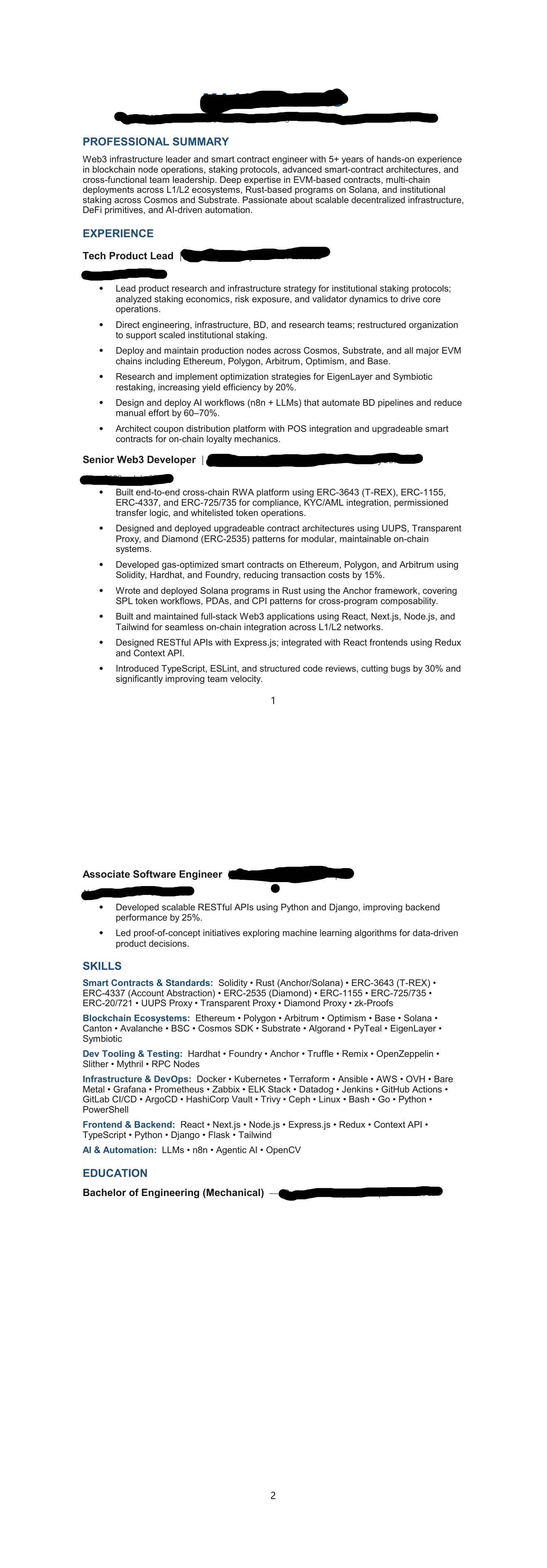
We are reviewing a real CV shared by a senior blockchain professional after removing the name and identifying details with their permission.

The CV mentions staking infrastructure, validator operations, Cosmos and Substrate nodes, EVM smart contracts, Solana Rust, RWA tokenisation, backend engineering and several performance claims.

The experience looks substantial. What is difficult to understand is the role this CV is trying to win.

The candidate could be considered for multiple roles like blockchain infrastructure, staking and validator operations, or smart-contract and RWA engineering. The CV is designed for all three directions and gets almost the same attention, so the strongest hiring case might be undiscovered.

Claims that will need more context are:

What part of the validator infrastructure did the candidate own?

Which contracts reached production?

How were the automation, transaction and cost-improvement numbers calculated?

Which architecture decisions or production incidents were handled directly by the candidate?

I have added the anonymised CV below so the discussion remains connected to the actual document.

While reading it, which role does this profile appear strongest for? Which claim would you verify first before moving the candidate to an interview?
Replies

Welcome, guest

Join ArtofBlockchain to reply, ask questions, and participate in conversations.

ArtofBlockchain powered by Jatra Community Platform

  • Shubhada Pande

    Shubhada Pande

    @ShubhadaJP Jun 30, 2026

    I would first change the order of the experience.

    Right now, multiple roles are competing for the same position, with staking infrastructure, smart contracts, RWA work, and backend engineering all carrying equal weight.

    Based on the CV, staking and blockchain infrastructure seem to be the clearest direction. Validator operations, node reliability, infrastructure deployment, upgrades, and production responsibility should therefore become easier to find.

    References to the smart-contract and RWA work can remain because it is adding value, but it should be a supporting experience and not something giving a different direction.

    I would also rewrite the performance claims so that each one makes the candidate’s contribution clear: what problem they handled, what they changed, and what result followed.

  • KK

    KK

    @kaustubh Jun 30, 2026

    It's difficult to understand the CV analysis without really seeing the CV. If the candidate has given permission to review CV, you could simply remove their name and identification information and share the CV. Maybe upload an image of the CV with name and other information blurred.

    Shubhada Pande

    Shubhada Pande

    @ShubhadaJP Jun 30, 2026

    Thanks for the suggestion @kaustubh I have added the anonymised CV to the main thread above after removing the identifying details.


  • Sayali Bhandari

    Sayali Bhandari

    @SayaliB Jun 30, 2026

    What I would examine more closely is whether the CV shows senior-level ownership or mainly lists senior-level technologies.

    At this level, mentioning that someone deployed infrastructure, contributed to contracts, or worked across several chains is only the starting point. I would critically see what the candidate's role was in these decisions.

    More critical questions will be if they design the architecture or implement an existing design; were they responsible for production reliability; did they handle validator failures, contract risks, upgrades, or security incidents; did they mentor other engineers or coordinate work across teams; what became possible because of their decisions?

    The CV includes outcomes such as transaction volume, automation improvements, and cost reduction, but the connection between those results and the candidate’s individual contribution is not clear.

    That distinction matters because seniority is demonstrated by the scale of responsibility, the difficult decisions taken, and the consequences owned.

    Emma Thomas

    Emma Thomas

    @emmathomas Jul 10, 2026

    The validator experience is the section where I would ask for more precision.

    “Worked on validator infrastructure” can mean monitoring nodes, maintaining deployment scripts, coordinating upgrades, investigating missed blocks, handling production incidents, or owning validator performance end to end. These represent very different levels of responsibility.

    For a senior staking infrastructure role, I would want to know whether the candidate was accountable for uptime, validator health, failover planning, upgrades and incident response.

    Public proof may not always be possible because validator infrastructure can be private. The CV can still explain the scale of the operation, the problems handled and the reliability improvements achieved without exposing confidential information.

    That context would tell me much more than another list of chains, protocols and tools.