
From Hyperledger Research to Polkadot Product Leadership: Bhavya Batra on AOB

"Web3 enthusiast is just a throwaway phrase. If you are really a builder, talk about what you actually do. If your CV is only serial hackathons, that's a red flag—Web3 needs operators who know what production-grade systems look like." — Bhavya Batra
When professionals look at Web3 from the outside, they often believe the only real technical entry point is writing smart contracts in Solidity. That assumption leaves many experienced Web2 leaders on the sidelines.
Bhavya Batra represents a clear, research-grounded transition. In today’s interview, we feature Bhavya Batra, Co-Founder at Nexo and former Head of Product at Polkassembly. Her journey started in 2019 coding medical record privacy protocols on Hyperledger Fabric at AIT Athens, progressed through leading developer education at Women Who Code and The Phoenix Guild, and culminated in managing complex on-chain OpenGov voting flows in the Polkadot ecosystem.
In this edition of our Web2 to Web3 Career Transition Series on ArtofBlockchain, Bhavya breaks down why non-engineering paths are often larger than coding roles, what makes a weak proof signal on a resume, and why early-stage protocols are actively hunting for senior Web2 generalists.
Key Takeaways
Architecture First, Syntax Second: Beginners struggle when they jump straight into Solidity without understanding distributed state machines, consensus mechanisms, and solution design.
Non-Engineering Is Core Infrastructure: Web3 sustains itself on coordination, user onboarding, business development, and governance design. Without UX, a smart contract is just code sitting on GitHub for a few developers.
Serial Hackathons vs. Product Longevity: Bounties prove you can hack a weekend prototype; 9–12+ months of tenure proves you can ship, monitor, and maintain production-grade software.
Why Protocols Want Web2 Seniors: Web3 teams run lean. They cannot afford large feature squads or dedicated QA departments. They need senior operators who understand end-to-end reliability and can wear multiple hats.
The Interview
ArtOfBlockchain: Can you briefly share your professional background before Web3 and what first pulled you into the blockchain space?
I learned about blockchain in 2019 while studying computer science at Delhi University. I read a blog post about Hyperledger Fabric, got interested, and wrote a detailed report about it. Sharing that report led to an opportunity to work as a research associate with Dr. Sofoklis Efremidis at AIT Athens in Greece.
We built a medical healthcare record system with time-bound access control using the gossip protocol to maintain health record privacy. I coded everything in Go myself, from the business logic to the privacy layer, alongside teammates in Greece.
After returning, enterprise blockchain was still early and public chains were finding their pace. I shifted to AI/ML for my final year, graduated during Covid, and joined Deloitte USI as a Core Business Operations Analyst working on Guidewire. When the public blockchain wave picked up, I researched public chains during my master’s at Masters' Union. I picked up freelance projects, learned Solidity, started teaching, and co-built HTRAX—a healthcare privacy token on Hyperledger Indy.
What pulled me in was the foundational research: consensus mechanisms, privacy preservation, and data integrity. I was always more interested in the technical capabilities of the infrastructure than the speculative side attached to it.
ArtOfBlockchain: How did your roles evolve across Women Who Code, The Phoenix Guild, Xponents Ventures, and Polkassembly?
Bhavya: My roles evolved as the industry matured. The core foundation across everything has always been research—translating complex systems into practical adoption.
Women Who Code Blockchain Track: My focus was developer education: teaching fundamentals and getting people job-ready so the market had actual talent capable of building real products.
The Phoenix Guild: As a core member, my role was global community expansion across India, Bangladesh, and Singapore. We hosted Hacker Houses, hackathons, and zk-treasure hunts while partnering with ecosystems like Starknet, Aleo, and Berachain to discover and mentor talent.
Xponents Ventures / W3X Studio: My focus shifted to venture evaluation—analyzing how the market adopted blockchain and identifying projects that used blockchain as core infrastructure rather than unsustainable token gimmicks.
Polkassembly: I stepped in as Head of Product to solve governance usability in the Polkadot ecosystem.
ArtOfBlockchain: Many Web2 professionals think entering Web3 requires becoming a smart contract developer. What are the serious non-engineering career paths?
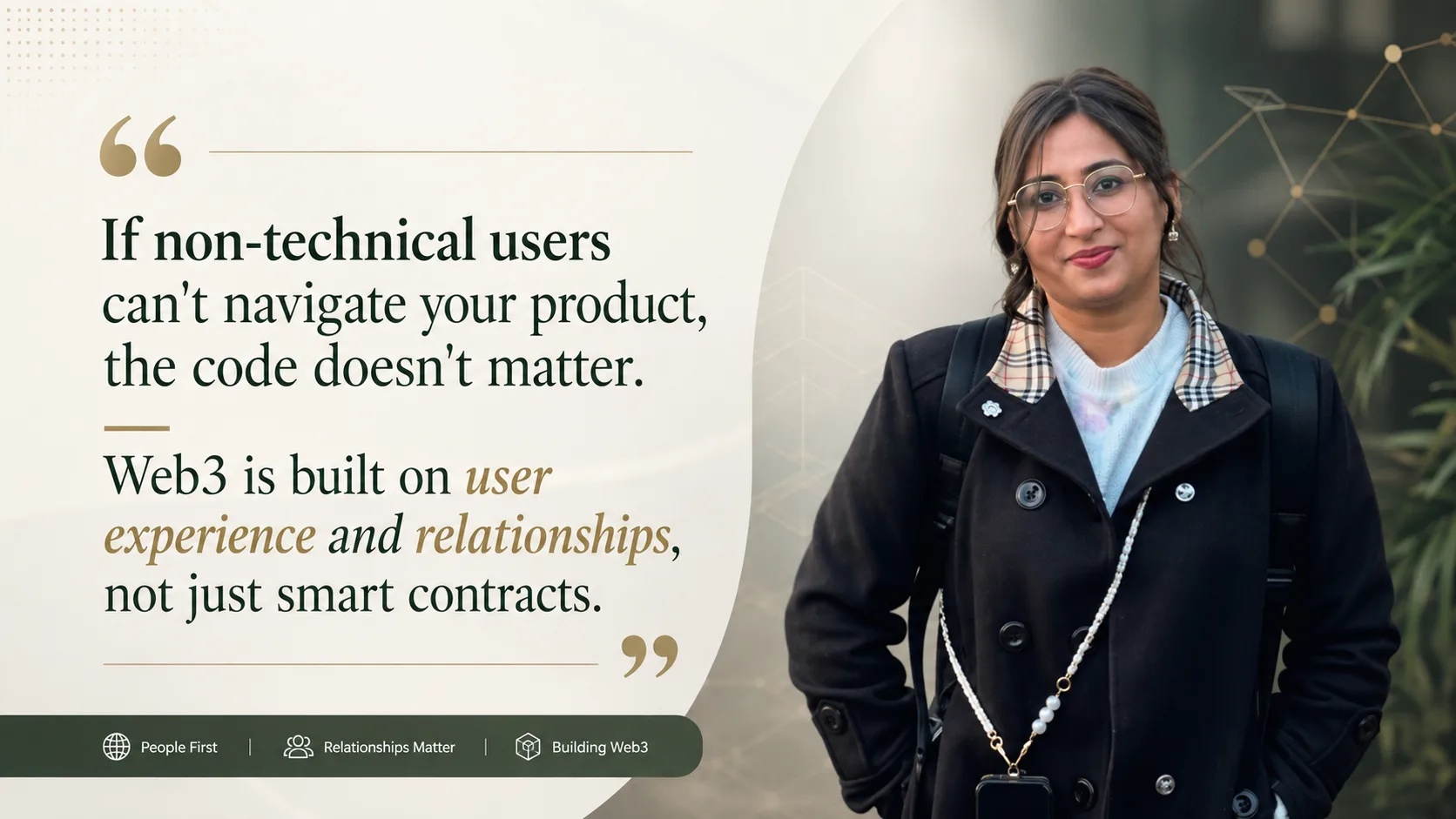
Bhavya: That's the myth: that Web3 is too technical and only for developers. I actually think the non-engineering paths are bigger, and the smart contract developer role is the smallest aspect of it. Web3 as an industry sustains itself on relationships. Teams are global, remote, and widely spread out, so networking, maintaining relationships, partnerships, collaborations, business development, and selling your offering the right way to non-technical users are of utmost importance here.
And the way you design a product so a non-technical user understands it matters more than being a smart contract developer. If the user can't use the product, it's as good as building something on Stack Overflow for a set of 5 or 10 developers. Marketing, product design, community, BD: these are honest, serious career paths in Web3.
ArtOfBlockchain: What did educating builders teach you about where beginners struggle?
Bhavya: Beginners struggle because they start at the wrong end of the stack: they jump straight into Solidity syntax instead of understanding distributed architecture.
They need to start with the foundational questions:
How does decentralized state differ from the client-server internet we have always used?
What problem does consensus actually solve?
How does this tech stack change solution architecture and security assumptions?
Coding syntax, product design, and marketing should follow that understanding. Many non-technical professionals get intimidated and give up because they assume Web3 is strictly about writing Solidity.
ArtOfBlockchain: What did product management look like at Polkassembly in the Polkadot ecosystem?
Bhavya: Polkadot governance (OpenGov) is technically complex: conviction voting, pure proxies, delegation, multi-wallet identity, and treasury allocation. Our goal at Polkassembly was to abstract that complexity so everyday token holders could participate effortlessly:
Sentiment Discovery: Every proposal starts as an open discussion thread. This lets proposers gauge community sentiment before formally requesting treasury funds.
Facilitating Nuance: We managed open debates around funding allocations (e.g., whether teams should request stablecoins or DOT) and turned those discussions into clear community signals.
Frictionless UX: We simplified and gamified voting mechanics so users could exercise governance rights without needing deep technical expertise.
Product work in that context meant constant communication: talking to users, engaging partners, and translating complex chain parameters into clean, accessible interfaces.
ArtOfBlockchain: What skills from Web2 helped you most, and what traditional mindset did you have to unlearn?
Bhavya: What Translated (First-Principles Thinking): In nascent markets, you often have to define whether the problem even exists before you build a solution. First-principles problem discovery from Web2 translates directly.
What I Had to Unlearn (The In-Office Presence Mindset): In Web2, there is a heavy reliance on physical office oversight. In Web3, I managed engineering teams across completely different time zones—from remote areas of Uttarakhand to parts of Africa.
Micromanagement fails in Web3. You must replace physical presence with strong deliverable systems, clear milestone boundaries, and radical trust.
ArtOfBlockchain: What does weak vs. strong proof of work look like on a Web3 CV or LinkedIn profile?
Bhavya: Weak Proof: Putting "Web3 Enthusiast" in your headline, or having a CV packed only with serial hackathons where you re-submitted the same prototype for bounty money. It shows you can build a weekend demo, but it doesn't prove you can maintain a live system.
Strong Proof: Concrete, verifiable claims about what you built, who you partnered with, and what you shipped.
Longevity Matters: Web3 roles can be volatile, but showing 9 to 12+ months of tenure at a project proves resilience and execution capability.
ArtOfBlockchain: Why should hiring teams prioritize senior Web2 talent over juniors?
Bhavya: With modern documentation and AI assistance, learning syntax is no longer the bottleneck. What you cannot teach overnight is what production-grade software looks like.
Web2 enterprises rely on large teams: dedicated QA, dedicated UAT, and specialized teams for single features. Web3 startups operate with lean teams. Protocols need senior generalists who know how backend, frontend, indexers, and contracts communicate, and who are ready to handle monitoring, testing, and user feedback themselves.
ArtOfBlockchain: What practical advice would you give a Web2 professional entering Web3 today?
Bhavya:
Focus on Infrastructure Over Syntax: Languages come and go. If you understand basic object-oriented principles, picking up new syntax takes days. Focus on understanding how blockchain infrastructure differs from traditional Web2 backends.
Differentiate Blockchain Utility from Crypto Hype: The durable value of blockchain is in enterprise data integrity, verifiable provenance, and zero-knowledge privacy—especially as AI adoption creates massive demand for verifiable source data.
Avoid Short-Term Arbitrage: Do not make career decisions based on travel perks or short-lived token packages. Commit to teams building long-term technological impact.
Guest Information
Name: Bhavya Batra
Current Role: Co-Founder @ Nexo | AI Strategist & Product Innovator
Connect: LinkedIn Profile | Nexo | Polkassembly | Blobscriptions